ScienceBasedKids.com may earn a commission from affiliate links in this article. Our ratings are never influenced by affiliate relationships. Read our full methodology.
Prices are approximate as of September 2026 — check the retailer for current pricing.
Developmental Frame for Age 6
A six-year-old is at the transition between early-childhood exploratory play and project-based building. They:
- Can follow 4–6 step instructions with illustrated guides
- Have early reading ability (varies wildly — some 6-year-olds read fluently, others are just starting)
- Have substantial fine motor control but still struggle with fine-assembly tasks
- Can focus on a single project for 20–45 minutes
- Start showing specific interests (one kid loves dinosaurs, another obsesses over trains, etc.)
The “right” gift for 6 depends heavily on where the child is in this transition. A 6-year-old who’s still mostly in sensory play (building with blocks and knocking them down) gets different picks than one who’s already project-focused (following instructions to build a specific thing). The guide below separates these two modes.
The Short Answer
| Situation | Pick |
|---|---|
| Classic “this will keep them engaged for years” | Magna-Tiles 100 |
| Logic puzzle that plays solo | ThinkFun Gravity Maze |
| Screen-free coding introduction | Botley 2.0 Coding Robot |
| Real chemistry at age-appropriate level | Thames & Kosmos Kids First Chemistry |
| Budget-conscious ($25 ceiling) | Rush Hour Jr. |
| Subscription gift | KiwiCo Kiwi Crate (see worth-it-at-6 piece) |
For the Younger 6-Year-Old (Still Mostly Exploratory)
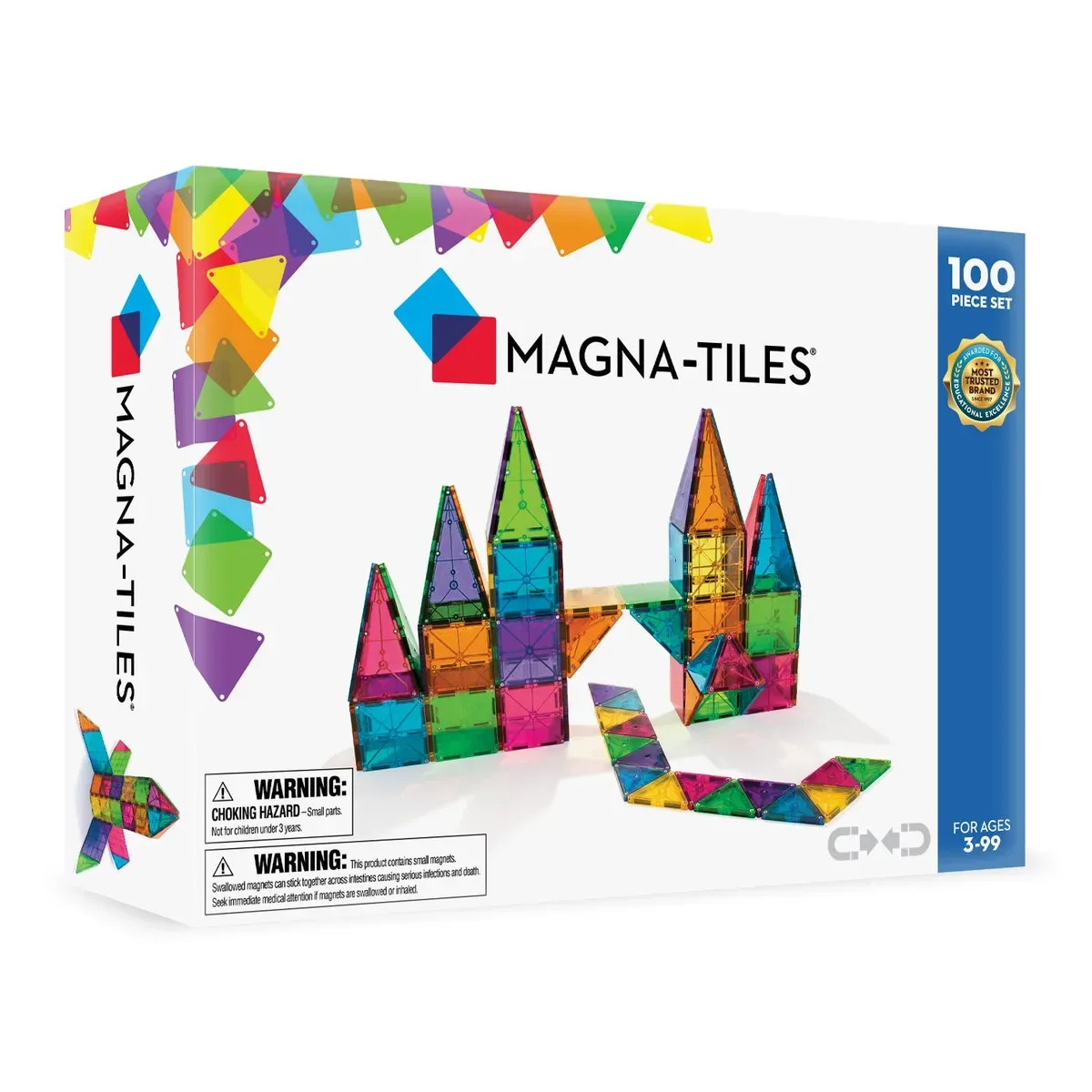
1. Magna-Tiles 100-Piece Clear Colors Set — $120
The single best open-ended building toy across the 3–8 age band. At 6, a child starts moving from random stacking to intentional building with planned structures. 9/10 rating, Moderate evidence.
Check the current price on Amazon
2. KEVA Planks 200-Piece Set — $50
Simple wooden planks. Supports engineering play (arches, towers, domino cascades) that remain interesting for years. A 6-year-old starts learning basic structural concepts (balance, weight distribution, stable-vs-unstable).
Check the current price on Amazon
3. Crazy Forts Building Set — $25
69 connector pieces for building life-size forts with blankets. Heavily imaginative-play driven, appropriate for a 6-year-old still deep in pretend-play mode.
Check the current price on Amazon
4. Hape Marble Run — $40
Marble run physics at a scale that’s satisfying to a 6-year-old. Less complex than GraviTrax (which is better for 8+), but more accessible at this age.
Check the current price on Amazon
For the Older 6-Year-Old (Transitioning to Projects)
5. ThinkFun Gravity Maze — $35
60 logic challenges that build spatial reasoning. At 6, the first 15 challenges solve easily; the next 30 provide months of engagement as the child grows. Plays solo, durable.
Check the current price on Amazon
6. Rush Hour Jr. — $20
40 sequential-reasoning puzzles. Budget-friendly alternative to Gravity Maze with similar long-horizon value.
Check the current price on Amazon
7. Botley 2.0 Coding Robot — $65
Screen-free coding introduction. A 6-year-old programs Botley with a remote-style controller (no app, no tablet) and learns the debugging mental model — “why didn’t it do what I expected?” The transferable skill is inference and iteration, not syntax.
Check the current price on Amazon
8. Thames & Kosmos Kids First Chemistry — $40
Real chemistry at an age-appropriate level. Food-grade reagents, scaled-down lab equipment. A 6-year-old can do most experiments with light adult scaffolding. 7/10 rating, Emerging evidence.
Check the current price on Amazon
9. Snap Circuits Jr. SC-100 — $35
Elenco rates this 8+, but a motivated 6-year-old with adult scaffolding can work through simpler projects. For a 6-year-old not yet at 8+ reading level, this is probably a bridge-too-far gift. For a reading-advanced 6-year-old, it works. See our Jr vs Classic piece for sizing.
Check the current price on Amazon
Cross-Cutting Picks (Work Across Both Age-6 Sub-Groups)
10. Crayola Inspiration Art Case — $18
Large art supply set at a low price. “Let the kid use whatever they want” becomes realistic. Pairs with every other gift on this list.
Check the current price on Amazon
11. Stomp Rocket Original — $20
Air-powered foam rockets for outdoor play. Real physics, safe, thrilling across the 5–10 age band.
Check the current price on Amazon
12. Ravensburger Labyrinth — $30
Family board game. Plays 2–4, 20-minute sessions. The rare game that genuinely works at 6 while scaling to adult engagement.
Check the current price on Amazon
The Subscription Question
KiwiCo Kiwi Crate (ages 5–8) is the standard subscription option for this age. At 6, it sits in the sweet spot of KiwiCo’s target — crates are calibrated for this age. Whether it’s “worth it” depends heavily on your family’s actual engagement pattern; see our full is-kiwico-worth-it-for-6-year-old piece for the decision framework.
For most families, starting with a 3-month subscription (~$75) to test fit, then continuing if engagement is real, is the lowest-regret path. A 6-year-old who engages with crates completes most of them; a 6-year-old who doesn’t lets crates pile up unopened by month 3.
What to Avoid at Age 6
- Anything rated 8+ that involves significant reading or precise fine-motor tasks. The age-rating floor matters — Elenco rates Snap Circuits Jr. 8+ for good reason; a 6-year-old on it works only with adult scaffolding.
- Chemistry kits with “real reagents” (isopropyl alcohol, copper sulfate). These are age-10+ products. See our ASTM F963 chemistry-set guide.
- Tablet-dependent “STEM” apps. At 6, screen-free beats screen-based for most developmental goals. See our Screen-Free STEM Kit Audit.
- Character-licensed “STEM kits” from cartoons/movies. The licensing premium pays for the marketing, not the content. Generic-brand Magna-Tiles or Snap Circuits beats Peppa Pig STEM Set on substance.
- LEGO sets that aren’t the child’s interest. A LEGO set themed around something the kid already loves is excellent. A LEGO set themed around something random is a commodity purchase.
The Bottom Line
For the younger, still-exploratory 6-year-old: Magna-Tiles 100 at $120 if budget allows, or KEVA Planks 200 at $50 as the mid-tier alternative.
For the older, project-ready 6-year-old: ThinkFun Gravity Maze at $35 or Botley 2.0 Coding Robot at $65.
Budget ceiling $25: Rush Hour Jr. or Stomp Rocket.
See also our developmental-fit gift guide for ages adjacent to 6 (3 and 7).
Every product recommended has been reviewed in depth by our team.