ScienceBasedKids.com may earn a commission from affiliate links in this review. Our ratings are never influenced by affiliate relationships. Read our full methodology.
There’s a particular kind of frustration that’s actually learning. You can see it on the face of a nine-year-old who has just released a marble from the top of his GraviTrax build for the fourteenth time. The marble rolls down the initial slope, banks off a curve, hits the magnetic cannon — and launches too far, overshooting the landing track by two hexagons. He stares at the layout. Moves the cannon one hex closer. Adds a curve tile to redirect the overshoot. Releases the marble again. This time it lands on the track, rolls three more segments, and stops dead at a slight uphill he didn’t notice. He stares again. This is the GraviTrax loop — design, test, fail, observe, adjust, test again — and it maps almost perfectly onto the scientific method, which is either a coincidence or a very clever piece of product design.
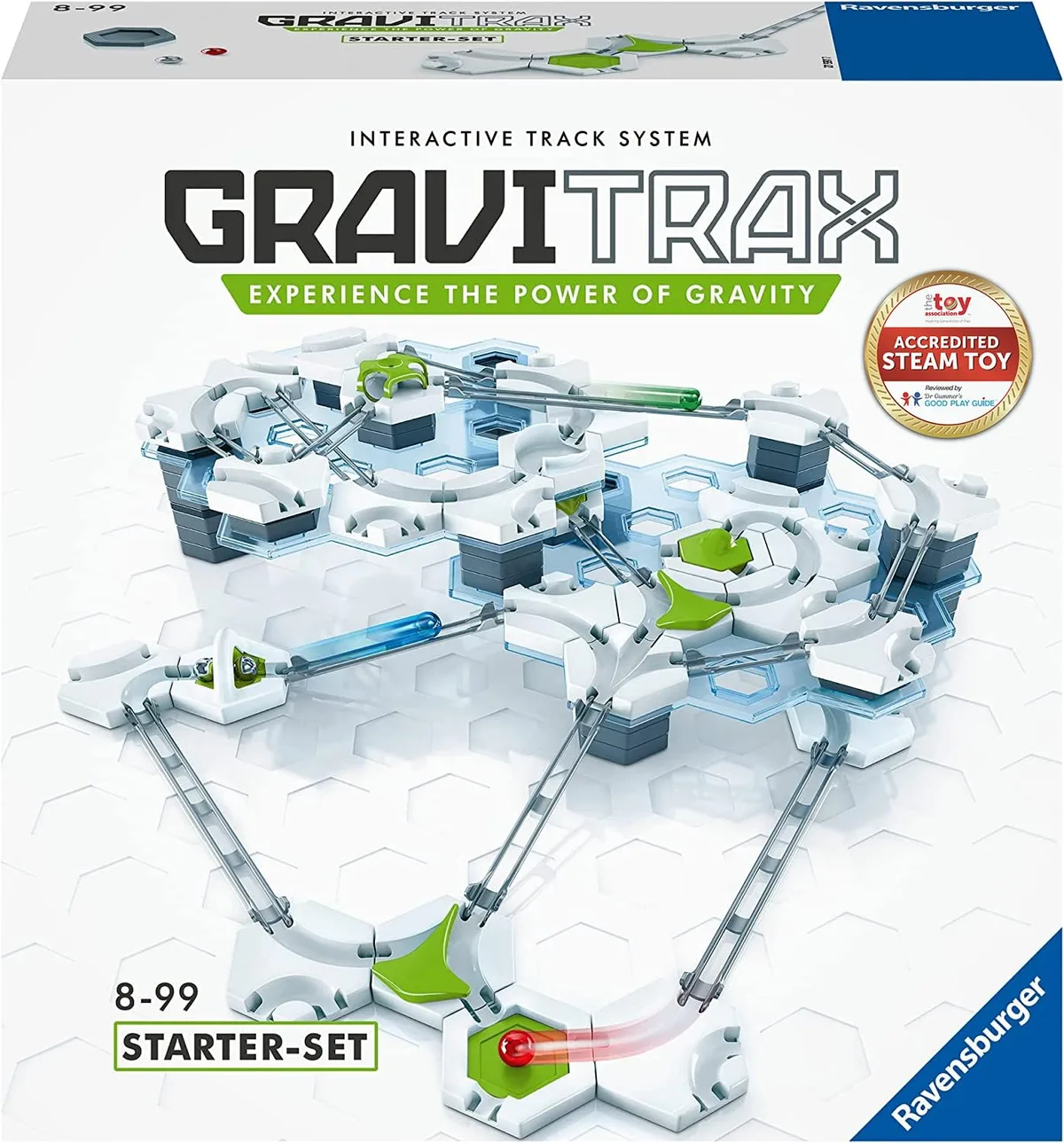
GraviTrax is Ravensburger’s modular marble run system, and at $50 for the starter set, it positions itself as a STEM toy that teaches physics through iterative play. We tested it with children ages 7 through 12 over five weeks. Here’s our honest assessment — including the uncomfortable truth about the expansion ecosystem.
Product Overview
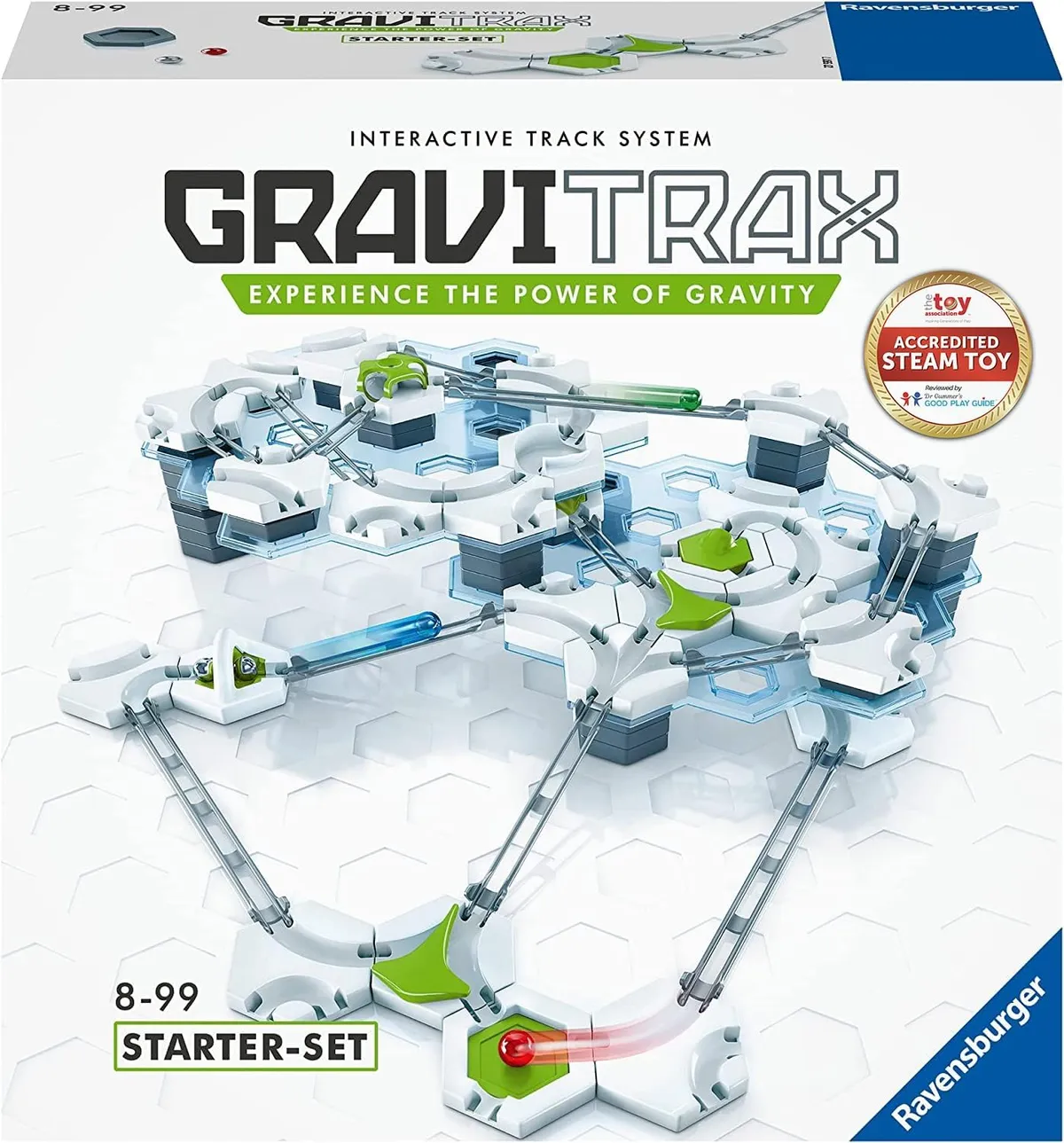
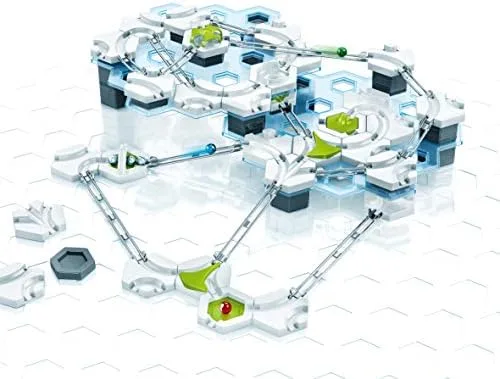
GraviTrax is a hexagonal-tile-based marble run system. Unlike traditional marble runs with pre-formed chutes and funnels, GraviTrax uses flat tiles and interchangeable components to create tracks on a base plate. The system is gravity-driven (no batteries, no motors) and modular — you design the layout, build it, and then release a marble to see if your track works.
The Starter Set includes:
- 4 base plates (hexagonal grid system)
- 18 height tiles (stackable for elevation changes)
- 21 curve tiles
- 3 intersections
- 2 switches
- 1 magnetic cannon (the signature action piece)
- 1 launcher
- 1 landing pad
- 6 steel marbles
- Construction booklet with 24 guided builds
The hexagonal tile system is the engineering insight that makes GraviTrax work. Hexagons tile perfectly (no gaps), allow six directional connections per tile (versus four for squares), and create naturally flowing curves. The result: marble paths that feel organic rather than blocky, and a building grammar that rewards spatial intuition.
Our Evaluation
Build Quality: 8/10
Ravensburger’s manufacturing precision is evident. The hexagonal tiles fit together with satisfying snugness — tight enough to stay put during marble runs, loose enough to rearrange without force. The height tiles stack cleanly without wobbling. The magnetic cannon — GraviTrax’s signature piece — has a strong, reliable magnet that launches marbles consistently.
The steel marbles are properly weighted for the system. They carry enough momentum to clear gaps and navigate curves, but not so much that they fly off open track sections at normal speeds. This calibration matters: a marble that’s too light would die on slight inclines, and one that’s too heavy would be impossible to control in curves.
The plastic quality is good but not premium. The tiles won’t break under normal use, but they do flex slightly under pressure — a child pressing down hard on a height stack will see some give. The track surface is smooth enough for consistent marble behavior, though we noticed that accumulated dust (inevitable in a toy used on floors) can slow marbles over time. A quick wipe with a cloth solves this.
Play Value: 7/10
Here’s where the starter set’s limitation surfaces. The 24 guided builds in the construction booklet are well-designed, escalating in complexity from simple slopes to multi-path tracks with the magnetic cannon. A child working through the booklet will learn the system’s grammar over roughly 4-6 sessions.
After the guided builds, the open-ended phase begins — and the starter set feels thin. With only one magnetic cannon, two switches, and limited height tiles, the creative ceiling for free-building is lower than it should be for a $50 product. Our testers reached that ceiling within two weeks, at which point the recurring question became: “Can we get more pieces?”
This is the GraviTrax paradox. The system is brilliant, but the starter set is designed to onboard you into an ecosystem, not to be a complete experience. A single $10-$20 expansion pack (the Trampoline is the most popular) meaningfully extends the creative range. Two expansion packs transform the experience. Ravensburger knows this, and the starter set’s component count feels calibrated to drive expansion purchases rather than to maximize standalone value.
We docked a point here because we evaluate the product you buy, not the product you could buy after spending more. The starter set alone is a 7. The starter set plus one expansion is an 8. The full ecosystem with multiple expansions is genuinely a 9 — one of the best STEM play experiences available.
Age Appropriateness: 7/10
The 8+ rating is accurate. Seven-year-olds in our testing could follow the guided builds but struggled with free-building — the spatial reasoning required to predict marble trajectories across a hexagonal grid is demanding. They needed frequent adult assistance to understand why their builds weren’t working.
Eight-year-olds hit the sweet spot for guided builds and began producing simple original designs by session 3-4. Nine and ten-year-olds showed the most dramatic skill progression, moving from guided builds to increasingly ambitious original tracks and developing intuitive understanding of how elevation, curve radius, and speed interact.
The most engaged age group in our testing was 9-11 — old enough for genuine spatial reasoning and iterative problem-solving, young enough that the physics concepts feel like discovery rather than homework.
Twelve-year-olds enjoyed the system but showed interest in the GraviTrax PRO vertical building system ($60), which adds multi-level tracks and more complex engineering challenges. The standard starter set may feel limiting for advanced builders at this age.
Durability: 8/10
The tiles and components survived five weeks of daily use without breakage, warping, or performance degradation. The magnetic cannon — the most mechanically complex piece — maintained consistent launch power throughout.
The most vulnerable components are the steel marbles (they roll under furniture and disappear) and the height tiles (which can crack if stepped on with full body weight). Both are replaceable. Marble loss is so common that Ravensburger sells a refill pack, which tells you everything about the product’s real-world durability profile.
Value for Money: 6/10
Here’s the honest math. The $50 starter set is a solid introduction to the GraviTrax system, but it’s an introduction — not the full experience. Most families will want at least one expansion ($10-$20) within the first month, which puts the true “complete starter experience” at $60-$70. Families who get deeply into GraviTrax can easily spend $150-$200 across multiple expansions.
As a $50 standalone toy, GraviTrax is good but not exceptional value. The play hours are more limited than Magna-Tiles or LEGO at comparable price points. As the entry point to a $100-$200 building ecosystem, it’s excellent — the system’s depth and replayability at scale rival any construction toy on the market.
We rate value based on what’s in the box, not the ecosystem potential. Hence the 6.
The Evidence
GraviTrax positions itself as a physics education tool, and the physics content is genuinely embedded in the play — not bolted on as educational packaging around a regular toy.
Intuitive physics and conceptual understanding. Children develop “intuitive physics” — informal mental models of how the physical world works — through interaction with objects. Shtulman and Valcarcel (2012) documented that intuitive physics concepts, while often imprecise, form the foundation upon which formal physics understanding is built.1 GraviTrax engages several core physics concepts: gravity (marbles accelerate downhill), momentum (marbles carry speed through curves), energy transfer (the magnetic cannon converts potential energy to kinetic), and friction (marbles slow on flat sections).
Critically, GraviTrax lets children experience these concepts through failure. When a marble doesn’t reach its target, the child must diagnose why — not enough height (gravitational potential energy), too sharp a curve (centripetal force exceeds track friction), or too flat a section (insufficient momentum). This diagnosis-and-correction cycle is experiential physics learning, and it’s more aligned with how conceptual understanding develops than textbook instruction.
Engineering design process. Lachapelle and Cunningham (2014) found that children who engaged in iterative engineering design activities — build, test, evaluate, redesign — showed improved problem-solving skills and a stronger understanding of the design process.2 GraviTrax is essentially a structured engineering design task: the child has a goal (marble reaches the target), a set of constraints (available components, physics), and a cycle of testing and revision.
Spatial reasoning. The hexagonal grid requires spatial visualization similar to other construction toys, though with an added dimension: the child must reason about a marble’s path through space over time, not just a static structure. Uttal et al. (2013) found that spatial skills are trainable and that training transfers to novel tasks,3 which suggests that the spatial reasoning practiced in GraviTrax building could generalize beyond the specific toy.
The honest summary: The evidence for learning physics concepts through hands-on play is theoretically strong but empirically emerging for products like GraviTrax specifically. No published study has evaluated GraviTrax as a learning tool. The broader literature on engineering design, intuitive physics, and spatial reasoning supports the idea that this type of iterative, construction-based play can build conceptual understanding — but we’re extrapolating from general principles, not product-specific research.
Safety Notes

GraviTrax contains steel marbles (approximately 14mm diameter) that present a choking hazard for children under 3. The 8+ age rating makes this a minimal concern for the target market, but households with younger siblings should enforce strict component storage.
The marbles are heavy enough to cause discomfort if thrown or stepped on, but not heavy enough to pose a serious injury risk under normal play conditions.
The magnetic cannon contains a strong magnet that is fully enclosed and not accessible during normal use. No small magnets are loose or separable.
No batteries, no electrical components, no toxic materials. The product meets ASTM and EN71 safety standards.
The Verdict
GraviTrax is a genuinely clever STEM toy that embeds real physics concepts into engaging, iterative play. The hexagonal grid system is elegant, the build quality is strong, and the play pattern — design, build, test, fail, diagnose, redesign — maps naturally onto both the scientific method and the engineering design process. The physics learning isn’t marketing veneer; it’s structurally embedded in how the toy works.
The starter set’s limitation is real, though. At $50, you get an excellent introduction to the system but not a complete experience. The creative ceiling arrives faster than it should, and the expansion ecosystem — while brilliant in design — means the true cost of GraviTrax is $70-$100+ for most families. We evaluate what you buy, and the starter set alone is a 7.
For families willing to invest in the ecosystem, GraviTrax is one of the best construction-based STEM toys available. The iterative problem-solving, spatial reasoning, and intuitive physics engagement are substantive, not superficial. Just go in knowing that the starter set is the appetizer.
Product Rating: 7/10 — A well-designed system with genuine STEM value, held back by a starter set that’s clearly calibrated to drive expansion purchases rather than to maximize standalone play.
Evidence Rating: Emerging — Strong theoretical alignment with research on intuitive physics, engineering design, and spatial reasoning. No product-specific studies. The learning mechanism is plausible and well-designed, but empirical validation is lacking.
Who Should Buy This
- Families with children ages 8-12 who enjoy building and engineering
- Children who like cause-and-effect experimentation and don’t mind iterative failure
- Parents looking for a screen-free STEM activity with genuine physics content
- Gift-givers who can bundle the starter set with one expansion for a complete experience
- Families who already enjoy LEGO, Magna-Tiles, or other construction toys
Who Should Skip This
- Children under 8 (the spatial reasoning demands are steep for younger builders)
- Families who want a complete, self-contained experience for $50 (the expansion pull is strong)
- Children with low frustration tolerance (the test-and-fail cycle is the point, but it’s not for everyone)
- Parents looking for a product with strong empirical evidence (the research is emerging, not established)
This review reflects our independent evaluation. ScienceBasedKids.com purchased this product at retail price. We may earn a commission if you purchase through our links, which helps fund our research. This never influences our ratings.
Footnotes
-
Shtulman, A., & Valcarcel, J. (2012). “Scientific knowledge suppresses but does not supplant earlier intuitions.” Cognition, 124(2), 209-215. ↩
-
Lachapelle, C. P., & Cunningham, C. M. (2014). “Engineering in elementary schools.” In S. Purzer, J. Strobel, & M. Cardella (Eds.), Engineering in Pre-College Settings: Synthesizing Research, Policy, and Practices (pp. 61-88). Purdue University Press. ↩
-
Uttal, D. H., Meadow, N. G., Tipton, E., Hand, L. L., Alden, A. R., Warren, C., & Newcombe, N. S. (2013). “The malleability of spatial skills: A meta-analysis of training studies.” Psychological Bulletin, 139(2), 352-402. ↩
Enjoyed this review? We publish two new evidence-based evaluations every week.
Free. No spam. Unsubscribe anytime.
Scores rated on a 10-point scale based on observation of 6 children ages 8-12 across 10 sessions.
Recommended Accessories
Affiliate links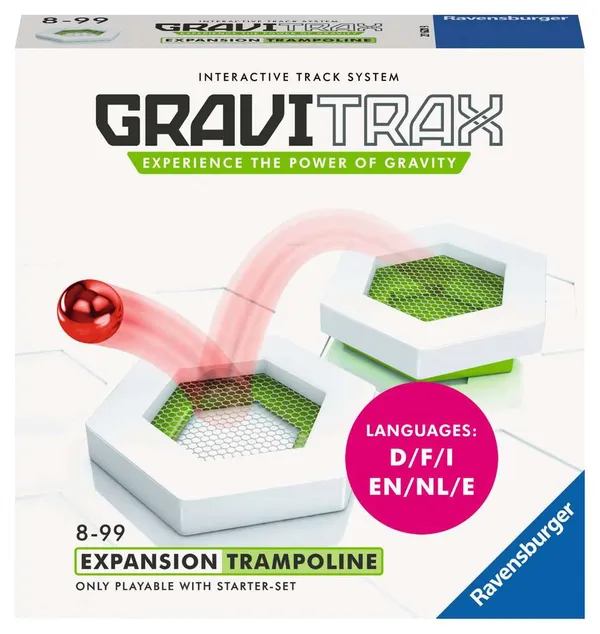
Ravensburger GraviTrax Trampoline Accessory
“Most popular single expansion. Adds bounce mechanics to marble runs.”
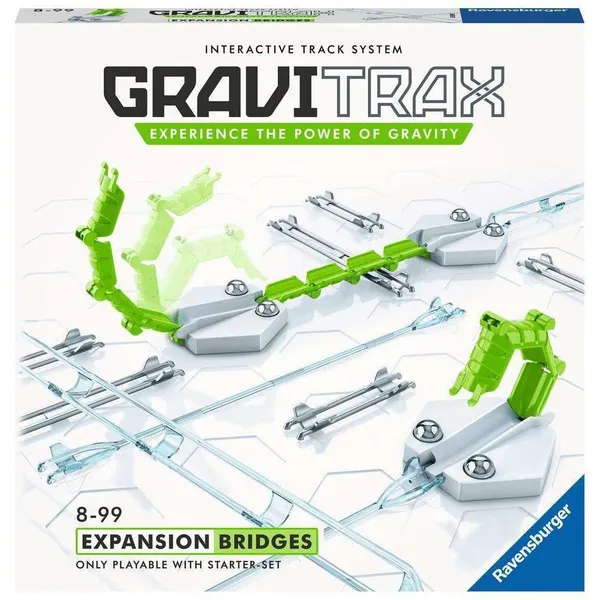
Ravensburger GraviTrax Bridges Expansion Set
“Multi-piece expansion with structural elements for taller, more complex runs.”
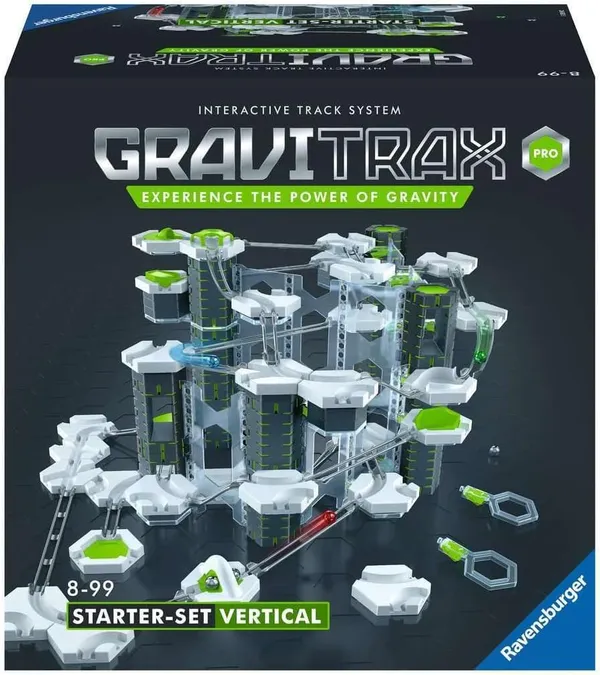
Ravensburger GraviTrax PRO Starter Set
“Vertical building system for more advanced builders. Step-up for kids who master the basic set.”
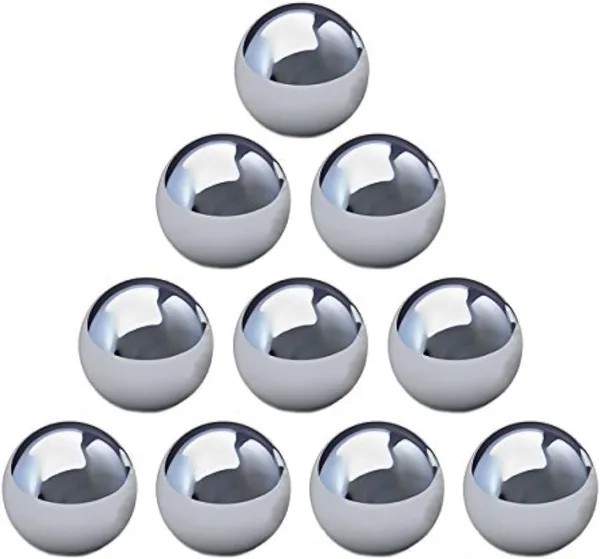
Four Brothers Replacement Steel Balls for GraviTrax (10-Pack)
“Marbles roll under furniture and disappear. Refills are a necessity.”

"Rube Goldberg's Simple Normal Humdrum School Day" by Jennifer George
“Picture book about chain reactions. Makes the physics concepts in GraviTrax into a story.”