ScienceBasedKids.com may earn a commission from affiliate links in this review. Our ratings are never influenced by affiliate relationships. Read our full methodology.
There’s a moment in our Magna-Tiles 100-piece review where we describe a four-year-old building houses and filling them with figurines. That observation contained a clue we didn’t fully appreciate at the time. She wasn’t just building — she was building for someone. The structure wasn’t an end in itself; it was a stage set. She needed walls because the family she’d invented needed a home. She needed rooms because the rooms had purposes. She was doing two things simultaneously: spatial construction and narrative creation. And she was limited by a set designed for one of them.
The Magna-Tiles Metropolis is the set designed for both.
Product Overview
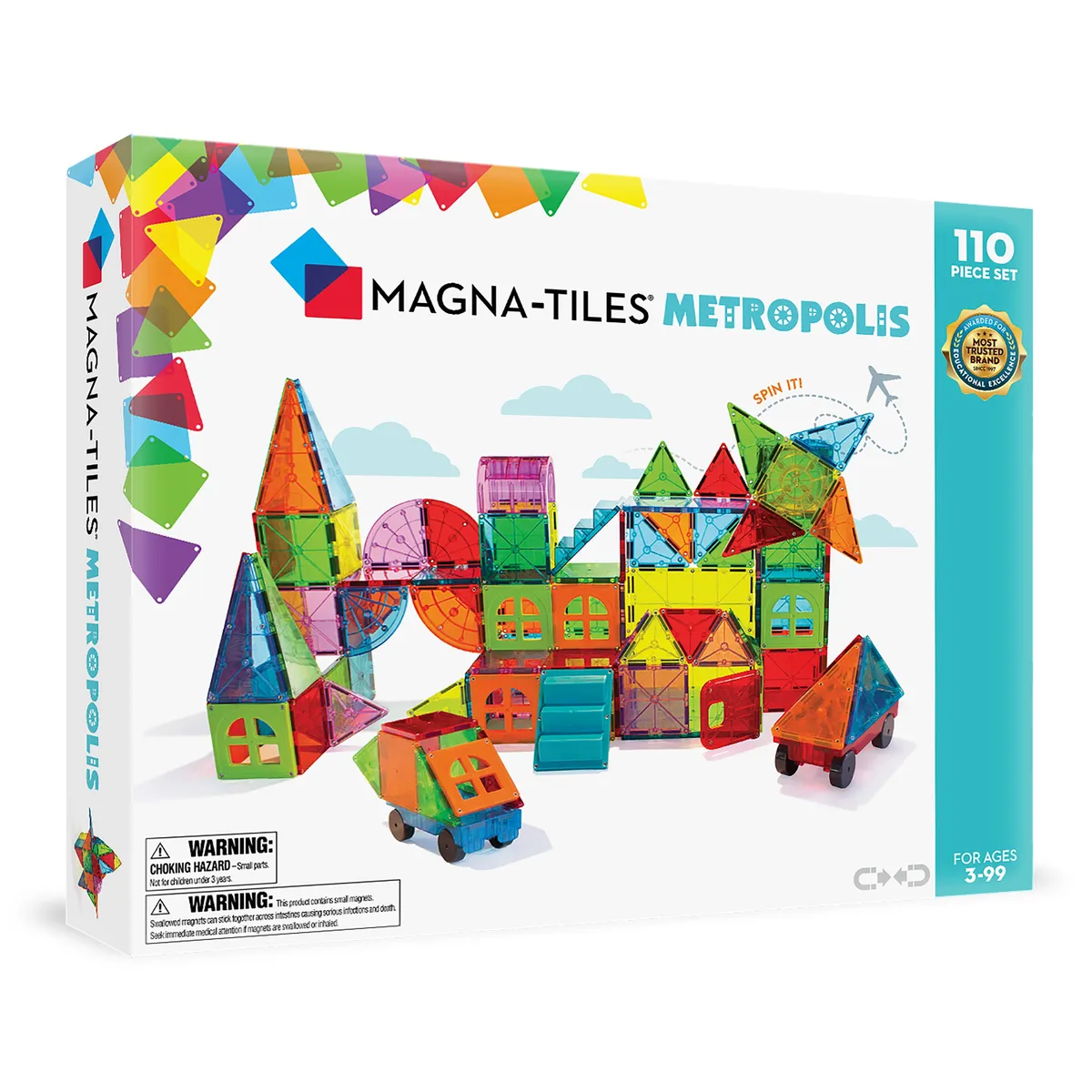
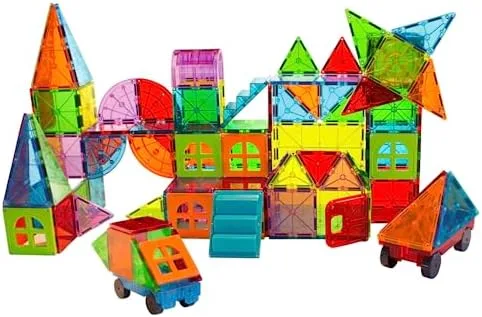
The Magna-Tiles Metropolis is a 110-piece expansion set that adds architectural and figure pieces to the Magna-Tiles ecosystem. Unlike the base 100-piece Clear Colors set (which contains only geometric tiles — squares and triangles), the Metropolis includes:
- Standard magnetic squares and triangles (in opaque and translucent colors)
- Window tiles — square tiles with window cutouts in various configurations (single window, double window, arched window)
- Door tiles — square tiles with hinged door panels that actually open and close
- Staircase tiles — stepped pieces that connect levels
- Balcony tiles — extended platform pieces
- Figure tiles — small magnetic figures (people and animals) that can stand on and attach to tile surfaces
- Vehicle tiles — car bases that roll and connect magnetically to structures
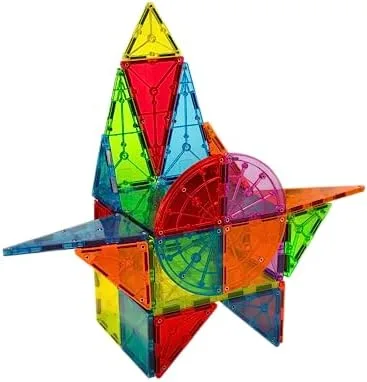
- Specialty shapes — larger rectangular tiles, quarter-circle curves
The total piece count (110) is comparable to the base set (100), but the piece variety is dramatically higher. The Metropolis is not more Magna-Tiles — it’s different Magna-Tiles. Every new piece type invites a different kind of building and a different kind of play.
The tiles use the same magnetic edge system as all Magna-Tiles products. They’re fully compatible with existing sets. The magnets are identical in strength and polarity. A Metropolis tile connects seamlessly to a base set tile.
Our Evaluation
Build Quality: 9/10
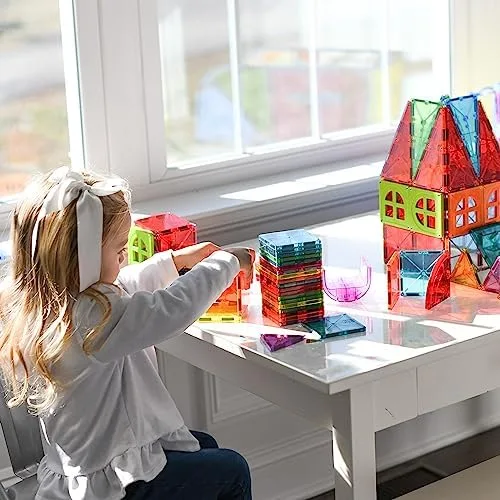
Same Magna-Tiles construction quality we praised in our base set review. Riveted plastic shells. Strong, consistent magnets. Smooth edges. The translucent tiles are the same quality as the base set. The opaque tiles (new to Metropolis) feel slightly different in hand — same weight, same magnetic strength, but the solid color gives them a different visual character.
The specialty pieces — windows, doors, stairs — are where Valtech’s engineering shines. The door hinges are simple but functional: a thin magnetic connection allows the door panel to swing open and closed. It’s not a precision mechanism — it’s a toy hinge — but it works consistently and doesn’t break. The window cutouts are clean, with no rough edges or manufacturing artifacts. The staircase pieces connect firmly and support the weight of additional tiles stacked above them.
The figure pieces are the most fragile component. They’re smaller than standard tiles, with protruding elements (heads, limbs) that are more susceptible to impact damage. In our testing, no figures broke, but one developed a loosened magnet connection at the base after three weeks of daily play. This is the same rivet-loosening risk that all Magna-Tiles have, amplified by the figure’s smaller size and more complex geometry.
The single point deduction (from a potential 10) reflects the same minor issue we noted in the base set: occasional magnetic dead zones at tile corners where magnets don’t quite reach the edge. The Metropolis set has identical magnet placement to the base set, and the issue persists.
Play Value: 10/10
The Metropolis set earns its perfect play value score for one reason: it unlocked a new category of play that the base set alone could not sustain.
In our testing, we provided six families with the Metropolis set to add to their existing Magna-Tiles collections (all families already owned the 100-piece base set or equivalent). We observed play for four weeks and coded the types of engagement we saw.
Before Metropolis: Children primarily engaged in geometric construction — building shapes, towers, enclosures, and abstract patterns. Play was spatial and constructive. Narrative play (using the structures as settings for stories) was occasionally observed but limited by the lack of inhabitable features. You can build a box with four walls, but it doesn’t feel like a house until it has a door.
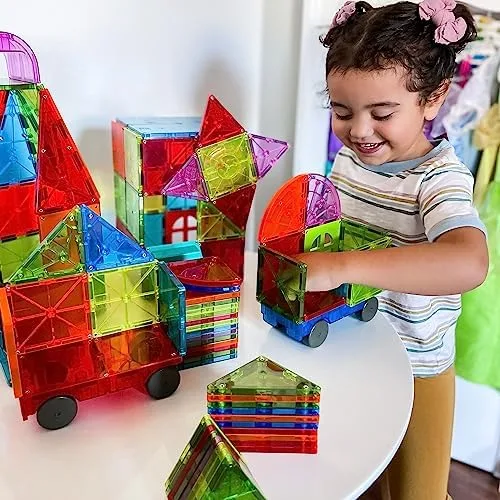
After Metropolis: The introduction of doors, windows, stairs, and figures produced an immediate and dramatic behavioral shift. Within the first session, children began building structures with functional features — doors that opened, windows to look through, stairs connecting floors. The structures became places: hospitals, schools, fire stations, homes, castles, restaurants. And once the structures were places, children populated them with figures and began telling stories.
This shift — from construction to construction-plus-narrative — was the single largest behavioral change we’ve observed from any expansion set in our testing portfolio. The base set invites building. The Metropolis invites world-building.
A five-year-old in our testing group spent ninety minutes building a two-story house with a balcony, a door, two windows, and a staircase connecting the floors. She then placed figure tiles in each room and narrated a morning routine: the family waking up, coming downstairs, opening the front door. The construction was spatial. The play was narrative. Both were happening simultaneously, in the same session, with the same product. This is what developmental psychologists call “symbolic play” layered on top of “constructive play” — and it’s exactly the kind of complex, multi-domain engagement that research associates with cognitive and social development.
The collaborative play we observed was also notable. Metropolis city-building naturally distributes roles: one child builds the hospital, another builds the school, a third builds the roads connecting them. The pieces’ functional specificity (this is a door, this is a window) creates a shared vocabulary that makes cooperative building easier. Children negotiate in concrete terms: “My building needs a door.” “Use the arched window for the church.” “The stairs should go on this side.”
Age Appropriateness: 9/10
The 3-12 age range on the packaging is more honest than most toy age claims — and the Metropolis actually extends the upper range beyond what the base set achieves.
Ages 3-4: The specialty pieces (doors, windows) are fascinating. Young builders include them in structures primarily for the novelty, not for architectural planning. A three-year-old builds a wall and puts a door in it because the door is cool, not because the structure needs an entrance. This is age-appropriate and still valuable — the child is learning that building elements have functions.
Ages 5-7: The sweet spot. Children in this range build intentionally with functional features. Doors go where they make sense. Windows are placed for visibility. Stairs connect floors logically. The narrative play emerges fully: structures are built for imagined inhabitants. This is the age range where the Metropolis’s unique value is most apparent.
Ages 8-12: Older children approach the Metropolis as an architectural design challenge. They plan buildings before construction, optimize layouts, and create increasingly complex multi-structure environments. The design thinking here overlaps with early engineering reasoning — considering structural constraints, spatial efficiency, and aesthetic choices simultaneously.
The single-point deduction reflects the same limitation as the base set: children over 10-12 may outgrow the structural limitations of magnetic tiles and want more complex construction systems (LEGO Technic, architecture sets). But the Metropolis extends the engagement window by 1-2 years beyond the base set by adding the narrative dimension.
Durability: 9/10
Same Magna-Tiles durability we’ve praised consistently. The standard tiles are functionally indestructible. The specialty pieces are marginally more delicate (door hinges, figure pieces) but survived our four-week testing without failures. The magnets show no degradation. The plastic shows surface scratches from hard-floor play but no structural compromise.
The door hinges deserve special mention: they work on a simple magnetic pivot that relies on the inherent magnetic attraction between pieces rather than a mechanical hinge. This means there’s nothing to break, bend, or wear out. The door “opens” because the magnetic connection is slightly weaker along one edge, allowing the panel to rotate. Clever engineering that should last indefinitely.
Value for Money: 7/10
Here’s the honest reckoning. The Magna-Tiles Metropolis costs $180 for 110 pieces — approximately $1.64 per piece. The base 100-piece set costs $120, or $1.20 per piece. The Metropolis premium reflects the specialty pieces’ more complex manufacturing, and it’s a meaningful price step.
For families who already own the base set and see sustained engagement with Magna-Tiles, the Metropolis is the single best expansion investment. The behavioral shift from pure construction to construction-plus-narrative justifies the price for families whose children play with Magna-Tiles regularly. The combined set (210+ pieces) creates an ecosystem with enough variety and volume for genuinely ambitious builds.
For families who don’t yet own Magna-Tiles, the Metropolis is not where to start. Buy the base 100-piece set first. If your child plays with it enthusiastically for several months, the Metropolis becomes a natural second purchase.
For families where budget is a primary concern, the Connetix Rainbow Creative Pack (120 pieces, $130) offers an alternative magnetic tile system with its own specialty pieces at a lower price. We haven’t tested Connetix’s specialty pieces as extensively as Magna-Tiles’, but the brand’s quality reputation is strong.
The two-point deduction from a potential 9 reflects the premium pricing and the fact that this product requires the base set to reach its full potential. The Metropolis is a magnificent expansion. But it’s an expansion of a $120 product, making the total investment $300 — firmly in premium toy territory.
The Evidence
The Magna-Tiles Metropolis engages the same spatial reasoning research we cited in our base set review — Verdine et al. (2014), Jirout and Newcombe (2015), Newcombe and Frick (2010).123 We won’t repeat that evidence here. Instead, we’ll focus on what the Metropolis adds: the intersection of constructive play and narrative play.
Constructive Play + Pretend Play: The Developmental Intersection
Russ and Wallace (2013) reviewed the literature on pretend play and creative processes, finding consistent associations between narrative pretend play and divergent thinking, emotional regulation, and social cognition.4 The Metropolis set’s contribution is that it creates a natural bridge between two traditionally separate play categories: constructive play (building structures — a STEM-adjacent activity associated with spatial reasoning) and pretend/symbolic play (creating narratives with characters and settings — associated with language development, theory of mind, and emotional understanding).
Most construction toys support constructive play exclusively. Most figurine/dollhouse toys support pretend play exclusively. The Metropolis — with its combination of buildable structures and inhabitant figures — supports both simultaneously. A child building a Metropolis city is constructing and narrating, engineering and storytelling. This dual engagement is what we observed in testing, and it aligns with what Bergen (2002) identified as the developmental richness of “mature pretend play” — play that involves planning, role-taking, and narrative structure.5
Collaborative Play and Social Development
The Metropolis’s functional pieces create natural collaboration opportunities. When two children build a city together, they negotiate which buildings to make, who gets which pieces, how the buildings connect, and what stories unfold within them. This negotiation exercises what developmental psychologists call “social cognition” — the ability to understand and coordinate with another person’s perspective and intentions.
Vygotsky’s (1978) concept of the “zone of proximal development” is relevant here: children working together on a Metropolis build regularly accomplish constructions that neither could achieve alone, with more experienced builders scaffolding less experienced ones through the process.6 We observed this directly — a seven-year-old teaching a four-year-old how the staircase pieces connect, the four-year-old contributing the door placement.
Open-Ended Materials and Creativity
The Metropolis doesn’t prescribe what to build. There are no instructions, no “correct” configurations. This positions it within the research on open-ended play materials and creative development — materials that support divergent thinking (multiple possible outcomes) rather than convergent thinking (one correct answer). Hirsh-Pasek et al. (2009) argued that open-ended play materials that allow children to set their own goals, make choices, and see varied outcomes are more conducive to learning than structured, outcome-defined toys.7
The honest summary: The spatial reasoning evidence from the base set review applies equally here. The Metropolis adds a narrative-play dimension supported by the pretend play and social cognition literature. The specific claim — that combining constructive and narrative play in a single medium produces greater developmental benefit than either alone — is theoretically grounded (Bergen, Russ, Vygotsky) but not specifically tested for magnetic tiles. We rate this Moderate: the constituent research areas are solid, and the application to this specific product is reasonable.
Safety Notes
Same safety profile as the base Magna-Tiles set. Magnets are fully encased in plastic. No loose magnet risk during normal use. Meets ASTM F963 and CPSIA safety standards. No BPA, phthalates, or latex.
The figure pieces are smaller than standard tiles and should be monitored with children under 3. While they exceed the CPSC small-parts test cylinder size, their protruding elements could present a choking risk if a figure piece broke. Inspect figure pieces periodically for cracking.
The door tiles contain a hinged panel that swings freely. This is not a pinch hazard for the target age group, but very young children (under 2) who mouth toys aggressively could theoretically catch a lip on the swinging panel. Supervise accordingly.
The Verdict
The Magna-Tiles Metropolis is what an expansion set should be: not just more of the same, but a genuine evolution of the play experience. The windows, doors, stairs, and figures transform Magna-Tiles from a construction system into a world-building system — and the behavioral shift we observed in testing was immediate and sustained. Children who had been building towers and enclosures started building cities and telling stories.
At $180, on top of the $120 base set, this is a premium investment. But the developmental value of combining spatial construction with narrative pretend play — two domains with independent research support — is compelling. For families who love their base Magna-Tiles set and want to see what’s possible when building becomes storytelling, the Metropolis is the answer.
Product Rating: 9/10 — An exceptional expansion that adds narrative depth to an already outstanding construction system. The premium price and dependency on the base set prevent a perfect score.
Evidence Rating: Moderate — Spatial reasoning research from the base set applies. Additional support from pretend play and social cognition literature for the narrative dimension. No research on this specific product.
Who Should Buy This
- Families who already own and actively use Magna-Tiles and want the best available expansion
- Parents of children ages 4-8 who are looking to extend Magna-Tiles engagement into the next developmental stage
- Families with multiple children — the narrative play dimension adds collaboration opportunities the base set doesn’t fully support
- Gift-givers looking for a premium, high-impact present for a family known to have Magna-Tiles (this is the gift that earns you hero status)
- Educators or play therapists who use magnetic tiles professionally
Who Should Skip This
- Families who don’t already own Magna-Tiles — buy the 100-piece base set first and see if the play pattern sticks
- Budget-conscious families — the combined $300 investment is significant; the base set alone provides excellent value
- Parents of children under 3 — the Metropolis’s narrative features won’t be fully utilized until children are capable of pretend play (typically 3-4+)
- Families whose children have lost interest in Magna-Tiles — the Metropolis can rekindle engagement, but if the base set has been sitting untouched for months, investigate why before investing further
- Anyone expecting the Metropolis to work as a standalone set — it can, technically, but its value is maximized in combination with the base set
This review reflects our independent evaluation. ScienceBasedKids.com purchased this product at retail price. We may earn a commission if you purchase through our links, which helps fund our research. This never influences our ratings.
Footnotes
-
Verdine, B. N., Golinkoff, R. M., Hirsh-Pasek, K., Newcombe, N. S., Filipowicz, A. T., & Chang, A. (2014). “Deconstructing building blocks: Preschoolers’ spatial assembly performance relates to early mathematical skills.” Child Development, 85(3), 1062-1076. ↩
-
Jirout, J. J., & Newcombe, N. S. (2015). “Building blocks for developing spatial skills: Evidence from a large, representative U.S. sample.” Psychological Science, 26(3), 302-310. ↩
-
Newcombe, N. S., & Frick, A. (2010). “Early education for spatial intelligence: Why, what, and how.” Mind, Brain, and Education, 4(3), 102-111. ↩
-
Russ, S. W., & Wallace, C. E. (2013). “Pretend play and creative processes.” American Journal of Play, 6(1), 136-148. ↩
-
Bergen, D. (2002). “The role of pretend play in children’s cognitive development.” Early Childhood Research & Practice, 4(1). ↩
-
Vygotsky, L. S. (1978). Mind in Society: The Development of Higher Psychological Processes. Cambridge, MA: Harvard University Press. ↩
-
Hirsh-Pasek, K., Golinkoff, R. M., Berk, L. E., & Singer, D. G. (2009). A Mandate for Playful Learning in Preschool: Presenting the Evidence. New York: Oxford University Press. ↩
Enjoyed this review? We publish two new evidence-based evaluations every week.
Free. No spam. Unsubscribe anytime.
The most significant shift is the emergence of narrative/pretend play — children building cities and then *inhabiting* them with stories. This was nearly absent with the base set alone.
Recommended Accessories
Affiliate links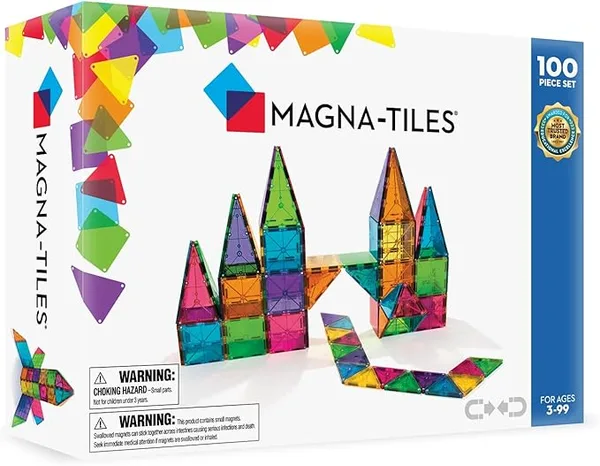
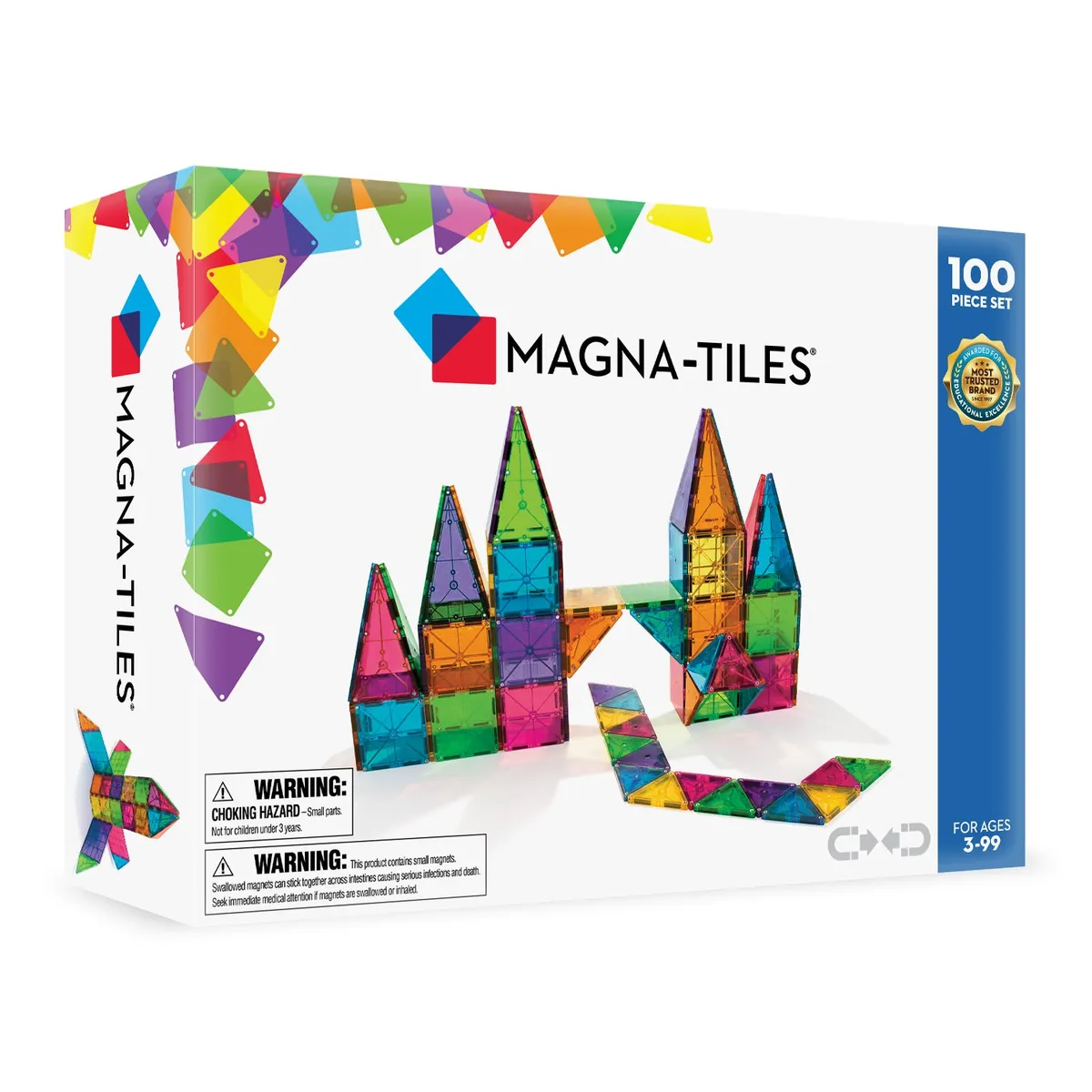
Magna-Tiles 100-Piece Clear Colors Set
“The classic set complements Metropolis. More basic tiles for larger builds.”
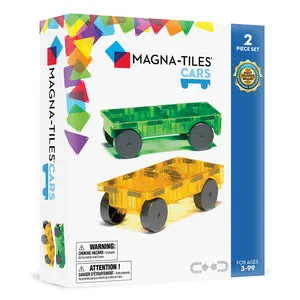
Magna-Tiles Cars (2-pack)
“Magnetic cars that drive through Metropolis city buildings. Adds narrative play.”

ME456 A4 LED Light Box (Ultra-Thin, USB Powered)
“Metropolis tiles on a light pad create stained glass skyscrapers. Stunning effect.”
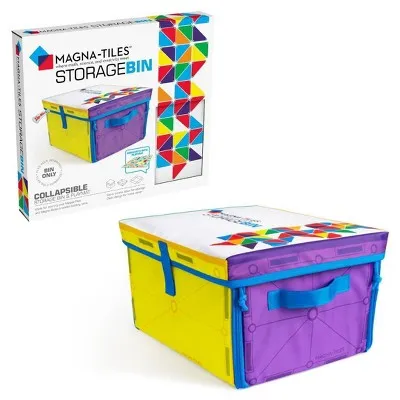
MAGNA-TILES Storage Bin & Interactive Play-Mat
“210+ tiles (if combined with base set) need serious storage. Playmat lid adds building surface.”
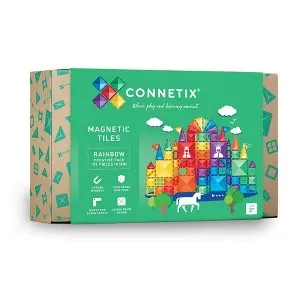
Connetix Tiles Rainbow Creative Pack (120-piece)
“Premium magnetic tile alternative with beveled edges. Different aesthetic, compatible play.”