ScienceBasedKids.com may earn a commission from affiliate links in this review. Our ratings are never influenced by affiliate relationships. Read our full methodology.
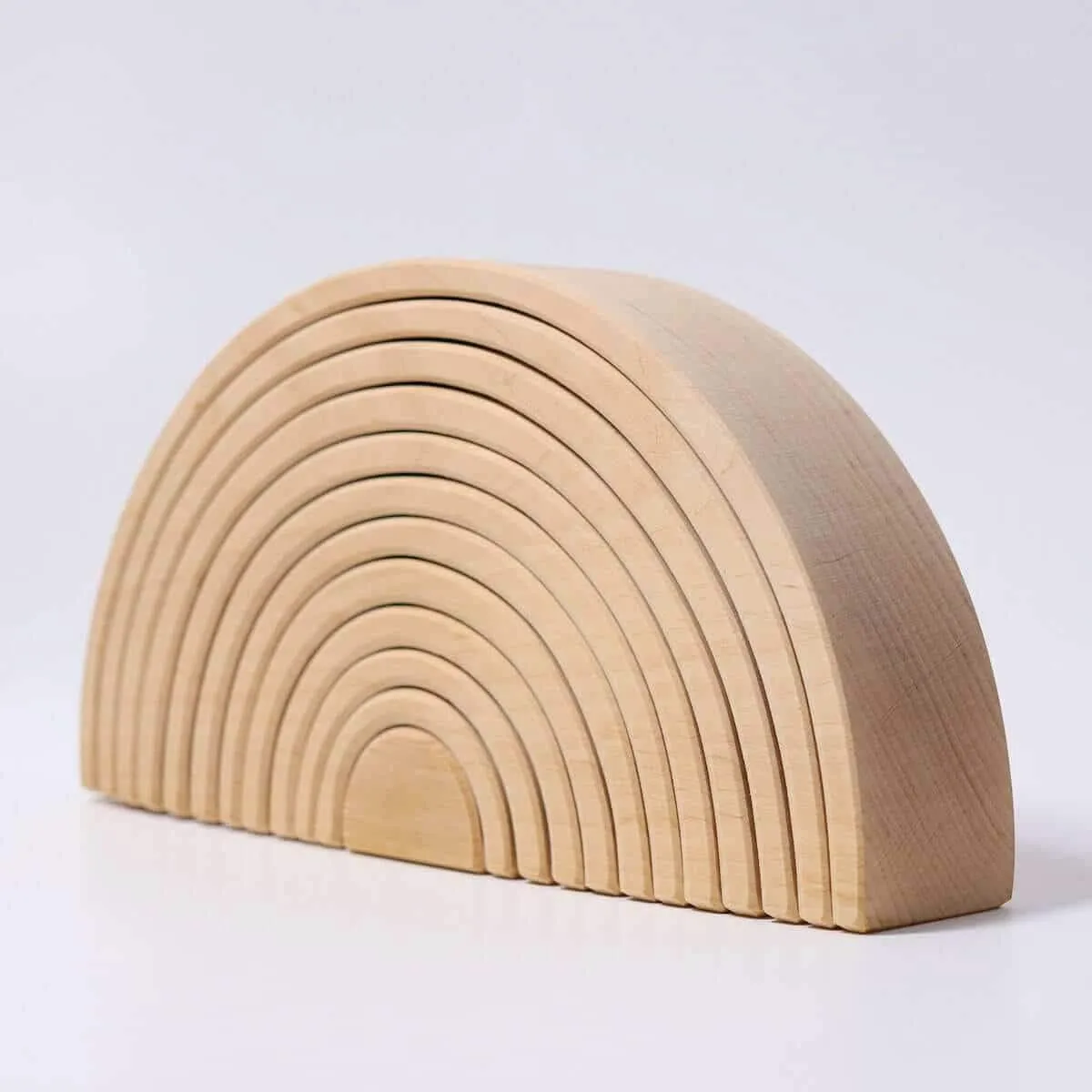
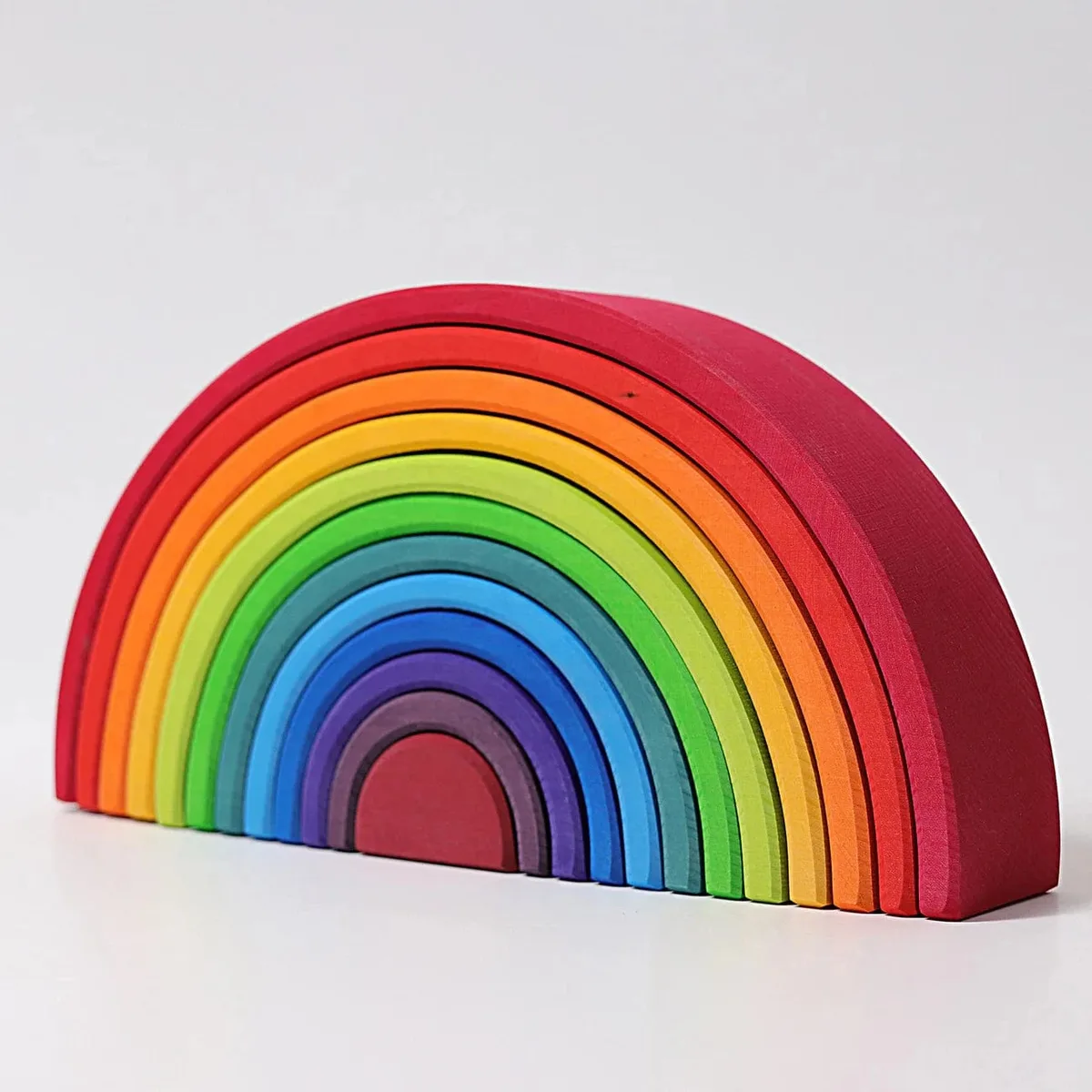
Twelve pieces of wood. That’s what $80 buys you. Twelve arched pieces of lime wood, stained in the colors of the rainbow with non-toxic water-based dyes, nested together into a shape that is instantly recognizable and completely undefined. It’s a rainbow. It’s a bridge. It’s a tunnel, a fence, a rocking chair for a small doll, a set of architectural arches, a color-sorting exercise, and a sculpture. It’s whatever a child decides it is, which is — according to both the Waldorf education philosophy and a growing body of research on open-ended play — the entire point.
Grimm’s Spiel und Holz Design has been making this rainbow in Germany since the early 2000s, and it has become something of an icon in the natural toy community. At $80, it’s one of the most expensive “simple” toys on the market. We tested it with five children ages 1.5 through 7 over twelve weeks. Here’s whether the craftsmanship and the philosophy justify the price.
Product Overview
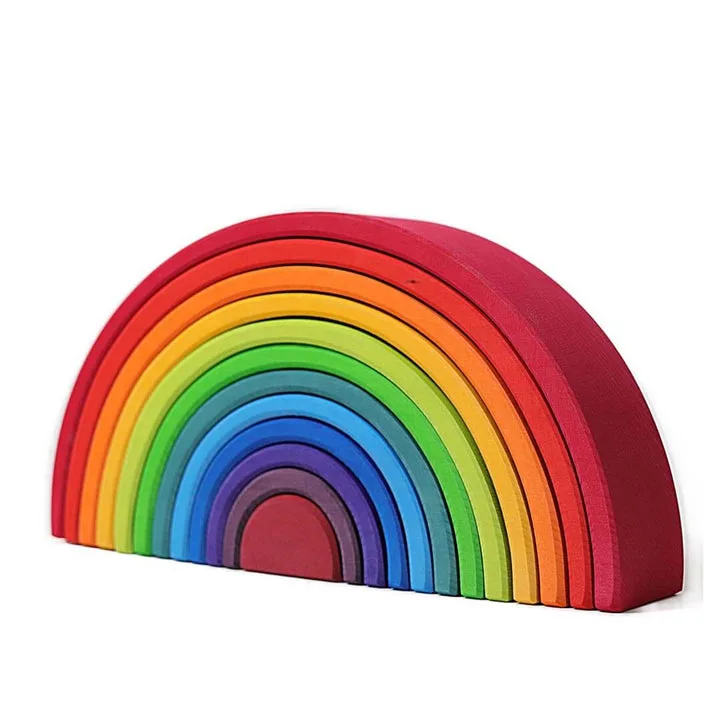
The Grimm’s Large Rainbow (also called the 12-piece Rainbow or Rainbow Tunnel) consists of:
- 12 nested arches in graduated sizes, from approximately 1.5 inches to 14.5 inches wide
- Lime wood (linden/basswood), sustainably harvested from European forests
- Non-toxic, water-based stain in rainbow spectrum colors (red, orange, yellow, green, blue, violet and shades between)
- No lacquer or sealant — the wood has a natural matte finish with visible grain
The arches have a slight roughness to the touch — deliberate, as the natural wood texture provides sensory feedback and friction that helps stacked pieces grip rather than slide. The colors are rich but not uniform; the water-based stain allows the wood grain to show through, giving each piece a handcrafted appearance because each piece literally is handcrafted.
Grimm’s manufactures in Hochdorf, Germany, using FSC-certified wood and solar-powered production facilities. The sustainability credentials are genuine and extensive — this is one of the most transparently ethical toy manufacturers we’ve encountered.
Our Evaluation
Build Quality: 9/10
The craftsmanship is immediately apparent. Each arch is smoothly sanded with rounded edges. The wood has a pleasing weight — the largest arch feels substantial in an adult’s hand and satisfyingly solid in a child’s. The stain penetration is even, and the colors are vivid without being plasticky.
The absence of lacquer or sealant is a deliberate choice. It means the wood surface develops a patina over time — it darkens slightly, and heavy-use areas become smoother. This is presented as a feature in the Waldorf tradition (the toy “grows” with the child), and functionally, it doesn’t affect play quality. However, the unfinished wood is susceptible to moisture staining. A wet cup left on a Grimm’s arch will leave a ring.
The precision of the nesting is excellent. Each arch fits cleanly inside the next larger one with consistent gaps. When stacked or arranged, the pieces align without wobbling. This precision matters for the more complex builds that older children attempt.
One deduction: we found minor color bleeding where the stain from one arch transferred to an adjacent arch during storage. The bleeding is faint and doesn’t affect the overall appearance, but at $80, the finish should be flawless.
Play Value: 9/10
The Grimm’s Rainbow has the highest play versatility of any single-item toy in our testing portfolio. Over twelve weeks, our testers used the arches in more than thirty distinct configurations, and we’re confident we didn’t document all of them.
The play modes we observed:
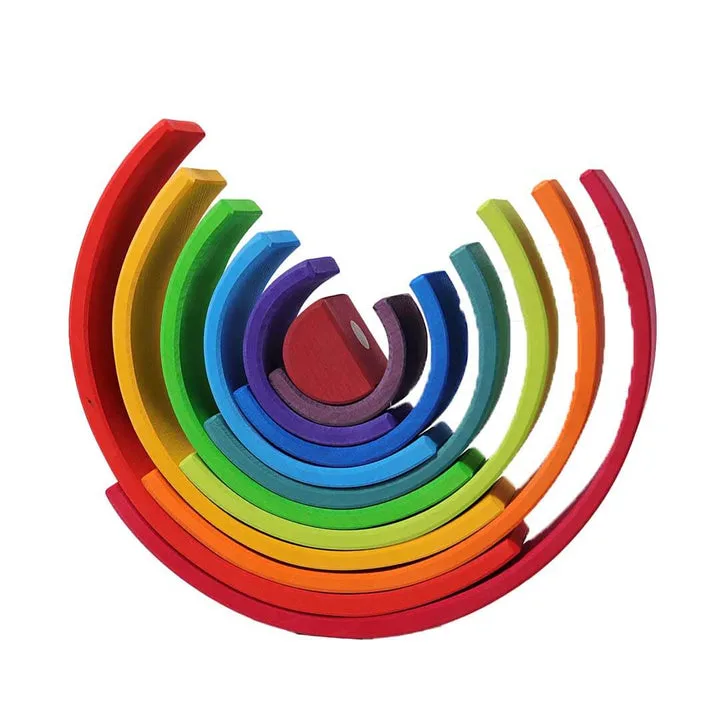
Building and architecture (all ages). Arches become bridges, tunnels, doorways, walls, and roofs. The largest arches span enough distance to create passageways for toy cars, trains, and figurines. The medium arches stack vertically into towers. The small arches serve as furniture for dolls and figurines.
Small-world play (ages 2-7). This was the most common mode in our testing. Children used the arches as elements in imagined scenes — a rainbow of arches became a series of hills, a farm fence, a dragon’s lair, a city skyline. The undefined shape of each arch means it can represent virtually anything, which is the core principle of open-ended toy design.
Nesting and sorting (ages 1-3). Younger children focused on the nesting relationship — fitting arches inside each other and removing them. Color sorting emerged naturally around age 2-2.5, when children began grouping arches by color temperature (warm vs. cool) or placing them in rainbow order.
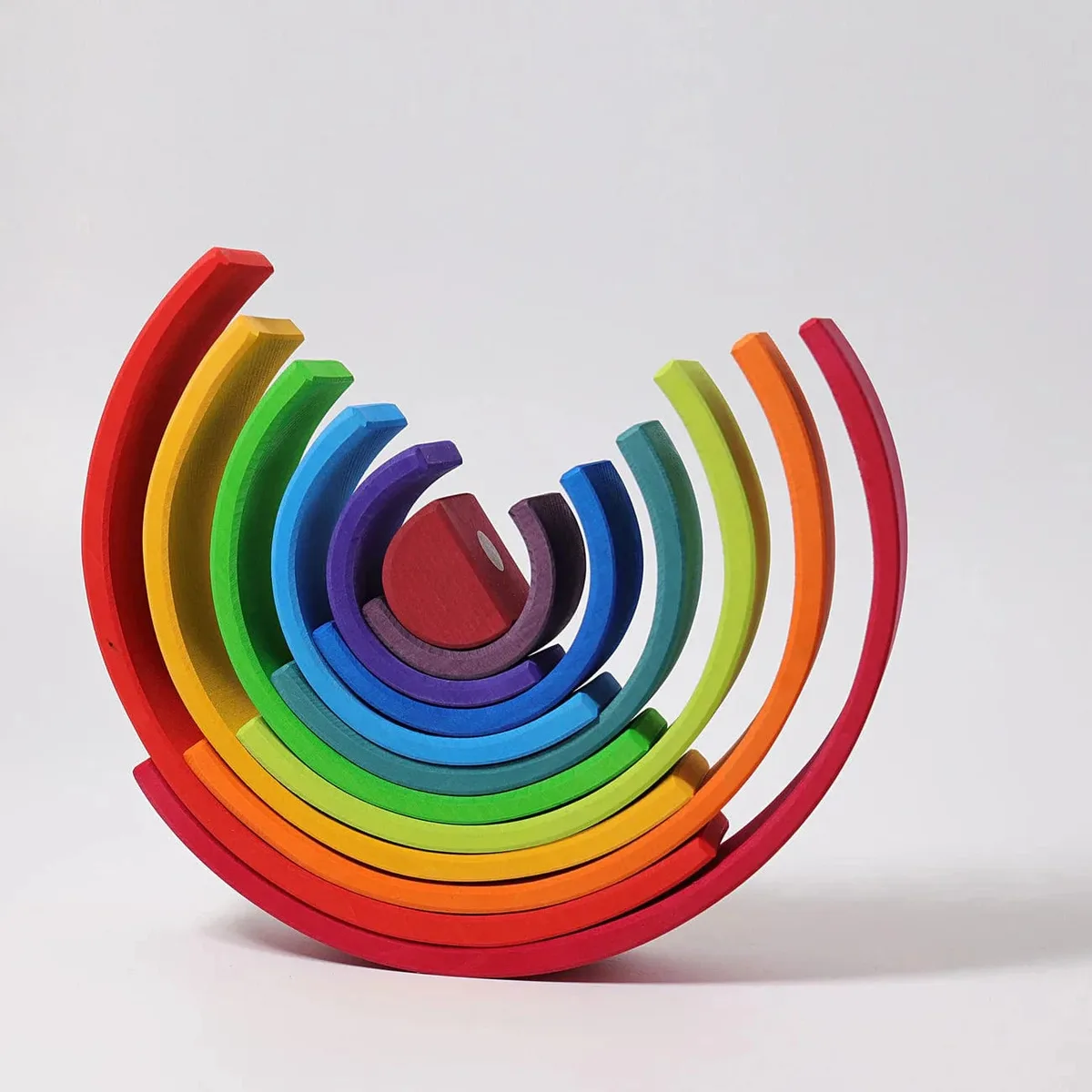
Physics exploration (ages 3-7). The curved shape makes arches natural rocking toys. Children discovered that pushing a single arch back and forth on a flat surface produces a satisfying rocking motion. They also discovered that stacking arches in non-standard orientations (upside down, sideways, in offset layers) creates structures with different stability properties — an intuitive lesson in center of gravity.
The key indicator of play value: return rate. Our testers reached for the Grimm’s Rainbow an average of 3.8 times per week over twelve weeks, with no decline in frequency. Most toys in our portfolio show declining engagement after week 4. The Grimm’s Rainbow didn’t.
Age Appropriateness: 8/10
The 1-8 age range is honest. Our 18-month-old tester engaged primarily with the largest arches — carrying them, mouthing the edges (the non-toxic stain is safe for this), and nesting and unnesting. Our 7-year-old tester built elaborate architectural scenes that incorporated the rainbow with other toys. Both were genuinely engaged, which is remarkable for a 5.5-year age span.
The lower age limit works because the arches are too large to be choking hazards and have no small parts, sharp edges, or detachable components. The upper age limit extends past 8 for children who use the arches as components in imaginative play with other toys, though by age 8-9 the rainbow alone may not sustain independent play.
Durability: 8/10
The lime wood is hard enough to resist surface denting during normal play. Over twelve weeks, our test set accumulated minor scuffs and surface marks — the wood shows use without looking damaged. The natural finish means these marks blend into the patina rather than standing out as damage (as they would on a lacquered surface).
The stain is durable. We tested mouthing resistance (extensive, courtesy of our 18-month-old), water exposure (brief immersion during an unsupervised bathtime incident), and surface cleaning (damp cloth, no soap). The stain held in all cases, with minor fading at the most-mouthed edges.
The arches do not crack, splinter, or delaminate. Parent community reports confirm multi-generational durability — Grimm’s rainbows are commonly passed down to younger siblings or cousins.
Value for Money: 5/10
This is where the Grimm’s Rainbow faces its most legitimate criticism. At $80 for 12 pieces of stained wood, the per-piece cost is $6.67. By raw material standards, this is expensive. The lime wood, non-toxic stain, and German manufacturing are costly, but the final product is still fundamentally simple.
The value argument rests on three pillars: longevity (5+ years of active use), versatility (dozens of play modes), and craftsmanship (ethically sourced, beautifully made). If you spread $80 across five years of play at 3-4 uses per week, the cost-per-session is approximately $0.08 — actually excellent. But the upfront cost is a real barrier.
The Grimm’s Small Rainbow ($28) provides a meaningful subset of the play experience at one-third the price. For families who want to test the concept before committing to the full-size version, the small rainbow is a smart entry point.
The Evidence
Grimm’s doesn’t make specific developmental claims. The product exists within the Waldorf education tradition, which emphasizes natural materials, open-ended play, and imagination-led learning. The scientific support for these principles is growing, if not yet definitive.
Open-Ended Play and Creativity. Hirsh-Pasek et al. (2009) argued that open-ended play materials — toys without prescribed functions or instructions — support divergent thinking (the ability to generate multiple solutions to open-ended problems) and creative problem-solving.1 The Grimm’s Rainbow is the archetype of an open-ended material: its lack of defined purpose is the design intent.
Russ and Wallace (2013) reviewed the literature on play and creativity, finding that pretend play with open-ended materials is consistently associated with creative thinking in children.2 The mechanism is practice — a child who regularly transforms the same set of arches into bridges, fences, tunnels, and doll furniture is rehearsing the cognitive skill of flexible representation.
Natural Materials and Sensory Development. The Waldorf emphasis on natural materials (wood over plastic) has modest empirical support. Sakr et al. (2016) found that children interact differently with natural materials compared to manufactured ones — touching, smelling, and exploring with more varied sensory engagement.3 The Grimm’s Rainbow’s unfinished wood, with its grain texture and natural weight, provides a sensory experience that plastic alternatives don’t.
Self-Directed Play and Intrinsic Motivation. Deci and Ryan’s Self-Determination Theory (2000) emphasizes that intrinsic motivation — doing something because it’s inherently satisfying rather than because of external reward — is supported by environments that offer autonomy, competence, and relatedness.4 The Grimm’s Rainbow supports autonomy (no right way to play), competence (the child’s builds get more complex over time), and relatedness (collaborative building with siblings or parents).
The honest summary: The research on open-ended play and creativity is generally supportive of the Grimm’s design philosophy, though it validates the approach rather than the specific product. The natural-materials research is emerging but limited. The strongest case for the Grimm’s Rainbow is experiential: it demonstrably sustains engagement across a wide age range and produces diverse, creative play behaviors. This is a toy that works in practice even if the theoretical framework behind it is still being formalized.
Safety Notes
The Grimm’s Large Rainbow meets EN-71 (European toy safety) and ASTM F963 standards. The water-based stains and dyes conform to EN-71-3 (migration of certain elements) and are safe for mouthing. No CPSC recalls have been issued for any Grimm’s product.
The arches are large enough to prevent any choking hazard. There are no small parts, no detachable components, and no sharp edges. The wood is sanded smooth. This is one of the safest toy designs we’ve reviewed.
The primary safety consideration is weight. The largest arch weighs approximately 200 grams (7 oz). If dropped on a toe or thrown, it can cause discomfort. This is a normal consideration for solid wood toys and not unique to Grimm’s.
The Verdict
The Grimm’s Large Rainbow is a beautifully made, endlessly versatile open-ended toy that children genuinely love and return to for years. The play value is exceptional — twelve simple arches generate more creative play than most 100-piece sets we’ve tested. The craftsmanship is evident and the sustainability credentials are genuine.
The price is the conversation. At $80, you’re paying a significant premium for ethical manufacturing, natural materials, and artisanal quality. If these values align with your priorities as a family, the Grimm’s Rainbow delivers. If you’re primarily seeking play value and don’t weight sustainability or aesthetics as heavily, the $28 Small Rainbow provides a meaningful subset of the experience, and plenty of other open-ended toys exist at lower price points.
Product Rating: 8/10 — Exceptional play value and craftsmanship. The price and the simplicity of the product will divide opinion, but the engagement data speaks for itself.
Evidence Rating: Emerging — The open-ended play research is supportive but not specific to this product. The Waldorf philosophy that inspired the design is more experiential tradition than empirical framework.
Who Should Buy This
- Families who value open-ended, imagination-led play over structured, instruction-based toys
- Parents in the Waldorf, Montessori, or natural-play communities
- Families who prioritize sustainably manufactured, non-toxic materials
- Gift-givers for first or second birthdays who want a lasting, meaningful present
- Families with multiple children — the age range and collaborative play potential multiply the value
Who Should Skip This
- Budget-focused families ($28 Small Rainbow or other open-ended toys provide similar play patterns at lower cost)
- Parents who want a toy with clear instructions or defined play outcomes
- Families who prefer their toys bright, plastic, and easy to wipe clean (the unfinished wood requires some care)
- Anyone who will be frustrated by the inevitable “it’s just wooden arches” reaction from relatives
This review reflects our independent evaluation. ScienceBasedKids.com purchased this product at retail price. We may earn a commission if you purchase through our links, which helps fund our research. This never influences our ratings.
Footnotes
-
Hirsh-Pasek, K., Golinkoff, R. M., Berk, L. E., & Singer, D. (2009). A Mandate for Playful Learning in Preschool: Presenting the Evidence. New York: Oxford University Press. ↩
-
Russ, S. W., & Wallace, C. E. (2013). “Pretend play and creative processes.” American Journal of Play, 6(1), 136-148. ↩
-
Sakr, M., Connelly, V., & Wild, M. (2016). “Children’s engagement with natural materials in early childhood settings.” Education 3-13, 44(3), 326-339. ↩
-
Deci, E. L., & Ryan, R. M. (2000). “The ‘what’ and ‘why’ of goal pursuits: Human needs and the self-determination of behavior.” Psychological Inquiry, 11(4), 227-268. ↩
Each build was photographed. Categories are not exhaustive — children regularly invented configurations we couldn't categorize.
Recommended Accessories
Affiliate links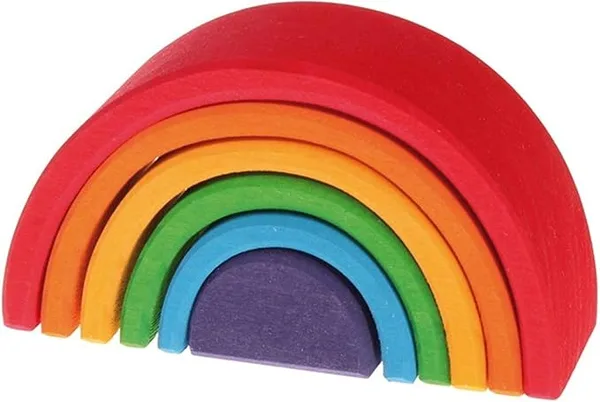
Grimm's Small Rainbow (6-Piece)
“Budget entry point into the Grimm's world. Good for younger kids or travel.”
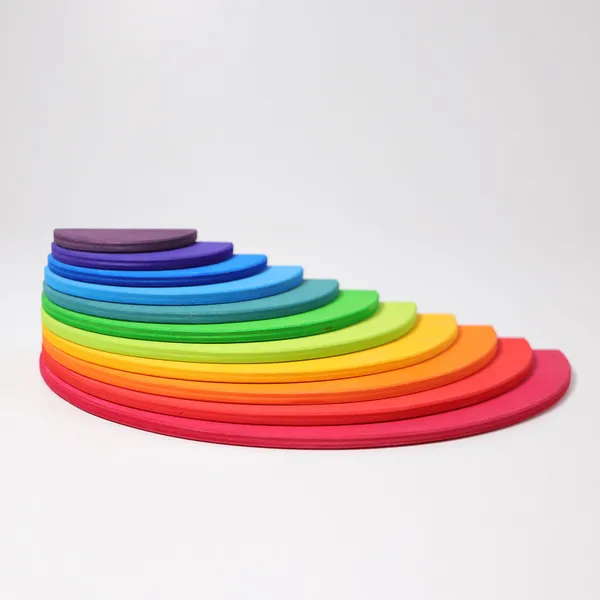
Grimm's Rainbow Semi-Circles
“Extends the rainbow with flat arc pieces. Doubles the building possibilities.”

Grimm's Giant Marbles in Pastel Rainbow Colors (6-Pack)
“Rolling balls through rainbow arcs. Adds cause-and-effect play to open-ended building.”
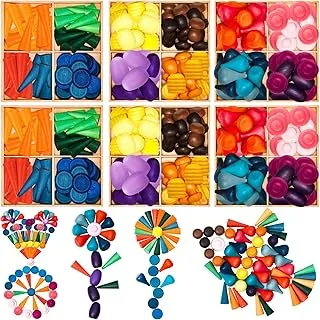
Wooden Mandala Loose Parts Set (54 Pieces)
“Loose parts from Waldorf-inspired brand. Pairs for small-world play and mandalas.”
"Beautiful Oops!" by Barney Saltzberg
“Interactive book celebrating creative mistakes. Pairs with Grimm's open-ended philosophy.”