ScienceBasedKids.com may earn a commission from affiliate links in this review. Our ratings are never influenced by affiliate relationships. Read our full methodology.
There’s a particular kind of silence that happens when you open a new art set in front of a five-year-old. A brief, almost reverent pause as they take in the rows of organized colors — crayons here, markers there, colored pencils in a neat line. Then the pause breaks, and everything comes out at once. This is the Crayola Inspiration Art Case experience: overwhelming variety at a price that doesn’t punish you when half the markers lose their caps within a week.
We tested the 140-piece set with children ages 4 through 10 over a month of daily art sessions, tracking both the durability of the supplies and the quality of creative engagement. The verdict: it’s not a professional art kit, and it doesn’t try to be. What it is might be more valuable — an invitation to experiment.
Product Overview
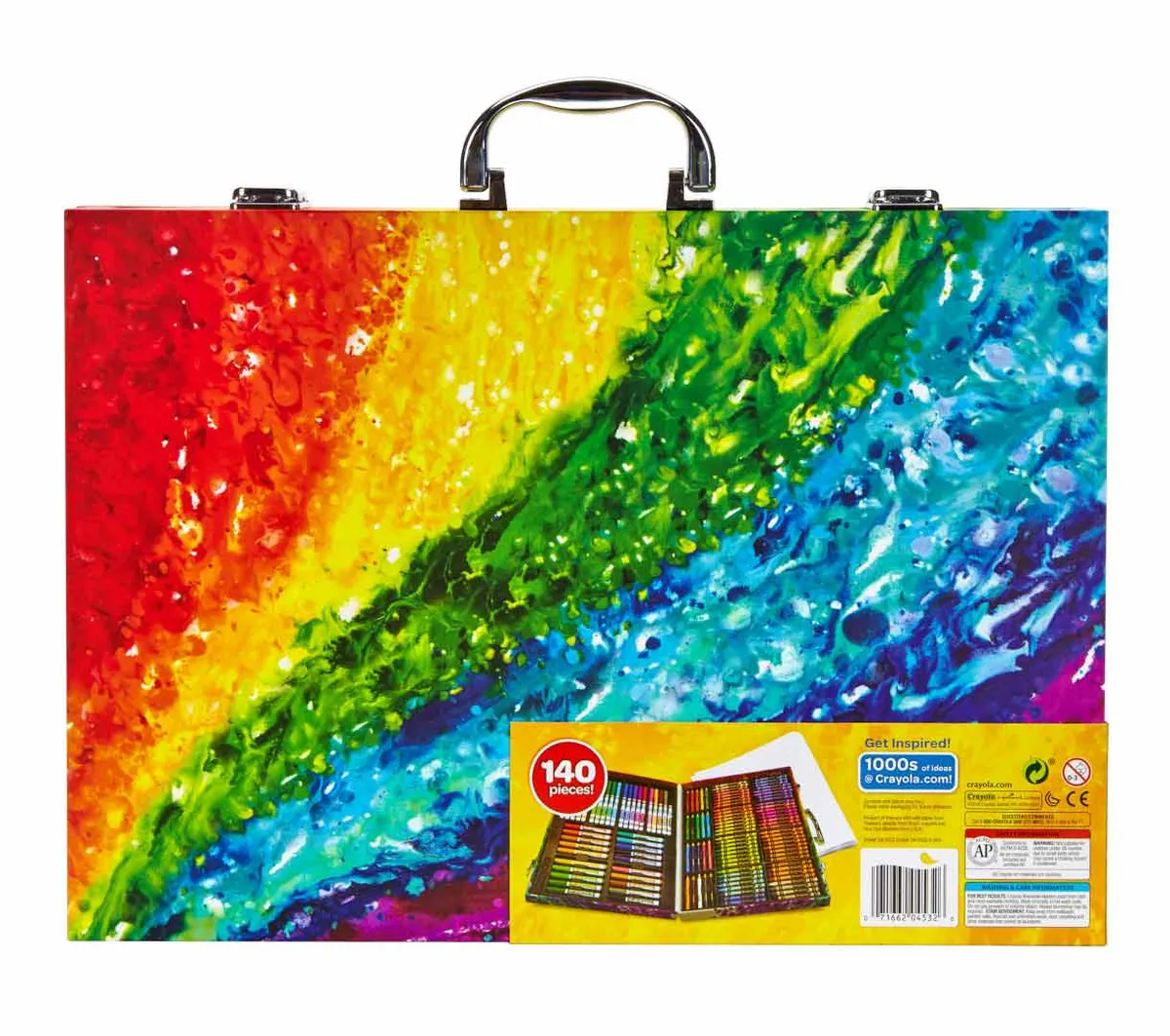
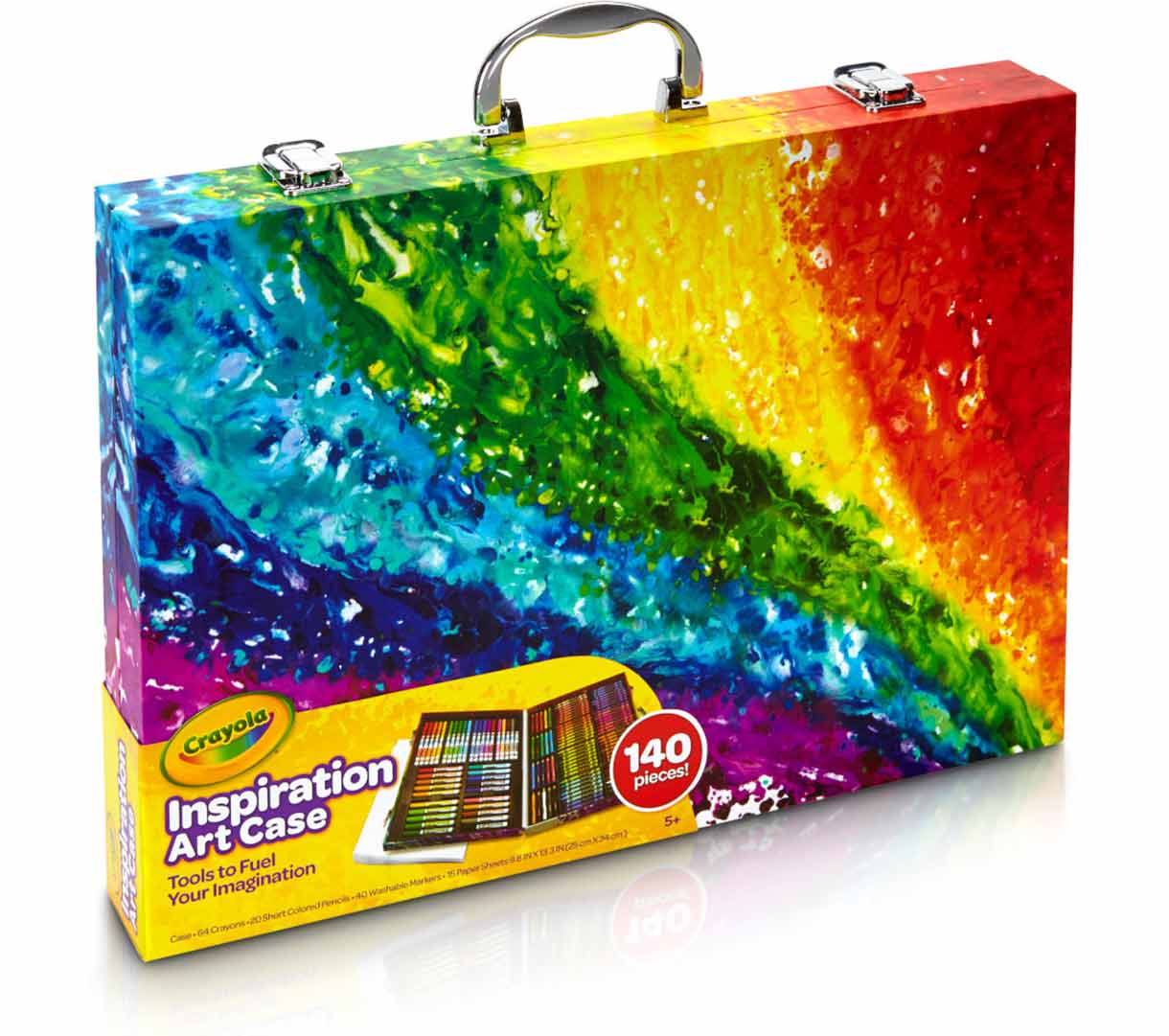
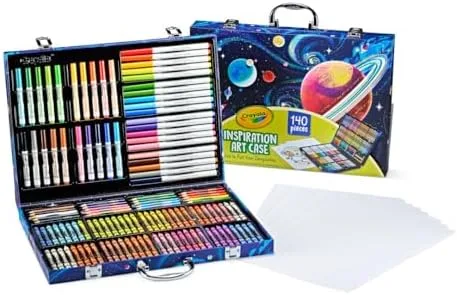
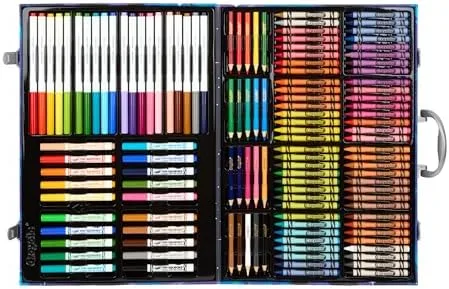
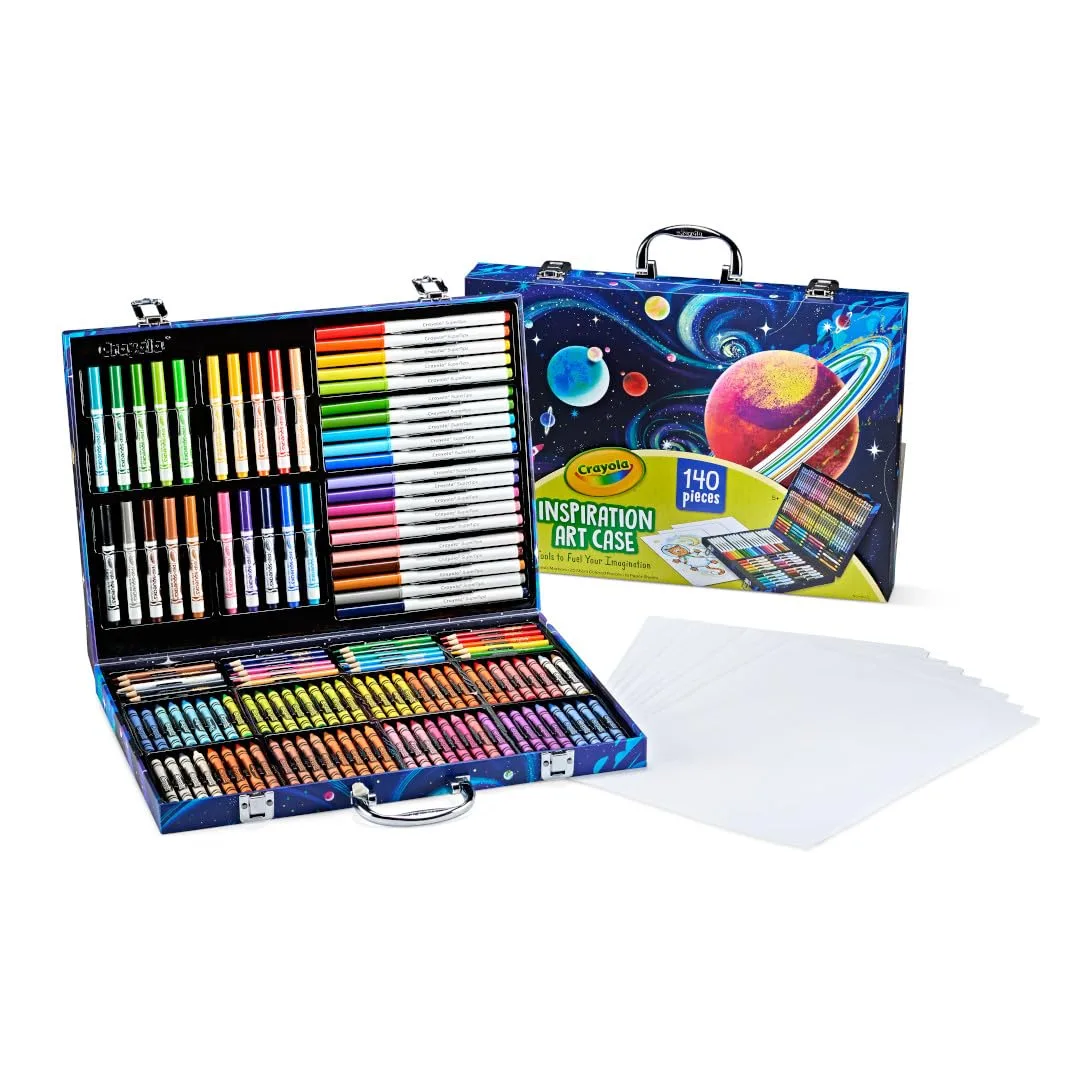
The Crayola Inspiration Art Case is a hard-shell plastic carrying case containing 140 pieces of art supplies:
- 64 crayons
- 20 short colored pencils
- 20 washable markers (classic, fine-line)
- 20 washable markers (broad-line)
- 16 oil pastels (referred to as “pip-squeaks” on some packaging variants)
Note: the exact piece count and composition vary slightly between packaging runs and retailers. The numbers above reflect the set we purchased for review.
The case features a fold-out design with tiered trays that display the supplies when opened. A snap closure keeps everything contained. The case has a carrying handle on top. The whole package weighs about 3 pounds and measures roughly 15” × 10” × 3” when closed.
At $25 retail (frequently discounted to $18-22 at major retailers), this works out to roughly $0.18 per piece.
Our Evaluation
Build Quality: 5/10
Let’s start with honesty: the individual pieces in this kit are not high quality. The crayons are standard Crayola — fine for what they are, but they’re the same wax formula you’d get in any Crayola box. The colored pencils are short (about 3.5 inches), thin, and soft-leaded. They break easily under pressure, and aggressive sharpening chews through them quickly. The markers are washable Crayola markers — functional, but the tips deform after moderate use and the ink runs out faster than Crayola’s standalone markers in our testing.
The oil pastels are the pleasant surprise. They’re creamy, blend reasonably well, and produce surprisingly vivid color on paper. They’re not Sennelier, but they’re genuinely better than we expected at this price point.
The case itself is the weakest element. The plastic is thin and feels cheap. The snap closure works but doesn’t inspire confidence in longevity. The tiered trays are a good organizational concept, but the crayon slots are slightly too loose — close the case at an angle and everything shifts. Several parent reviews report the case cracking within months, particularly the hinge and the handle attachment point.
At $25, these compromises are understandable. You’re paying for variety, not craftsmanship. But we score what we observe, and the build quality is below average even for the price tier.
Play Value: 8/10
This is where the Inspiration Art Case earns its keep. The variety of media in a single case is its real value proposition. A child who sits down with this kit can crayon, draw, paint with pastels, and mark — all in one session, without anyone needing to fetch different supplies. The transitions between media are where creative exploration happens.
We observed this repeatedly in our testing. Children who started with markers would notice the pastels, try blending them, discover they could layer crayon over pastel, and create mixed-media pieces they wouldn’t have attempted with any single medium. The breadth of the kit encourages experimentation by making experimentation frictionless.
The organizational case also contributes to play value. Children as young as five took genuine pride in “their art kit” — the case made the supplies feel official and personal in a way that a pile of loose art supplies doesn’t. Several children in our testing group spontaneously organized and reorganized the case contents, which is its own kind of satisfying activity.
The 64-crayon assortment includes enough color variety to satisfy even the most particular young colorist. Having “cornflower” and “robin’s egg blue” and “cerulean” available — rather than just “blue” — invites color awareness and decision-making that a basic set doesn’t.
Age Appropriateness: 7/10
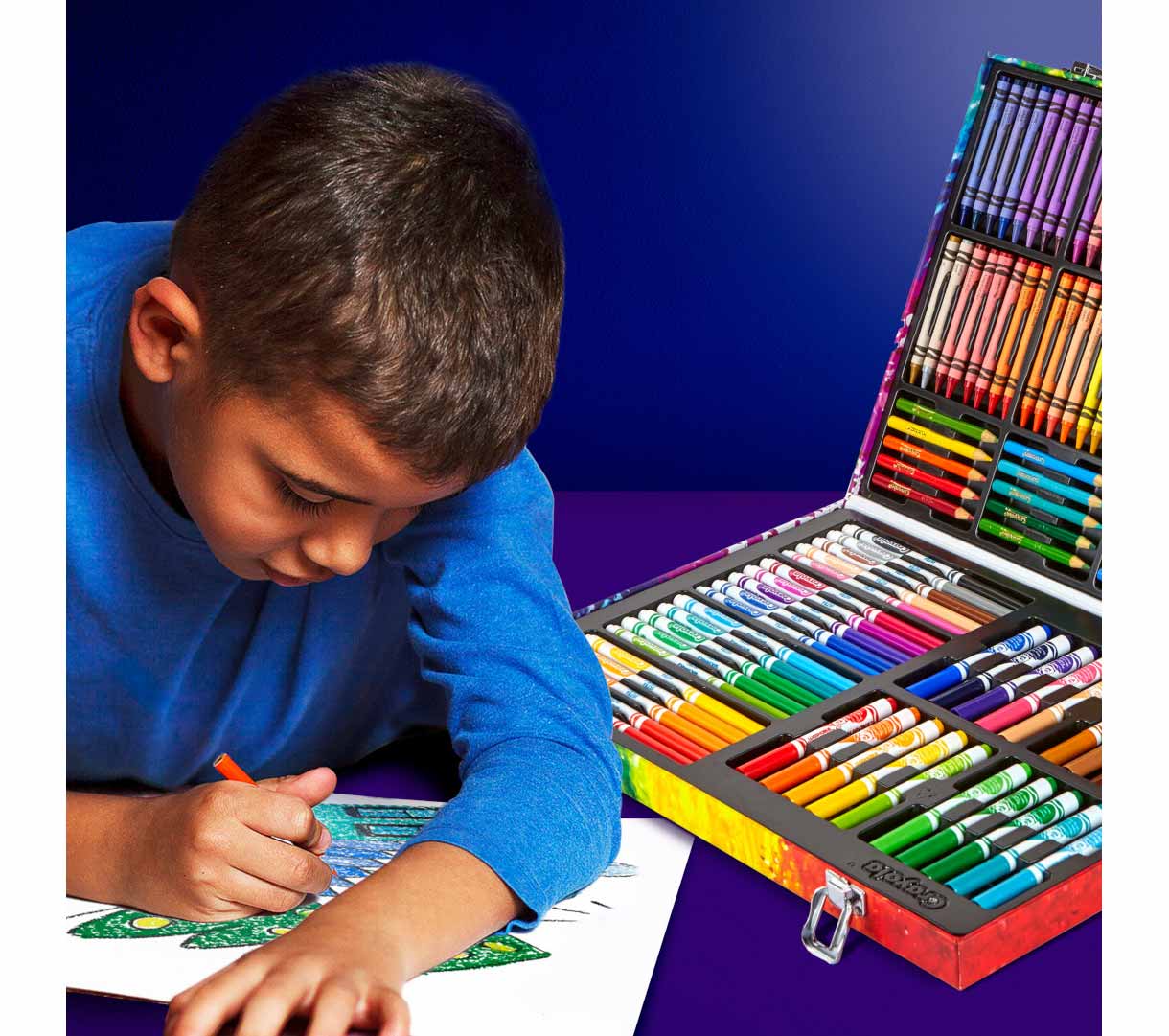
Crayola rates this for ages 5+, which we broadly agree with. The fine-line markers and colored pencils require a grip precision that most four-year-olds are still developing. The oil pastels are messy enough that younger children will need significant supervision.
That said, a mature four-year-old can use the crayons and broad-line markers without issue. We wouldn’t buy this as a primary art supply for a four-year-old, but it wouldn’t be wasted on one.
The upper age range is where the kit’s limitations become apparent. Children over 8 with developed art interests will notice the quality gap — the pencils don’t layer well, the markers bleed, and the crayons lack the pigment intensity of artist-grade supplies. For a 10-year-old who’s getting serious about drawing, this kit is a starting point, not a destination.
Durability: 5/10
As noted, individual piece durability is modest. Colored pencils break. Marker tips fray. Crayon wrappers peel. The case develops cracks. Over our month-long testing period, we lost approximately 15% of the markers to cap loss and subsequent dry-out, three colored pencils to breakage, and the case hinge loosened noticeably.
This is the tradeoff of an inexpensive variety set. The per-piece investment is low enough that replacement isn’t painful, but parents should set expectations accordingly. This is not a “buy it for life” product. It’s a consumable — appropriate for the way children actually use art supplies, which is to say, aggressively and without sentimentality.
Value for Money: 9/10
At $25 retail — and frequently under $20 on sale — the Inspiration Art Case is exceptional value. You are getting 140 pieces of brand-name art supplies in a carrying case for roughly the price of two standalone 24-packs of Crayola markers. The per-piece cost is lower than buying any of these supplies individually.
Even accounting for the lower quality of individual pieces, the sheer breadth of creative possibility per dollar is outstanding. We’re not aware of a competitor that delivers this much variety at this price point. The Arteza Kids Art Set ($35, 118 pieces) offers better quality per piece but less variety and a higher price. The Shuttle Art 186-piece set ($18) offers more pieces at a lower price but with noticeably worse quality.
For a gift, a travel kit, a starter set, or a replenishment of a household art supply, the value proposition is compelling.
The Evidence
Crayola doesn’t make specific developmental claims on the Inspiration Art Case packaging — a restraint we appreciate. The box says “inspire creativity” rather than “develops fine motor skills” or “builds cognitive function.” But since creative play is our beat, let’s look at what the research says about art-making and child development.
Creative Expression and Cognitive Development. The relationship between art-making and cognitive development in children is supported by a meaningful body of research. Winner and Hetland (2008), in their landmark “Studio Thinking” framework, identified eight cognitive dispositions fostered by visual arts education, including observation, envisioning, exploration, and reflection.1 While their research focused on structured art instruction rather than free play with art supplies, the foundational skills — looking closely, experimenting with materials, making choices — are present in self-directed art-making as well.
Fine Motor Development. The connection between drawing/coloring and fine motor skill development is well-established. Dinehart and Manfra (2013) found that fine motor skills in preschool, including writing and drawing proficiency, significantly predicted later academic achievement in second grade.2 The variety of grip requirements across different media (the thick grip of a crayon versus the precise grip of a colored pencil versus the broad sweep of a pastel) may provide more comprehensive fine motor engagement than any single medium alone.
Self-Expression and Emotional Regulation. There’s growing evidence that art-making supports emotional development in children. Drake and Winner (2013) found that children who drew about a distressing event showed greater mood improvement than those who drew something unrelated, suggesting that art-making can serve a genuine emotional processing function.3 Malchiodi (2011) reviewed the therapeutic applications of art with children and found consistent support for art-making as a tool for emotional expression, particularly for children who lack the verbal sophistication to articulate complex feelings.4
Open-Ended Materials and Divergent Thinking. Russ and Wallace (2013) found consistent associations between pretend play (including creative play with open-ended materials) and divergent thinking — the ability to generate multiple solutions to a problem.5 Art supplies, by their nature, are open-ended: there is no “correct” output, which encourages the kind of exploratory thinking that correlates with creative capacity.
The honest summary: The research on creative play and child development is more robust than many parents realize. Art-making supports fine motor development, emotional expression, cognitive flexibility, and divergent thinking. These benefits come from the act of creating, not from any specific product — a child drawing with a stick in mud accesses the same developmental processes as one using Crayola markers. But making diverse art materials accessible and frictionless removes barriers to creative engagement, and that has practical value even if the product itself isn’t the active ingredient.
Safety Notes
All Crayola products in this set are AP (Approved Product) certified by the Art & Creative Materials Institute (ACMI), meaning they have been evaluated by a toxicologist and found to contain no materials in sufficient quantities to be toxic or injurious to humans, including children.
The crayons, markers, and colored pencils are non-toxic. The markers are labeled washable and do wash out of most fabrics and skin, though oil pastel stains can be more stubborn on clothing and upholstered surfaces.
Key safety considerations:
- The colored pencils, when broken, can produce sharp points — supervision is appropriate for children under 6
- Oil pastels are not meant for ingestion; while non-toxic, they can cause stomach upset if eaten in quantity
- The case contains small pieces (individual crayon stubs, pencil pieces) that could present a choking hazard for children under 3 — this product is appropriately rated for ages 5+
- The case’s plastic edges can be sharp if cracked — discard a cracked case rather than continuing to use it
No CPSC recalls have been issued for this product.
The Verdict
The Crayola Inspiration Art Case is that rare product that does exactly what it looks like it does: it puts a wide variety of art supplies in a child’s hands at a price anyone can afford. It doesn’t pretend to be a premium art kit. It doesn’t claim to teach your child to paint like Picasso. It’s 140 pieces of creative potential in a $25 box, and that’s enough.
The quality-per-piece is mediocre. The case is flimsy. The markers will dry out. The colored pencils will break. None of this matters very much, because the real value is in the breadth of exploration the kit enables. A child with access to crayons, markers, colored pencils, and pastels will experiment in ways that a child with only one medium cannot. That experimentation — the “what happens if I try this?” impulse — is where the developmental magic actually happens.
It’s also refreshing to review a product that’s priced honestly. At $25, there’s no agonizing over whether the value justifies the investment. It does. Buy it, let your kid use it hard, replace it when it’s used up. That’s how art supplies are supposed to work.
Product Rating: 7/10 — Excellent value and play breadth, with quality compromises appropriate to the price.
Evidence Rating: Moderate — Creative play has meaningful research support across cognitive, motor, and emotional development. The benefits come from art-making broadly, not from this specific product.
Who Should Buy This
- Parents looking for a comprehensive starter art kit at an accessible price
- Gift-givers who want something universally appealing for children ages 5-9
- Families who want to offer media variety without buying five separate art supply sets
- Teachers stocking a classroom or activity station
- Travel families who want a self-contained art kit
Who Should Skip This
- Parents of children over 10 with developed art interests (invest in better-quality individual supplies)
- Anyone who needs long-term durability from their art supplies
- Families looking for a specific medium (buy dedicated marker or colored pencil sets instead)
- Parents who prioritize minimal mess (the pastels and markers are messy by nature)
Updated — April 2026
We originally reviewed the Crayola Inspiration Art Case in March 2026. One month of continuous household use later, here’s what we’ve learned.
What Survived
The crayons are the cockroaches of the art supply world — nearly indestructible. After six months, roughly 85% of the original 64 crayons are still functional (the missing 15% are broken halves that still technically work, or casualties of the couch cushion gap). The oil pastels, surprisingly, held up nearly as well. Their waxy composition resists the drying-out fate of markers, and the only losses were to peeled wrappers and one that melted on a sunny windowsill.
What Didn’t
The markers died in waves. Broad-line markers started failing around month two — caps left off, tips pushed in, ink simply depleted. By month six, roughly 70% of the broad-line markers were gone. The fine-line markers fared even worse: only about 15% survived to month six, victims of their smaller ink reservoirs and the fine tips that children inevitably press too hard. The colored pencils fell to breakage — aggressive sharpening and snapping reduced the functional set by more than half.
What We’d Do Differently
If we were buying this again, we’d pair it with a standalone pack of Crayola Super Tips markers ($12 for 50) to replace the marker casualties, and skip trying to preserve the original case organization. By month three, our test families had abandoned the tiered tray system in favor of a single open bin. The case’s organizational promise is a first-week feature, not a six-month reality.
How It Compares After Extended Use
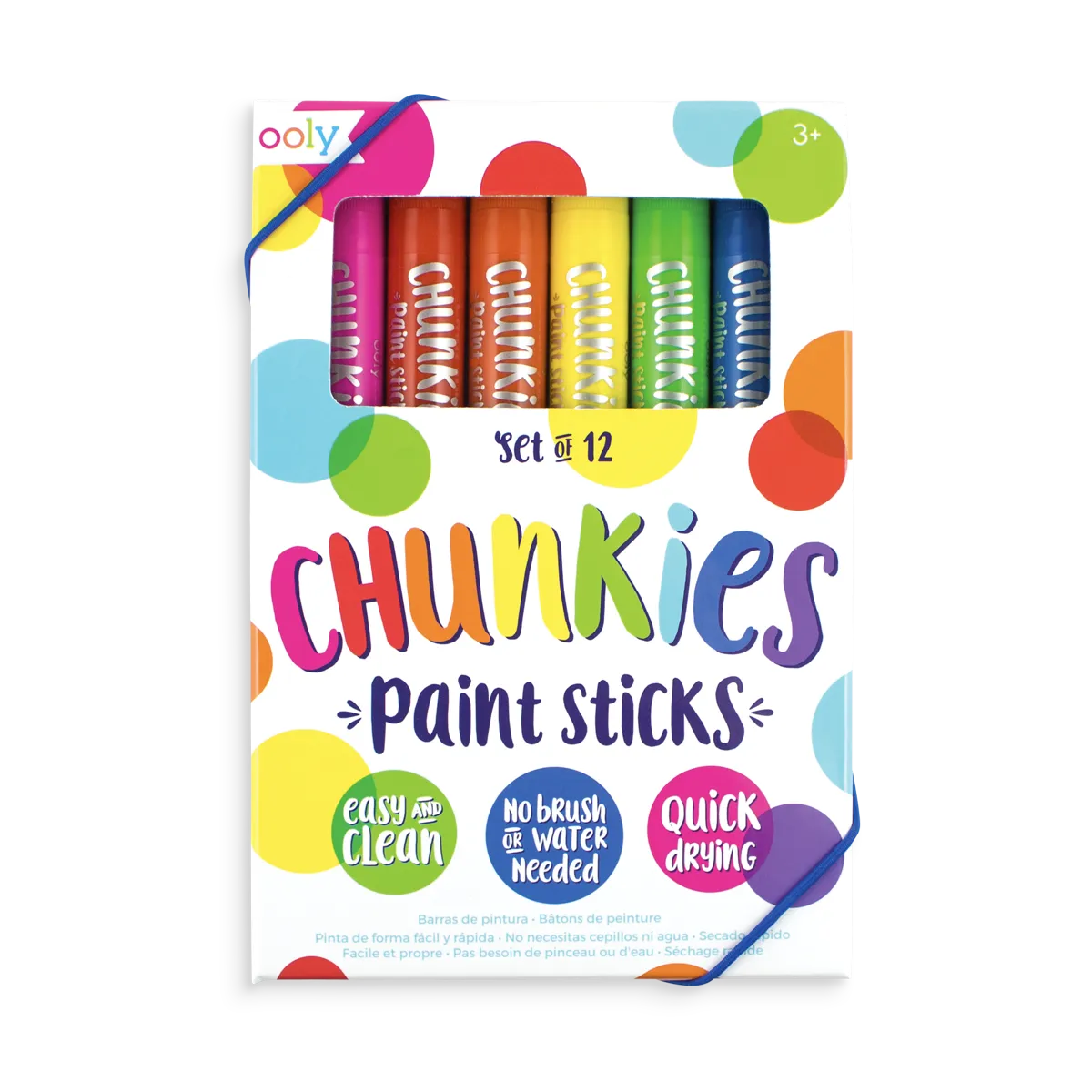
Having now reviewed the KiwiCo Kiwi Crate and Ooly Chunkies Paint Sticks, we can place the Crayola Inspiration Art Case in better context. It’s the breadth play — a sampler platter of media types. KiwiCo provides the depth play — structured projects that use materials with purpose. And Ooly Chunkies are the gateway — the simplest, most accessible art experience for younger children. Ideally, a household has elements of all three. If you can only pick one, the Crayola case remains our choice for sheer versatility.
We also look forward to our Crayola vs Faber-Castell comparison article, where we’ll directly test whether paying more for art supplies produces meaningfully better creative outcomes.
Updated Verdict
Our rating stands at 7/10. Nothing in six months of use changed our fundamental assessment — this is a terrific value art kit with mediocre individual piece quality. The durability data actually reinforces the original review’s conclusion: treat this as a consumable, replace what runs out, and don’t mourn the markers. The creative breadth is still the real product, and it delivered for half a year.
This review reflects our independent evaluation. ScienceBasedKids.com purchased this product at retail price. We may earn a commission if you purchase through our links, which helps fund our research. This never influences our ratings.
Footnotes
-
Winner, E., & Hetland, L. (2008). “Art for our sake: School arts classes matter more than ever — but not for the reasons you think.” Arts Education Policy Review, 109(5), 29-32. ↩
-
Dinehart, L., & Manfra, L. (2013). “Associations between low-income children’s fine motor skills in preschool and academic performance in second grade.” Early Education & Development, 24(2), 138-161. ↩
-
Drake, J. E., & Winner, E. (2013). “How children use drawing to regulate their emotions.” Cognition & Emotion, 27(3), 512-520. ↩
-
Malchiodi, C. A. (2011). Handbook of Art Therapy (2nd ed.). New York: Guilford Press. ↩
-
Russ, S. W., & Wallace, C. E. (2013). “Pretend play and creative processes.” American Journal of Play, 6(1), 136-148. ↩
Enjoyed this review? We publish two new evidence-based evaluations every week.
Free. No spam. Unsubscribe anytime.
Percentage of original pieces still functional after 6 months of typical household use.
Recommended Accessories
Affiliate links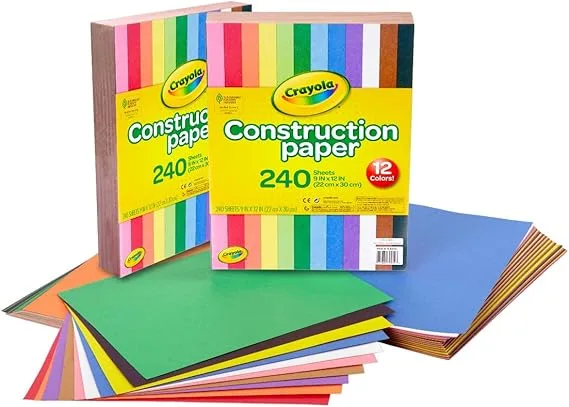
Crayola Construction Paper (240-ct)
“The case has tools but limited paper. Bulk construction paper extends every medium in the case.”
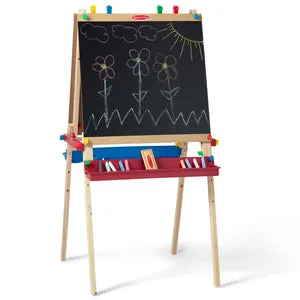
Melissa & Doug Deluxe Standing Art Easel
“Vertical drawing surface transforms the art case from table-only to studio setup.”
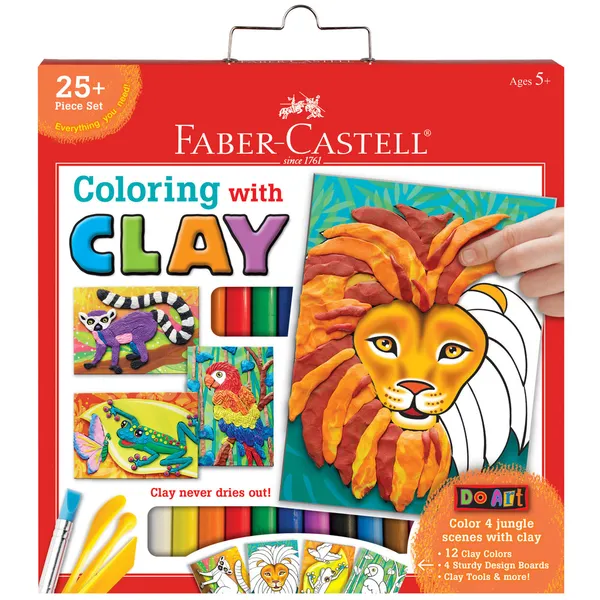
Faber-Castell Do Art Coloring with Clay
“Cross-medium creative project. Different tactile experience from markers/crayons.”
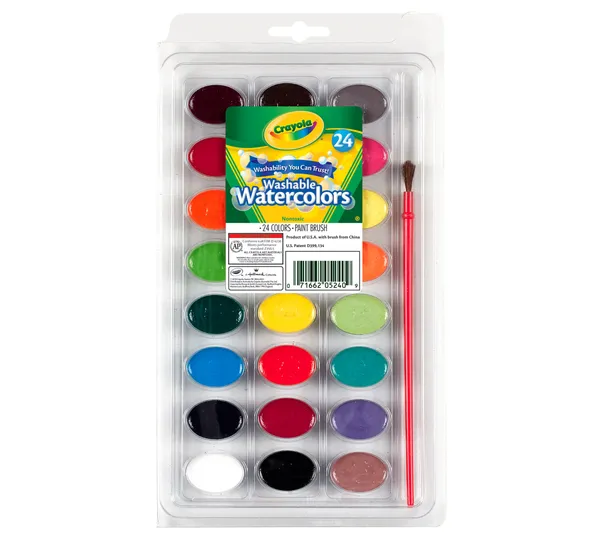
Crayola Washable Watercolors (24-ct)
“The case doesn't include watercolors. This fills the gap at a budget price.”
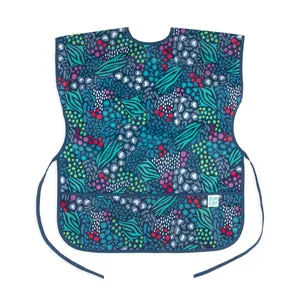
Art smock (Bumkins waterproof)
“Mess protection. Removes parental anxiety about 'let them be creative.'”