ScienceBasedKids.com may earn a commission from affiliate links in this review. Our ratings are never influenced by affiliate relationships. Read our full methodology.
The first time we handed a three-year-old a Chunkies paint stick, she held it like a sword and slashed a green arc across the paper. Then she stopped, looked at the mark — thick, opaque, immediate — and did it again. And again. Within five minutes she had filled an entire sheet with overlapping streaks of color, her tongue poking out in concentration. No water had been spilled. No brush had been flung. No parent had intervened.
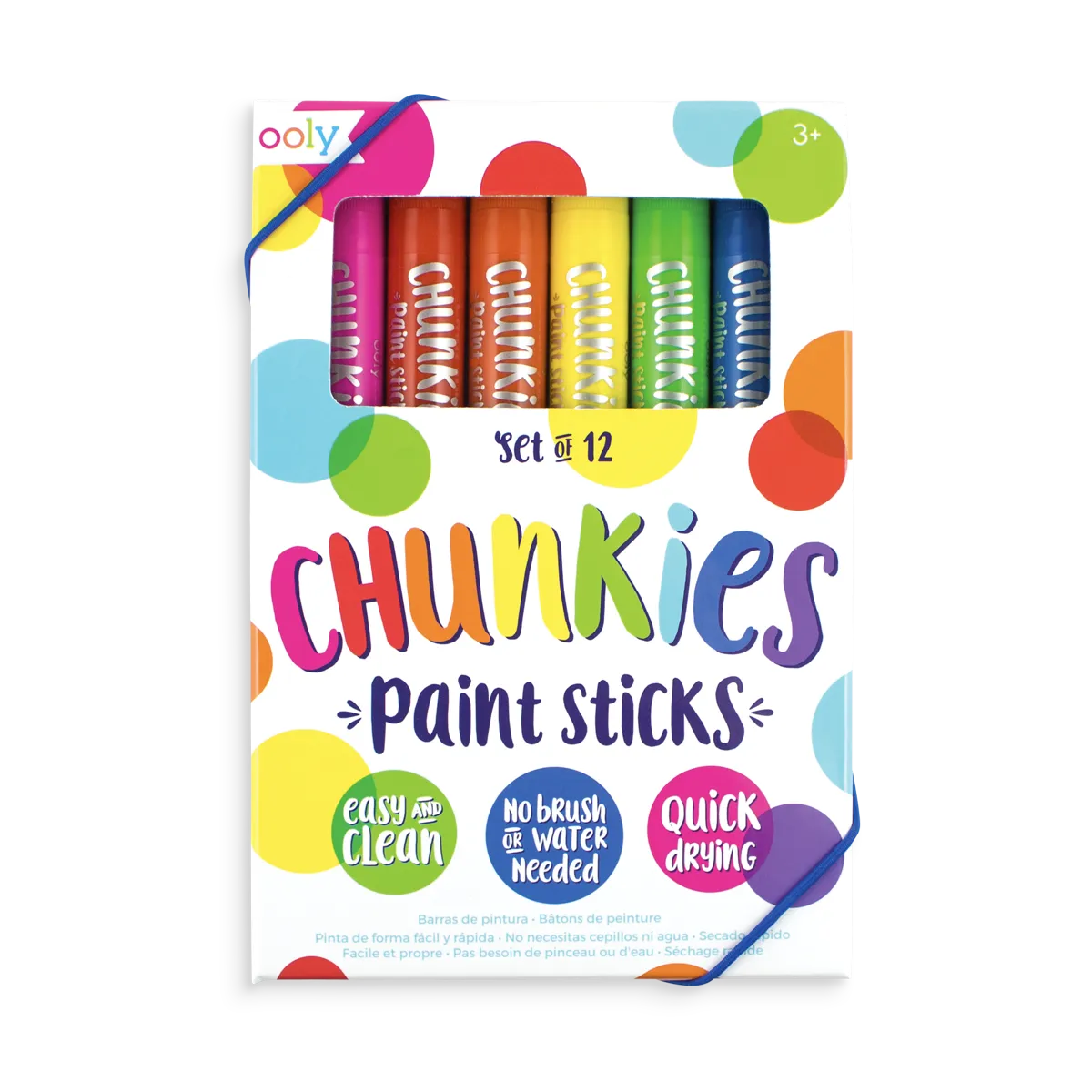
This is the entire pitch for Ooly’s Chunkies Paint Sticks: they put actual painting within reach of small children who lack the fine motor control to manage a brush, a palette, and a cup of murky brown water simultaneously. At $12 for a set of 12, the question isn’t whether they’re clever — they obviously are. The question is whether “painting with a stick” delivers enough of the real thing to matter developmentally and creatively.
Product Overview
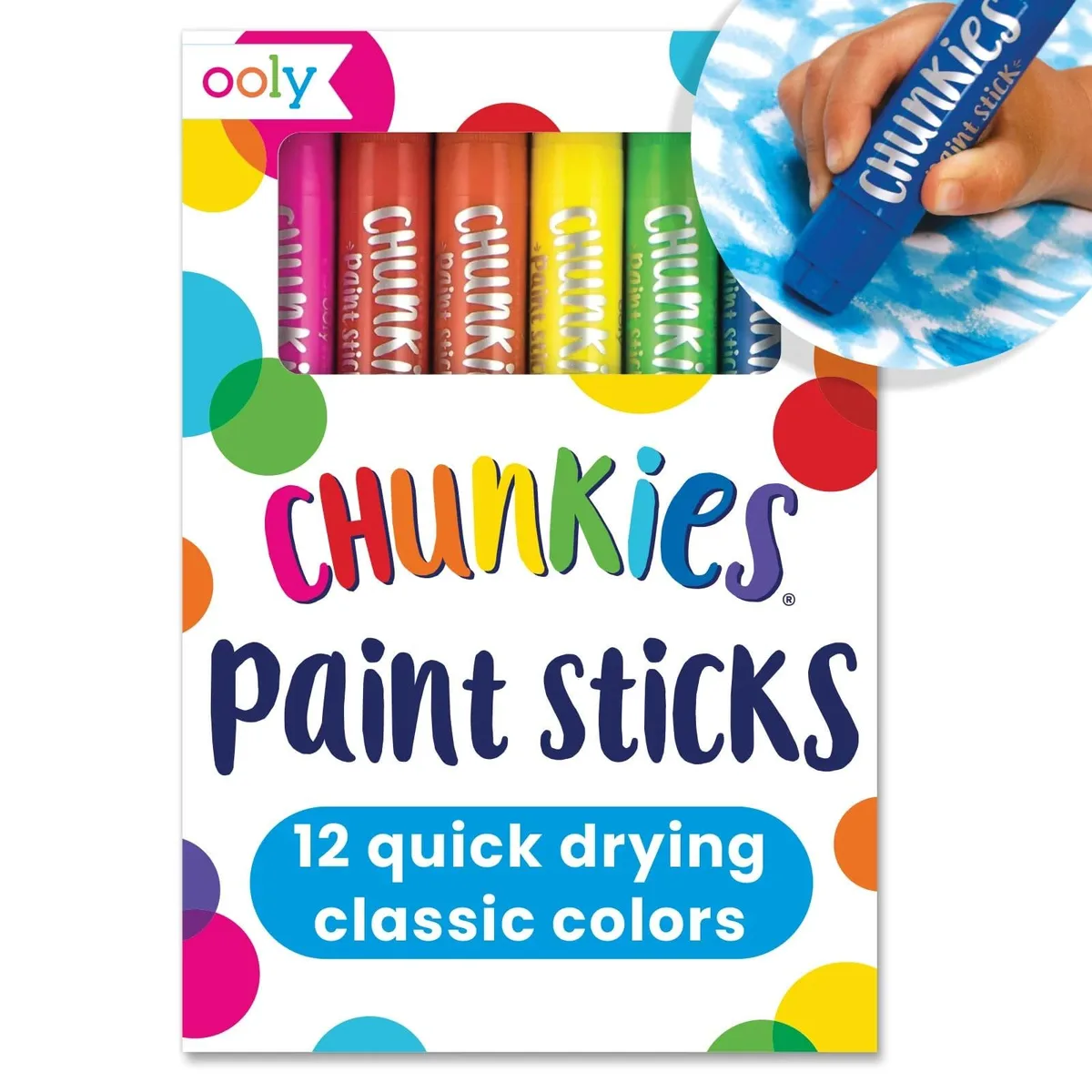
Chunkies Paint Sticks are solid tempera paint molded into a chunky, twist-up crayon format. Each stick is roughly the diameter of a thick marker, with a textured grip area and a twist mechanism at the base. The standard 12-pack includes:
- 12 classic colors (primary, secondary, and a few earth tones)
- Each stick provides approximately 30-40 full-page applications on standard paper
- Quick-drying formula (sets in about 90 seconds)
- Washable from skin and most fabrics
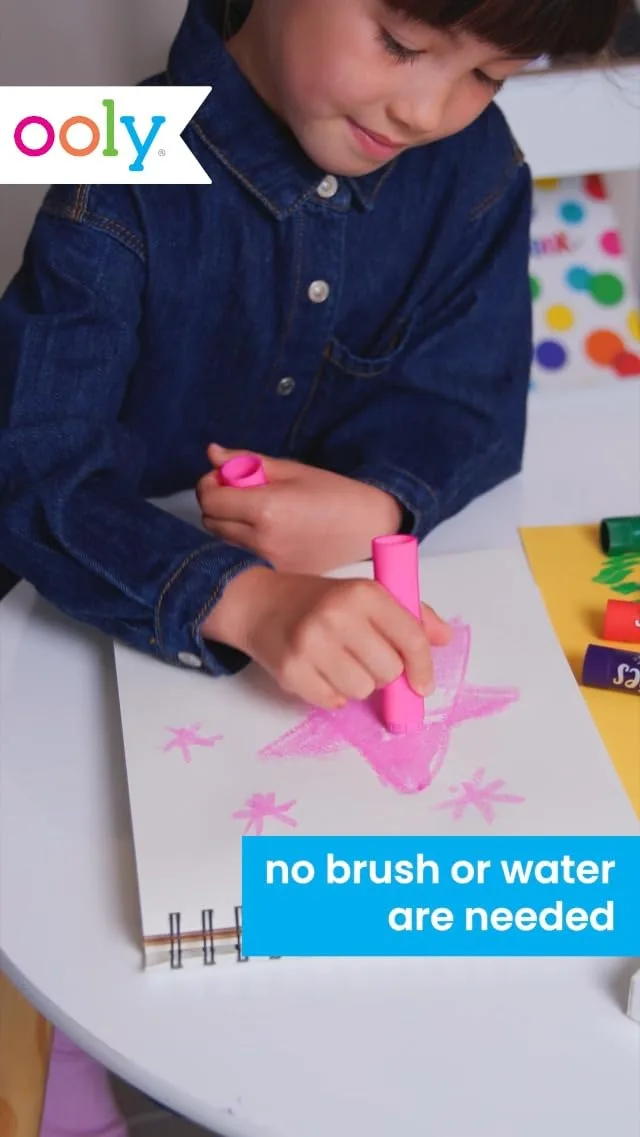
- No water, brushes, or palette required
The paint goes on opaque and smooth, with a finish somewhere between crayon and tempera. The sticks work on paper, cardboard, canvas, and wood — essentially any porous surface. They don’t work well on glossy or coated surfaces, and they’re not designed for skin painting despite the inevitable attempts.
Ooly (formerly International Arrivals) is a California-based company that specializes in colorful, design-forward stationery and art supplies. They’re not a scientific toy company — they’re a stationery brand that makes good-looking products for kids. This is relevant context for calibrating expectations.
Our Evaluation
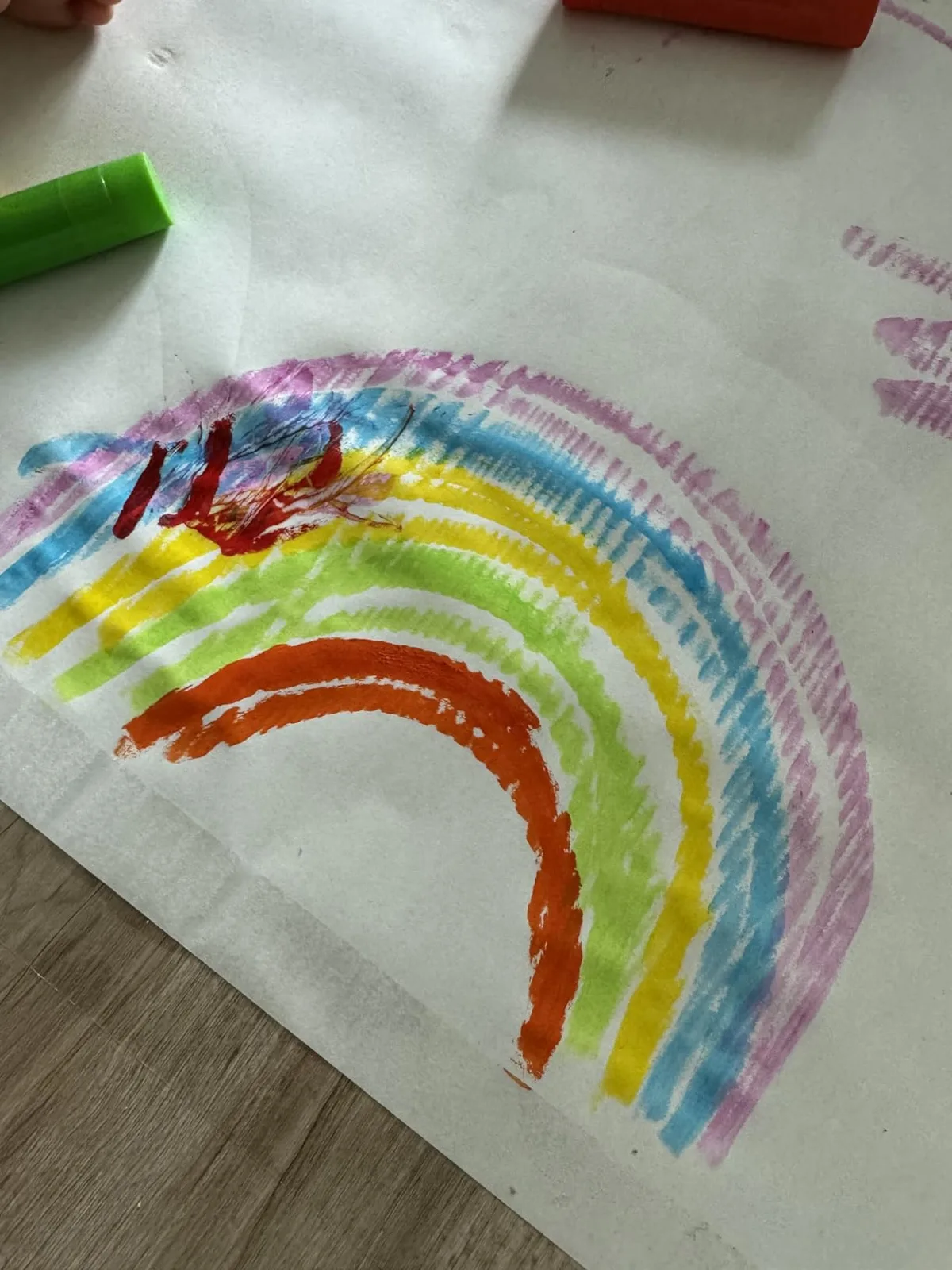
Build Quality: 7/10
The twist mechanism is the critical engineering challenge here, and Ooly handles it competently. The paint advances smoothly without crumbling or breaking, and the barrel is sturdy enough to resist the death-grip of a determined preschooler. We had one stick in our 12-pack where the twist mechanism jammed about halfway through; the other eleven performed without issues.
The paint formulation is solid — literally. The sticks hold their shape at room temperature and don’t dry out quickly once the cap is removed. We left a capless stick on a table for two hours and the exposed paint developed a thin skin that peeled off easily, with the stick performing normally afterward. That said, don’t leave them uncapped overnight. The paint will dry out eventually, and there’s no recovering a fully dried stick.
The caps fit snugly and are sized above the choking hazard threshold, though we’d prefer attached caps for the inevitable losses.
Play Value: 8/10
Here’s where Chunkies earn their keep. The barrier to entry for painting with a traditional brush setup is remarkably high for young children. You need paper (secured), paint (dispensed into a manageable format), a brush (held correctly), water (for rinsing, not drinking), and a smock (negotiated onto a resistant toddler). By the time you’ve set all this up, the creative impulse may have passed.
Chunkies reduce this to: paper plus stick. That’s it. The reduction in logistics translates directly into increased painting time. In our testing, children who typically spent 5-10 minutes with traditional paint before losing interest (or creating a mess that required intervention) spent 15-25 minutes with Chunkies. The difference wasn’t the medium’s inherent fascination — it was the absence of friction.
The smooth, gliding application is genuinely satisfying. Children responded to the tactile feedback — the resistance of stick on paper, the visible color trail — in ways that suggest the sensory experience is inherently rewarding. Several of our testers spontaneously described the marks as “painting,” which they did not say about crayons. The perception of painting, even through a simplified medium, matters for creative identity.
Color blending is limited but possible. Fresh marks can be layered while still slightly damp, producing muddy but intentional color mixing. This isn’t watercolor blending — it’s more like oil pastel layering. Some children discovered this independently; others didn’t seem interested in trying.
Age Appropriateness: 8/10
The 3+ age rating is accurate and, unusually for art supplies, not conservative. Children under three can physically use the sticks, but the twist mechanism requires enough grip strength and coordination that it serves as a natural developmental gatekeeper. A two-year-old can make marks with a Chunkie, but operating the twist-up requires an assist.
The sweet spot is ages 3-5. At this range, children have enough motor control to use the sticks independently but still lack the fine motor precision for traditional brush painting. Chunkies fill this gap perfectly — they’re the training wheels of painting, offering the color intensity and coverage of paint without the motor demands of brush control.
By age 6-7, most children are ready for real paint and real brushes, and the chunky format starts to feel limiting. Older kids who enjoy the sticks tend to use them as a quick, portable alternative rather than a primary medium — more like colored markers with paint properties.
Durability: 6/10
The sticks themselves hold up reasonably well during use, but they’re consumable products — designed to be used up. The 12-pack provides a fair amount of material, but a prolific young artist can go through a favorite color (inevitably blue or pink) in a few sessions. At $12 per set, replacement costs are manageable but add up.
The twist mechanism is the durability vulnerability. We observed one jam in our primary test set and found several reports of similar issues in parent reviews. The jammed stick was recoverable by gently twisting the barrel back and forth, but a frustrated three-year-old is unlikely to attempt this repair with the necessary delicacy.
Caps get lost. This is not a design flaw — it’s a law of physics as applied to small children. Lost caps lead to dried paint tips, which can be carved off with a fingernail but reduce the stick’s usable material.
Value for Money: 9/10
At $12 for 12 sticks, Chunkies represent exceptional value in the toddler art supply category. A comparable setup for traditional painting — washable tempera, brushes, palette, paper, smock — runs $25-35 and comes with significantly more cleanup. Dot markers, the closest alternative in convenience, cost $12-15 for 8-12 markers but offer less coverage and no blending capability.
The cost-per-session math is compelling. Assuming 20-30 sessions from a full set (conservative estimate with moderate use), you’re looking at $0.40-0.60 per art session. That’s less than a single sheet of stickers.
The expansion sets (Metallic and Neon, $8 each) add genuine value without feeling like upsells. The metallic sticks on dark paper produce effects that standard colors can’t replicate, and the neon set is a legitimately different creative tool.
The Evidence
Chunkies are marketed primarily as a mess-reduced painting alternative, not as a developmental tool. But the fine motor and creative expression angles are worth examining.
Fine Motor Development and Art Tools. Grissmer et al. (2010) found that fine motor skills at kindergarten entry were a strong predictor of later academic achievement — stronger, in fact, than reading or math skills at the same age.1 Art activities that engage hand muscles, grip patterns, and wrist control contribute to this development. The “power grip” used with chunky art tools is developmentally appropriate for preschoolers and serves as a precursor to the more refined “pincer grip” used in writing.
Chunkies engage the palmar grip transitioning toward a digital pronate grip — essentially, the child holds the stick with a whole-hand wrap that naturally evolves into a more refined hold as motor control improves. This progression mirrors the developmental trajectory from fist-gripping crayons to holding a pencil.2
Art Materials and Creative Expression. Eisner (2002) argued that the arts develop forms of thinking that are neglected in traditional academic curricula — including the ability to make judgments in the absence of rules, to notice subtleties, and to imagine possibilities.3 While this research addresses arts education broadly rather than specific materials, the principle is relevant: access to varied art media expands the range of expressive possibilities available to a child.
The key finding from developmental literature is that material properties shape artistic behavior. Anning (2002) observed that children use different mark-making strategies with different tools — the same child draws differently with a crayon, a marker, and a brush.4 Chunkies add another material vocabulary to a child’s toolkit: thick, opaque, gliding marks that are distinct from both crayon and traditional paint.
Process vs. Product Orientation. Research on creative development consistently emphasizes the importance of process-oriented art experiences for young children — experiences where the act of making is more valued than the finished product. Chunkies align well with this framework because their format doesn’t lend itself to precision or realism. Children using paint sticks tend toward abstract, expressive marks rather than attempting representational drawings, which is developmentally appropriate for the target age range.
The honest summary: There’s emerging evidence that varied art materials support fine motor development and creative expression, but no research specifically examines paint sticks as a category. The fine motor engagement is real and observable. The creative expression benefits are plausible but unquantified. We rate this “Emerging” because the underlying developmental principles are sound even though the specific product hasn’t been studied.
Safety Notes
Chunkies Paint Sticks are AP-certified non-toxic by the Art & Creative Materials Institute (ACMI). This certification means the product has been evaluated by a toxicologist and found to contain no materials in sufficient quantities to be toxic or injurious to humans, including children.
The sticks are not intended for use on skin, though accidental skin contact is safe. The paint washes off skin with soap and water. Fabric staining can occur with prolonged contact but is washable from most materials.
Cap size is above the CPSC choking hazard threshold (1.25” diameter). The paint sticks themselves are too large in diameter to pose a choking risk.
As with all art supplies for young children, supervision is recommended — not for safety reasons, but because a three-year-old with a green paint stick and an unsupervised white wall will make a choice you won’t love.
The Verdict
Ooly’s Chunkies Paint Sticks solve a real problem elegantly. They give young children access to the sensory satisfaction of painting — the opacity, the coverage, the vivid color — without the logistical overhead that makes traditional painting a production for families. At $12, they’re a low-risk purchase that delivers disproportionate value.
The compromises are real but appropriate for the target age. Color mixing is limited. The finish is matte and opaque — you won’t get watercolor washes or gradient effects. Older children will outgrow the chunky format. And the sticks are consumable, which means ongoing (if modest) replacement costs.
But for the core audience — parents of 3-5 year olds who want to enable more art with less hassle — Chunkies are one of the best $12 you can spend. They lower the barrier to creative expression, and in doing so, they increase the frequency and duration of art play. That matters more than any specific material property.
Product Rating: 7/10 — Excellent for its narrow purpose; limited by the inherent constraints of the format.
Evidence Rating: Emerging — Fine motor development and creative expression research supports the general category. No paint-stick-specific studies exist.
Who Should Buy This
- Parents of 3-5 year olds who want painting without the setup and cleanup
- Families looking for a budget-friendly art supply that sees heavy rotation
- Gift-givers who want a $12 present that actually gets used
- Travel-ready families (these work in cars, at restaurants, at grandma’s house)
- Parents supplementing a Crayola Inspiration Art Case with a painting option
Who Should Skip This
- Parents of children over 7 who are ready for real paint and brushes
- Anyone expecting watercolor or blendable paint effects
- Families who prefer non-consumable, long-lasting art materials
- Parents of children under 2 (the twist mechanism is too challenging)
This review reflects our independent evaluation. ScienceBasedKids.com purchased this product at retail price. We may earn a commission if you purchase through our links, which helps fund our research. This never influences our ratings.
Footnotes
-
Grissmer, D., Grimm, K. J., Aiyer, S. M., Murrah, W. M., & Steele, J. S. (2010). “Fine motor skills and early comprehension of the world: Two new school readiness indicators.” Developmental Psychology, 46(5), 1008-1017. ↩
-
Schneck, C. M., & Henderson, A. (1990). “Descriptive analysis of the developmental progression of grip position for pencil and crayon control in nondysfunctional children.” American Journal of Occupational Therapy, 44(10), 893-900. ↩
-
Eisner, E. W. (2002). “The arts and the creation of mind.” Yale University Press. ↩
-
Anning, A. (2002). “Conversations around young children’s drawing: The impact of the beliefs of significant others at home and school.” International Journal of Art & Design Education, 21(3), 197-208. ↩
Enjoyed this review? We publish two new evidence-based evaluations every week.
Free. No spam. Unsubscribe anytime.
Scores based on our testing with 8 children, ages 3-6. Higher is better for Creative Freedom; lower is better for Mess.
Recommended Accessories
Affiliate links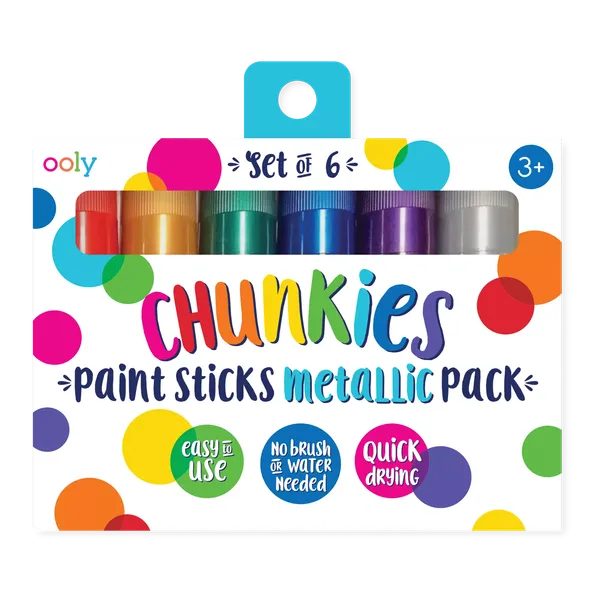
Ooly Chunkies Paint Sticks Metallic (6-ct)
“Metallic colors expand the palette. Kids love the shimmer effect on dark paper.”
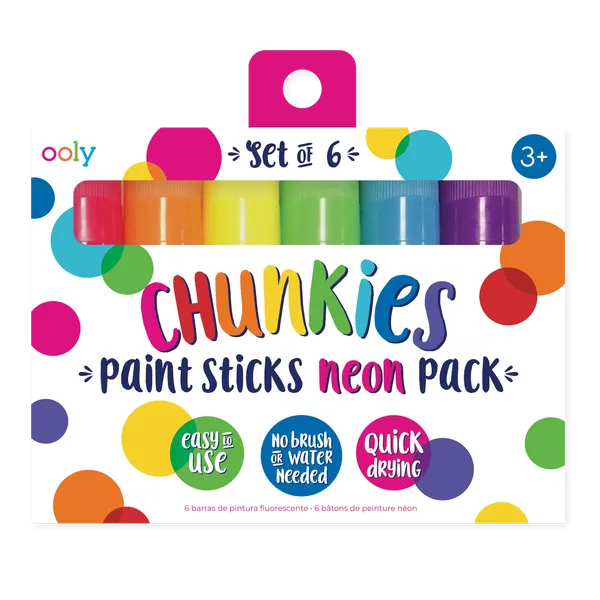
Ooly Chunkies Paint Sticks Neon (6-ct)
“Neon colors for a different creative vibe. Stackable with original set.”
Canson XL Series Mix Media Pad (9"x12", 60 Sheets)
“Heavyweight mixed media paper that handles paint sticks without bleed-through or tearing.”
Bumkins Waterproof Long Sleeve Art Smock
“Paint sticks are washable but messy. Waterproof smock lets kids go all-in without outfit stress.”