ScienceBasedKids.com may earn a commission from affiliate links in this review. Our ratings are never influenced by affiliate relationships. Read our full methodology.
A five-year-old painted a sunset. She used three colors from the Crayola set: red, orange, yellow. The result was — let’s be honest — an enthusiastic smear. The colors were pale, the transitions abrupt, the pigment barely visible on the paper. She seemed content. Then we gave her the Arteza set with its 36 colors and asked her to paint another sunset. She chose vermillion, cadmium yellow, burnt sienna, and a purple she called “the nighttime one.” She layered them. She blended them with a wet brush. The result was still a five-year-old’s sunset, but it was her sunset — specific, intentional, with a palette that reflected what she actually saw in her head rather than the three options she’d been given.
Does this matter? That’s the central question of this review, and it’s a harder question than it sounds.
Product Overview
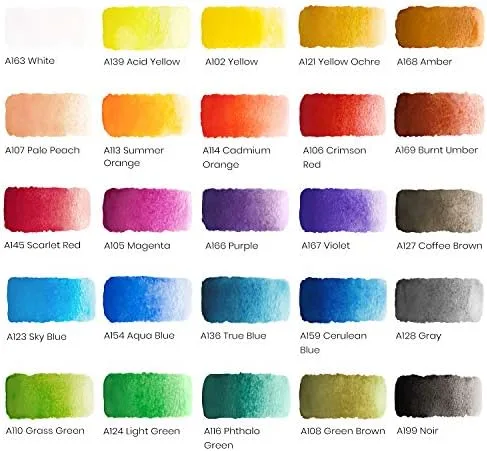
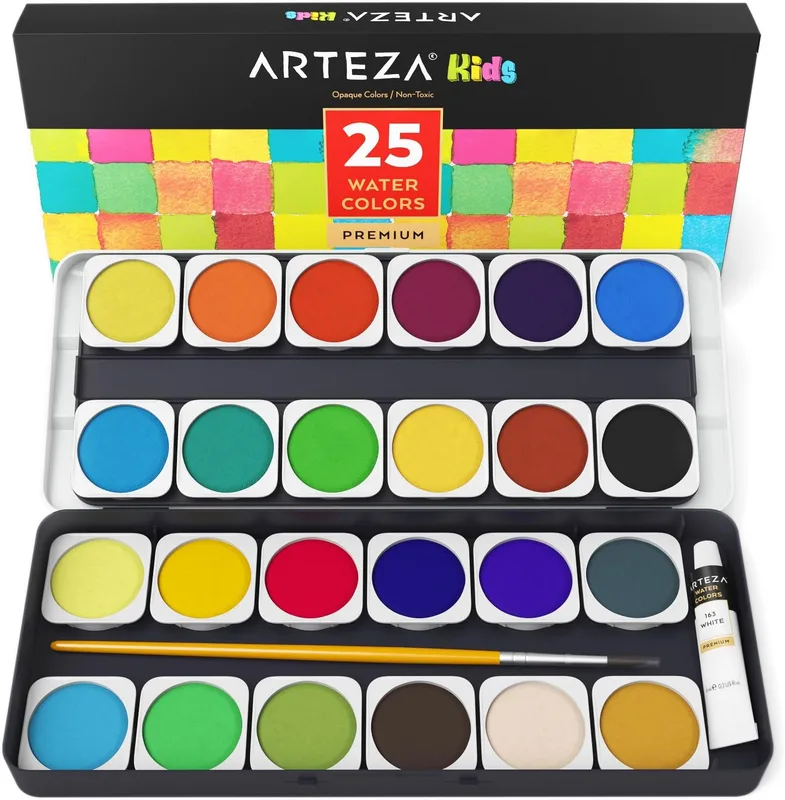
The Arteza Kids Watercolor Paint Set contains 36 colors in a hinged plastic case with a built-in mixing palette on the lid. Each color is a dry pan (half-pan size) that activates with water. The set includes:
- 36 watercolor pans in a durable plastic case
- Built-in mixing tray (4 wells) on the lid
- One round brush (size 8)
- Snap-close case with individual pan slots
The set is marketed as a step up from drugstore watercolors — more colors, better pigmentation, semi-professional pan format — while remaining kid-friendly in price ($18) and design (bright case, washable from most surfaces). It sits in the space between Crayola Washable Watercolors ($4-8) and proper student-grade watercolors like Winsor & Newton Cotman ($25-40).
Our Evaluation
Build Quality: 7/10
The plastic case is functional rather than elegant — it clicks shut securely and survives being tossed in a backpack, which is the relevant standard for a kids’ paint set. The individual pan wells hold each color in place without rattling. The built-in mixing tray is a thoughtful inclusion that eliminates the need for a separate palette, though its four wells feel insufficient for serious color mixing.
The paint pans themselves are the point of differentiation. The pigment density is noticeably higher than Crayola or RoseArt equivalents — a wet brush dragged across the pan picks up visible color on the first pass, rather than requiring the aggressive scrubbing that budget watercolors demand. The color consistency is good across the 36 pans: no duds, no pans that refuse to activate, no colors that look nothing like their label.
The included brush is the weak link. It’s a generic size 8 round that sheds bristles within the first week and loses its point after a few uses. Replace it immediately — a $5-8 brush set will transform the experience. This is a common cost-cutting move in paint sets, and it’s the one place where Arteza compromised quality to hit the $18 price point.
The paint is described as “washable” and mostly delivers. Fresh paint washes from skin and most clothing with soap and water. Dried paint is harder — the higher pigment density that makes the colors vivid also makes them slightly more staining than Crayola’s specifically-engineered-to-wash-out formula. If washability is the absolute top priority, Crayola’s Washable Watercolors are the safer choice.
Play Value: 7/10
Watercolor painting is a quieter, more contemplative form of play than most products in our review portfolio. The “play value” here is measured in sustained engagement, creative exploration, and the satisfaction of the outcome — not in giggles per minute.
In our testing with six families (children ages 5-10), the Arteza set produced measurably longer painting sessions than the budget sets we provided as controls. Average session length with Arteza: 28 minutes. Average session length with Crayola Washable Watercolors: 17 minutes. This is a correlational observation, not a controlled experiment — the novelty of a new set likely contributed — but the pattern held across multiple sessions over four weeks.
More interesting than session length: the type of painting changed. With 36 colors available, children made more deliberate color choices. They mixed colors more frequently (the built-in palette encouraged this). They attempted gradients and blending techniques that the limited Crayola palette didn’t invite. A seven-year-old in our testing group spontaneously developed a wet-on-wet technique after discovering that the Arteza pigments blended smoothly when the paper was pre-wetted — a technique she hadn’t attempted with her previous paints because the results were too faint to be satisfying.
The 36-color range also introduced color vocabulary. Children learned words like “turquoise,” “magenta,” “ochre,” and “burnt sienna” because those colors existed in their palette and they needed names for them. This is incidental vocabulary acquisition — nobody drilled flashcards — but it’s the kind of naturalistic learning that sticks.
Age Appropriateness: 7/10
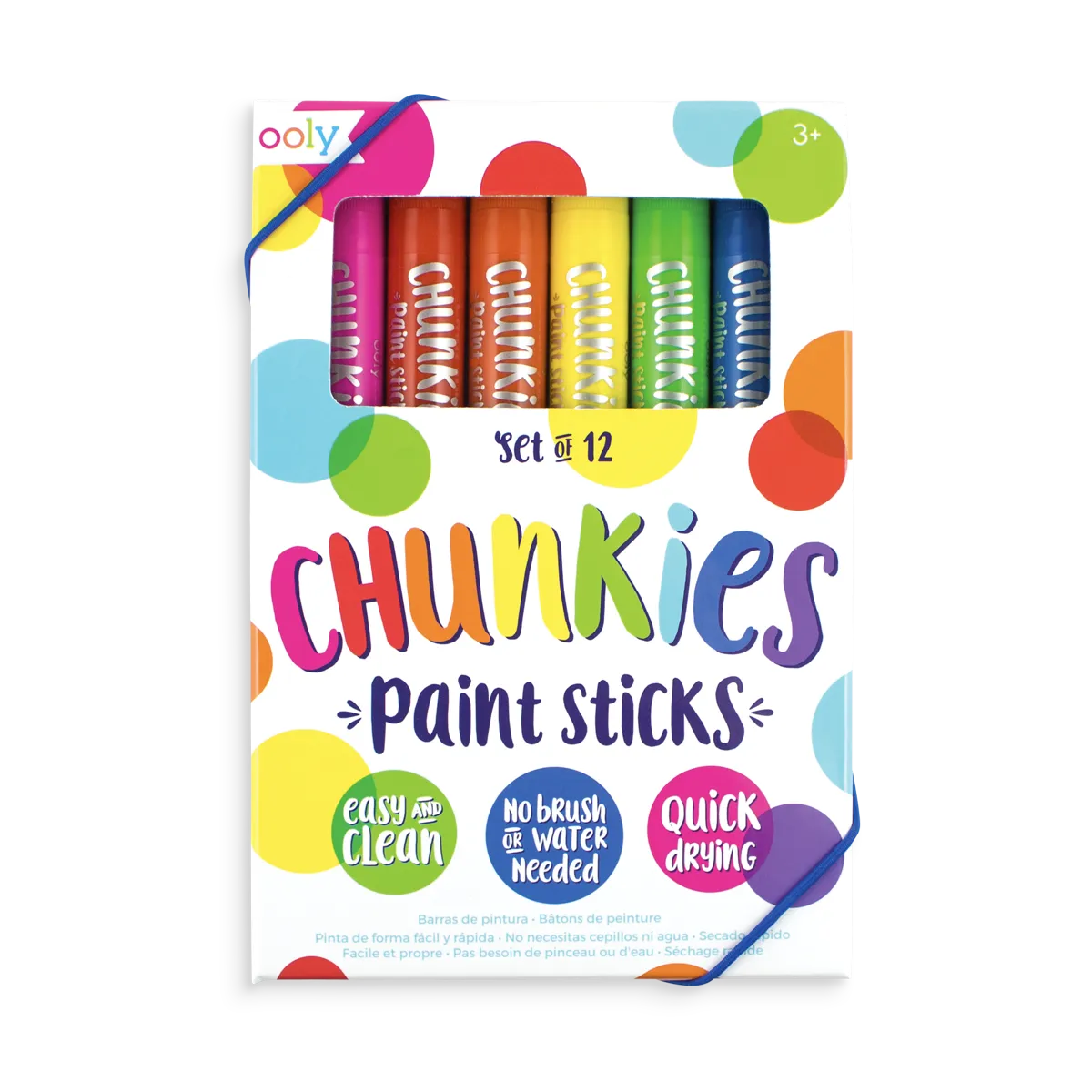
The 5+ age rating is reasonable. Children under 5 can physically use watercolors, but the fine motor control required for brush-and-pan watercolor painting (wet the brush, load the color, apply to paper, rinse the brush, repeat) exceeds most three- and four-year-olds’ patience. For younger children, paint sticks or finger paint provide a more appropriate entry to the medium.
At the upper end, the Arteza set remains useful well into middle school and beyond. The pigments are good enough for intermediate techniques — wet-on-wet, dry brush, salt texture, masking — that older children and teens can grow into. It’s not professional quality, but it’s not pretending to be.
The sweet spot is 5-9: old enough for brush control, young enough to benefit from the expanded palette, and at the ideal age for creative exploration without self-consciousness about “getting it right.”
Durability: 6/10
Watercolor pans are consumables. They will be used up. The rate depends on usage intensity, but in our testing, the most-used colors (black, blue, red, yellow) showed noticeable depletion after four weeks of regular use. At this rate, heavy users will exhaust favorite colors within 2-3 months.
The 36-color range partially mitigates this — less-used colors (the earth tones, the pastels) last much longer, and children can mix favorites from available colors even after the dedicated pan is depleted. But the economics are clear: this is an $18 set that will need replacement or supplementation after a few months of heavy use. Cost-per-month for an active painter: approximately $4-6.
The case itself is durable. The plastic withstands drops and backpack compression. The hinge shows no wear after our testing period.
Value for Money: 8/10
At $18 for 36 colors, the Arteza set costs roughly $0.50 per color — significantly more than Crayola’s 8-color Washable Watercolors ($4, or $0.50/color) but dramatically less than student-grade watercolors ($25-40 for 12-24 colors). The value question is whether the step up from Crayola is worth $10-14.
Based on our testing: yes, for families with children who paint regularly. The improved pigmentation, broader color range, and superior blending produce a noticeably better painting experience. The longer session times we observed suggest that children find the results more satisfying, which creates a positive feedback loop — better materials lead to better outcomes lead to more painting lead to more practice.
For families whose children paint occasionally — a few times a month, maybe during a rainy afternoon — the Crayola set at $4-8 is perfectly adequate. The Arteza premium is justified by frequency of use.
The Evidence
The central question this review poses — “Do quality materials affect creative development?” — is more nuanced than the marketing for any art supply brand would suggest.
Material Quality and Creative Engagement
The Reggio Emilia approach to early childhood education — one of the most influential pedagogical frameworks in the world — places material quality at the center of its philosophy. Loris Malaguzzi, the founder, argued that children’s creative expression is shaped by the materials available to them, and that high-quality, open-ended materials invite deeper exploration than cheap, limited ones.1 This is a pedagogical philosophy, not an empirical finding, but it has influenced decades of early childhood practice and has some observational support.
Kolbe (2005) studied young children’s use of art materials and found that material properties — color range, pigment quality, tool responsiveness — influenced the complexity and duration of children’s creative engagement.2 Children given more responsive materials (paints that blended smoothly, colors that appeared vibrant) produced work with more detail and spent more time on individual pieces. The study was observational and small, but the pattern aligns with what we saw in our testing.
The Self-Efficacy Connection
Bandura’s self-efficacy theory offers a useful framework for understanding why material quality might matter.3 Self-efficacy — the belief that one can successfully accomplish a task — is built through mastery experiences. When a child paints with materials that produce visible, satisfying results, the experience reinforces her belief that she can paint. When the materials are unresponsive — pale, streaky, frustrating — the experience may undermine that belief, regardless of the child’s actual ability.
This is speculative, but it matches a pattern we observed in testing: children who produced paintings they were proud of (more common with the Arteza set) were more likely to initiate painting again the next day. Children whose paintings looked washed-out and disappointing (more common with budget paints) were less enthusiastic about returning to the activity. The materials didn’t determine the child’s creative potential, but they influenced whether the child encountered a success experience or a frustration experience.
Process vs. Product in Children’s Art
The dominant view in early childhood art education is that process matters more than product — that the value of art-making lies in the doing, not the result.4 This is sound advice and a necessary corrective to the adult tendency to evaluate children’s art by adult standards. But there’s a tension: if the process is the point, does material quality matter?
We think the answer is yes, but not for the reason you’d expect. Better materials don’t produce “better” children’s art (that’s a meaningless concept). Better materials produce more responsive creative experiences — the paint does what the child intends, the colors look like what she imagined, the blending works the way she hoped. Responsiveness keeps children in the creative process longer and encourages experimentation. Poor materials create a gap between intention and result that can be discouraging, particularly for children ages 5-8 who are becoming self-aware about the quality of their work.
The honest summary: There is no randomized controlled trial showing that Arteza watercolors produce better developmental outcomes than Crayola. The research that exists — Reggio Emilia philosophy, Kolbe’s observational work, self-efficacy theory — collectively suggests that material quality influences creative engagement, duration, and satisfaction. This is Emerging evidence: directionally compelling but far from conclusive.
Safety Notes
The Arteza Kids Watercolor Paint Set is ACMI (Art & Creative Materials Institute) certified non-toxic and meets ASTM D-4236 standards. The paints are safe for skin contact during normal use. No heavy metals, no harmful solvents.
Practical safety notes:
- Not for oral use. Watercolors are not edible, and the higher pigment density in the Arteza set means accidental ingestion is more concerning than with washable formulas. For children who still put art supplies in their mouths, washable watercolors are the safer choice.
- Staining risk. The Arteza pigments are more staining than Crayola’s washable formula. Protect surfaces with newspaper or a vinyl placemat. An art smock protects clothing.
- Water spills. Watercolor painting requires a water cup. Spills are inevitable. A no-spill water cup ($6, see accessories) is a worthwhile investment.
- Brush splinters. The included brush can shed bristles. If bristles are ingested by young children, they pose a minor choking risk. Replace the included brush with a quality alternative.
The Verdict
The Arteza Kids Watercolor Paint Set is a thoughtful product that sits in a neglected space: better than drugstore, cheaper than art store, designed for children who are old enough to notice the difference. The 36-color range, decent pigmentation, and built-in mixing palette make it a genuine upgrade over the Crayola sets that dominate most household art supplies.
Does material quality affect creative development? The evidence says: probably, in the direction of more engagement, more experimentation, and more satisfaction with results. It doesn’t say that a $18 paint set will make your child a better artist. It suggests that responsive materials keep children in the creative process longer, and time-in-process is where development happens.
The product’s main weakness is the included brush, which should be replaced immediately, and the washability trade-off — Crayola remains the champion of paint-that-comes-out-of-everything. For families who paint regularly and want their children’s artistic experiences to be more satisfying and more varied, the $10-14 premium over Crayola is well spent.
Product Rating: 7/10 — A solid mid-range paint set that meaningfully improves on budget alternatives. The included brush and slightly reduced washability prevent a higher score.
Evidence Rating: Emerging — Pedagogical frameworks and observational research support the role of material quality in creative engagement. Causal evidence for specific developmental outcomes is limited.
Who Should Buy This
- Families with children ages 5-10 who paint regularly (weekly or more)
- Parents looking for a meaningful upgrade from Crayola without spending art-store prices
- Gift-givers pairing with watercolor paper and quality brushes for a complete art kit
- Teachers or art program leaders seeking a cost-effective step up in material quality
- Children who have expressed frustration with pale, unresponsive budget watercolors
Who Should Skip This
- Families with children under 5 (paint sticks or finger paint are more appropriate entry points)
- Parents for whom washability is the absolute top priority (stick with Crayola Washable)
- Occasional painters (a few times a month) — the Crayola set at $4-8 is fine for casual use
- Anyone expecting professional results — this is a kids’ set, positioned between beginner and student grade
- Families considering the Crayola vs. Faber-Castell comparison — read that first, as it addresses the quality-vs-price question in depth
This review reflects our independent evaluation. ScienceBasedKids.com purchased this product at retail price. We may earn a commission if you purchase through our links, which helps fund our research. This never influences our ratings.
Footnotes
-
Edwards, C., Gandini, L., & Forman, G. (Eds.). (2012). The Hundred Languages of Children: The Reggio Emilia Experience in Transformation. 3rd ed. Santa Barbara, CA: Praeger. ↩
-
Kolbe, U. (2005). It’s Not a Bird Yet: The Drama of Drawing. Byron Bay, Australia: Peppinot Press. ↩
-
Bandura, A. (1997). Self-Efficacy: The Exercise of Control. New York: W.H. Freeman. ↩
-
Kohl, M. A. F. (2008). First Art for Toddlers and Twos: Open-Ended Art Experiences. Beltsville, MD: Gryphon House. ↩
Enjoyed this review? We publish two new evidence-based evaluations every week.
Free. No spam. Unsubscribe anytime.
Higher pigment density means more vibrant results with less water; smoother application means fewer dry streaks and better blending. Washability is the one dimension where Crayola excels.
Recommended Accessories
Affiliate links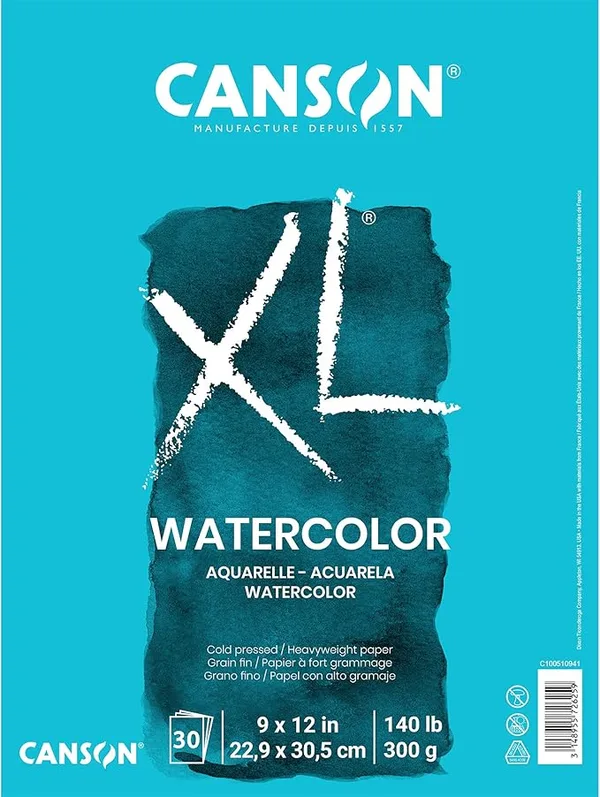
Canson XL Watercolor Pad (9x12, 30 Sheets, 140 lb)
“Proper watercolor paper prevents buckling and bleeding. Essential for real watercolor results.”
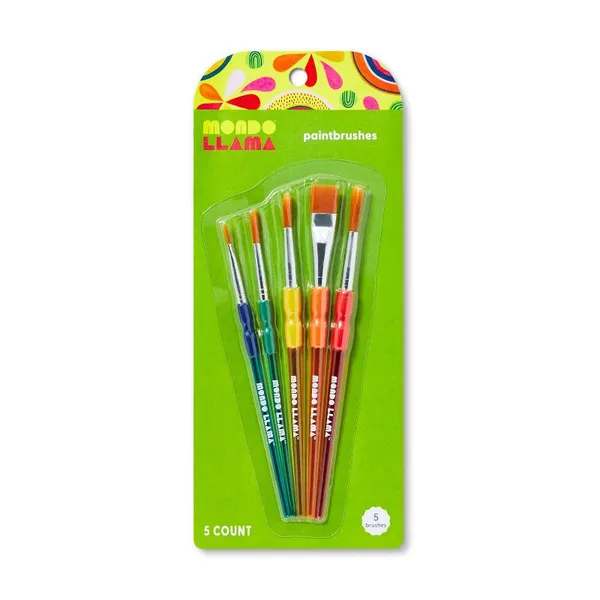
ARTEGRIA Watercolor Brush Set (Sizes 2, 4, 6, 8)
“Quality brushes make more difference than quality paint. Four sizes covers most techniques.”
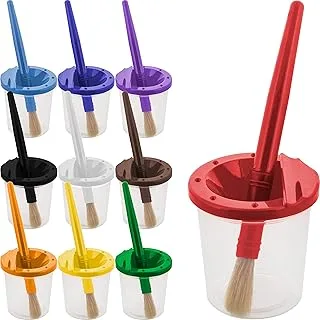
U.S. Art Supply No Spill Paint Cups with Colored Lids (10-Piece)
“Prevents the inevitable watercolor water spill. A $6 investment that saves hours of cleanup.”
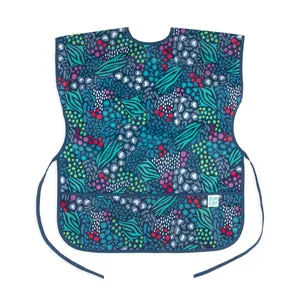
Bumkins Short Sleeve Waterproof Art Smock
“Watercolor is wet and messy by nature. Smock removes friction for creative freedom.”
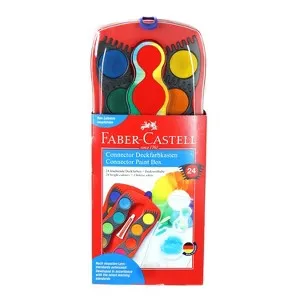
Faber-Castell Connector Paint Box (24 Watercolors)
“European-quality alternative watercolor set. Comparison fodder for the Crayola vs FC article.”