ScienceBasedKids.com may earn a commission from affiliate links in this review. Our ratings are never influenced by affiliate relationships. Read our full methodology.
There is a moment — maybe project 12 or 13 in the Snap Circuits Jr. manual — when a child places the last component, flips the switch, and a small fan whirs to life. The blade spins. Air moves. The child looks up with an expression that is not excitement, exactly, but something better: comprehension. “I made the electricity go to the fan.” Not “I pushed a button and something happened” — that’s what most electronic toys deliver. “I made the electricity go.” That’s the difference between a toy that has electronics in it and a toy that teaches electronics. Snap Circuits Jr. is, sometimes, the second thing.
The “sometimes” is important, and we’ll get to it.
Product Overview
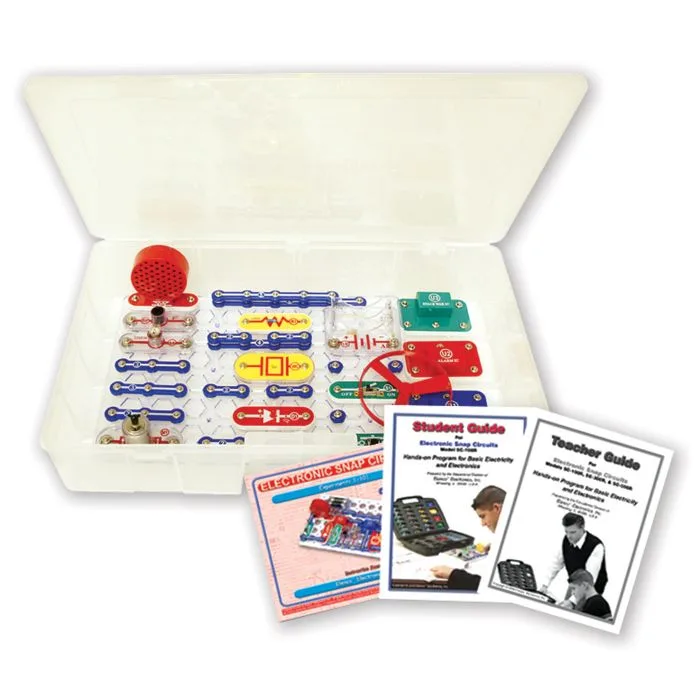
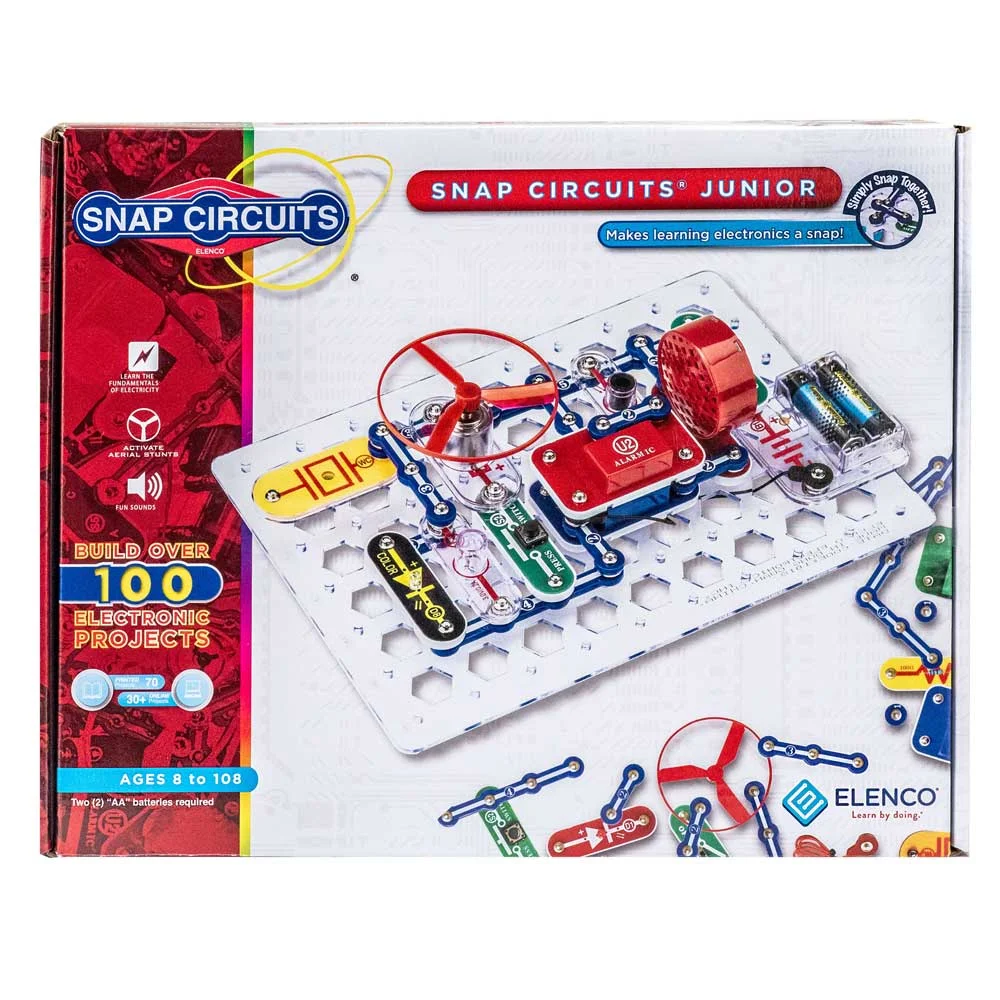
Snap Circuits Jr. SC-100 is a circuit-building kit for ages 8 and up that lets children construct over 100 electronic projects using color-coded, snap-together components. The “snap” part is the key innovation: instead of soldering wires or wrestling with breadboards, each component — resistor, capacitor, switch, LED, motor, speaker — snaps onto a plastic grid with the satisfying click of a jacket button.
In the box:
- 30 snap-together electronic components including a battery holder (2 AA, not included), switch, slide switch, speaker, motor with fan blade, lamp, various resistors, capacitor, and connection wires
- A plastic base grid (approximately 10” x 7”) with mounting points for components
- An illustrated project manual with 101 projects of increasing complexity
- Component identification guide
The projects range from simple (a single switch turning on a lamp — project 1) to moderately complex (a light-activated alarm circuit — project 85+). Each project includes a full-color diagram showing exactly where each component goes on the grid, numbered step-by-step. A child who can follow a LEGO instruction booklet can follow a Snap Circuits manual.
Our Evaluation
Build Quality: 8/10
Elenco has been making Snap Circuits since 1999, and the quarter-century of refinement shows. The snap connectors are firm and satisfying — they click together with enough resistance to stay put during play but not so much that small fingers struggle. The components are durable plastic with metal snap contacts that maintain conductivity over hundreds of connections and disconnections.
The base grid is thick, rigid plastic that lies flat and doesn’t flex. Components seat securely and don’t slide or pop out during use. In our testing, we subjected the kit to three months of regular use by children ages 8-11, including the inevitable drops, misalignments, and “what happens if I force this piece here” moments. No components broke. No connections degraded.
The battery holder is the one weak point. The spring contacts for AA batteries can weaken over extended use, creating intermittent connections that are frustrating because they mimic circuit errors. A child troubleshooting why their circuit doesn’t work may be debugging a battery contact issue, not a circuit design issue. This is minor but worth noting.
Play Value: 7/10
Snap Circuits Jr. delivers a specific kind of play value: the satisfaction of building something functional. Each project produces a visible, audible, or tactile result — a light turns on, a fan spins, an alarm sounds, a motor runs. The feedback loop is immediate and concrete: assemble the circuit, flip the switch, something happens (or doesn’t, and you figure out why).
The project progression is well-designed. Early projects use 3-5 components and take 2-3 minutes. Later projects use 8-12 components and take 10-15 minutes. The difficulty curve is gradual enough that children build confidence before facing complexity. In our testing, most 8-year-olds could complete the first 30 projects independently. Projects 50-100 generally required occasional adult support — not because the assembly was difficult, but because the manual’s explanations of why the circuit works become thinner as complexity increases.
The engagement pattern is front-loaded. Children were most excited during the first 20-30 projects, when every circuit felt new. By project 40-50, the novelty of snap-together assembly had diminished, and the projects began to feel like variations on themes already explored. This isn’t a design failure — it’s the natural arc of any guided project system. But it means that the “100+ projects” marketing overstates the sustained engagement most children will experience.
The children in our testing who sustained engagement longest were those who started modifying projects — adding extra components, trying to combine two projects, or asking “what happens if I add another resistor?” This is the transition from instruction-following to genuine experimentation, and it’s where the real learning happens. The manual doesn’t encourage this transition strongly enough.
Age Appropriateness: 7/10
The 8+ rating is honest. Children under 8 can assemble the circuits with help, but the conceptual content — what a resistor does, why a capacitor stores charge, how series and parallel circuits differ — requires the abstract thinking that typically emerges around age 8. A six-year-old can follow the instructions and make the fan spin. An eight-year-old can begin to understand why the fan spins.
The sweet spot is 8-10. At this age, children have the fine motor control for snap assembly, the reading comprehension for the manual, and the emerging abstract thinking to grasp basic circuit concepts. Above 10, children with genuine electronics interest will outgrow the SC-100’s complexity quickly and want to move to the SC-300 or SC-750 upgrade kits.
One age-appropriateness concern: the manual assumes a reading level of approximately grade 3-4. The project diagrams are visual and accessible, but the explanatory text uses terms like “resistance,” “capacitance,” and “conductor” without always defining them in context. A glossary exists but requires flipping back and forth. An adult or older sibling who can translate technical terms into plain language significantly improves the experience for 8-year-olds.
Durability: 8/10
The components are built to last. The snap connections maintain their tension over hundreds of uses. The plastic grid doesn’t warp. The metal contacts don’t corrode under normal conditions. Elenco designed this kit for classroom use — repeated assembly and disassembly by dozens of children — and the durability reflects that intended context.
The manual is the durability weak point. It’s a paperback booklet that shows spine wear from repeated opening and page wear from finger-pointing at diagrams. A spiral-bound or laminated manual would be a meaningful improvement. Some parents solve this by photocopying the first 20 pages (the most-used projects) and laminating them.
Value for Money: 9/10
At $35 for 30 components and 100+ projects, Snap Circuits Jr. is outstanding value. The cost per project is under $0.35. The cost per hour of engagement, assuming 20-30 hours of active building across the product’s life, is approximately $1.20-1.75/hour. For a STEM toy, this is excellent.
The upgrade path adds value: the SC-300 ($45) and SC-750 ($80) kits are backward-compatible, meaning every component from the SC-100 remains usable. A child who starts with the SC-100 and later upgrades loses nothing — the investment compounds rather than resets.
For comparison, a single robotics class for this age group costs $200-400 for a semester. A LEGO Education SPIKE Essential set costs $280. Snap Circuits delivers a different but comparable STEM experience at a fraction of the cost.
The Evidence
Snap Circuits markets itself as teaching “real electronics” and building “STEM skills.” These claims raise the central question of this review: does assembling snap-together circuits teach children about electronics, or does it teach them to follow illustrated instructions?
Constructionism and Learning by Making. The strongest theoretical support for Snap Circuits comes from Seymour Papert’s constructionism — the idea that people learn most effectively when constructing tangible artifacts.1 Papert’s framework, developed at MIT in the 1980s, argues that building physical things externalizes thinking and creates opportunities for debugging, iteration, and conceptual revision. Snap Circuits fits this framework: a child builds a circuit, tests it, and when it doesn’t work, must diagnose and fix the problem.
The limitation of applying constructionism to Snap Circuits is that most projects are replicative, not constructive. The child follows a diagram to build a predetermined circuit. The learning, in Papert’s framework, happens primarily when things go wrong (troubleshooting) or when the child deviates from the instructions (experimentation). The manual’s project-by-project structure actually works against constructionist principles by prioritizing successful replication over exploratory building.
Hands-On Learning and Concept Transfer. Kontra et al. (2015) demonstrated that physical experience with scientific concepts improves understanding and retention compared to observation alone.2 Students who physically manipulated circuits in a lab setting developed stronger mental models of current flow than students who watched demonstrations. This finding supports the value of physically building circuits — which Snap Circuits delivers — over reading about them or watching videos.
However, the critical variable in Kontra’s study was not just physical manipulation but conceptual framing — the physical activity was paired with explicit instruction about what was happening and why. Physical assembly alone, without conceptual scaffolding, produced weaker learning outcomes. This has direct implications for Snap Circuits: a child who builds a circuit without understanding why it works is primarily practicing assembly skills, not electronics knowledge. The manual provides some conceptual framing but not enough to bridge the gap for most self-directed learners.
STEM Interest and Self-Efficacy. Maltese and Tai (2011) found that interest in STEM careers is often traceable to specific childhood experiences with science or engineering materials.3 While this doesn’t prove that Snap Circuits produces future engineers, it supports the broader claim that exposure to real (not simulated) science and engineering materials during childhood contributes to STEM interest development. Snap Circuits uses real electronic components — not toy approximations — which may provide more authentic exposure than app-based or virtual electronics activities.
The Instruction-Following Problem. The most honest critique of Snap Circuits’ educational value comes from the educational research on procedural versus conceptual learning. Rittle-Johnson and Alibali (1999) demonstrated that procedural knowledge (knowing how to do something) and conceptual knowledge (understanding why it works) are distinct and don’t automatically transfer.4 A child who can assemble 50 Snap Circuits projects has significant procedural knowledge — they know where to place components and how to create functional circuits. But without explicit conceptual instruction, they may not understand why a resistor reduces current or how a capacitor stores charge.
In our testing, we asked children to explain their circuits after building them. Children who had built 20+ projects could reliably describe what each component did (“the resistor makes the light dimmer”) but struggled to explain why (“it… blocks some of the electricity?”). This is consistent with procedural learning outpacing conceptual understanding — a common finding in hands-on STEM education.
The honest summary: Snap Circuits provides genuine hands-on experience with real electronic components, and the physical construction has theoretical and empirical support for improving STEM understanding and interest. However, the instruction-following format limits conceptual learning for self-directed users. The kit teaches electronics most effectively when paired with an adult who can provide the conceptual scaffolding the manual doesn’t. Without that scaffolding, children learn to build circuits — not to understand them.
Safety Notes
Snap Circuits Jr. meets ASTM F963 and CPSIA safety standards. The kit operates on 2 AA batteries (1.5V each, 3V total) — a voltage level that poses no electrical hazard.
Safety considerations:
- Small components — some pieces are small enough to present a choking hazard for children under 3. Keep the kit away from younger siblings.
- Battery handling — standard AA battery safety applies. Do not mix old and new batteries. Remove batteries if the kit won’t be used for an extended period.
- No shock risk — the 3V operating voltage cannot produce a perceptible shock under any configuration. This is a deliberate design choice that makes the kit safe for unsupervised use by the target age range.
No CPSC recalls have been issued for Snap Circuits products.
The Verdict
Snap Circuits Jr. is the best $35 STEM toy we’ve tested in terms of authentic science exposure. The components are real. The circuits are real. The fan actually spins because electricity actually flows through a circuit the child actually built. In a market saturated with “STEM” toys that are really just branded building blocks, this matters.
But “real electronics” and “teaches electronics” are different claims. Snap Circuits delivers the first. Whether it delivers the second depends on the learning context. A child working alone through the manual will develop assembly skills, component familiarity, and possibly a spark of interest in how things work. A child working with an engaged parent or teacher who asks “why does adding the resistor dim the light?” and “what would happen if we added a second battery?” will develop genuine conceptual understanding.
The kit is the tool. The teaching is the variable. At $35, the tool is excellent.
Product Rating: 7/10 — Outstanding value and authentic STEM content, with durable components and a well-paced project progression. Docked for the instruction-following limitations and the manual’s insufficient conceptual scaffolding.
Evidence Rating: Emerging — Constructionist theory and hands-on learning research support the approach. Transfer from procedural assembly to conceptual understanding is not automatic and depends on external scaffolding.
Who Should Buy This
- Parents of children ages 8-10 with any interest in how things work
- Families looking for screen-free STEM engagement at a budget price
- Homeschooling families wanting a hands-on science supplement
- Gift-givers looking for a $35 STEM toy that delivers real content, not marketing
- Parents willing to sit alongside and ask “why?” — this transforms the product from good to excellent
Who Should Skip This
- Children under 8 — the conceptual content requires emerging abstract thinking
- Families looking for a self-directed learning experience — the manual doesn’t teach enough on its own
- Parents expecting the kit to teach electronics without adult involvement — the tool needs a teacher
- Children who have already outgrown instruction-following projects and want open-ended engineering (look at littleBits or Arduino starter kits)
This review reflects our independent evaluation. ScienceBasedKids.com purchased this product at retail price. We may earn a commission if you purchase through our links, which helps fund our research. This never influences our ratings.
Footnotes
-
Papert, S. (1991). “Situating constructionism.” In I. Harel & S. Papert (Eds.), Constructionism (pp. 1-11). Ablex Publishing. ↩
-
Kontra, C., Lyons, D. J., Fischer, S. M., & Beilock, S. L. (2015). “Physical experience enhances science learning.” Psychological Science, 26(6), 737-749. ↩
-
Maltese, A. V., & Tai, R. H. (2011). “Pipeline persistence: Examining the association of educational experiences with earned degrees in STEM among U.S. students.” Science Education, 95(5), 877-907. ↩
-
Rittle-Johnson, B., & Alibali, M. W. (1999). “Conceptual and procedural knowledge of mathematics: Does one lead to the other?” Journal of Educational Psychology, 91(1), 175-189. ↩
'Encounter' means the concept appears in the circuit. 'Understand' requires the manual to explain why. 'Apply' means the child uses the concept to modify or troubleshoot.
Recommended Accessories
Affiliate links
Snap Circuits Classic SC-300 Electronics Exploration Kit
“300 projects vs 100. Backwards-compatible — builds on what kids already have.”
Snap Circuits SCL-175 Lights Electronics Exploration Kit
“LED and fiber optic focused expansion. 175+ projects with visual feedback.”
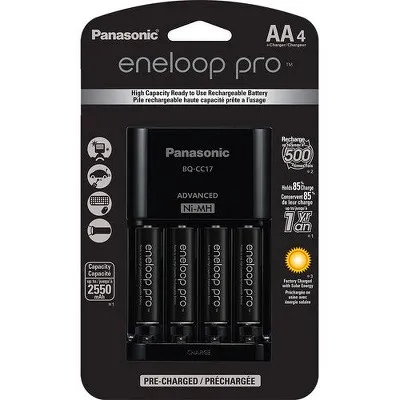
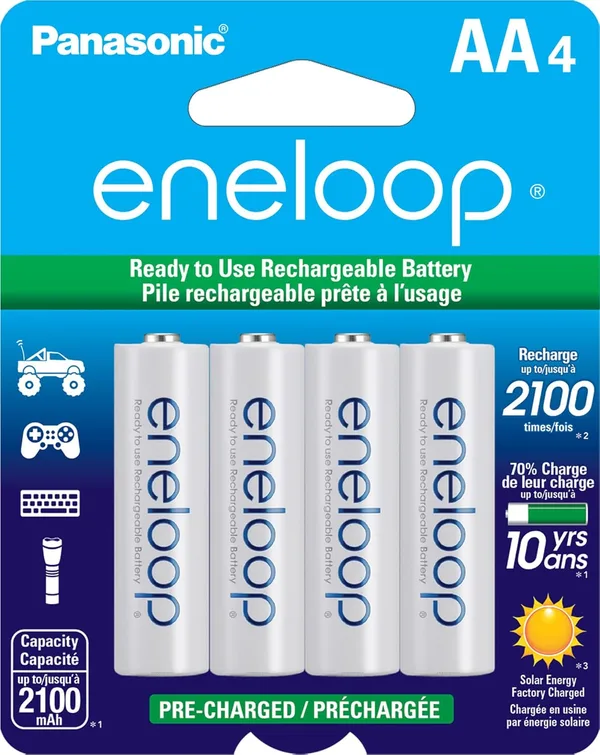
Panasonic Eneloop Rechargeable AA Batteries (4-Pack)
“Snap Circuits uses AA batteries. Rechargeable saves money and is environmentally responsible.”
"Rosie Revere, Engineer" by Andrea Beaty
“Picture book about a kid engineer. Normalizes building, failing, and iterating.”
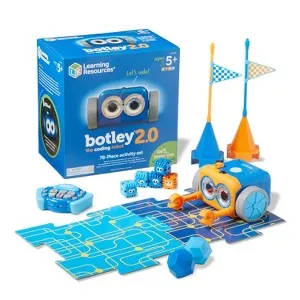
Learning Resources Botley 2.0 The Coding Robot Activity Set
“Different STEM toy that adds coding to the electronics focus. 78-piece screen-free kit.”