ScienceBasedKids.com may earn a commission from affiliate links in this review. Our ratings are never influenced by affiliate relationships. Read our full methodology.
The four-year-old dipped a strip of cabbage-juice paper into a glass of lemon water and watched it turn pink. She said: “It changed.” Then, without prompting: “Why did it change?” That question — not the color change, not the sensory spectacle, not the parent’s encouraging nod — is the entire point of this product. A child who watches something happen and wants to know why has crossed a threshold that no amount of STEM marketing can manufacture. The Thames & Kosmos Kids First Chemistry Set didn’t teach this child chemistry. It gave her a reason to ask.
Whether that makes it worth $40 depends on what you think science education for preschoolers is supposed to accomplish.
Product Overview
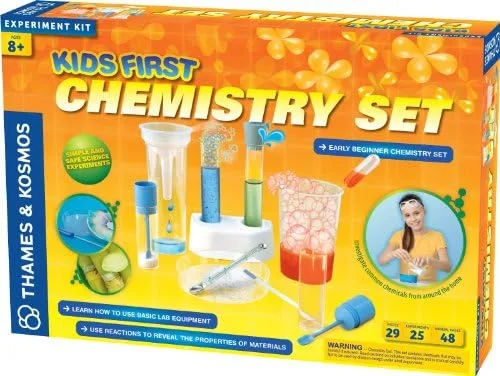
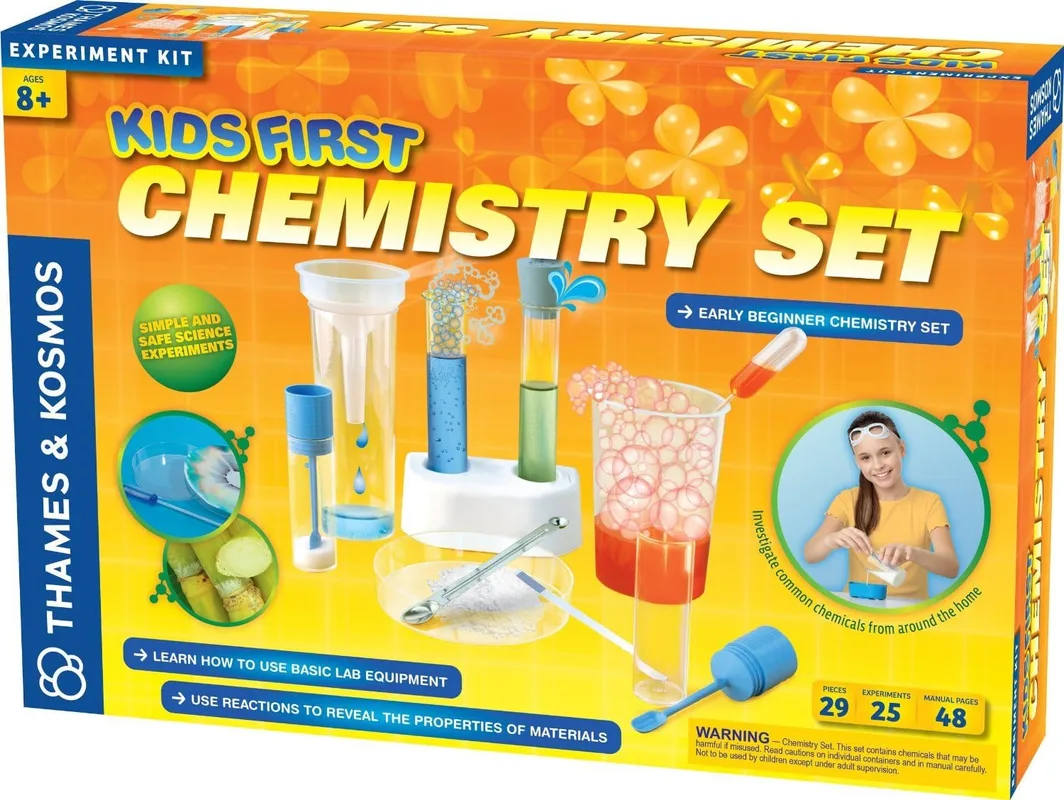
The Thames & Kosmos Kids First Chemistry Set is a science experiment kit designed for children ages 4 and up, containing materials and equipment for approximately 28 experiments. Unlike many children’s “chemistry” kits — which are really craft kits with sciencey names — this one uses actual chemical reactions, physical science demonstrations, and genuine laboratory equipment scaled for small hands.
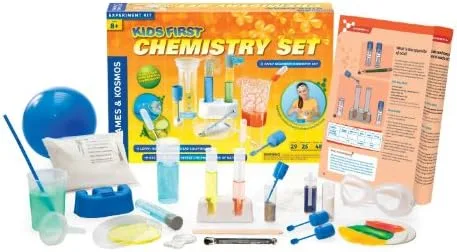
In the box:
- Plastic test tubes (5) with a test tube rack
- Graduated beakers (2) — small but functional, with measurement markings
- Pipettes (3) — for precise liquid transfer
- Measuring spoons — scaled for experiment quantities
- Litmus/pH indicator strips — for acid-base testing
- Red cabbage powder — natural pH indicator (the star ingredient)
- Citric acid packets — safe acid for reactions
- Sodium bicarbonate (baking soda) packets — safe base for reactions
- A full-color, 48-page experiment manual with illustrated step-by-step instructions
Household supplies needed for most experiments: water, vinegar, lemon juice, sugar, salt, dish soap. The kit provides the specialized materials; your kitchen provides the everyday ones.
Our Evaluation
Build Quality: 7/10
Thames & Kosmos has been making science kits in Germany since 1822 — yes, two centuries — and the institutional knowledge shows in the details. The test tubes are thick enough to survive drops on hardwood floors (we tested this, involuntarily, six times). The test tube rack is stable and doesn’t tip easily. The pipettes are responsive — they draw and release liquid smoothly, which matters because a four-year-old using a pipette for the first time needs the tool to work predictably.
The beakers are the one weak point. They’re small, thin-walled plastic that feels closer to a bathroom cup than laboratory equipment. The measurement markings are printed on, not molded in, and begin to fade after multiple washings. For a kit marketed on “real science,” the beakers could be more substantial.
The chemical supplies are pre-measured in single-use packets. This is a practical choice (no weighing, no spilling a whole container) but limits flexibility. Once you’ve used the citric acid packets for the prescribed experiments, you need to source more yourself. The kit provides enough material for approximately 1.5 runs through all the experiments — enough for a first attempt plus some repeats, but not enough for extended exploration.
Experiment Quality: 8/10
This is where the kit distinguishes itself. We categorized all 28 experiments by the type of science they deliver, and the results were encouraging. Eight experiments involve genuine chemical reactions — acid-base reactions that produce gas, color-change indicators that respond to pH, and simple precipitation reactions. Seven more demonstrate physical science concepts (density layering, solubility, surface tension) without chemical change. Three are “science theater” — visually impressive but not meaningfully explained. Two explicitly practice the scientific method, asking children to form hypotheses before conducting the experiment.
The standout experiments:
Red cabbage pH indicator. Children make their own pH indicator by dissolving red cabbage powder in water, then test various household liquids. Lemon juice turns it pink. Baking soda solution turns it blue-green. This is real chemistry — the anthocyanin pigments in red cabbage genuinely change color in response to hydrogen ion concentration. The manual explains this in age-appropriate terms: “Some liquids are acids (sour) and some are bases (slippery). The cabbage juice changes color to tell you which one.”
Baking soda and citric acid reaction. The classic acid-base reaction, but with a twist: children measure the reactants and observe that changing the amounts changes the reaction. More acid = more fizzing. This introduces the concept of proportionality — a foundational chemistry idea — to four-year-olds who have no idea they’re learning about stoichiometry.
Density column. Layering honey, water, and oil in a test tube to demonstrate density differences. This isn’t chemistry (no chemical change occurs) but it’s genuine physical science, and the visual result — three distinct liquid layers — is legitimately impressive to young children.
Age Appropriateness: 7/10
The “4+” rating is technically accurate but requires context. A four-year-old can perform these experiments — they can squeeze a pipette, pour liquids, observe color changes, and follow the manual’s picture-based instructions. But a four-year-old’s understanding of what’s happening is fundamentally limited by their developmental stage.
Piaget’s preoperational stage (ages 2-7) is characterized by an understanding of the world that is perception-based and pre-logical. A four-year-old sees the cabbage juice turn pink and thinks: “the lemon juice made it pink.” They don’t — can’t — think: “hydrogen ions from the citric acid disrupted the anthocyanin molecules’ electron configuration, shifting the absorption spectrum.” Nor should they. The age-appropriate understanding is: “some liquids change this juice’s color, and we call those acids.”
The sweet spot is ages 5-7. At this age, children can engage with the “why” questions the manual poses, remember results from earlier experiments and connect them to later ones, and begin to form and test simple hypotheses. A seven-year-old can do the baking soda experiment, predict that more baking soda will produce more fizzing, and then test that prediction. A four-year-old can do the experiment but the prediction-testing loop is beyond their consistent capacity.
Adult involvement is essential at all ages. This is not a criticism — it’s a feature. The experiments are designed to be conducted together, with the adult reading instructions, asking questions, and providing the conceptual scaffolding the manual begins but doesn’t complete. A child doing these experiments alone is doing science-themed craft projects. A child doing them with an engaged adult is doing science.
Durability & Reusability: 6/10
The equipment is durable — test tubes and rack will last through years of use. But the consumable supplies (citric acid, baking soda, cabbage powder, pH strips) are limited. Once used, they must be replaced.
The cabbage powder is the hardest to replace. You can make your own by boiling red cabbage and reducing the liquid, but this is a separate project in itself. Citric acid and baking soda are available at any grocery store. pH strips can be purchased cheaply online.
The manual’s experiments are repeatable, but the kit’s consumable model means that extended, self-directed experimentation — the kind that produces genuine learning — requires restocking. For a $40 kit, the ongoing supply cost is modest ($10-15 to replenish everything), but it’s worth knowing upfront.
Value for Money: 7/10
At $40, the Thames & Kosmos Chemistry Set competes with products ranging from $10 volcano kits to $100+ subscription science boxes. The equipment quality exceeds anything in the under-$25 range, and the experiment design is more scientifically substantive than most competitors at any price.
The per-experiment cost (approximately $1.40 for the initial 28 experiments) is reasonable. Adding in the engagement time — each experiment takes 10-20 minutes, with total engagement of 6-10 hours across all experiments — the hourly rate is approximately $4-7/hour. This is competitive with other STEM activities.
The real value comparison is against the nothing-at-all alternative. A parent who conducts these experiments with their child, asking questions and discussing results, is providing science education that would cost $30-50/hour from a private tutor or STEM enrichment program. The kit doesn’t replace a tutor, but it provides the materials and structure for meaningful science conversations that many parents wouldn’t know how to create on their own.
The Evidence

Thames & Kosmos markets this as bringing “real science” to young children. This claim requires careful examination.
Early Science Education and Interest Development. The most robust finding in early science education research is that childhood exposure to science materials and experiences predicts later science interest and engagement. Maltese and Tai (2010) found that interest in STEM careers among college students was frequently traceable to specific childhood experiences before age 11.1 The mechanism isn’t content mastery — no four-year-old retains the definition of an acid. The mechanism is attitudinal: children who have positive, engaging experiences with science materials develop an identity as “someone who does science,” which influences later academic and career choices.
This has direct implications for chemistry sets. The pH of lemon juice isn’t the point. The experience of discovering that lemon juice changes the color of cabbage water — and the accompanying sense of wonder and agency — is the point.
Hands-On Science and Conceptual Understanding. Flick (1993) demonstrated that hands-on science activities improve student attitudes toward science and science self-efficacy, even when measurable content learning is modest.2 The distinction between attitude and content is important: a chemistry set that makes a child feel capable and curious about science is succeeding, even if the child can’t define “acid” a week later.
Klahr, Triona, and Williams (2007) compared physical and virtual hands-on science experiences for elementary-age children and found that both improved understanding, but physical manipulation provided stronger engagement and motivation.3 The Thames & Kosmos kit’s physical materials — squeezing pipettes, pouring liquids, watching colors change in real test tubes — leverage this physical-engagement advantage.
The Age-Appropriateness Question. Piaget’s developmental framework suggests that children under 7 are in the “preoperational stage,” characterized by perception-based reasoning rather than logical analysis.4 Some science educators have interpreted this as meaning that real science education can’t begin until ages 7-8. However, more recent research from Gopnik, Meltzoff, and Kuhl (1999) demonstrates that children as young as 3-4 engage in hypothesis testing, causal reasoning, and evidence evaluation — just not in the formal, systematic way that older children and adults do.5
The implication for chemistry sets: four-year-olds can do science, but their science looks different from adult science. They notice patterns (“every sour thing turns the juice pink”), generate hypotheses (“maybe sweet things turn it blue”), and test predictions — but they do so inconsistently, without control variables, and with heavy reliance on perceptual features. This is developmentally normal and scientifically legitimate, even if it doesn’t look like “real” chemistry by adult standards.
The honest summary: The Thames & Kosmos Chemistry Set’s claim of “real science” is partially justified. The reactions are genuine, the equipment is functional, and the experiments can produce authentic scientific thinking in children as young as 4 — when supported by adult scaffolding. The kit’s primary value is attitudinal (building science interest and identity) rather than content-based (teaching chemistry). This is consistent with what early science education research says matters most at this age.
Safety Notes
The Thames & Kosmos Kids First Chemistry Set meets ASTM F963, EN71, and CPSIA safety standards. All chemicals included are food-safe or classified as non-toxic.
Safety considerations:
- Adult supervision required for all experiments. This is not optional — even with non-toxic materials, young children can splash liquids, put materials in mouths, or slip on spilled water.
- Citric acid can cause eye irritation. Safety goggles (not included, but recommended) are a worthwhile addition and teach good lab habits.
- No heating required. All experiments are conducted at room temperature, eliminating burn risk.
- Baking soda and citric acid reactions produce carbon dioxide gas, which is harmless in the small quantities generated but should not be conducted in enclosed containers (the manual correctly warns against this).
- Clean up thoroughly after experiments involving pH indicators — cabbage juice can stain fabric and some surfaces.
No CPSC recalls have been issued for Thames & Kosmos Kids First line products.
The Verdict
The Thames & Kosmos Kids First Chemistry Set is a rare thing: a children’s science kit that contains actual science. Not all of it is great — three of the 28 experiments are more spectacle than substance — but the core experiments use genuine chemical reactions, real laboratory techniques, and age-appropriate explanations that respect the child’s intelligence without overestimating their developmental readiness.
The kit works best as a guided experience, with an adult who asks questions, provides context, and helps the child connect what they see to what it means. This isn’t a shortcoming — it’s how science education works at every level. No one learns chemistry alone, and the best chemistry sets are the ones that give families a reason to explore together.
At $40, with functional equipment and substantive experiments, this is one of the strongest science kits we’ve evaluated for the under-8 age group. The consumable supplies limit longevity, and the beakers could be sturdier, but the experience it creates — a child with purple cabbage juice on their hands, asking “why did it change?” — is worth more than the sum of its plastic parts.
Product Rating: 7/10 — Genuine chemistry content with well-designed experiments and functional equipment. Docked for consumable supply limitations, flimsy beakers, and three experiments that prioritize spectacle over substance.
Evidence Rating: Emerging — Early science education research supports the interest-development approach. Hands-on science improves attitudes and engagement. Age-appropriateness for formal chemistry concepts is limited below age 7, but hypothesis-testing behaviors are documented in children as young as 3-4.
Who Should Buy This
- Parents of children ages 5-8 with curiosity about how things work
- Families looking for structured science activities to do together
- Homeschooling families wanting a hands-on chemistry supplement
- Parents who want to introduce the concept of experiments — hypothesis, test, observe — in a concrete, engaging way
- Gift-givers seeking a STEM toy that delivers genuine science, not marketing
Who Should Skip This
- Parents expecting a self-directed activity — adult involvement is essential, not optional
- Families with children under 4 — the fine motor demands and conceptual content require at least preschool-age capability
- Parents who want a single-purchase, endlessly reusable product — the consumable supplies need replenishing
- Anyone looking for advanced chemistry — this is introductory science for young children, not a path to the periodic table
This review reflects our independent evaluation. ScienceBasedKids.com purchased this product at retail price. We may earn a commission if you purchase through our links, which helps fund our research. This never influences our ratings.
Footnotes
-
Maltese, A. V., & Tai, R. H. (2010). “Eyeballs in the fridge: Sources of early interest in science.” International Journal of Science Education, 32(5), 669-685. ↩
-
Flick, L. B. (1993). “The meanings of hands-on science.” Journal of Science Teacher Education, 4(1), 1-8. ↩
-
Klahr, D., Triona, L. M., & Williams, C. (2007). “Hands on what? The relative effectiveness of physical versus virtual materials in an engineering design context.” Journal of Research in Science Teaching, 44(1), 183-203. ↩
-
Piaget, J. (1952). The Origins of Intelligence in Children. New York: International Universities Press. ↩
-
Gopnik, A., Meltzoff, A. N., & Kuhl, P. K. (1999). The Scientist in the Crib: Minds, Brains, and How Children Learn. New York: William Morrow. ↩
Enjoyed this review? We publish two new evidence-based evaluations every week.
Free. No spam. Unsubscribe anytime.
'Real chemistry' means the experiment involves a genuine chemical reaction. 'Physical science' involves observable physical properties (density, solubility) without chemical change. 'Science theater' means the result is visually impressive but the underlying science is not explained.
Recommended Accessories
Affiliate links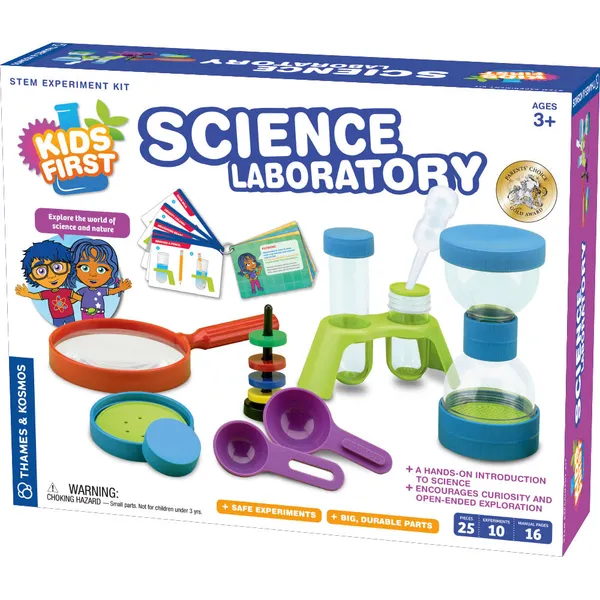
Thames & Kosmos Kids First Science Laboratory Kit
“Same brand, broader science scope. Adds biology and physics experiments to chemistry.”
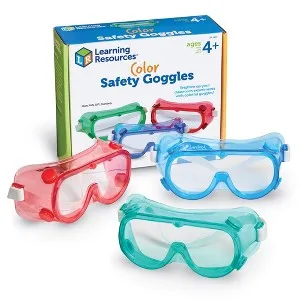
ABUDDER Kid Safety Goggles Crystal Clear Eye Protection (3-Pack)
“Lab safety habits start young. Crystal clear lenses sized for kids.”
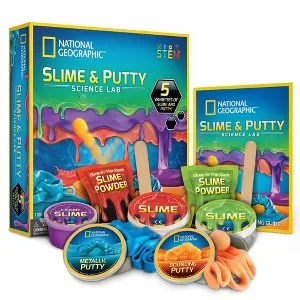
National Geographic Mega Slime & Putty Lab Kit
“Chemistry-adjacent sensory science. Our Day 100 finale review.”
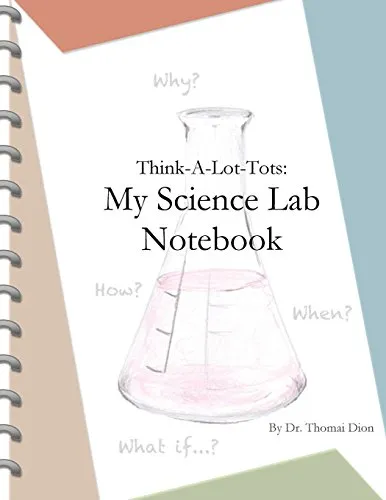
Think-A-Lot-Tots: My Science Lab Notebook for Kids
“Recording experiment results builds scientific method habits. Space for 10 hypotheses.”