ScienceBasedKids.com may earn a commission from affiliate links in this guide. Our ratings are never influenced by affiliate relationships. Read our full methodology.
How to Use This Guide
Every pick below is a product we’ve reviewed in depth — linked to the full review. Each age section includes:
- 3 primary picks — our top recommendations for this developmental window
- Gift budget notes — what to spend if the goal is one substantial gift vs several smaller ones
- Developmental framing — what children at this age can actually do and what they’ll outgrow quickly
- What to avoid — common mis-purchases for this age
Age 3
Developmental frame: A three-year-old is in the peak of symbolic play and exploratory physical interaction. Fine motor control is improving rapidly but still imprecise. Attention span for structured instruction is short (5–10 minutes); attention for self-directed play can be much longer. Language is exploding — narrative play becomes possible. They can’t yet follow multi-step instructions reliably, so any kit requiring “do step 3, then step 4” will frustrate.
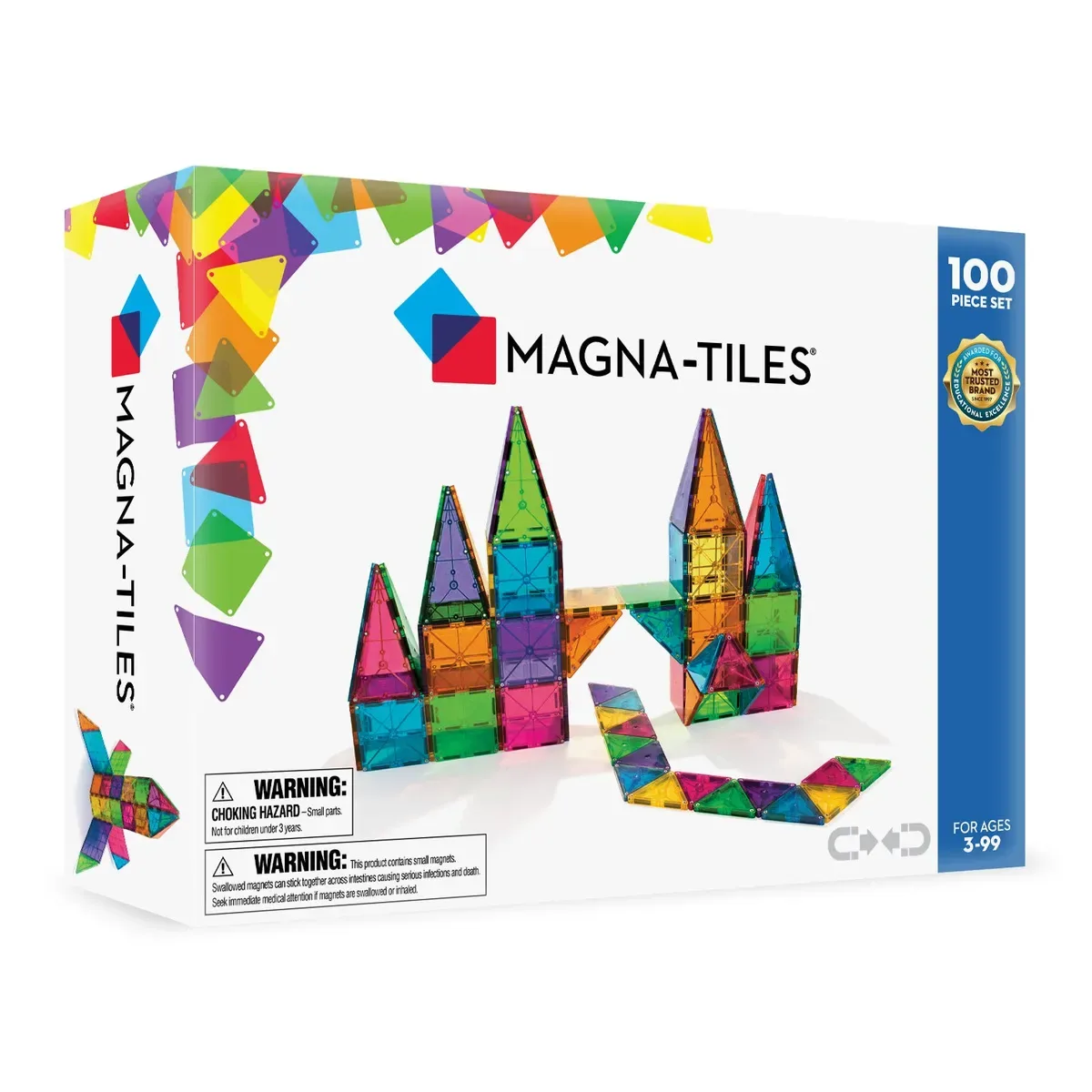
1. Magna-Tiles 100-Piece Clear Colors Set — $120
The single best three-year-old STEM purchase. Open-ended, no instructions to follow, forgiving magnetic connections, no small parts. A 3-year-old stacks tiles and knocks them down; a 5-year-old builds houses; a 7-year-old builds architectural puzzles. The same set grows with the child. Product Rating: 9/10, Moderate evidence.
2. Hape Pound & Tap Bench — $28
A classic cause-and-effect toy executed well. A three-year-old hammers wooden balls that roll down into a xylophone, producing a note. Develops grip strength, hand-eye coordination, and cause-and-effect understanding. Simpler than Magna-Tiles but complementary.
3. Melissa & Doug Shape Sorting Cube — $20
Fundamental spatial reasoning development. A three-year-old at the upper end of the age window has mostly mastered this, but a child just turning three will work on it for months. Budget-friendly and durable.
What to avoid at 3: Any “coding” toy (developmentally premature), anything with small parts (choking risk), anything requiring reading instructions, and most electronics kits (including Snap Circuits Jr, which is rated 8+ for good reason).
Age 5
Developmental frame: A five-year-old can follow simple multi-step instructions, has usable fine motor control, early reading skills, and a longer attention span for structured projects (20–30 minutes). They’re transitioning from pure exploratory play to project-completion play — the satisfaction of finishing a build becomes a real motivator. They can’t yet handle complex abstractions (like circuit diagrams) but can handle visual step-by-step guides.
1. Magna-Tiles 100-Piece Clear Colors Set — $120
Still the #1 pick. At age 5, children move from random stacking to intentional building — they start planning structures and working with symmetry. A set bought at age 3 continues paying off.
2. Rush Hour Jr. — $20
Logic puzzles that start simple and ramp up. 40 challenges of increasing difficulty. Develops planning, sequential reasoning, and the specific skill of “mental simulation” (running a move in your head before executing). A 5-year-old solves the first 10 puzzles easily and spends months working through the harder ones.
3. ThinkFun Gravity Maze — $35
Spatial reasoning puzzle that pairs physical manipulation with problem-solving. 60 challenges. At age 5, a child works on early-tier challenges with adult support; by age 7–8, they solve the harder levels independently. Long-horizon value.
What to avoid at 5: Chemistry kits marketed for 8+ (reagent handling is a real concern), “coding” apps that require reading (most are mis-calibrated for this age), anything with 100+ small parts as a single project (attention span mismatch).
Age 7
Developmental frame: A seven-year-old is typically a fluent-enough reader to work through a well-illustrated manual, has sufficient fine motor control for detailed assembly, and can sustain 30–60 minutes of focused activity. They’re capable of understanding basic abstract systems (a simple circuit, a chemical reaction) when presented concretely. They can handle “if-then” logic but are just entering the ability to handle multi-variable systems.
1. Snap Circuits Jr. SC-100 — $35
Real electronics without soldering. A 7-year-old can follow the illustrated circuit diagrams and build the first 20–30 projects with light adult scaffolding. The intrinsic feedback (the fan spins, the light turns on) is strong enough to sustain engagement. See our comparison with Classic SC-300 if you’re deciding between kits.
2. Botley 2.0 Coding Robot — $65
Screen-free introductory coding. A child programs Botley with a remote-style controller — no app, no tablet required. At 7, kids build simple programs (forward 5, turn left, forward 3) and debug why Botley didn’t end up where they expected. The debugging mental model is the valuable skill, not the specific code.
3. Osmo Little Genius Starter Kit — $80
Physical-digital hybrid for phonics, drawing, and early math. Requires an iPad (significant cost), but for families who already own one, it’s a high-value addition. Pairs well with reading practice for this age.
What to avoid at 7: Chemistry sets with “real reagents” (isopropyl alcohol, copper sulfate) — those are age-10+ even with supervision. Anything that’s mostly marketing (“educational” LEGO sets that are really just LEGO sets with themed stickers). Single-concept puzzles a child will solve in one afternoon and shelve.
Age 9
Developmental frame: A nine-year-old can follow detailed written instructions, has strong fine motor control, can handle multi-hour projects in a single session, and is capable of genuinely abstract reasoning (simple algebra, circuit theory, chemical equations at a basic level). This is where “real STEM” starts making sense — the cognitive scaffolding is there for content that isn’t just dressed-up toys.
1. Snap Circuits Classic SC-300 — $45
At 9, the Classic’s broader component set unlocks circuits the Jr. can’t build — amplification, numeric displays, sound input, light-sensitive circuits. This is where “Snap Circuits” transitions from toy to genuine electronics intro. See our head-to-head with the Jr. for the full rationale.
2. GraviTrax Starter Set — $60
Marble-run physics in expandable form. At 9, kids start engineering solutions to specific challenges (“how do I get the marble to reverse direction?”). The kit scales: start with the starter, add expansion sets over subsequent birthdays. Replay value is exceptional.
3. LEGO SPIKE Essential — $290
The serious investment pick. Programmable robotics with real sensors, motors, and visual programming. At 9, kids can start with guided projects and move into open-ended builds. LEGO’s ecosystem matters here — SPIKE Essential compounds with any LEGO collection the child already owns. Expensive but meaningful.
What to avoid at 9: Products marketed as “advanced” that are really just more complex versions of age-6 toys. Anything that requires an iPad purchase to function (check the hidden costs). “Coding robots” that only do one thing.
Age 11
Developmental frame: An 11-year-old can work through complex written instructions, reason about multi-step causal chains, handle abstract concepts with ease, and engage with subject matter at a secondary-school level if the material is calibrated for them. This is also the age where peer perception starts to matter — products that feel “young” get rejected even when the content is good.
1. Thames & Kosmos Chem C1000 (step-up from their Kids First set) — $100
Real chemistry. Dilute acids and bases (at EN 71-4 concentration caps), color-change indicators, metal-salt chemistry. 125 experiments. Requires committed adult supervision. For a chemistry-curious 11-year-old with an engaged parent, this is the right entry point to secondary-school-level content at home. Our ASTM F963 chemistry safety guide covers the full standards context.
2. GraviTrax Starter Set + expansions — $60 (starter)
Still a strong pick at 11. The replay value compounds — at this age, kids can design their own tracks without referring to manuals, iterate on “what if I add magnets here” modifications, and share builds with friends.
3. Mel Chemistry Subscription — $44.90/mo
The structured-curriculum alternative to Thames & Kosmos’s one-time kit. 18-month progression through secondary-school chemistry topics. VR app for molecular visualization. See our Mel vs T&K comparison for the decision framework.
What to avoid at 11: Anything that looks like a “toy” rather than a “tool” — at this age, packaging that reads as childish gets dismissed regardless of content quality. Products that assume a younger vocabulary (instruction manuals written at a 3rd-grade reading level feel condescending).
Age 13
Developmental frame: A 13-year-old is operating at pre-adolescent capacity — fully abstract reasoning, substantial reading stamina, real interest in “adult” content in whatever domain they care about. The developmental frame shifts here: STEM gifts become either serious entry points into a field they might pursue, or adjacent to their existing hobby (the kid who programs games already gets an Arduino kit).
1. Mel Chemistry Subscription — $44.90/mo
The curriculum-driven option remains the strongest recurring gift for a chemistry-interested teen. If they’ve done the first 6 months at age 11, the next 12 at age 13 deliver real secondary-school content.
2. Thames & Kosmos Chem C3000 — $200
The most comprehensive consumer chemistry kit on the market. 330+ experiments. Real reagents at EN 71-4 caps. A 13-year-old with prior kit experience can work through this over 12–18 months and come out with secondary-school lab chemistry fundamentals.
3. CrunchLabs Hack Pack Subscription — $25/mo
Teen-focused Arduino-style electronics monthly kit. The Mark Rober-associated brand cachet matters at this age in a way it doesn’t at younger ages. If the 13-year-old is already engineering-inclined, this is a substantive monthly stimulus. See our KiwiCo vs CrunchLabs piece for the sister-product analysis.
What to avoid at 13: Anything with “STEM” in the name that isn’t also appropriate for an adult. Most toy-aisle “coding” kits. Anything that feels like a grade-school classroom exercise.
The Gift Budget Question
$25 or less: Rush Hour Jr., Shape Sorting Cube (age 3), single book tied to a science interest. $25–$50: Snap Circuits Jr., Thames & Kosmos Kids First, ThinkFun Gravity Maze, Botley 2.0. $50–$100: Snap Circuits Classic, GraviTrax Starter Set, Thames & Kosmos C1000. $100–$150: Magna-Tiles 100, Thames & Kosmos C2000. $150+: LEGO SPIKE Essential, Thames & Kosmos C3000, Cubetto Coding Robot (age 3–6).
Cross-Age Picks Worth Knowing
A few products repeat across multiple ages because they genuinely scale:
- Magna-Tiles: Ages 3–10. The “grows with the child” winner of this guide.
- GraviTrax: Ages 8–14. Engineering that scales by adding expansion sets.
- Snap Circuits (Jr. → Classic): Ages 7–14. Start with Jr. at 7–8, upgrade to Classic at 9–10.
- Thames & Kosmos Chemistry (Kids First → C500 → C1000 → C2000 → C3000): Ages 4–16. The most complete age-progressive chemistry path available.
For families planning multi-year STEM investments, picking a “path” product and extending it (Magna-Tiles, GraviTrax, or T&K Chemistry) usually delivers better per-dollar engagement than rotating through single-use kits.
What the Research Says About Developmental Fit
The evidence on toy-child developmental fit is substantial. Bornstein and Tamis-LeMonda have documented across multiple studies that children’s sustained engagement with objects correlates with developmental-appropriateness of the object’s complexity relative to the child’s current cognitive and motor capacity.1 Toys too simple produce quick disengagement; toys too complex produce frustration and avoidance.
The practical implication for gift-buying: manufacturer age ranges are rough approximations. A child’s actual developmental stage matters more than their birth year. This is why this guide is organized by ages 3, 5, 7, 9, 11, 13 rather than by ranges — a focused age-specific recommendation is substantively different from a 5–8 or 8–12 range recommendation.
Every product recommended in this guide has been reviewed in depth by our team; links go to the full reviews where you can read our full evaluation, evidence rating, and safety notes.
Footnotes
-
Bornstein, M. H., & Tamis-LeMonda, C. S. (2010). “Parent-infant interaction.” In J. G. Bremner & T. D. Wachs (Eds.), The Wiley-Blackwell Handbook of Infant Development (Vol. 1, pp. 458–482). Wiley-Blackwell. ↩