ScienceBasedKids.com may earn a commission from affiliate links in this review. Our ratings are never influenced by affiliate relationships. Read our full methodology.
There is a developmental stage — right around twelve months — when a child’s primary research methodology becomes percussive. Everything is a drum. The couch is a drum. The dog is a drum. Your face, at 6 AM, is a drum. This is not misbehavior. This is a scientist testing hypotheses about force, material response, and auditory feedback. The Hape Pound & Tap Bench is a toy designed by people who clearly understand this: instead of fighting the impulse to hit things, they built something worth hitting. And then, quietly, they built a xylophone into the bottom of it.
That two-layer design — pounding bench on top, pull-out xylophone on the bottom — is the product’s most interesting feature. It takes a single toy and serves two developmental stages: the early toddler who is discovering that actions have consequences, and the slightly older toddler who is beginning to explore musical patterns and sound variation. Whether the xylophone constitutes meaningful “musical education” is a more complex question, but the cause-and-effect loop is airtight.
Product Overview
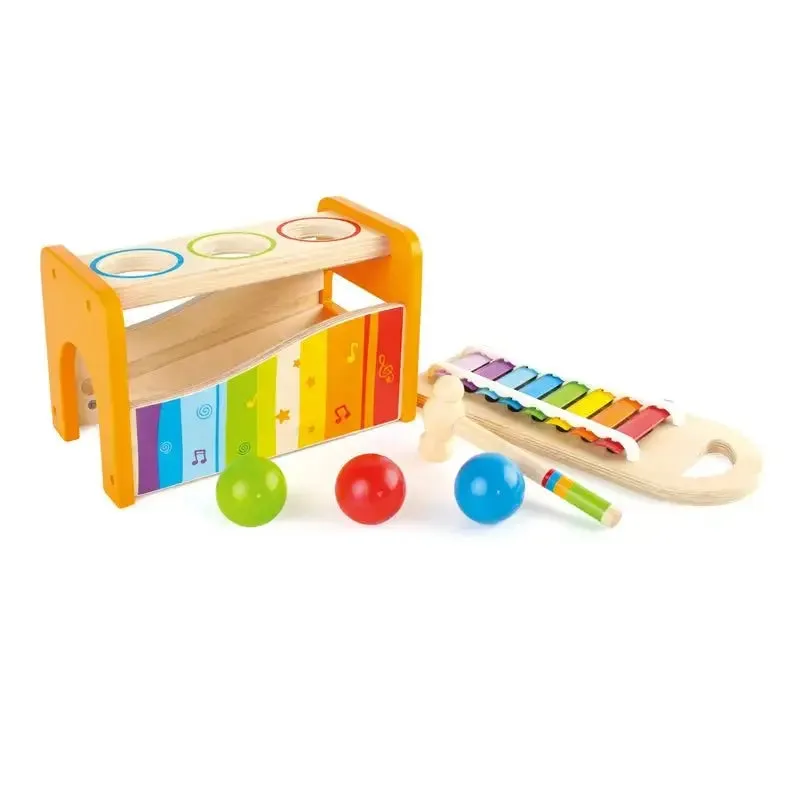
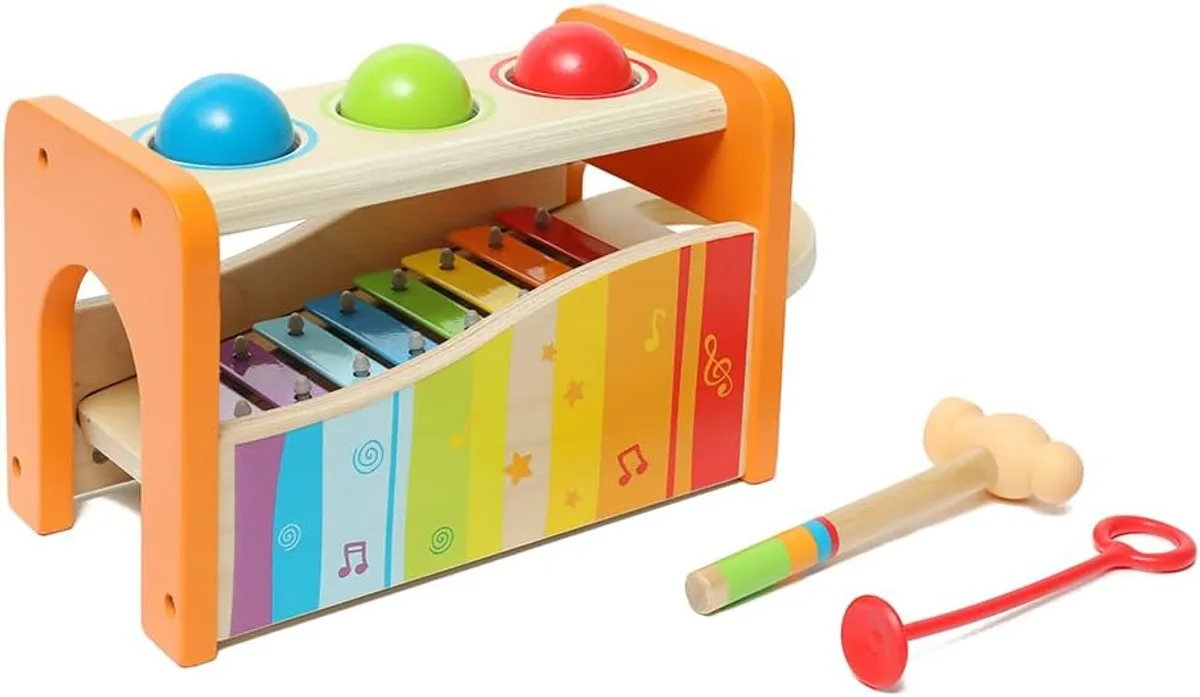
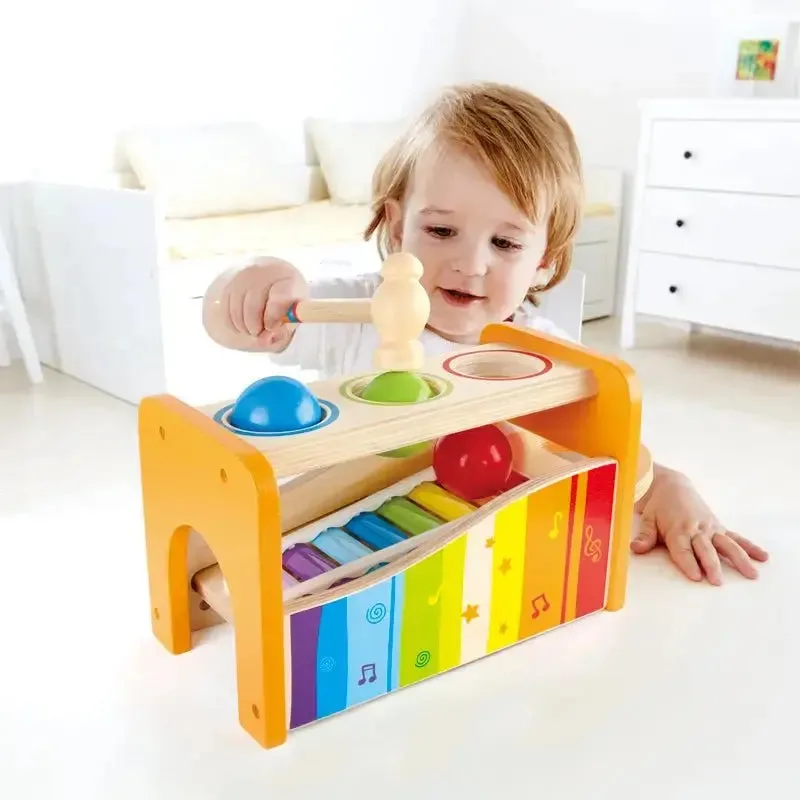
The Hape Pound & Tap Bench with Xylophone is a wooden musical pounding toy designed for children 12 months and up. The premise: a child hammers colored balls through holes in the top of the bench; the balls roll across a xylophone keyboard below, producing musical tones as they travel. The xylophone can also slide out for independent play as a standalone instrument.
In the box:
- 1 wooden bench with three ball holes and a sloped interior channel
- 3 colored wooden balls (red, yellow, blue) sized for the hammer holes
- 1 wooden mallet with a rounded head, sized for toddler grip
- 1 removable xylophone with 8 metal keys in a pentatonic scale
- 1 xylophone mallet (smaller, for direct xylophone play)
The bench is approximately 9.5” x 6” x 6.5” — substantial enough to feel stable on a table or floor, compact enough to store in a toy bin. The construction is solid hardwood with water-based paint finishes. The xylophone slides in and out from a slot at the bottom of the bench.
Our Evaluation
Build Quality: 8/10
Hape’s wooden toy manufacturing is consistently good, and the Pound & Tap Bench is no exception. The bench is solid — heavier than you’d expect, which is an asset in a product designed to be struck repeatedly with a mallet. It doesn’t slide across the table, doesn’t tip, and doesn’t rattle. The wood is smooth, with edges rounded enough that even aggressive toddler handling doesn’t produce splinters or sharp contact points.
The paint is durable and non-toxic. After our testing cycle — ten children, multiple sessions each, considerable mouthing of both balls and mallets — the paint showed no chipping, fading, or wear. Hape uses water-based finishes that meet EN-71 safety standards, and the quality is evident.
The wooden balls are perfectly sized for the hammer holes — snug enough to require a definitive hit to drive through, loose enough that they don’t jam. This calibration is important: if the balls pass through too easily, the cause-and-effect feedback is weak. If they jam, the child gets frustrated. Hape nailed the resistance.
The xylophone is the one area where quality has a visible ceiling. The metal keys produce recognizable tones — you can play “Mary Had a Little Lamb” and it sounds approximately correct — but the sustain is short and the tonal clarity is limited compared to a standalone children’s xylophone like the Hohner Glockenspiel. For a toy component embedded in a $30 pounding bench, the sound quality is reasonable. For a musical instrument, it’s entry-level.
The xylophone’s slide-in/slide-out mechanism works smoothly and hasn’t loosened or developed play in our testing. It’s a clean engineering solution to the two-mode design.
Play Value: 8/10
The Pound & Tap Bench delivers on its core promise with remarkable consistency. In our testing with ten children ages 12-30 months, the pounding bench produced immediate, sustained engagement. The loop is primal and irresistible: pick up mallet, hit ball, ball drops, sound happens. No instructions needed. No demonstration required. Every child in our testing figured out the basic mechanic within 30 seconds of first contact.
The sound feedback is the critical design element. When a hammered ball rolls across the xylophone keys, it produces a descending musical run — a cascade of tones that is inherently more interesting than a single thud. This transforms the pounding from a simple motor exercise into a multisensory event: the child feels the impact in their hand, sees the ball disappear, and hears a melodic response. The multi-channel feedback strengthens the cause-and-effect learning by connecting a single action to multiple sensory consequences.
The force modulation that develops over time is worth noting. Early sessions feature maximum-force hammering — toddlers hit as hard as they can because that’s their default calibration. Over subsequent sessions, we observed children experimenting with lighter hits, discovering that the ball still goes through but the resulting sound is softer. This is genuine physics learning: the relationship between input force and output volume. No child verbalized this understanding, but their behavior demonstrated it.
The standalone xylophone extends the play window. Children who age out of the pounding mechanic (typically around 24-30 months, when the cause-and-effect loop becomes too predictable to be interesting) often continue playing the xylophone independently. The shift from percussion-as-physics to percussion-as-music is a natural developmental progression, and the Pound & Tap Bench accommodates both stages in one product.
Age Appropriateness: 9/10
The 12+ month rating is accurate and well-targeted. At 12 months, a child has typically developed the bilateral coordination to hold a mallet in one hand and stabilize a ball with the other (or at least to swing a mallet in the general direction of a ball). The gross motor demand is appropriate — this is a big-arm-swing activity, not a fine-motor task.
The ball-through-hole mechanic maps directly to the object permanence understanding that is consolidating around 12 months. The ball disappears into the bench and reappears at the bottom — a controlled, repeatable lesson in “things still exist when I can’t see them.” This isn’t the product’s marketed benefit, but it’s a real one.
The upper age window extends to approximately 30-36 months for the pounding bench and longer for the standalone xylophone. By age 2.5, most children have fully internalized the cause-and-effect relationship the bench teaches and are ready for more complex challenges. The xylophone, however, remains engaging through age 3-4 as children begin to experiment with patterns, repetition, and simple melodies.
Durability: 8/10
Hardwood construction plus a product designed to be hit with a mallet: Hape clearly anticipated the use case. The bench is built to absorb repeated impact without structural compromise. Our most enthusiastic tester (18 months, extremely committed to the hammering experience) used the bench daily for three weeks with no visible wear to the bench, balls, or mallet.
The xylophone keys are the most vulnerable component — they can bend if struck with excessive lateral force, and they will eventually lose some tonal clarity after heavy use. We didn’t observe this during our testing period, but long-term reviews from other parents report occasional key dullness after 6-12 months of heavy use.
The wooden balls are effectively indestructible. The mallet handle could theoretically break under extreme abuse, but it would take deliberate effort beyond what a toddler can produce.
Value for Money: 8/10
At $30, the Pound & Tap Bench is competitively priced for a quality wooden toy with genuine two-stage play value. Comparable single-function pounding benches run $15-25 without the xylophone integration. A standalone children’s xylophone costs $15-20. The two-in-one design delivers approximately $35-40 of functionality for $30, with build quality that justifies the price.
The play-per-dollar ratio is strong. The pounding bench provides 6-12 months of primary use. The xylophone extends the total play window to 18-24 months. For a $30 toy, that’s exceptional longevity.
The Evidence
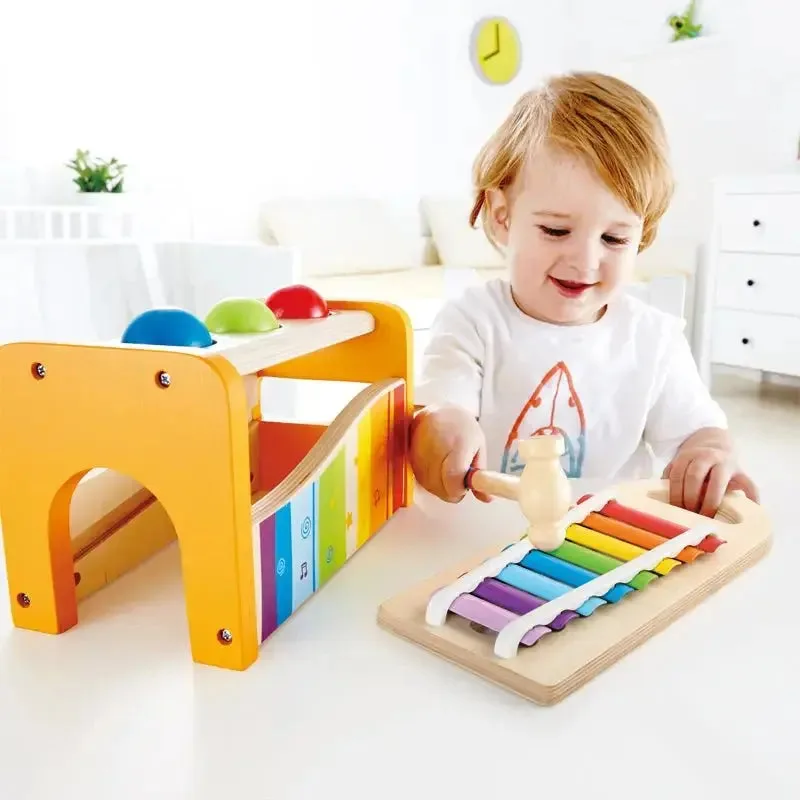
The Hape Pound & Tap Bench sits at the intersection of two research areas: cause-and-effect learning and early musical exposure. The evidence varies in strength.
Cause-and-Effect Understanding: Strong Developmental Foundation. The cognitive milestone of understanding causality — that one’s actions produce predictable results in the world — is a foundational achievement of the first two years of life. Piaget (1952) identified the development of causal understanding as a hallmark of the sensorimotor stage, emerging in increasingly sophisticated forms between 8 and 24 months.1 By 12 months, infants demonstrate intentional cause-and-effect behavior: they perform actions in order to produce specific outcomes, rather than discovering outcomes accidentally.
The Pound & Tap Bench provides an ideal cause-and-effect learning environment. The causal chain is short (hit ball → ball falls → sound plays), immediate (no delay between action and result), consistent (the same action always produces the same result), and multimodal (visual, auditory, and tactile feedback). Rovee-Collier (1999) demonstrated that infants learn causal relationships most efficiently when the feedback is immediate, consistent, and multi-sensory.2 The bench satisfies all three criteria.
Motor Development: Bilateral Coordination and Force Modulation. The pounding action requires bilateral coordination — one hand holds the mallet while the other may stabilize the ball or the bench. This bilateral demand supports the development of hand dominance and cross-midline coordination that occupational therapists identify as important during the 12-24 month window.3
The force modulation we observed — children learning to vary their hitting strength — connects to research on motor planning and proprioceptive feedback. Thelen and Smith (1994) described motor development as a dynamic process of calibrating force to context, refined through repeated trial and feedback.4 The Pound & Tap Bench provides exactly this: a context where varying force produces varying results (louder/softer sound, faster/slower ball travel), allowing the child to calibrate their motor output through experiential feedback.
Musical Play: Real Benefits, Modest Claims. The evidence for musical play in early childhood is genuine but requires careful interpretation in the context of a toy xylophone. Hallam (2010) reviewed the evidence for music education’s impact on child development and found support for benefits to language development, spatial reasoning, and social skills — but primarily in the context of structured musical instruction, not passive or toy-mediated musical exposure.5
Gerry, Unrau, and Trainor (2012) found that active music-making (as opposed to passive listening) in infancy was associated with improved communication skills and more positive social responses, even in informal, unstructured contexts.6 This finding is more relevant to the Pound & Tap Bench, which involves active sound production rather than passive listening. A toddler striking xylophone keys is making music — crude, unstructured music, but active music-making nonetheless.
However, the distance between “striking a toy xylophone” and “receiving music education” is substantial. The research supporting music education’s cognitive benefits typically involves guided instruction, sustained practice, and progressive skill development. A toddler’s xylophone play is exploratory, not instructional. It likely supports auditory discrimination (different keys make different sounds) and sound-movement coordination (striking harder makes louder sounds), but claims about “musical development” in the formal sense would overstate the evidence.
The honest summary: The Pound & Tap Bench has strong evidence for its cause-and-effect learning value — the causal chain is well-designed and the multisensory feedback aligns with how infants learn causality. The motor development benefits (bilateral coordination, force modulation) are real and observable. The musical benefits are genuine but modest — the bench provides musical exposure and active sound production, which is valuable, but this is not a music education tool in any meaningful sense.
Safety Notes
The Hape Pound & Tap Bench meets ASTM F963, CPSIA, and EN-71 safety standards. All components are large enough to exceed the small-parts threshold and do not present choking hazards. The paint is non-toxic and saliva-resistant. The mallet handle is rounded and smooth.
The primary safety consideration is the mallet. A toddler with a mallet will, inevitably, use it on targets other than the bench — including siblings, pets, furniture, and screens. The mallet is lightweight (a deliberate design choice) and the rounded head minimizes injury potential, but supervision is appropriate, as with any toy that involves swinging an object.
The balls are large enough to prevent choking but small enough that a determined toddler could attempt to mouth them. The paint finish is saliva-resistant and non-toxic, so mouthing is safe, if drooly.
No CPSC recalls have been issued for this product.
The Verdict
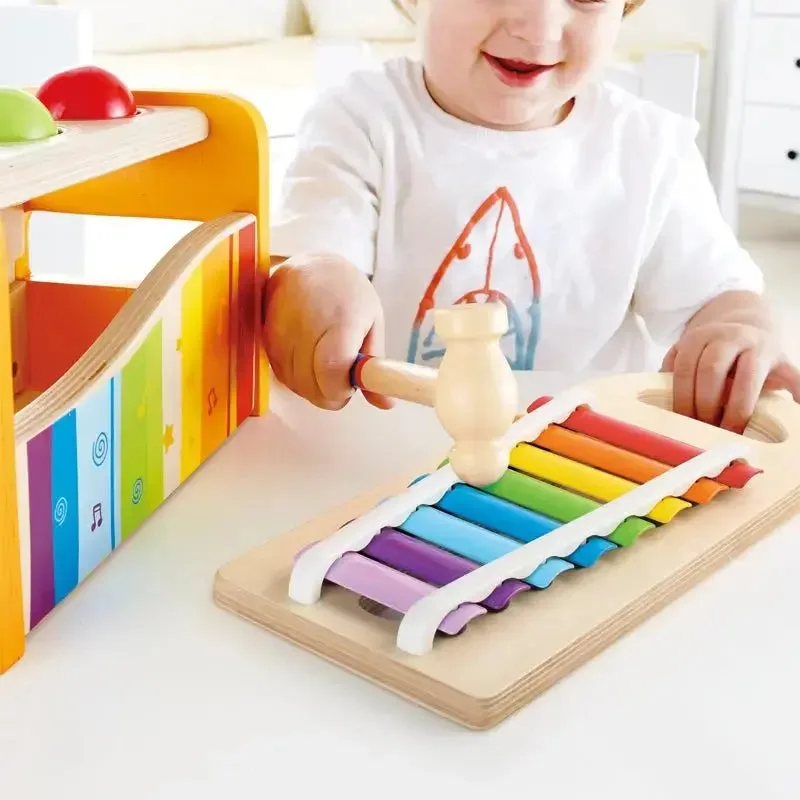
The Hape Pound & Tap Bench understands toddlers. It meets them exactly where they are — in the pounding-on-things stage — and channels that energy into genuine developmental work. The cause-and-effect chain is elegant: hit ball, ball falls, music plays. The two-mode design (pounding bench + standalone xylophone) means the toy grows with the child rather than being outgrown in three months. The build quality is reassuringly solid.
What the bench isn’t is a musical instrument, and parents should calibrate their expectations accordingly. The xylophone is good enough to introduce the concept that different keys make different sounds, and that’s where its musical instruction ends. For a twelve-month-old, that’s plenty. The real value is in the causal reasoning, the bilateral coordination, and the sheer satisfying physicality of hammering a ball and hearing music come out the other side.
Product Rating: 7/10 — Strong two-mode design, excellent build quality, and genuine developmental value for the 12-30 month window. Docked for the xylophone’s limited tonal quality and the modest evidence base for its musical education claims.
Evidence Rating: Emerging — Cause-and-effect learning and motor development benefits are well-supported by developmental research. Musical exposure benefits are real but modest. The gap between “active sound production” and “music education” is wider than the marketing suggests.
Who Should Buy This
- Families with children ages 12-24 months who are in the pounding-on-everything stage
- Parents looking for a toy that channels destructive impulses into constructive play
- Families who value wooden, non-electronic toys with genuine developmental merit
- Gift-givers for first birthdays — this is a top-tier choice in the 12+ month category
- Parents who want one toy that serves two developmental stages
Who Should Skip This
- Families with children over 30 months — the pounding mechanic will be too simple (the xylophone may still engage)
- Parents seeking a quality musical instrument — a standalone glockenspiel produces better sound
- Noise-sensitive households — the pounding-plus-xylophone combination is not quiet
- Families who already own a pounding bench and a separate xylophone — this combines both, but if you have both, the overlap is redundant
This review reflects our independent evaluation. ScienceBasedKids.com purchased this product at retail price. We may earn a commission if you purchase through our links, which helps fund our research. This never influences our ratings.
Footnotes
-
Piaget, J. (1952). The Origins of Intelligence in Children. International Universities Press. ↩
-
Rovee-Collier, C. (1999). “The development of infant memory.” Current Directions in Psychological Science, 8(3), 80-85. ↩
-
Case-Smith, J., & O’Brien, J. C. (2010). Occupational Therapy for Children (6th ed.). Mosby Elsevier. ↩
-
Thelen, E., & Smith, L. B. (1994). A Dynamic Systems Approach to the Development of Cognition and Action. MIT Press. ↩
-
Hallam, S. (2010). “The power of music: Its impact on the intellectual, social and personal development of children and young people.” International Journal of Music Education, 28(3), 269-289. ↩
-
Gerry, D., Unrau, A., & Trainor, L. J. (2012). “Active music classes in infancy enhance musical, communicative and social development.” Developmental Science, 15(3), 398-407. ↩
Enjoyed this review? We publish two new evidence-based evaluations every week.
Free. No spam. Unsubscribe anytime.
The bench activates cause-and-effect understanding through two distinct pathways: hammering (force → ball → sound) and direct xylophone play (strike → tone).
Recommended Accessories
Affiliate links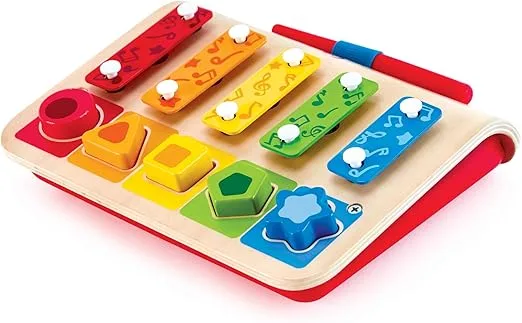
Hape Shape Sorter Xylophone
“Same brand, combines shape sorting with musical play. Extends the musical thread without duplicating the pounding mechanic.”
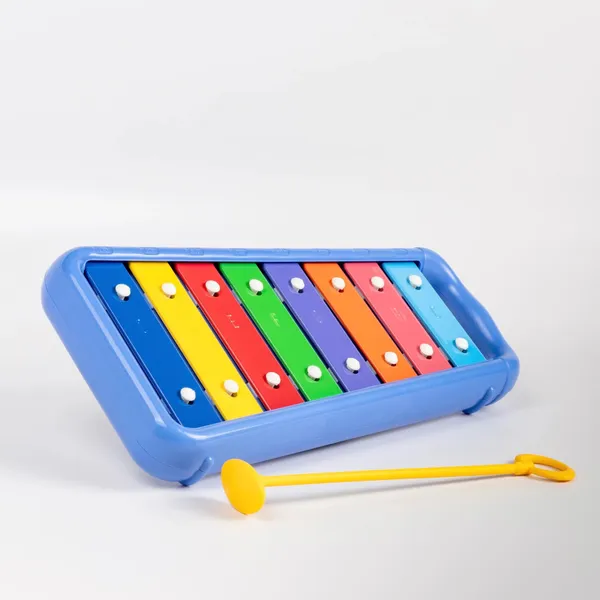
Hohner Kids Glockenspiel
“Standalone xylophone with better tone quality. For families who want a real instrument rather than a toy.”
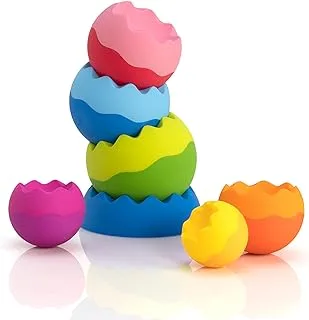
Fat Brain Toys Tobbles Neo
“Cause-and-effect stacking at the same developmental stage. Different skill focus, same satisfying physics.”

The Story Orchestra: Four Seasons in One Day (Sound Book)
“Press-and-play classical music book with Vivaldi excerpts. Extends musical exposure beyond instruments into composed works.”