ScienceBasedKids.com may earn a commission from affiliate links in this review. Our ratings are never influenced by affiliate relationships. Read our full methodology.
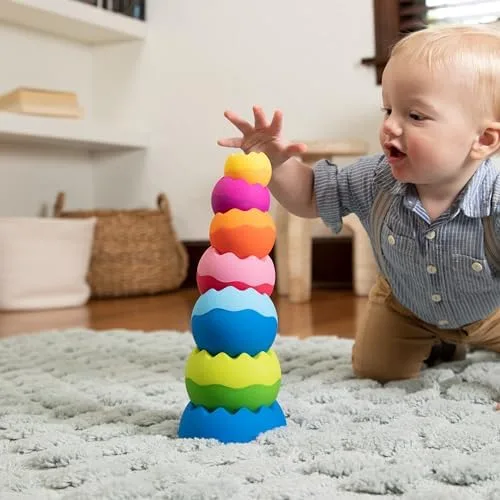
The eleven-month-old placed the orange piece on top of the blue one. It wobbled. He stared. It wobbled more. His hand hovered, ready to intervene. It settled. He exhaled — a full-body exhalation of relief that, frankly, seemed disproportionate to the stakes. Then he placed the green piece on top. It wobbled, and this time it slid sideways and fell. He looked at the fallen piece. He looked at the remaining tower. He picked up the green piece and tried again. This — the wobble, the wait, the fall, the retry — is the entire thesis of the Tobbles Neo, and it’s a more sophisticated learning experience than it has any right to be for a $25 baby toy.
Fat Brain Toys has a knack for taking a simple play concept and engineering just enough complexity to make it interesting without making it frustrating. The Tobbles Neo is a stacking toy. You stack the pieces. That’s it. Except that each piece is weighted and curved in a way that makes stacking an act of negotiation with gravity — and that negotiation is where the developmental value lives.
Product Overview
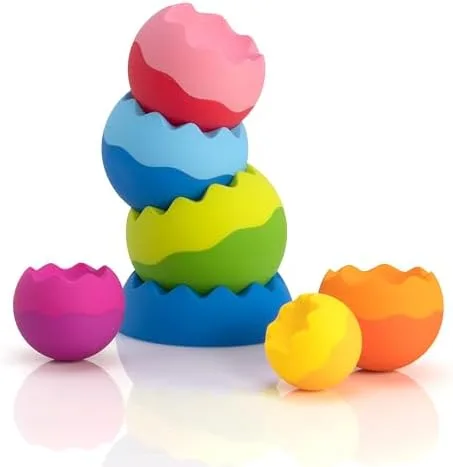
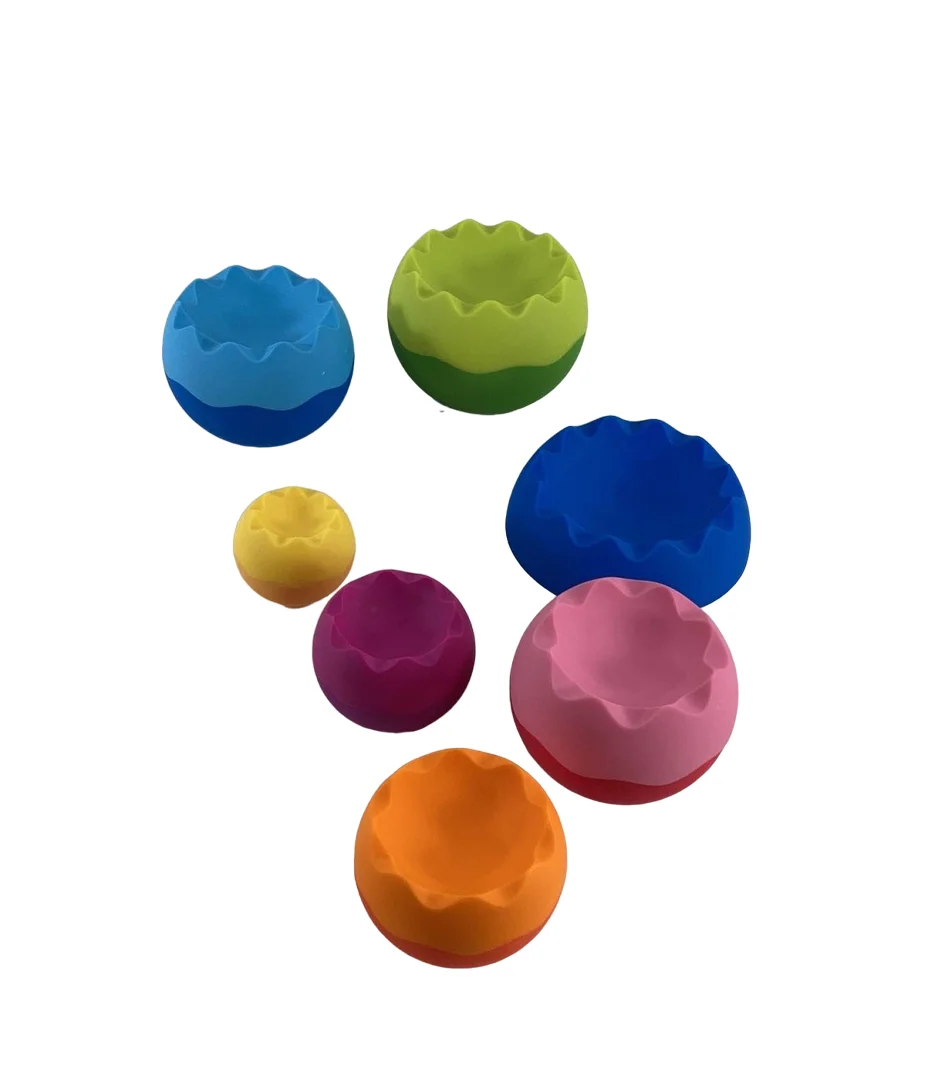
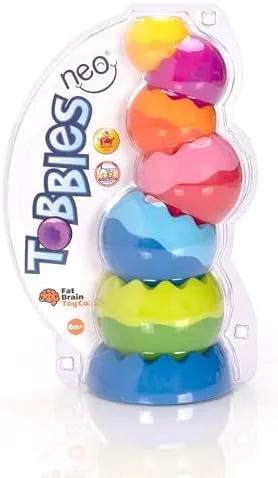
The Tobbles Neo set contains six spherical pieces in graduated sizes, each in a different color (purple, blue, green, yellow, orange, red — basically a rainbow). Each piece is a dome-shaped half-sphere with a weighted, convex bottom. When placed on a flat surface, a single piece tilts and wobbles before settling in a resting position. When stacked, the wobble of the top piece is amplified by the curved surface of the piece below it, creating a dynamic balancing challenge.
The pieces are made from ABS plastic with a soft, matte finish. They’re substantial — the largest piece (about 4 inches in diameter) weighs roughly 3 ounces, and the set totals about 12 ounces. The weight is deliberate: the pieces feel satisfying to hold and don’t blow over in a breeze, which matters for a toy that toddlers will use on the patio.
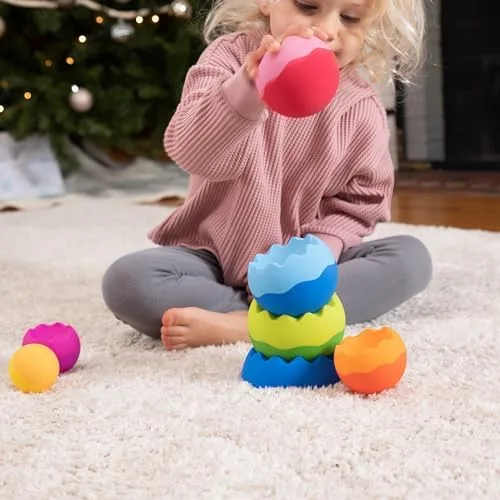
The interior of each piece is smooth and painted in a complementary color to the exterior, which adds visual interest when pieces are turned upside down or nested.
Fat Brain Toys is an Omaha-based toy company founded in 2002 that specializes in developmental toys. They design and develop their products in-house, which gives their lineup a coherent design philosophy: simple concepts, high-quality materials, thoughtful engineering. The Tobbles Neo is one of their flagship products.
At $25, it sits in the moderate range for a baby stacking toy — more expensive than basic stacking cups ($5-10) but less than premium wooden stackers ($30-50).
Our Evaluation
Build Quality: 9/10
The Tobbles Neo is impeccably made. The ABS plastic is thick, smooth, and seamless — no mold lines, no rough edges, no visible joints. The matte finish has a slightly soft, almost rubbery feel that makes the pieces pleasant to hold and provides grip for small hands. The internal weighting is invisible; you’d never know the pieces are weighted unless you felt the off-center balance.
We subjected the pieces to the full battery of infant testing: dropped repeatedly from table height, thrown across a room by a frustrated 14-month-old, stepped on by an adult, submerged during an unauthorized bathtub experiment, and chewed on for extended periods by multiple babies. All six pieces emerged without any visible damage, discoloration, or change in balance.
The matte finish does show fingerprints and drool marks, which some parents find aesthetically bothersome. A quick wipe restores the surface.
Play Value: 9/10
The genius of the Tobbles Neo is the wobble. Standard stacking toys are a pass-fail exercise: either the piece stays or it falls. Tobbles adds a third state — the piece wobbles, threatens to fall, and then settles. This interstitial moment of uncertainty is where the learning happens.
We observed distinct play phases across our testing group:
6-9 months: Babies at this stage don’t stack. They hold individual pieces, mouth them, turn them over, and bang them on surfaces. The curved bottom makes single pieces interesting — they rock and spin when batted, which provides cause-and-effect feedback for pre-stacking babies. The large size and matte finish make the pieces easy to grip.
9-12 months: Knocking down becomes the primary activity. An adult or older child stacks the tower; the baby destroys it. This is developmentally appropriate and genuinely delightful — the wobble-enhanced topple is more dramatic and satisfying than a standard tower collapse. The pieces scatter with a pleasant clatter rather than falling in a static pile.
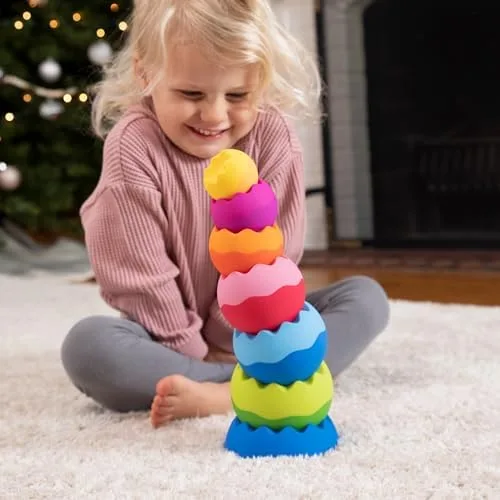
12-18 months: Stacking attempts begin. This is where the Tobbles Neo shines. A child placing a smaller dome on a larger one must adjust position, wait for the wobble to settle, and decide when to release. The weighted bases mean that slightly off-center placements can self-correct — the piece wobbles toward center — which provides a small margin of error that rewards near-misses rather than punishing them. This is brilliant design: it’s easier to succeed than with flat-bottomed blocks, but the wobble communicates how close to success each attempt was.
18-24 months: Deliberate stacking and experimentation with spin. Children at this age discover that twisting a piece when placing it creates a satisfying spinning motion on the curved surface below. We watched a 20-month-old spend ten minutes placing and spinning the same piece, varying the twist speed and direction. This wasn’t repetitive behavior — it was systematic experimentation.
24-36 months: Color sorting, size ordering, pretend play (the pieces become bowls, hats, boats), and deliberately creating the tallest possible tower. The stacking challenge remains engaging because the wobble increases with height, creating natural difficulty escalation.
Beyond 36 months: Interest tapers. Three-year-olds still play with Tobbles occasionally, but the primary developmental window has closed. The toy has done its work.
Age Appropriateness: 8/10
Fat Brain Toys rates Tobbles Neo for 6 months and up. We agree with the lower bound — six-month-olds can hold and explore individual pieces — but the upper bound is more nuanced. Active stacking engagement peaks between 12-24 months. Children over 3 still enjoy the toy but are ready for more complex challenges.
The practical lifespan is about 6 months to 3 years, which is a respectable window for a single toy. The developmental appropriateness within that window is excellent — the same toy serves sensory exploration (6-12mo), cause-and-effect learning (9-18mo), fine motor practice (12-24mo), and early cognitive skills like sorting and sequencing (18-36mo).
Durability: 10/10
We can’t find a way to break these. The ABS plastic is thick enough to survive any force a toddler can generate, and the internal weighting mechanism is sealed and unaffected by drops or impacts. Parents in online communities report Tobbles sets lasting through multiple children over 5+ years.
The matte finish may develop surface scratches over time, but these are cosmetic. The balance and function of the pieces remain unchanged.
Value for Money: 8/10
At $25 for a toy that serves 6 months to 3+ years with virtually no durability concerns, the value is strong. The per-month cost over a 2.5-year lifespan is about $0.83. Cheaper stacking alternatives exist (Green Toys Stacking Cups at $10 are excellent), but they don’t offer the wobble mechanic that makes Tobbles distinctive. More expensive alternatives exist (wooden rainbow stackers at $30-50) but don’t offer the same physics-based play.
The Tobbles Neo occupies a sweet spot: premium enough to feel like a considered purchase, affordable enough that the price doesn’t create performance expectations the toy can’t meet.
The Evidence
Fat Brain Toys doesn’t make specific developmental claims on the Tobbles Neo packaging — the box says “stacking toy” and lists the age range, full stop. This is refreshingly honest. But stacking, as a play behavior, has meaningful developmental research behind it.
Object Manipulation and Cognitive Development. Piaget’s foundational work on sensorimotor development identified object manipulation — picking up, stacking, combining, and separating objects — as a primary mechanism through which infants construct understanding of physical reality.1 More recently, Needham et al. (2002) demonstrated that infants who were given increased opportunities for object manipulation (through “sticky mittens” that allowed pre-reaching babies to interact with objects) showed accelerated development in object exploration and attention patterns.2 The implication: toys that support and reward object manipulation are doing genuine developmental work.
Stacking and Spatial Reasoning. Verdine et al. (2014), in the same study we cited in our Magna-Tiles review, found that spatial assembly performance in preschoolers predicted later mathematical skills.3 Stacking — figuring out which piece goes where, how to orient it, how to balance it — is a spatial assembly task. The Tobbles Neo’s curved surfaces make this task dynamic rather than static, adding a temporal dimension (waiting for the wobble to settle) to the spatial challenge.
Cause-and-Effect Understanding. The wobble mechanic provides continuous causal feedback. Baillargeon (2004) reviewed decades of research on infant physical reasoning and found that infants develop increasingly sophisticated expectations about how objects behave — including expectations about support, balance, and stability — through repeated observation and interaction.4 A stacking toy that wobbles before settling provides richer causal information than one that simply stays or falls. The baby learns not just “does it stay?” but “how does it stay?” and “what affects whether it stays?”
Persistence and Frustration Tolerance. This is a less-studied area, but Lucca and Sommerville (2018) found that infants who observed adults persisting effortfully at a task showed greater persistence on their own subsequent tasks.5 The Tobbles Neo, by its design, creates a context for self-generated persistence: the wobble creates moments of near-failure that resolve into success, training the infant to wait through uncertainty rather than give up immediately. We observed this directly — babies who initially gave up after a wobble gradually learned to wait for the piece to settle.
The honest summary: There’s no Tobbles Neo-specific research. But stacking play, object manipulation, cause-and-effect reasoning, and persistence development are well-studied areas of infant development. The Tobbles Neo’s weighted, wobbling design adds meaningful complexity to a fundamental play pattern, creating richer learning opportunities than a standard stacking toy. We rate the evidence as Emerging — the developmental principles are established, but the specific contribution of the wobble mechanic is our inference, not a measured finding.
Safety Notes
The Tobbles Neo meets ASTM F963 and CPSIA safety standards. Key safety details:
- BPA-free, phthalate-free, lead-free. The ABS plastic is certified non-toxic and safe for mouthing.
- Size. All six pieces are larger than the small-parts testing cylinder (1.75” diameter), eliminating choking risk for the target age range. The smallest piece (about 2” diameter) cannot fit in an infant’s mouth.
- No sharp edges. The spherical design and smooth finish eliminate any puncture or scratch risk.
- Weight. Individual pieces are light enough (1-3 ounces) that impacts from dropped or thrown pieces are harmless.
- Cleaning. Wipe with warm soapy water or a baby-safe disinfectant. The pieces are not dishwasher-safe (high heat can affect the internal weighting).
No CPSC recalls have been issued for Fat Brain Toys Tobbles Neo.
The Verdict
The Tobbles Neo takes the most fundamental play activity in infant development — stacking things — and adds just enough physics to make it interesting. The weighted, wobbling design transforms a pass-fail activity into a continuous feedback loop that teaches balance, persistence, and cause-and-effect reasoning without anyone needing to explain any of those concepts. It’s the kind of toy design that looks obvious in retrospect and ingenious on reflection.
At $25, it’s well-priced for the quality and developmental lifespan. The build quality is exceptional. The play value spans years. The design philosophy — simple concept, thoughtful engineering, no electronic gimmicks — represents what we wish more baby toys looked like.
It’s not a revolutionary product. It’s a stacking toy. But it’s a stacking toy that demonstrates how much design thinking can add to a simple interaction, and that makes it one of our favorite infant toy recommendations.
Product Rating: 8/10 — Cleverly engineered stacking toy with exceptional build quality and a developmental arc that spans infancy through toddlerhood.
Evidence Rating: Emerging — Stacking, object manipulation, and cause-and-effect learning are well-supported by developmental research. The specific wobble mechanic’s contribution is inferred, not measured.
Who Should Buy This
- Parents of babies 6-18 months looking for a high-quality developmental toy
- Gift-givers who want something beautiful, safe, and non-electronic for a baby
- Families who value toys with long developmental arcs (this one spans 6 months to 3+ years)
- Parents who appreciate thoughtful toy design and want to support independent toy companies
Who Should Skip This
- Families with children over 2 who haven’t used a Tobbles before (the peak engagement window is closing)
- Budget-focused parents (Green Toys Stacking Cups at $10 provide comparable stacking play without the wobble mechanic)
- Parents looking for a toy with higher complexity or longer upper-age engagement — Tobbles is fundamentally an infant-to-toddler product
This review reflects our independent evaluation. ScienceBasedKids.com purchased this product at retail price. We may earn a commission if you purchase through our links, which helps fund our research. This never influences our ratings.
Footnotes
-
Piaget, J. (1952). The Origins of Intelligence in Children. New York: International Universities Press. ↩
-
Needham, A., Barrett, T., & Peterman, K. (2002). “A pick-me-up for infants’ exploratory skills: Early simulated experiences reaching for objects using ‘sticky mittens’ enhances young infants’ object exploration skills.” Infant Behavior and Development, 25(3), 279-295. ↩
-
Verdine, B. N., Golinkoff, R. M., Hirsh-Pasek, K., Newcombe, N. S., Filipowicz, A. T., & Chang, A. (2014). “Deconstructing building blocks: Preschoolers’ spatial assembly performance relates to early mathematical skills.” Child Development, 85(3), 1062-1076. ↩
-
Baillargeon, R. (2004). “Infants’ reasoning about hidden objects: Evidence for event-general and event-specific expectations.” Developmental Science, 7(4), 391-424. ↩
-
Lucca, K., & Sommerville, J. A. (2018). “The little engine that can: Infants’ persistence counts.” Proceedings of the 40th Annual Conference of the Cognitive Science Society. ↩
Enjoyed this review? We publish two new evidence-based evaluations every week.
Free. No spam. Unsubscribe anytime.
Play behaviors evolve but overlap — older children still knock towers over, they just also stack deliberately.
Recommended Accessories
Affiliate links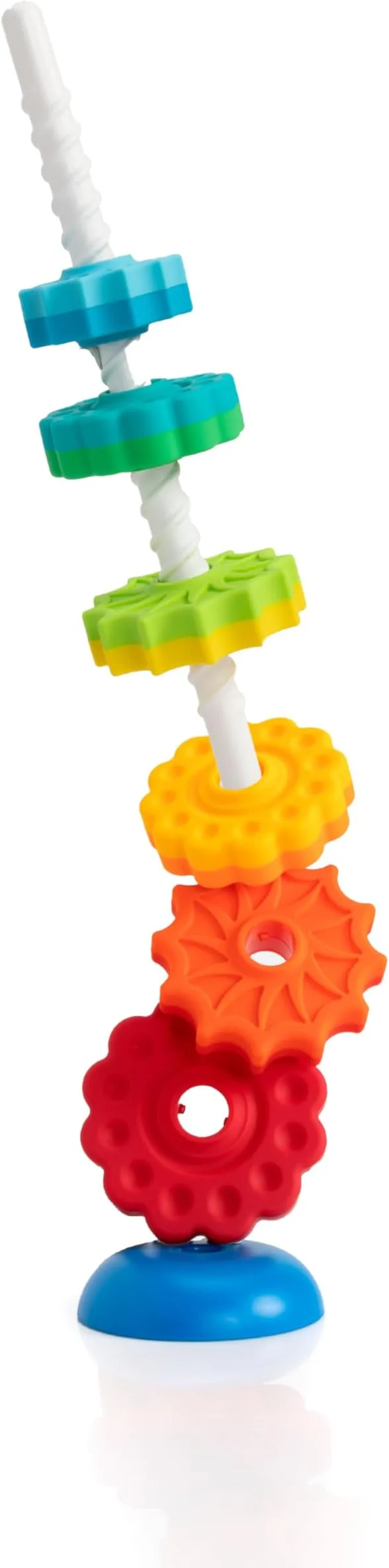
Fat Brain Toys SpinAgain Stacking Spinner
“Same brand's stacking spinner. Different stacking mechanic (threading vs balancing).”
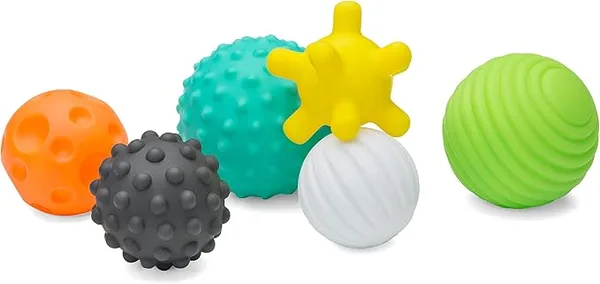
Infantino Textured Multi Ball Set (6-Piece)
“Six textured sensory balls for grasping and rolling. Different tactile experience from Tobbles' smooth weighted discs.”
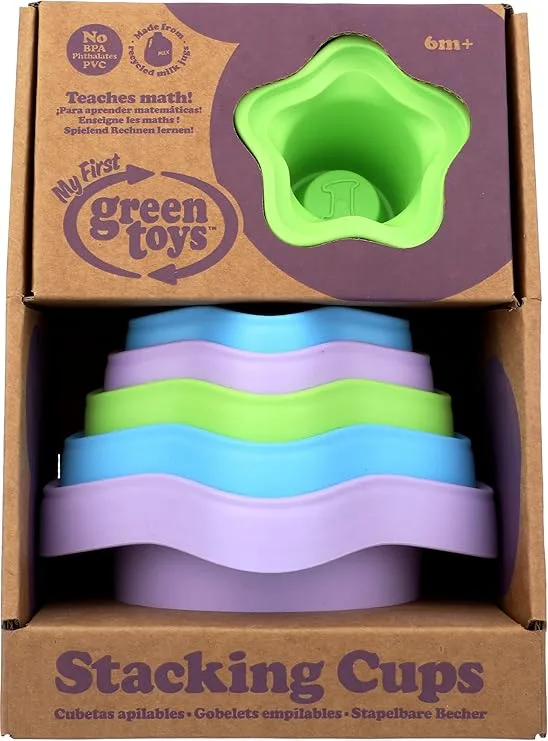
Green Toys Stacking Cups (6-Piece)
“Budget stacking alternative with nesting functionality. Different material (recycled plastic).”
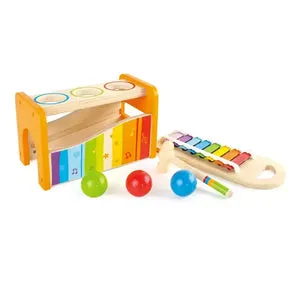
Hape Pound & Tap Bench with Slide Out Xylophone
“Cause-and-effect with musical reward. Pairs well for the same developmental stage.”