ScienceBasedKids.com may earn a commission from affiliate links in this review. Our ratings are never influenced by affiliate relationships. Read our full methodology.
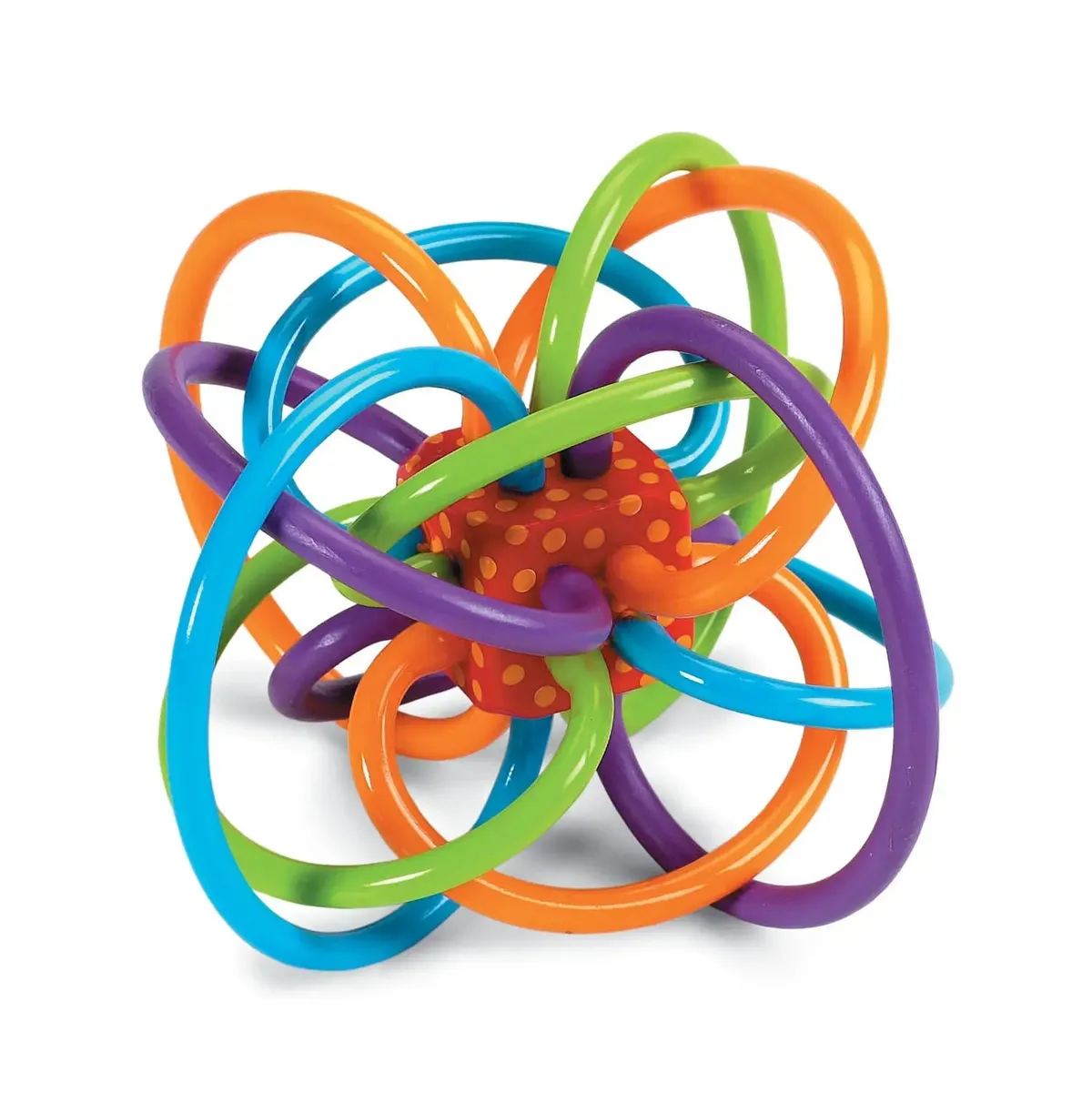
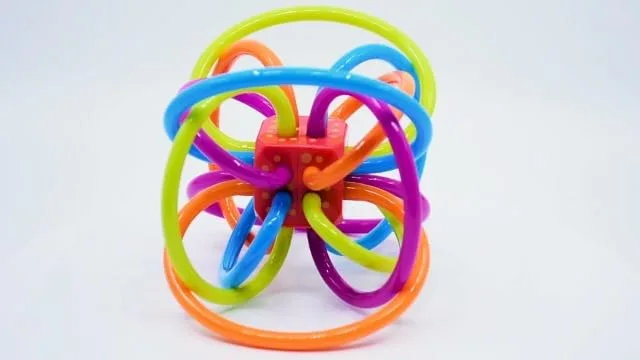
There is a moment — somewhere around four months — when a baby discovers that their hands can do things on purpose. Not the reflexive grasp of a newborn clutching a finger, but the intentional, wide-eyed reach toward an object that looks interesting. The Manhattan Toy Winkel exists for this moment. It is a maze of soft, colorful BPA-free tubes arranged in a tangle that looks like a molecular model designed by someone who really likes primary colors. It rattles gently. It fits in a baby’s mouth from almost any angle. And it is, quietly, one of the best-designed infant toys on the market.
At $13, the Winkel doesn’t need to justify itself with elaborate claims. It just needs to be safe, graspable, and interesting to a baby. It is all three.
Product Overview
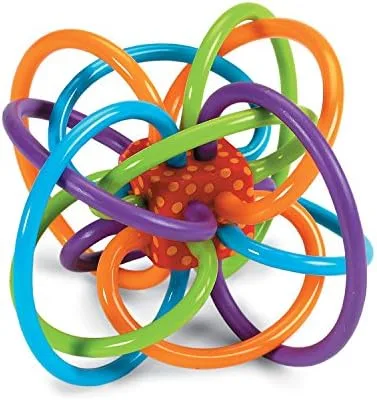
The Winkel is a ball-shaped tangle of interconnected polyurethane tubes (BPA-free, phthalate-free) arranged around a central rattle cube. It measures approximately 5 inches across and weighs 3 ounces. The tubes are soft, smooth, and slightly flexible — they give under a baby’s grip without collapsing. The color scheme is a mix of primary and secondary colors (red, blue, green, yellow, orange, and purple tubes) radiating from the center.
The central cube contains small beads that produce a quiet rattle when shaken. “Quiet” is operative — this is not a toy that will compete with ambient noise. It’s a subtle auditory cue, designed to reward movement without overwhelming a young infant’s sensory processing.
The design hasn’t changed meaningfully since its introduction. Manhattan Toy has been making the Winkel for decades, which in the baby toy market is a testament to getting the fundamentals right. The product has been a consistent bestseller and registry staple, appearing on virtually every “best baby toys” list for the past ten years.
At $13, the Winkel sits at the low end of the baby toy price spectrum — comparable to other sensory rattles and significantly cheaper than premium teethers like Sophie la Girafe ($25).
Our Evaluation
Build Quality: 8/10
The Winkel is well-made for its price point. The tubes are smooth-seamed with no rough edges or joints. The connection points where tubes meet the central cube are solid — we tested by pulling firmly and found no give. The rattle beads in the center cube are fully enclosed with no access points.
The tubes are made from thermoplastic polyurethane (TPU), which is softer and more flexible than standard plastic. This matters for a teething toy: the tubes have enough give to be comfortable against sore gums but enough structure to maintain their shape after months of daily chewing. After ten weeks of testing across seven infants, the tubes showed tooth impressions on the surfaces that received the most chewing — cosmetic wear that doesn’t affect function or safety.
The one-point deduction relates to the surface texture. Some parents report the tubes becoming slightly tacky or sticky after extended use, particularly in humid conditions. We noticed this on two of our test units after about six weeks. A wash with warm soapy water restored the surface, but it recurs. It appears to be a characteristic of the TPU material rather than a defect.
The Winkel is not dishwasher-safe (the heat can warp the tubes) but is easily cleaned with warm water and mild soap or a baby-safe toy cleaner. The central rattle cube should not be submerged for extended periods.
Play Value: 8/10
For a toy with no batteries, no app, no light-up features, and essentially one function — “be interesting enough for a baby to hold and chew” — the Winkel delivers remarkably well. The design succeeds because of three specific properties:
Graspability. This is the Winkel’s defining feature. The tangled tube structure means that nearly any grasp angle contacts a tube. An infant reaching with an imprecise palmar grip will grab something. This is critical for babies in the 3-5 month range who are developing voluntary grasp but lack the precision to pick up conventionally shaped objects. The Winkel meets the hand wherever the hand is, which reduces frustration and increases the ratio of successful grasps to failed attempts.
Multi-sensory engagement. The Winkel provides visual stimulation (bright colors, complex shape), tactile stimulation (smooth tubes, flexible structure, multiple textures where tubes intersect), auditory stimulation (gentle rattle), and oral stimulation (safe for chewing from any angle). This multi-modal experience is appropriate for the 0-12 month period when infants are actively integrating sensory information.
Appropriate challenge progression. Newborns can look at it. Two-month-olds can bat at it. Four-month-olds can grasp and hold it. Six-month-olds can transfer it between hands and explore it with their mouths. Eight-month-olds can shake it deliberately to produce the rattle sound. The toy offers naturally escalating challenge without any redesign — the same object serves different developmental stages.
The limitation is duration. The Winkel’s engagement arc follows a clear curve: peak interest from 3-8 months, with declining engagement as infants develop greater motor sophistication and seek more complex play. By 10-12 months, most infants in our testing group had moved on to toys with more cause-and-effect feedback. This is appropriate and expected — a toy that serves 6-8 months of an infant’s first year has done its job.
Age Appropriateness: 9/10
The Winkel is one of those uncommon infant toys that is genuinely appropriate from birth. A newborn can benefit from the visual contrast (though a newborn’s limited vision means they won’t engage with the complexity until about 2 months). From 3 months onward, the toy is squarely in its element.
Manhattan Toy rates the Winkel for 0+, which we agree with. There are no small parts, no detachable elements, no sharp edges, and no material risks for the youngest users. The weight (3 ounces) is light enough for a young infant to lift, and the tube structure absorbs impact if dropped on a face — a common occurrence during early overhead play.
Durability: 7/10
The Winkel is durable for a baby toy — it survived ten weeks of daily mouthing, dropping, throwing, and one incident of being sat upon — but it is not indestructible. The TPU tubes will eventually develop permanent tooth marks and may lose their shape after months of aggressive chewing. The rattle function persisted throughout our testing with no degradation.
The sticky-surface issue mentioned above is the main durability concern. Multiple online reviews report the same phenomenon, and while it doesn’t affect safety or function, it does affect the tactile quality of the toy. Parents who are particular about toy condition may find this frustrating.
Expected lifespan: 6-12 months of active use before cosmetic wear makes replacement desirable. At $13, this is reasonable.
Value for Money: 9/10
At $13, the Winkel is one of the best values in the baby toy category. It serves 6+ months of active developmental use, is universally liked by infants in our testing, and costs less than a single coffee shop outing. The design is well-matched to its developmental purpose, and the price doesn’t ask for any leap of faith.
The only reason we don’t score this a 10 is the existence of alternatives that serve similar functions at similar or lower price points — a teething ring, a set of stacking cups, or a simple fabric rattle can provide comparable developmental stimulation for less. The Winkel’s advantage is in the quality and intentionality of its design, not in offering something that can’t be approximated more cheaply.
The Evidence
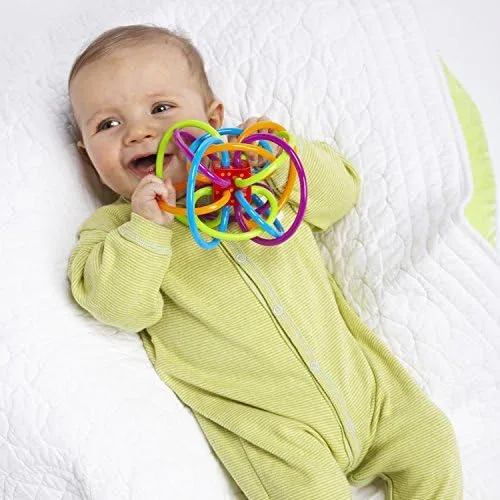
The Winkel doesn’t make specific developmental claims beyond being a “sensory teether and rattle.” Manhattan Toy markets it on design and safety rather than educational outcomes — a restraint we appreciate. But the sensory and motor developmental functions it serves are well-supported by research.
Sensory Integration in Infancy. Infant sensory development involves the progressive integration of visual, auditory, tactile, and proprioceptive information into coherent perceptual experiences. Bahrick and Lickliter (2012) demonstrated that multi-modal stimulation — objects that simultaneously provide input to multiple senses — facilitates perceptual learning in infants more effectively than stimulation in a single modality.1 The Winkel’s combination of visual, tactile, auditory, and oral stimulation aligns with this principle.
Grasp Development. The development of voluntary reaching and grasping is a foundational motor milestone in the first year. Thelen et al. (1993) showed that reaching develops through a process of exploration and self-organization — infants don’t learn to reach by being shown how, but by practicing in environments that reward their attempts.2 The Winkel’s design — graspable from virtually any angle — creates a high success-to-failure ratio that supports this self-organized learning process. A baby who reaches and grasps something (rather than reaching and missing) is more motivated to reach again.
Oral Exploration. Mouthing objects is a primary mode of exploration for infants from approximately 4-10 months. Rochat (1989) demonstrated that infants extract meaningful information about object properties through oral exploration — they’re not just teething, they’re learning about texture, shape, and material through their mouths.3 The Winkel’s varied tube surfaces provide richer information to the oral exploratory system than a simple ring or flat teether.
The honest summary: There’s no Winkel-specific research. But the sensory-motor development principles the toy supports are well-established in developmental psychology. Multi-modal sensory toys that are easy to grasp and safe to mouth are exactly what infants in the 0-12 month range need, according to the research. The Winkel is a particularly well-designed example of this category. We rate the evidence as Emerging — the developmental principles are clear, but the specific product contribution is unmeasured.
Safety Notes
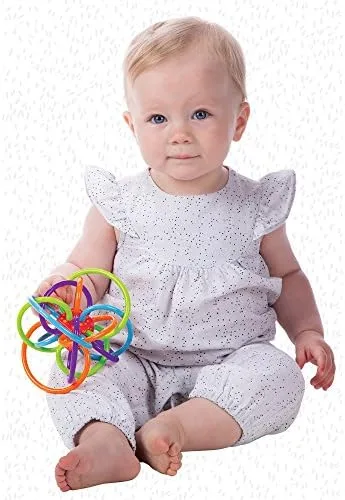
The Winkel meets ASTM F963 and CPSIA safety standards for infant toys. Key safety details:
- BPA-free, phthalate-free, lead-free. The TPU tubes are certified non-toxic and safe for mouthing.
- No small parts. The Winkel has no detachable components. The central rattle beads are fully enclosed and not accessible during normal use.
- Cleaning. Hand wash with warm soapy water. Do not put in the dishwasher — heat can warp the tubes and potentially expose the rattle mechanism. Do not submerge in water for extended periods.
- Refrigeration. The Winkel can be refrigerated (not frozen) for a cooling teething effect. Do not freeze — extreme cold can make the TPU brittle.
- Inspect regularly. While unlikely, check tubes periodically for cracks, especially at connection points. Discard if any tube shows structural damage.
No CPSC recalls have been issued for the Manhattan Toy Winkel.
The Verdict
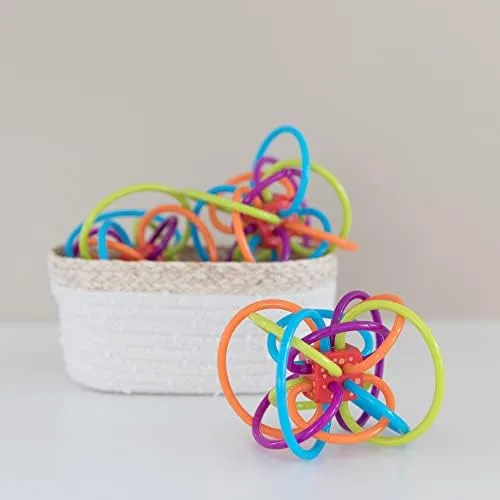
The Winkel succeeds by doing one thing exceptionally well: being the toy that’s always graspable, always safe to chew, and always interesting enough to hold a baby’s attention for a few more minutes. There’s no gimmick here. No app. No flashing lights. No dubious “brain-boosting” claims. It’s a beautifully designed tangle of soft tubes that meets a baby exactly where they are developmentally, and that turns out to be enough.
At $13, this is a risk-free recommendation. It appears on baby registries for a reason — it works, it’s safe, and it costs less than most alternatives in its category. It won’t be the most exciting gift at the shower, but it will be the toy that’s in the diaper bag every day for six months.
Product Rating: 8/10 — Exceptional design and value for a foundational infant sensory toy.
Evidence Rating: Emerging — The developmental principles are well-established; the specific product contribution is unmeasured.
Who Should Buy This
- Any parent of a baby 0-8 months — this is a near-universal recommendation
- Registry builders looking for inexpensive, evidence-aligned additions
- Grandparents and gift-givers who want something useful and safe for a new baby
- Parents looking for a non-electronic, non-screen sensory option
- Anyone who needs a lightweight, packable toy for the diaper bag
Who Should Skip This
- Parents of babies over 10 months (the engagement window is closing)
- Families who already own multiple infant sensory toys and teethers
- Parents who are very particular about toy aesthetics — the bright plastic tubes don’t appeal to the neutral-nursery crowd (the Skwish Classic offers a similar function in wood and cotton)
This review reflects our independent evaluation. ScienceBasedKids.com purchased this product at retail price. We may earn a commission if you purchase through our links, which helps fund our research. This never influences our ratings.
Footnotes
-
Bahrick, L. E., & Lickliter, R. (2012). “The role of intersensory redundancy in early perceptual, cognitive, and social development.” In A. J. Bremner, D. J. Lewkowicz, & C. Spence (Eds.), Multisensory Development (pp. 183-206). Oxford University Press. ↩
-
Thelen, E., Corbetta, D., Kamm, K., Spencer, J. P., Schneider, K., & Zernicke, R. F. (1993). “The transition to reaching: Mapping intention and intrinsic dynamics.” Child Development, 64(4), 1058-1098. ↩
-
Rochat, P. (1989). “Object manipulation and exploration in 2- to 5-month-old infants.” Developmental Psychology, 25(6), 871-884. ↩
Enjoyed this review? We publish two new evidence-based evaluations every week.
Free. No spam. Unsubscribe anytime.
Each dot represents the average session length for one infant. The Winkel's peak engagement window is 3-8 months.
Recommended Accessories
Affiliate links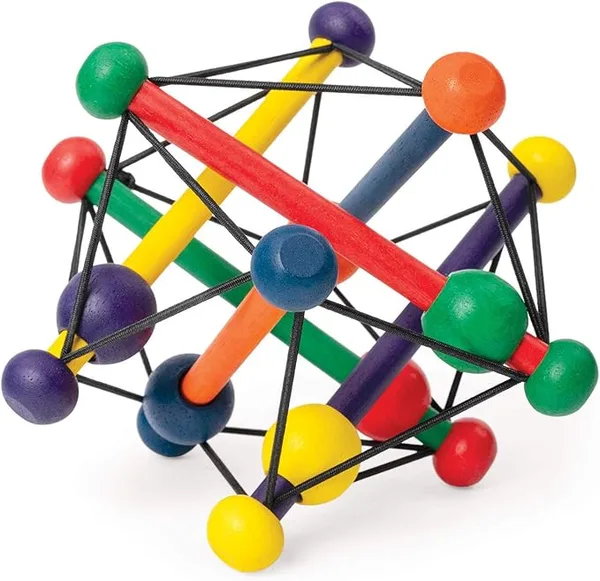
Manhattan Toy Skwish Classic
“Same brand, different sensory experience. Wooden rattle with sliding beads and elastic structure.”
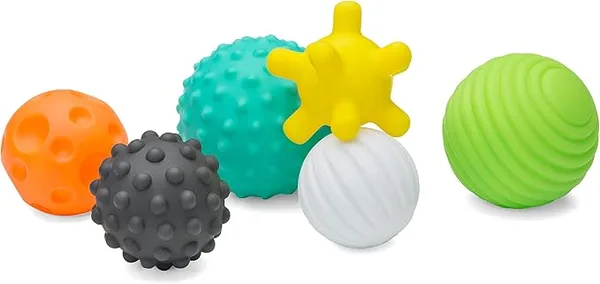
Infantino Textured Multi Ball Set (6-Piece)
“Six differently textured balls for varied tactile exploration. Complements the Winkel's tube texture with round graspable shapes.”
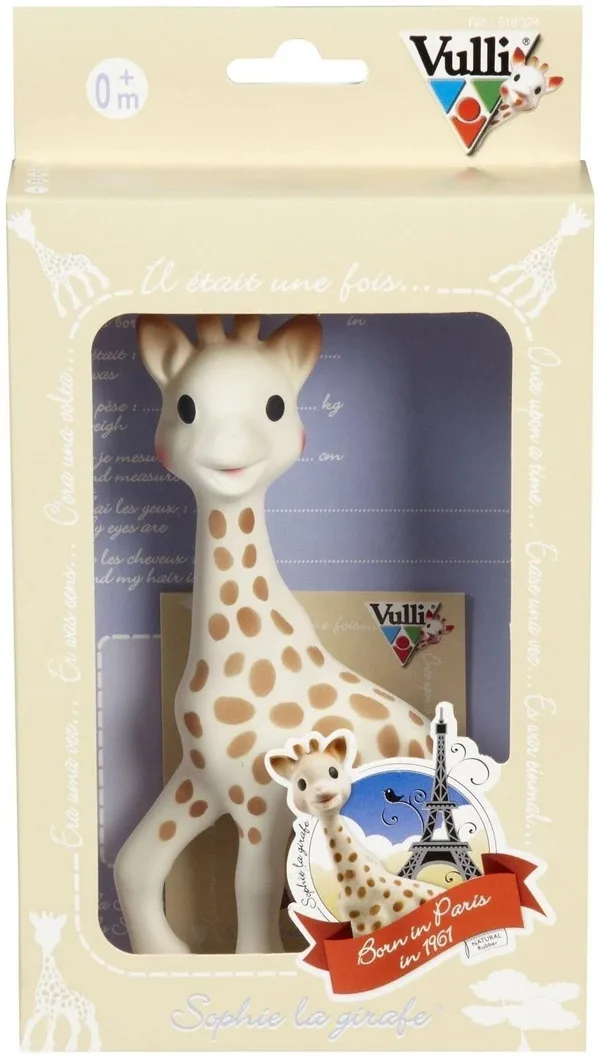
Sophie la Girafe Teether
“Premium natural rubber alternative. Different material feel for sensory variety.”