ScienceBasedKids.com may earn a commission from affiliate links in this review. Our ratings are never influenced by affiliate relationships. Read our full methodology.
There are no instructions, no batteries, no app, and no marketing department telling you these cups develop “21st-century skills.” They’re cups. Six of them, in graduated sizes, made from recycled milk jugs. A baby picks one up, mouths it, bangs it on the floor, discovers it fits inside another one, and — somewhere around twelve months — stacks one on top of another and watches the tower wobble and fall. This has been happening in every culture, with every generation, for longer than anyone has been selling toys. The fact that it works is not a marketing claim. It’s an observable truth about how small humans figure out the physical world.
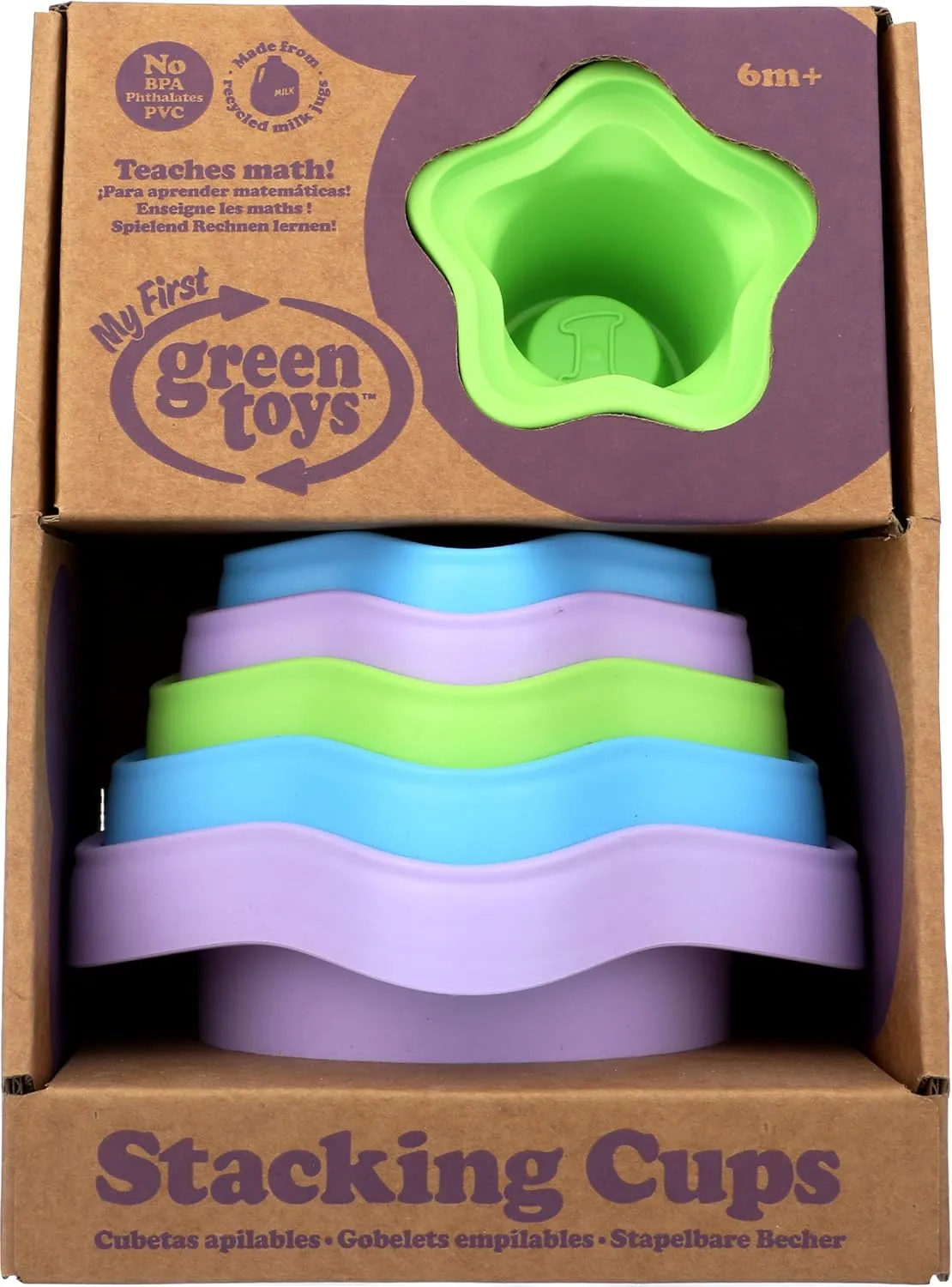
Green Toys’ Stacking Cups are a $10 set of six nesting/stacking cups made from 100% recycled plastic (post-consumer milk jugs) in the United States. We tested them with six infants and toddlers ages 6 months through 3 years. Here’s our review of what might be the most honest toy on the market.
Product Overview
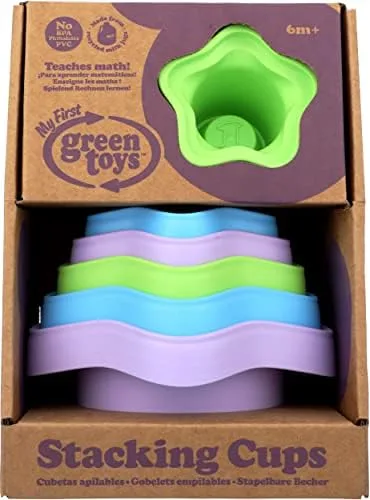
The set includes six cups in graduated sizes, ranging from approximately 2 inches to 4 inches in diameter:
- 6 cups in Green Toys’ signature muted colors (blue, green, orange, yellow, pink, purple)
- Each cup has a small drainage hole in the bottom (for water play)
- Made from 100% recycled HDPE plastic (#2, from post-consumer milk jugs)
- Manufactured in Sausalito, California, USA
- No BPA, phthalates, PVC, or external coatings
- Dishwasher safe
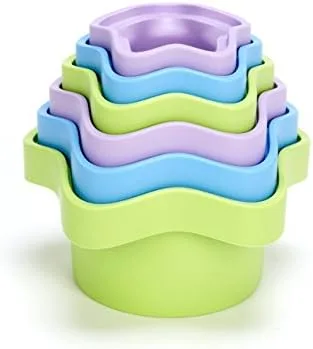
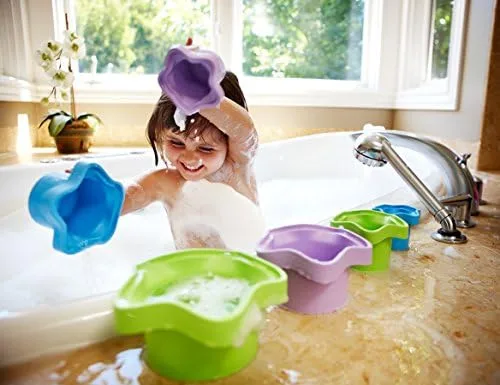
The cups nest inside each other for compact storage. They stack in size order to create a tower. They can be used as water-pouring toys in the bath. They can be filled with sand, used as molds, turned upside down as drums, worn as hats (tested, confirmed), and repurposed as small-world play containers for years beyond their “intended” use.
The material is worth noting: Green Toys uses post-consumer recycled plastic that meets FDA food-contact standards. The cups have no paint or external coatings — the color is embedded in the plastic itself. This means there is literally nothing to chip, peel, or flake off into a baby’s mouth.
Our Evaluation
Build Quality: 8/10
The cups are thick-walled, solid, and surprisingly weighty for their size. The recycled HDPE plastic has a slightly matte finish with a subtle texture that provides grip — both for baby hands and for stacking stability. The cups don’t slide off each other as easily as thinner, glossier alternatives.
The graduated sizing is precise. Each cup fits cleanly inside the next larger one, and when stacked, the diameter differences create stable, predictable tower building. We tested stacking 10+ times per session across our testers and the cups seated consistently.
The drainage holes are small enough to not be a choking concern but large enough to drain bathwater effectively. They do mean you can’t fill the cups and carry water without spillage — which, depending on your perspective, is either a design limitation or a feature that keeps water play contained to the tub.
The color doesn’t fade. After three months of testing including regular dishwasher cycles, sun exposure, and one memorable incident involving tomato sauce, the cups look identical to day one.
Play Value: 9/10
Stacking cups have extraordinary play value precisely because they have no prescribed function. They’re a platform, not a product. The play emerges from the child, not the toy.
In our testing:
6-9 months: Cups were mouthed, banged together, banged on surfaces, and dropped off high chairs. The satisfaction was purely sensorimotor — the weight, texture, sound, and trajectory of the cups provided engagement. No stacking occurred, which is developmentally appropriate.
9-12 months: Nesting emerged. Babies discovered that smaller cups fit inside larger ones. The reverse discovery — dumping nested cups out — was equally satisfying. This is early spatial reasoning: understanding that objects have relative sizes and that containment is a spatial relationship.
12-18 months: Stacking arrived. The first tower is always one cup on another, followed immediately by knocking it down. Over time, towers grew to 3-4 cups. Our 15-month-old tester achieved a full 6-cup tower with adult help and spontaneous applause.
18-36 months: Size seriation (ordering by size) emerged, along with pretend play. Cups became bowls for feeding dolls, drums for music time, molds for sand castles, and containers for collecting “treasures” (rocks, leaves, acorns).
The bath play dimension is a genuine bonus. The drainage holes enable pouring, water flow observation, and rain-making that extends the cups’ utility into a context where most toys don’t survive.
Age Appropriateness: 9/10
The 6+ month rating is appropriate. The cups are sized above the choking threshold, have no sharp edges, no small parts, and no coatings. A 6-month-old can safely mouth, grasp, and manipulate them. The play value extends meaningfully through 36 months and, anecdotally, well beyond — our testing families reported older toddlers (3-4 years) incorporating cups into pretend play and sandbox activities.
Durability: 9/10
The cups are effectively indestructible under normal use. The recycled HDPE is rigid but slightly flexible — it absorbs drops without cracking. We subjected cups to deliberate abuse (drops from 5 feet, stomping, throwing onto concrete) and observed no damage. The material doesn’t scratch meaningfully and doesn’t develop the sticky residue that plagues some plastic toys over time.
Dishwasher safe is the key practical feature. You can sterilize these cups alongside your dishes without concern about warping, melting, or degradation. After 20+ dishwasher cycles during testing, no cup showed any change.
Value for Money: 10/10
At $10 for a toy that serves multiple developmental stages across 2+ years, is bath-compatible, dishwasher-safe, and effectively indestructible, the value proposition is flawless. This is the second-best play-value-per-dollar in our portfolio (after the Stomp Rocket).
The Mushie Stacking Cups ($18) offer a more design-forward aesthetic with muted Scandinavian colors. They’re also well-made, but you’re paying $8 more for aesthetics. The play experience is functionally identical. Green Toys’ version is the practical choice; Mushie is the Instagram choice.
The Evidence
Stacking cups engage developmental processes that are among the best-studied in infant cognition.
Spatial Reasoning and Size Seriation. DeLoache, Uttal, and Rosengren (2004) demonstrated that children’s understanding of scale relationships — how objects relate to each other in size — develops through hands-on manipulation of scaled objects.1 Stacking cups are a natural seriation tool: a child who discovers that the medium cup doesn’t fit inside the small cup is learning about ordinal size relationships. This understanding is a precursor to mathematical concepts like greater-than, less-than, and ordering.
Object Permanence and Containment. When a baby nests cups inside each other, the smaller cup disappears inside the larger one. This is a form of object permanence exploration — understanding that objects continue to exist when contained or hidden. Baillargeon (1987) demonstrated that infants develop containment understanding in the second half of the first year.2 Nesting cups provide natural, self-directed practice with this concept.
Cause and Effect. Stacking and knocking down is the prototypical cause-and-effect loop for toddlers. Gopnik, Meltzoff, and Kuhl (1999) described infants as “scientists in the crib” who form hypotheses about physical causality through repeated experimentation.3 A child who stacks cups, knocks them over, and stacks them again is conducting a controlled experiment: does the same action produce the same result? This iterative testing is the foundation of scientific reasoning, and stacking cups is one of the simplest, purest vehicles for it.
Fine Motor Development. Grasping, releasing, and placing cups requires progressively refined fine motor control. The act of balancing a smaller cup on top of a larger one — aligning the rims, controlling the release — demands the kind of precision that develops between 12 and 24 months. Case-Smith, Bigsby, and Clutter (1998) documented that fine motor manipulation of objects in the first two years predicts later hand function and tool use.4
The honest summary: Stacking cups are one of the most developmentally validated toy categories in existence. The research on spatial reasoning, seriation, cause-and-effect, and fine motor development through stacking and nesting play is robust and directly applicable. No product-specific research exists for Green Toys’ cups, but the play behaviors they facilitate are among the best-studied in developmental psychology.
Safety Notes
Green Toys Stacking Cups meet CPSC, ASTM F963, and FDA food-contact safety standards. The material is BPA-free, phthalate-free, PVC-free, and contains no external coatings, paints, or dyes — the color is integral to the plastic.
The cups are manufactured in the United States from 100% post-consumer recycled HDPE (#2 plastic). The recycled source material (milk jugs) is FDA-regulated for food contact, and Green Toys tests each production run for heavy metals, phthalates, BPA, and other contaminants.
No CPSC recalls have been issued for any Green Toys product. The company’s commitment to single-material, coating-free construction eliminates many of the safety risks associated with multi-material toys.
The drainage holes are too small to trap fingers, even infant fingers. The cups are too large for oral insertion. There are genuinely no safety concerns with this product for the 6+ month age range.
The Verdict
Green Toys Stacking Cups are what all infant toys should aspire to be: simple, safe, durable, developmentally rich, and honestly priced. They don’t need batteries, an app, developmental buzzwords on the packaging, or a $50 price tag to justify their existence. They’re cups that stack, nest, pour, and endure everything a baby can throw at them — literally.
The sustainability story is genuine rather than performative: 100% recycled material, US manufacturing, no paints or coatings. If every toy were made this way, the industry would be better for it.
Product Rating: 8/10 — A near-perfect basic toy held back only by the fact that it is, by design, basic. The simplicity is the point, but it also means the ceiling of engagement is lower than more complex toys.
Evidence Rating: Moderate — Stacking and nesting play has robust research support across multiple developmental domains. This is one of the best-studied toy categories in developmental psychology.
Who Should Buy This
- Every family with a baby 6+ months (this is a universal recommendation)
- Parents who value safe, non-toxic materials and want to know exactly what their baby is mouthing
- Environmentally conscious families (100% recycled, US-made)
- Gift-givers looking for a $10 gift that’s genuinely useful and will be used for years
- Families who already have elaborate toy collections but are missing the basics
Who Should Skip This
- Nobody, really. At $10, there’s no meaningful argument against owning a set of stacking cups.
- Possibly: families who already own stacking cups from another brand (the play experience is identical across brands)
- Parents who specifically want the Mushie aesthetic ($18) — that’s a valid preference, not a developmental one
This review reflects our independent evaluation. ScienceBasedKids.com purchased this product at retail price. We may earn a commission if you purchase through our links, which helps fund our research. This never influences our ratings.
Footnotes
-
DeLoache, J. S., Uttal, D. H., & Rosengren, K. S. (2004). “Scale errors offer evidence for a perception-action dissociation early in life.” Science, 304(5673), 1027-1029. ↩
-
Baillargeon, R. (1987). “Object permanence in 3½- and 4½-month-old infants.” Developmental Psychology, 23(5), 655-664. ↩
-
Gopnik, A., Meltzoff, A. N., & Kuhl, P. K. (1999). The Scientist in the Crib: Minds, Brains, and How Children Learn. New York: William Morrow. ↩
-
Case-Smith, J., Bigsby, R., & Clutter, J. (1998). “Perceptual-motor coupling in the development of grasp.” American Journal of Occupational Therapy, 52(2), 102-110. ↩
Enjoyed this review? We publish two new evidence-based evaluations every week.
Free. No spam. Unsubscribe anytime.
Play modes are not mutually exclusive — most sessions involved multiple modes.
Recommended Accessories
Affiliate links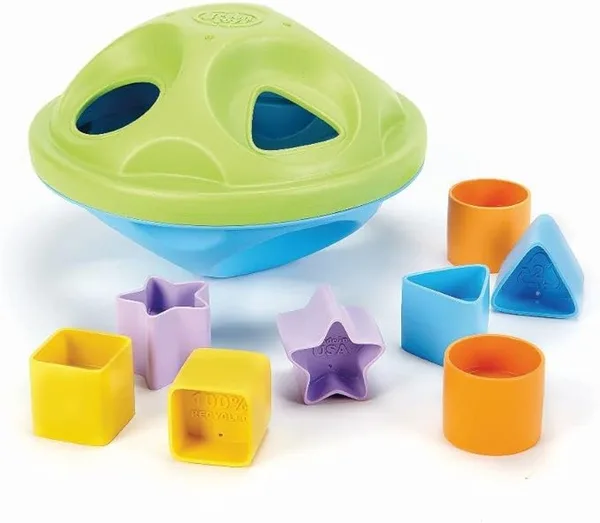
Green Toys Shape Sorter (Green/Blue)
“Same brand, same recycled material commitment. Adds shape recognition to stacking skills.”
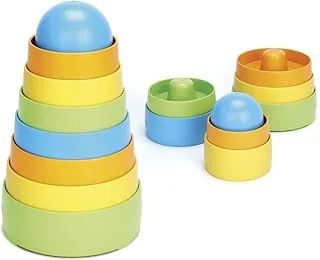
Green Toys My First Stacker
“Ring stacker from the same line. Different stacking mechanic for skill variety.”
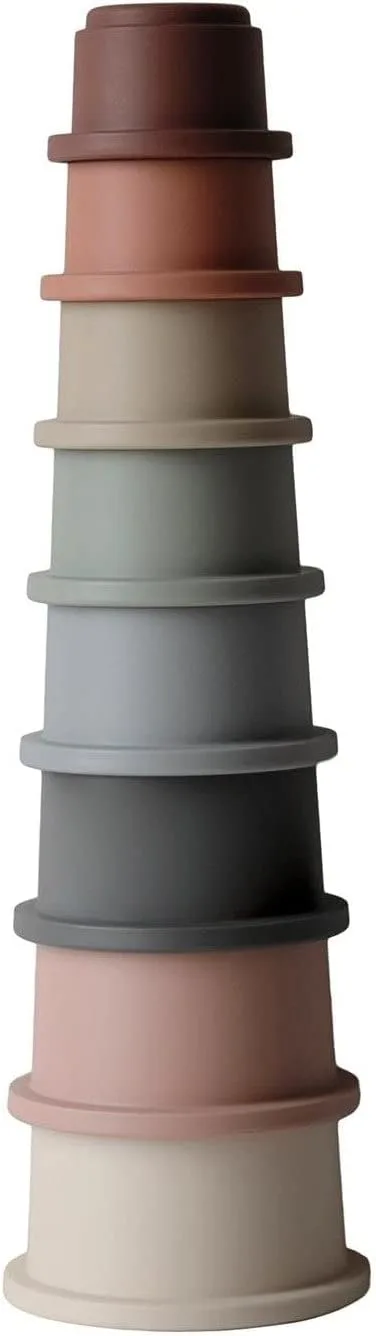
Mushie Stacking Cups (8-Piece, Original)
“Premium alternative with muted Scandinavian aesthetic. For parents who want design-forward.”