ScienceBasedKids.com may earn a commission from affiliate links in this review. Our ratings are never influenced by affiliate relationships. Read our full methodology.
Drop a marble into a tower and gravity does the rest. That’s the promise of every marble run ever built. But Gravity Maze inverts the proposition: here, the marble’s path is the answer, and the child’s job is to figure out the question. Which towers go where? How does a marble entering this opening exit that one? If I place a blue tower here and a green one there, will gravity carry the marble through both and land it in the target — or will it fly off the edge of the board and roll under the couch?
This is spatial reasoning made physical. And it’s one of the best $30 you can spend on a child’s cognitive development.
Product Overview
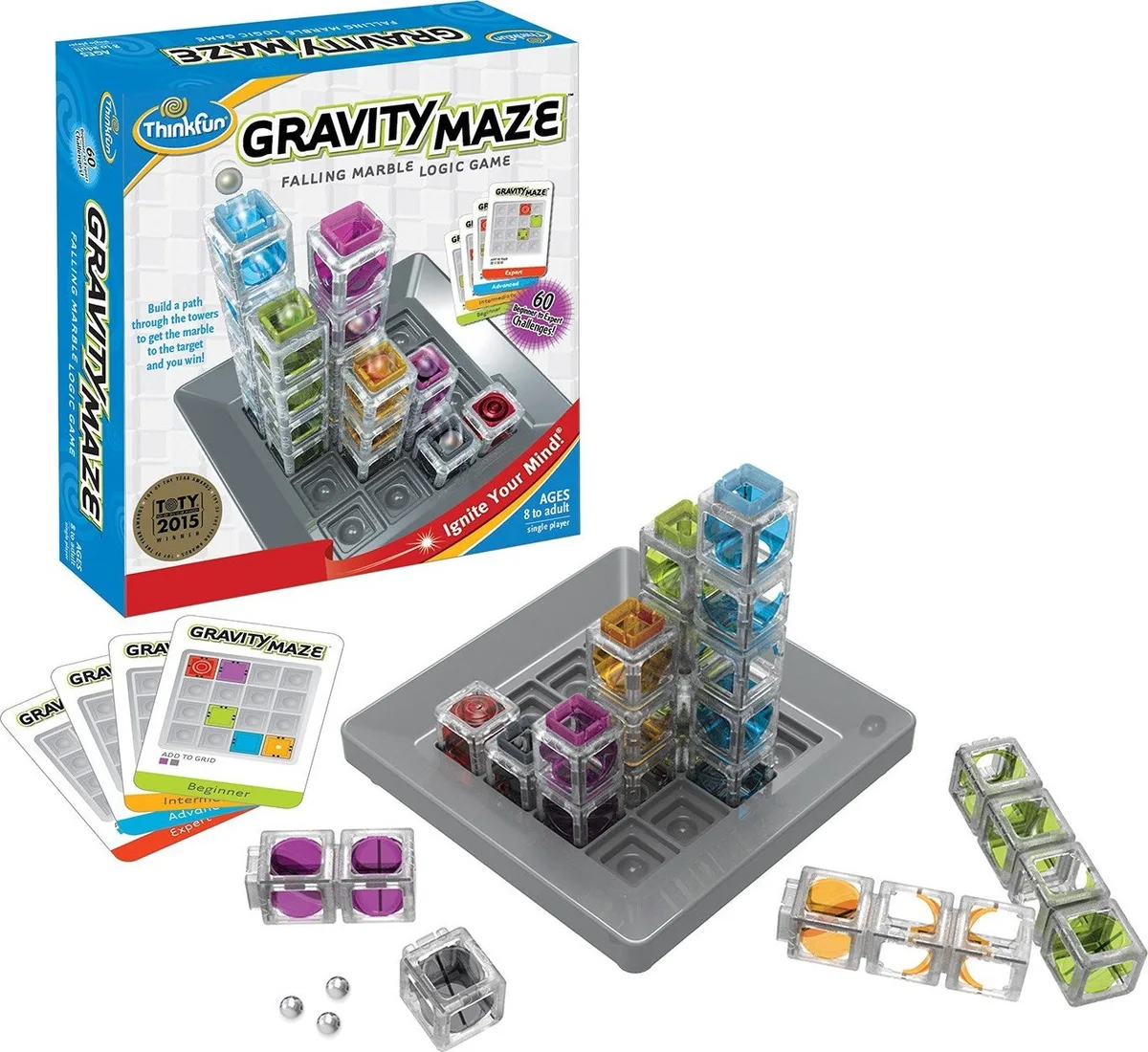
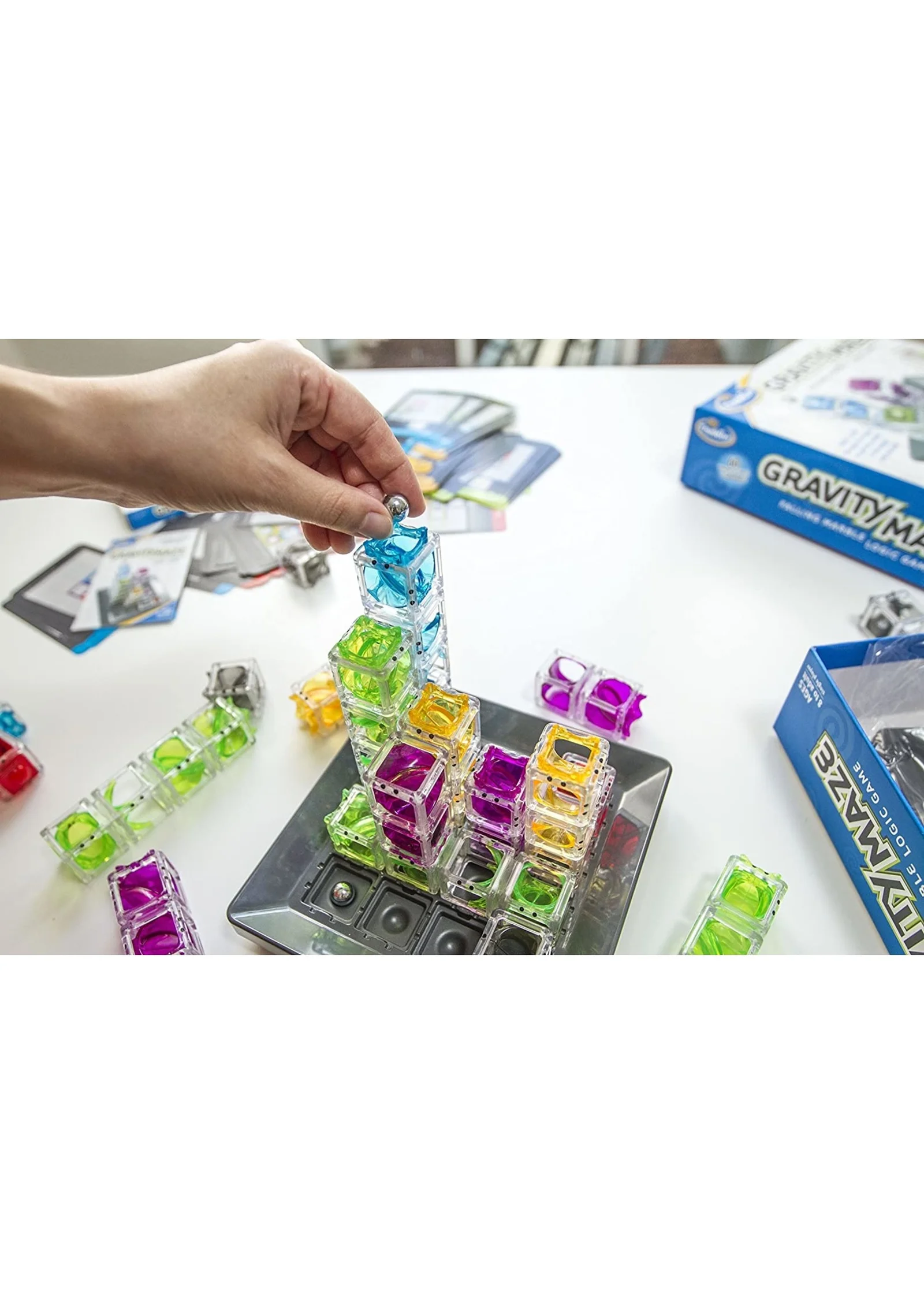
ThinkFun Gravity Maze ($30) is a single-player logic game consisting of:
- 1 game grid: A 4×4 plastic grid board with a raised target tower permanently mounted at one corner
- 9 transparent towers: Color-coded towers of varying heights (1-4 levels) with internal channels that direct a marble’s path through turns, drops, and straightaways
- 1 target piece: The end-point where the marble must land
- 3 steel marbles: Small steel bearings that serve as the test objects
- 60 challenge cards: Progressing from Beginner to Expert difficulty, each card specifies which towers to use and shows partial placement — the solver must determine the remaining tower positions
The gameplay loop: select a challenge card. Place the pre-assigned towers on the grid as shown. Figure out where the remaining tower(s) go so that dropping a marble into the designated start tower will carry it through all towers and into the target. Drop the marble. Watch it either follow the intended path (satisfaction) or fly off in an unintended direction (recalibration). Adjust. Try again.
The towers are the engineering heart of the product. Each is a transparent column with internal channels visible through the walls. A marble entering from the top of a tower will follow the internal channel — which might send it straight down, curve it left, curve it right, or eject it from a side opening at a specific height. Understanding what each tower does — and then compositing that understanding across multiple towers in sequence — is the core cognitive demand.
Our Evaluation
Build Quality: 8/10
ThinkFun’s construction is a clear step above typical mass-market puzzle games. The game grid is thick, rigid plastic with positive detents at each grid position — towers click into place and stay there. The towers themselves are clear, hard plastic with smooth internal channels that guide the marble without snagging. The transparency is a critical design feature: being able to see the marble’s path through a tower provides the visual feedback that makes the spatial reasoning tangible rather than abstract.
The steel marbles are appropriately weighted — heavy enough to follow the channels reliably, light enough that they don’t damage the plastic towers when they inevitably miss the target and ricochet off the grid. In three months of testing, we observed no channel wear, no grid loosening, and no tower cracking. The fit between towers and grid positions remained tight throughout.
The challenge cards are laminated and durable. The printing is clear, with color-coded tower identification that makes setup unambiguous. The card holder — a plastic slot in the game grid — is a nice touch that keeps the active challenge visible during play.
One design miss: the game grid sits on four small rubber feet that are adequate on hard surfaces but insufficient on fabric surfaces (carpet, tablecloths). The grid slides slightly during enthusiastic tower placement. This sounds trivial until you’ve watched a child carefully solve an Expert-level puzzle, place the final tower with a triumphant push, and accidentally shift the entire grid half a centimeter, ruining the marble path.
Play Value: 9/10
Gravity Maze’s play value hinges on its difficulty curve, and ThinkFun nailed it.
Beginner challenges (1-15): One or two towers pre-placed, one tower to position. The solver can often see the answer visually — the gap in the path is obvious, and only one available tower fits. These challenges serve as tutorials, teaching the solver how each tower type behaves. In our testing, 8-year-olds completed Beginner challenges in 30-90 seconds each. The risk here is that confident children will dismiss the game as too easy before reaching the real challenges. Encourage them to push through.
Intermediate challenges (16-30): Two towers to position, with paths that require understanding how towers chain together. The solver must think at least one step ahead: “If I place this tower here, the marble exits at this height and this direction — does that reach the next tower?” Our 8-10 year old testers averaged 2-5 minutes per challenge. Frustration levels were productive — children who got stuck tended to reset and retry rather than abandon.
Advanced challenges (31-50): This is where Gravity Maze earns its keep. Multiple towers to place, paths that require true three-dimensional mental modeling, and solutions that are not visually obvious. The solver must hold a mental representation of the marble’s path through multiple towers, accounting for entry heights, exit directions, and gravity effects at each junction. Our testers in this range regularly spent 5-15 minutes per challenge, with some challenges requiring multiple sessions. The “walk away and come back” phenomenon was common and productive — children would return to an unsolved challenge with fresh spatial models.
Expert challenges (51-60): Legitimately difficult. Adults in our office struggled with several Expert challenges. The placement options are numerous, the correct solution requires precise spatial reasoning, and trial-and-error becomes increasingly inefficient as the number of possible configurations grows. These challenges extend the toy’s lifespan into adolescence and beyond.
Free play mode: After exhausting the challenge cards (which takes most children weeks to months), the towers become an open-ended marble run building kit. This mode is less structured but still engaging — children create their own paths, test them, and iterate. It doesn’t match the depth of a dedicated marble run system like GraviTrax, but it provides a creative capstone to the structured challenge experience.
The engagement pattern we observed was distinctive: focused, quiet, and self-sustaining. Children working on Gravity Maze challenges were absorbed in a way we typically associate with puzzle-solving adults — brow furrowed, towers held up to eye level for inspection, muttered “no, wait…” as mental models were tested and discarded. This is not background play. This is deep work.
Age Appropriateness: 8/10
The 8+ age rating is accurate and important. Gravity Maze demands spatial reasoning capabilities that typically emerge around ages 7-8:
- Mental rotation — visualizing how a three-dimensional object looks from different angles
- Spatial composition — understanding how multiple spatial elements combine into a whole
- Causal prediction — predicting a marble’s path through a channel based on the channel’s geometry
- Working memory — holding the mental model of a multi-tower path while evaluating placement options
Children under 8 can physically manipulate the towers and enjoy watching marbles run through them, but the puzzle-solving aspect — the core value of the product — requires cognitive capabilities that most children develop between ages 7 and 9. A 6-year-old playing Gravity Maze is playing marble run, not solving spatial puzzles. There’s nothing wrong with this, but it misses the product’s design intent.
The upper age limit is functionally unlimited. The Expert challenges are genuinely challenging for adults. Families that play together report that Gravity Maze becomes a shared puzzle experience, with children and parents working challenges collaboratively.
Durability: 7/10
The towers and grid are durable plastic that resists normal play wear. The steel marbles are indestructible. The challenge cards are laminated and hold up well.
The vulnerability is marble loss. Three small steel marbles in a household with children is a recipe for gradual attrition. Marbles roll off tables, into heating vents, behind refrigerators, and into the dimensional rift that also claims socks and hair ties. The game ships with three marbles (only one is needed per challenge), but replacement marbles are not sold by ThinkFun, requiring a trip to a hardware store or a generic steel marble pack. This is a minor but real ongoing issue — we recommend keeping a bag of spare 9/16” steel marbles on hand.
The tower channels can accumulate dust and debris over time, which occasionally affects marble path consistency. A quick rinse under water clears this.
Value for Money: 9/10
Thirty dollars for a puzzle system that provides 60 graduated challenges, open-ended free play, and a genuine difficulty curve that scales from age 8 to adult is extraordinary value. The per-challenge cost is $0.50. The per-hour cost, given the engagement depth we observed, is negligible.
The competitive landscape: Gravity Maze competes with other ThinkFun puzzles (Rush Hour, $22; Laser Maze, $25), Ravensburger’s GraviTrax system ($50 for the starter), and app-based puzzle games (free-$10). Against physical competitors, Gravity Maze offers the best combination of cognitive depth, tactile satisfaction, and price. Against app-based puzzles, it offers the irreplaceable advantage of three-dimensional physical manipulation — holding a tower, rotating it, feeling the marble’s weight, watching the path unfold in real space.
The Evidence
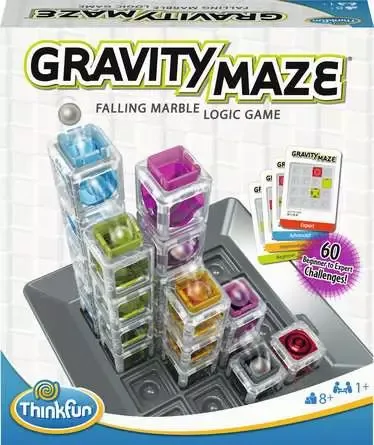
Spatial reasoning — the cognitive ability to understand, manipulate, and reason about spatial relationships — is one of the most researched domains in developmental psychology, and Gravity Maze maps onto this research more directly than almost any toy we’ve reviewed.
Spatial Reasoning and STEM Achievement. Wai, Lubinski, and Benbow (2009) analyzed data from Project TALENT, a longitudinal study of over 400,000 students, and found that spatial ability in adolescence was a significant predictor of STEM career entry and achievement decades later — even after controlling for mathematical and verbal ability.1 This finding has been replicated and extended: Uttal et al. (2013), in a meta-analysis of 217 studies, demonstrated that spatial skills are malleable (they improve with training) and that improvements transfer to STEM-related tasks.2
Gravity Maze engages multiple spatial sub-skills identified in the Uttal framework: mental rotation (imagining how a tower’s channel functions from different orientations), spatial visualization (predicting the marble’s path through a sequence of towers), and spatial relations (understanding how tower positions relate to each other on the grid). The game is, functionally, a spatial reasoning training system with a marble-run reward mechanism.
Executive Function and Planning. The challenge-solving process in Gravity Maze requires planning — the ability to think ahead, evaluate options, and select a course of action before acting. Diamond (2013) identifies planning as a complex executive function that builds on working memory (holding the spatial model), inhibitory control (resisting the impulse to try the first placement that seems right), and cognitive flexibility (revising the model when a marble path fails).3
The difficulty curve in Gravity Maze maps onto this executive function development. Beginner challenges require minimal planning (one tower, one placement option). Expert challenges require multi-step planning with contingency evaluation — the solver must mentally simulate the marble’s path through 3-4 towers before committing to a placement. This progressive challenge structure aligns with what researchers call “scaffolded practice” — gradually increasing demands on executive function capacity.
Physical vs. Digital Spatial Training. Newcombe (2010) argues that spatial reasoning development benefits from physical, hands-on manipulation of three-dimensional objects — not just screen-based spatial tasks.4 The ability to pick up a Gravity Maze tower, rotate it in your hands, peer through its channels, and physically place it on the grid engages proprioceptive and tactile feedback systems that screen-based puzzles cannot access. This isn’t digital snobbery — it’s a genuine sensory dimension of spatial learning that physical puzzles provide and digital puzzles don’t.
The Caveats. ThinkFun has not published or commissioned research on Gravity Maze specifically. The spatial reasoning benefits are inferred from the task demands of the game and the broader spatial cognition literature. We don’t have evidence that playing Gravity Maze improves spatial test scores, STEM performance, or any other measurable outcome. The connection is plausible, well-supported by the underlying science, and unvalidated for this specific product.
Additionally, the executive function claims assume the child is actually puzzle-solving (evaluating, planning, testing) rather than trial-and-erroring (randomly placing towers until the marble works). In our testing, most children naturally gravitated toward genuine problem-solving, but some younger testers (8-9) reverted to trial-and-error on difficult challenges. The cognitive benefits depend on the cognitive process the child actually employs.
The honest summary: Gravity Maze engages the specific spatial reasoning and executive function skills that decades of research link to STEM achievement. The game’s design closely mirrors spatial training paradigms used in cognitive research. No direct evidence validates this specific product’s developmental impact, but the task demands are among the best-aligned with the research of any toy we’ve evaluated.
Safety Notes
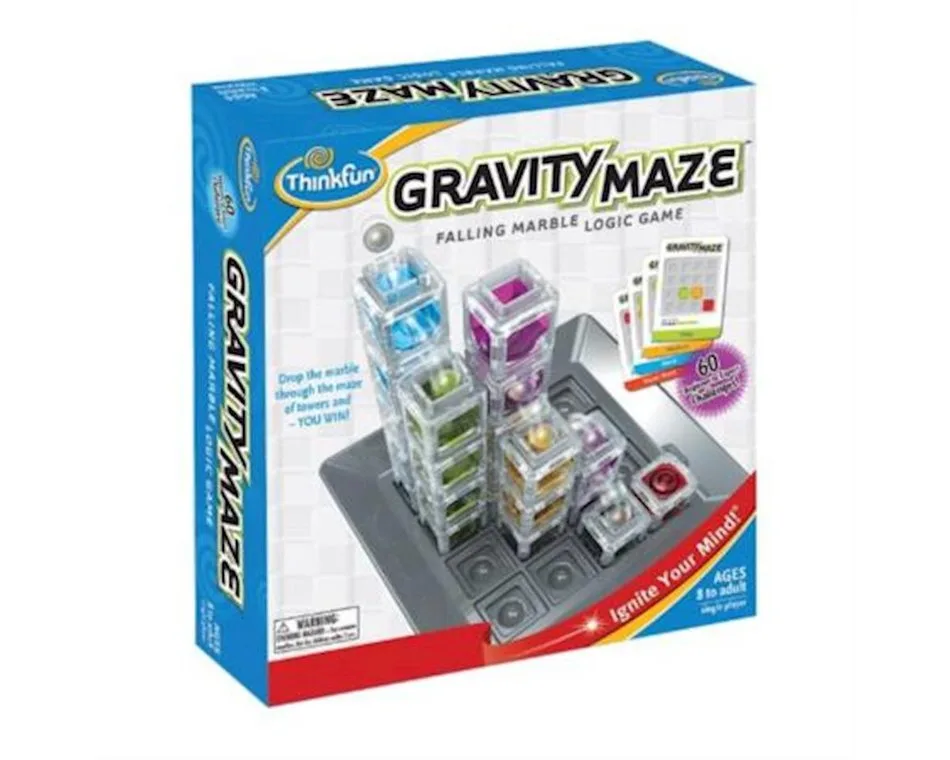
ThinkFun Gravity Maze meets ASTM F963 toy safety standards.
Safety considerations:
- Small parts warning. The steel marbles (approximately 9/16” diameter) are a choking hazard for children under 3. The 8+ age rating addresses this, but households with younger siblings should store the marbles carefully.
- Marble projectiles. Failed marble runs sometimes eject the marble from a tower at speed. The marble is small and steel. While unlikely to cause injury, it can starttle and can damage fragile items on the table. Play on a contained surface.
- Ingestion risk. Steel marbles that are swallowed require immediate medical attention. Keep count of all three marbles; replace any that go missing.
No CPSC recalls have been issued for ThinkFun Gravity Maze.
The Verdict
Gravity Maze is ThinkFun at its best — a deceptively simple concept (put towers on a grid, make the marble reach the target) that demands genuine cognitive work. The difficulty curve is expertly calibrated, the physical design supports rather than frustrates the puzzle-solving process, and the transparent towers provide the kind of visible, tangible feedback that makes abstract spatial reasoning feel concrete.
This is not a flashy toy. It doesn’t light up, make sounds, or connect to an app. It sits on a table and waits for someone to think hard. For children who enjoy that challenge — and our testing suggests most 8+ year olds do, once they push past the beginner levels — Gravity Maze provides some of the deepest cognitive play we’ve encountered at any price point.
Product Rating: 8/10 — Exceptional puzzle design with a well-calibrated difficulty curve, strong build quality, and extraordinary value. Docked for the marble-loss issue and the grid’s tendency to slide on soft surfaces.
Evidence Rating: Moderate — Spatial reasoning benefits are well-supported by decades of cognitive science research. The game’s task demands closely mirror validated spatial training paradigms. Executive function engagement is theoretically sound. No product-specific studies exist, but the alignment between the game’s demands and the research base is among the strongest we’ve seen.
Who Should Buy This
- Children ages 8+ who enjoy puzzles, logic games, or STEM activities
- Families looking for high-quality solo play that doesn’t involve a screen
- Parents seeking toys that develop spatial reasoning — a skill linked to STEM success
- Gift-givers for the “hard to buy for” child who already has enough action figures
- Families who already own ThinkFun games and want to expand the collection
Who Should Skip This
- Children under 8 — the spatial reasoning demands exceed most younger children’s capabilities
- Children who strongly prefer collaborative or social play — this is primarily a solo activity
- Families seeking open-ended creative play — Gravity Maze is structured and solution-based (try GraviTrax for the open-ended marble run experience)
- Children who become frustrated by sustained challenge — the Advanced and Expert tiers are genuinely difficult
This review reflects our independent evaluation. ScienceBasedKids.com purchased this product at retail price. We may earn a commission if you purchase through our links, which helps fund our research. This never influences our ratings.
Footnotes
-
Wai, J., Lubinski, D., & Benbow, C. P. (2009). “Spatial ability for STEM domains: Aligning over 50 years of cumulative psychological knowledge solidifies its importance.” Journal of Educational Psychology, 101(4), 817-835. Landmark analysis showing spatial ability in adolescence predicted STEM career entry 11+ years later, even after controlling for math and verbal scores. ↩
-
Uttal, D. H., Meadow, N. G., Tipton, E., Hand, L. L., Alden, A. R., Warren, C., & Newcombe, N. S. (2013). “The malleability of spatial skills: A meta-analysis of training studies.” Psychological Bulletin, 139(2), 352-402. Meta-analysis of 217 studies demonstrating that spatial skills are trainable, durable, and transferable to novel tasks. ↩
-
Diamond, A. (2013). “Executive functions.” Annual Review of Psychology, 64, 135-168. Comprehensive review of executive function development, including planning, working memory, inhibitory control, and cognitive flexibility — all engaged by Gravity Maze puzzle-solving. ↩
-
Newcombe, N. S. (2010). “Picture this: Increasing math and science learning by improving spatial thinking.” American Educator, 34(2), 29-35. Argues for the importance of hands-on, three-dimensional spatial experiences in developing spatial reasoning, beyond screen-based alternatives. ↩
Enjoyed this review? We publish two new evidence-based evaluations every week.
Free. No spam. Unsubscribe anytime.
Success defined as placing all towers correctly and having the marble reach the target on the first drop after final placement. The steep drop between Intermediate and Advanced reflects the shift from two-dimensional to fully three-dimensional spatial reasoning.
Recommended Accessories
Affiliate links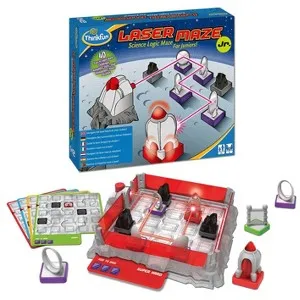
ThinkFun Laser Maze (Class 1) Brain Game
“Same brand logic puzzle with light and mirrors instead of marbles. Different STEM angle.”
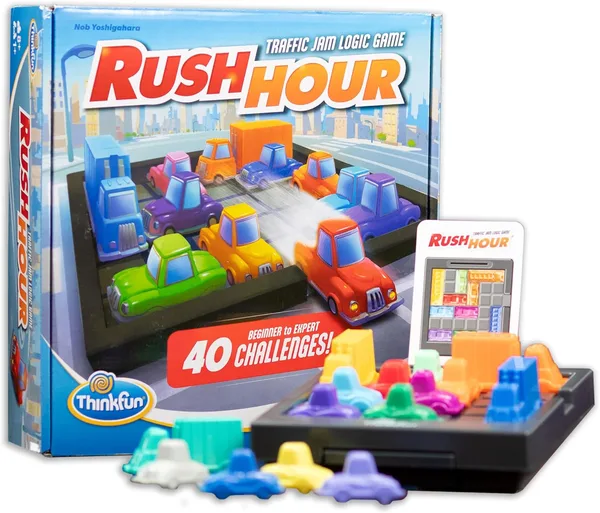
ThinkFun Rush Hour Traffic Jam Logic Game
“Classic sliding puzzle from the same brand. Different spatial challenge.”
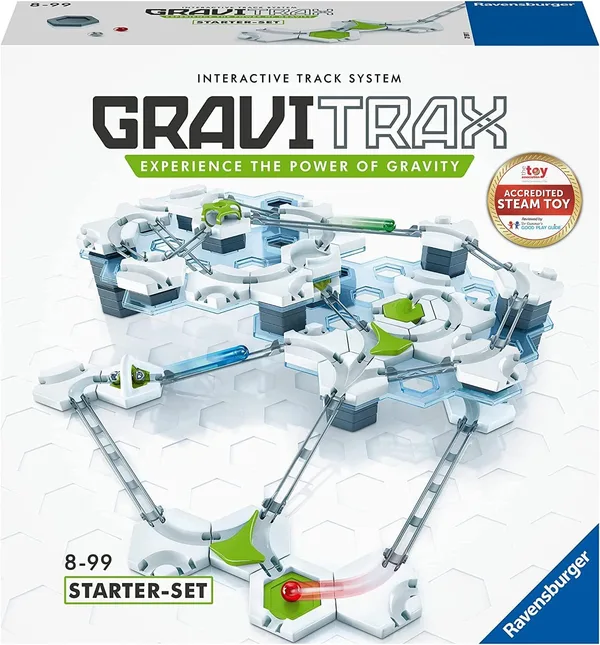
Ravensburger GraviTrax Starter Set Marble Run
“Open-ended marble run counterpart. Gravity Maze is structured; GraviTrax is creative.”

Four Brothers 1/2" Replacement Steel Balls for Gravity Maze (10-Pack)
“Marbles get lost. Chromium steel replacements sized for Gravity Maze.”