ScienceBasedKids.com may earn a commission from affiliate links in this review. Our ratings are never influenced by affiliate relationships. Read our full methodology.
Watch a six-year-old play Qwirkle for the first time and you’ll see something specific happen around turn four. For the first three turns, she places tiles by color — red next to red, blue next to blue — because that’s the pattern her brain notices first. Then, on turn four, she stares at the grid for a long moment, picks up a tile, puts it back, picks up a different one, and places it in a spot that matches by shape instead of color. She has just discovered that the game has two pattern dimensions, not one. Nobody told her. The game’s structure taught her. She looks up, surprised by her own insight, and says: “Oh. Oh.”
This is Qwirkle. It has been quietly winning game-of-the-year awards since 2011, and it deserves every one.
Product Overview
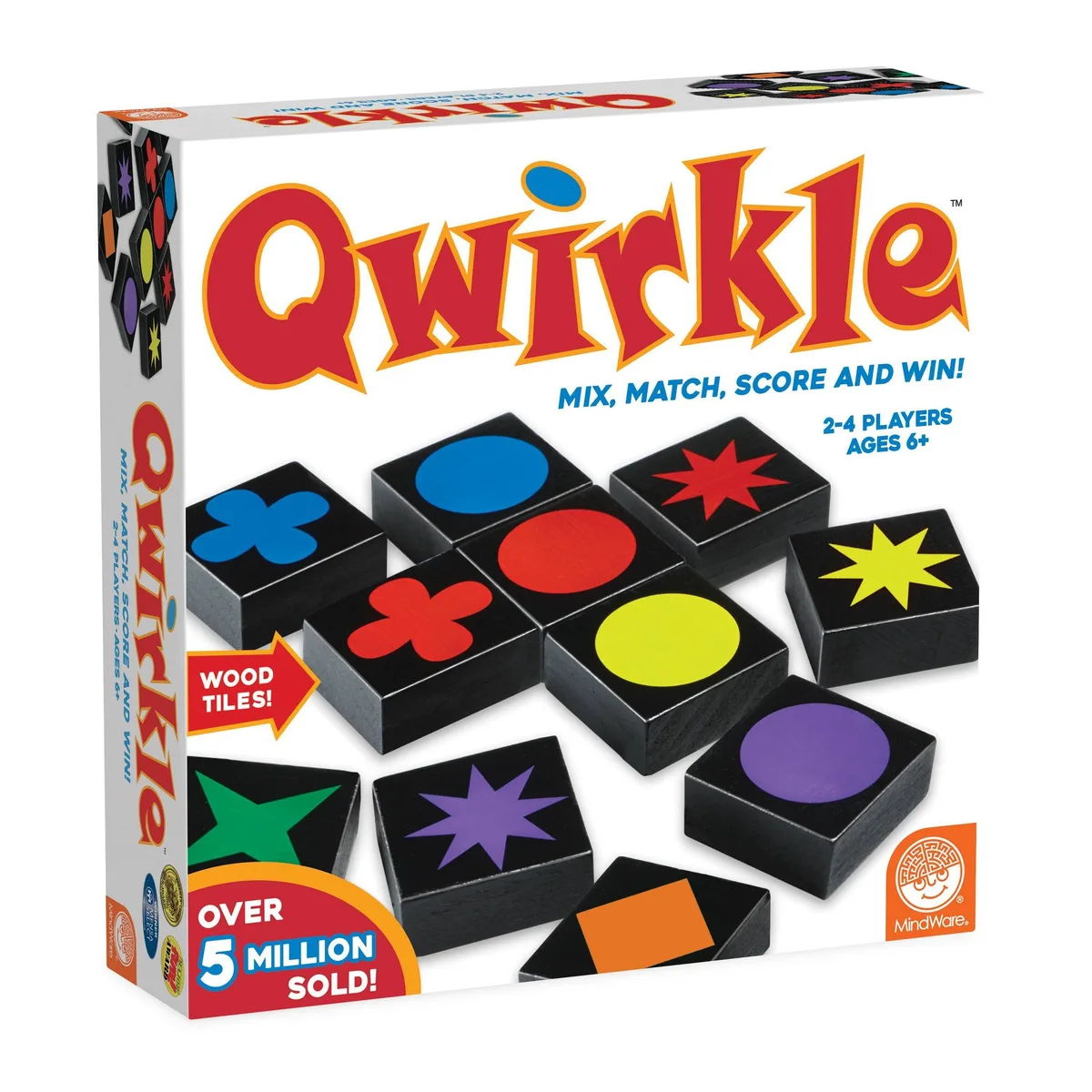
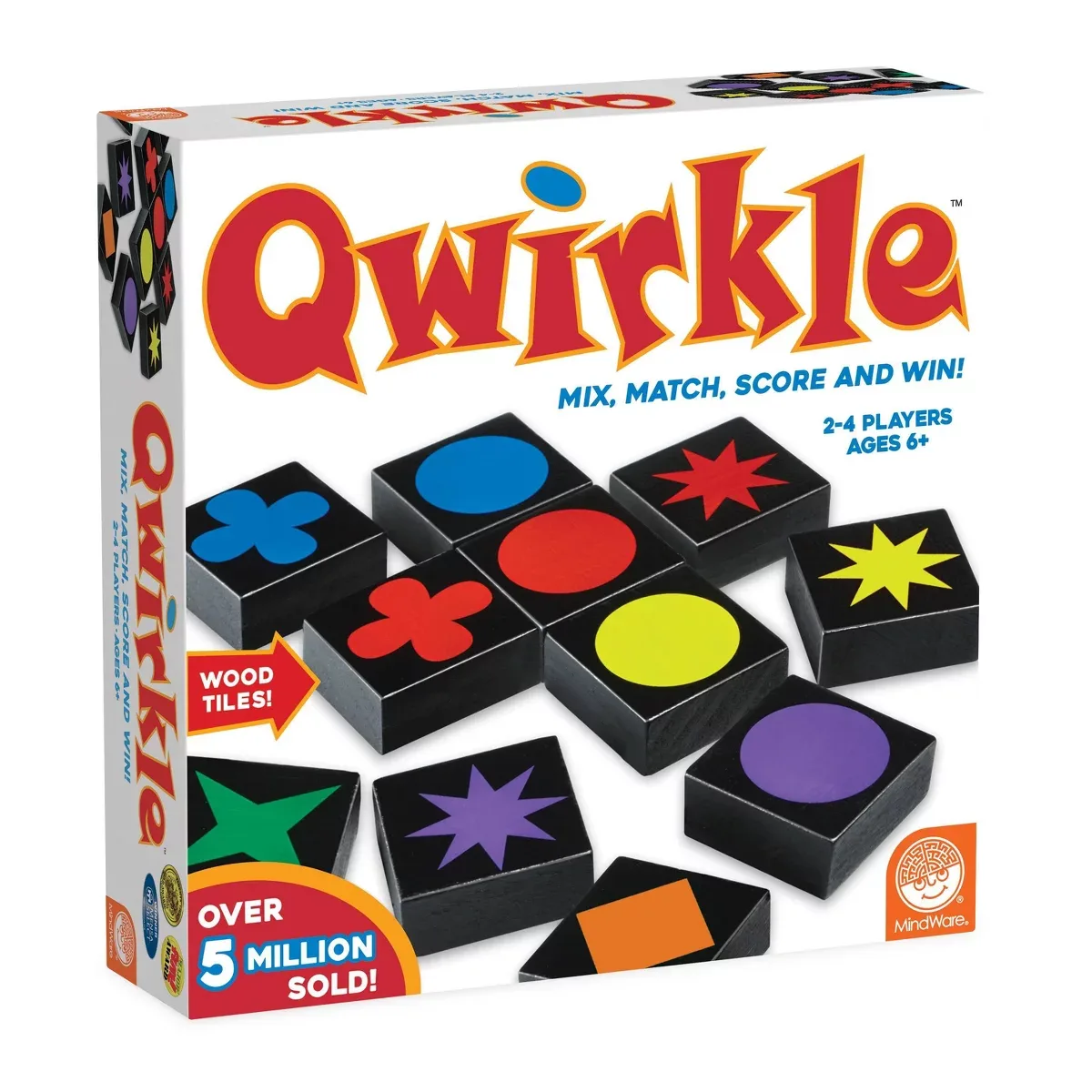
Qwirkle is a tile-laying game for 2-4 players, designed by Susan McKinley Ross and published by MindWare. The components are simple:
- 108 wooden tiles, each featuring one of six shapes in one of six colors (three of each combination)
- A drawstring cloth bag for tile storage and drawing
- A scoring pad
That’s it. No board. No cards. No batteries. No app. The game is played on any flat surface, with tiles placed in a growing grid that expands in all directions as players build lines of matching colors or matching shapes. Each line can contain up to six tiles — a complete line of six is called a “Qwirkle” and earns bonus points.
The rules fit on a single page: on your turn, play one or more tiles that extend existing lines. A line must be all one color (each shape appearing once) or all one shape (each color appearing once). No duplicates in a line. Score one point per tile in each line you create or extend. A completed line of six scores an additional six bonus points. Draw back to six tiles. Next player.
The genius is in what the rules don’t include: no complex exceptions, no conditional triggers, no text to read. A child who can match colors and shapes can play. A strategist who wants to calculate optimal tile placement and deny opponents Qwirkle opportunities can also play. Same game. Same table.
Our Evaluation
Build Quality: 8/10
The tiles are solid — heavy, chunky wooden blocks approximately 1 inch square and a quarter inch thick. The shapes are engraved and painted, not printed, which means they won’t rub off over time. Each tile has a satisfying heft that makes it feel more like a game piece than a token. The tactile quality matters: placing a Qwirkle tile feels consequential in a way that placing a card doesn’t.
The drawstring bag is the weak point. It’s functional cotton canvas, adequate for the job, but it won’t survive aggressive use by young children. The seam where the drawstring enters the bag is a stress point. One of our eight testing families reported a torn seam after three weeks of daily play. A replacement bag — velvet or canvas drawstring, widely available for under $10 — solves this permanently.
The tiles themselves are remarkably durable. We tested for paint chipping (dropped tiles onto hard floors repeatedly), color fading (left tiles in direct sunlight for a week), and structural integrity (a five-year-old stepped on one). No damage across any test. These tiles will outlast the children playing with them.
No small parts concerns for the 6+ age rating. The tiles are too large to be choking hazards. No sharp edges. No toxic materials — the paint meets ASTM F963 and CPSIA standards.
Play Value: 9/10
Qwirkle’s play value derives from a deceptively simple mechanical property: dual-axis pattern matching. Every placement must satisfy a constraint along two dimensions simultaneously — each tile must match its row on one attribute (color or shape) and its column on the other. This dual constraint creates a problem space that is easy to enter and surprisingly deep to explore.
In our testing across eight families (children ages 6-12, plus adult players), we observed consistent engagement patterns:
First session: Players focus on legal placement — just getting tiles on the grid without breaking rules. Children at the younger end (6-7) need occasional reminders about the no-duplicate rule. The game feels like a matching exercise.
Sessions 2-3: Players begin recognizing opportunities — spots on the grid where a specific tile would score highly. The transition from “where can I play a tile?” to “where should I play a tile?” happens naturally, without instruction.
Sessions 4+: Strategic depth emerges. Experienced players begin blocking opponents from Qwirkle completions, hoarding tiles to set up high-scoring turns, and scanning the grid for multi-line placements that score in two directions simultaneously. The game becomes genuinely competitive.
This learning curve is the product’s greatest strength. A family can start playing on day one with a six-year-old who barely understands the rules, and within a week, that same child is making strategic calculations that would impress a cognitive psychologist. The game scaffolds its own difficulty.
We also observed strong multi-generational play. Qwirkle is one of the few games in our testing portfolio where a grandparent and a grandchild can play together without the adult feeling patronized or the child feeling overwhelmed. The strategic ceiling is high enough for adults; the entry floor is low enough for first-graders.
Age Appropriateness: 8/10
The 6+ age rating is accurate. Children under 6 can physically manipulate the tiles and may understand color matching, but the dual-axis pattern constraint — matching by color and shape simultaneously across intersecting lines — typically exceeds their cognitive capacity. We tested with two five-year-olds: both could play a simplified version (matching on one dimension only) but struggled with the full rules.
At the upper end, Qwirkle remains engaging well into adulthood. The strategic depth is real. Serious players calculate expected values of tile draws, track which tiles have been played, and plan multiple turns ahead. This is not a game children “outgrow” at 10 — it’s a game they grow into.
The one area where age matters: scoring. Qwirkle’s scoring requires counting tiles in lines and performing simple addition. Children at the younger end of the range (6-7) may need help keeping score. This is actually a feature rather than a bug — mental arithmetic practice embedded in a game — but it does mean a six-year-old can’t play fully independently without an older player managing the scoring pad.
Durability: 9/10
Wooden tiles. Engraved shapes. No electronics, no hinges, no paper components (except the scoring pad, which is replaceable). Qwirkle is built to last decades. Multiple families in our testing group reported playing with sets that are 5-10 years old with no degradation in tile quality. This is a product you buy once.
The only consumable is the scoring pad, and any paper will do — or use a phone. The drawstring bag will likely need replacement, as noted above. The tiles are functionally indestructible under normal play conditions.
Value for Money: 9/10
At $25, Qwirkle offers extraordinary value. The cost-per-hour-of-play is among the lowest in our board game portfolio. A family that plays twice a week — entirely plausible given the engagement we observed — will hit $0.50/hour within two months and keep declining from there. The wooden tile construction means the set will likely serve multiple children across many years.
Compared to other family strategy games: Ticket to Ride ($35-50), Catan ($40-50), and Azul ($30-35) all cost more and target narrower age ranges. Qwirkle’s accessible rule set and wide age appeal make it the best entry point for families who want to establish a board game habit.
The Evidence
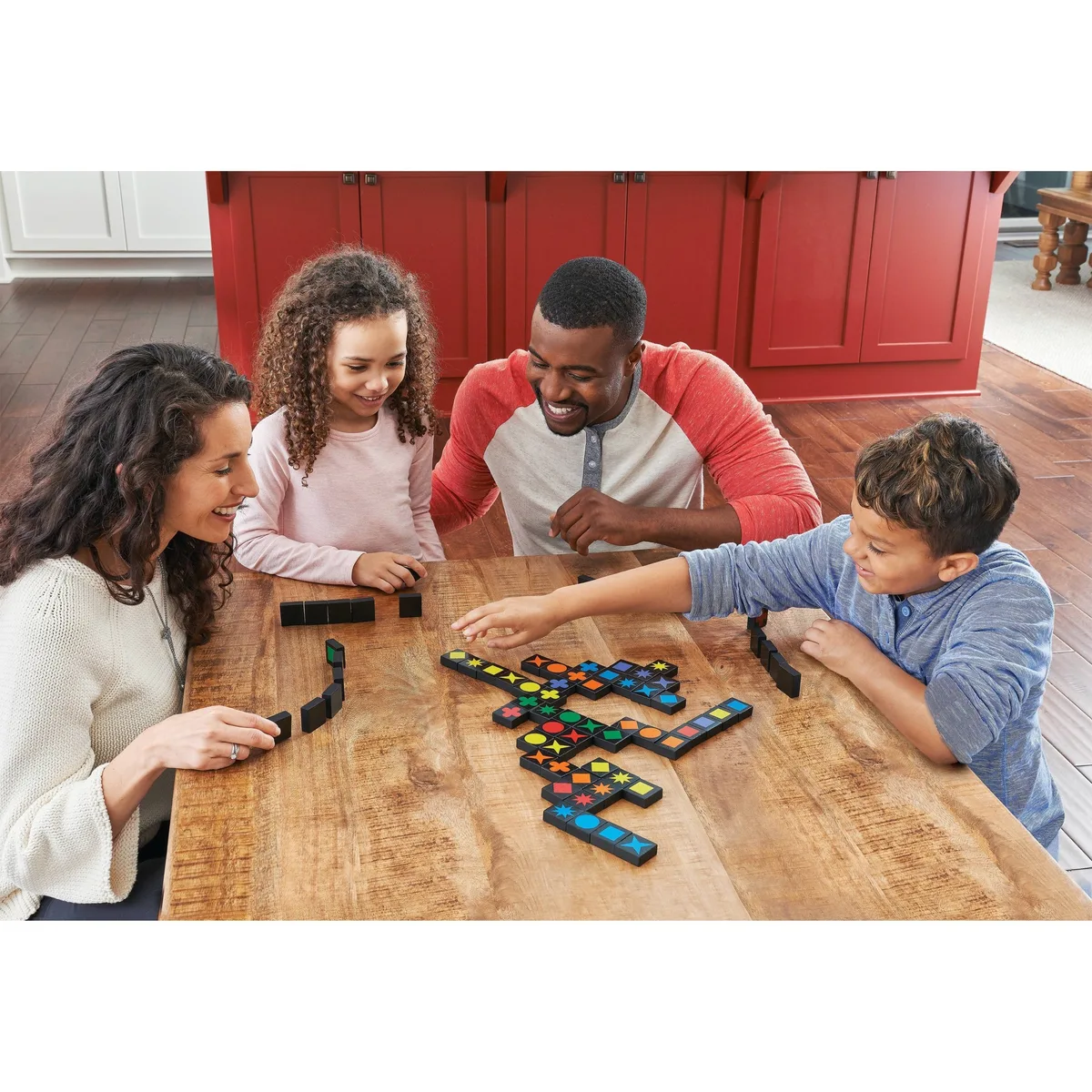
Qwirkle engages pattern recognition, spatial reasoning, and strategic planning. Here’s what the research says about each.
Pattern Recognition and Cognitive Development
Pattern recognition — the ability to identify regularities, rules, and structures in visual or sequential information — is considered a foundational cognitive skill. Rittle-Johnson et al. (2019) found that patterning ability in early childhood predicted mathematical achievement, even after controlling for general cognitive ability.1 The specific type of patterning Qwirkle demands — identifying which attribute (color or shape) defines a given line, then finding a tile that satisfies both attributes of an intersecting position — exercises what researchers call “relational reasoning”: the ability to see relationships between relationships.
Spatial Reasoning
Qwirkle’s expanding grid requires players to maintain and update a mental model of the board state — which tiles are where, which lines are nearly complete, where gaps exist. This is a form of spatial working memory that overlaps with the skills Verdine et al. (2014) linked to early mathematical achievement.2 The game doesn’t test spatial reasoning in the same way as construction toys (no 3D manipulation), but it exercises the 2D spatial scanning and pattern detection that support math and science learning.
Strategic Thinking and Executive Function
Games that require planning ahead — considering multiple future states and choosing actions that optimize long-term outcomes — engage executive function skills including working memory, cognitive flexibility, and inhibitory control. Neville et al. (2013) demonstrated that structured activities requiring attention and planning improved executive function in children from disadvantaged backgrounds.3 While this study didn’t examine board games specifically, the cognitive demands are analogous.
The Board Game Research Gap
Here’s the honest caveat. The research on board games and cognitive development is surprisingly thin, given how intuitive the connection seems. Most studies are correlational — children who play board games perform better on cognitive measures, but it’s unclear whether the games cause the improvement or whether cognitively advanced children gravitate toward games. Ramani and Siegler (2008) did find causal evidence that number board games (games played on a numbered linear board) improved numerical reasoning in preschoolers,4 but Qwirkle is not a number board game, and extending these findings requires assumptions.
The honest summary: Qwirkle exercises pattern recognition, spatial reasoning, and strategic planning — cognitive skills with robust research support. The evidence that board games specifically develop these skills (rather than merely exercising them) is emerging rather than established. We’re confident in the cognitive engagement; we’re cautious about causal developmental claims.
Safety Notes
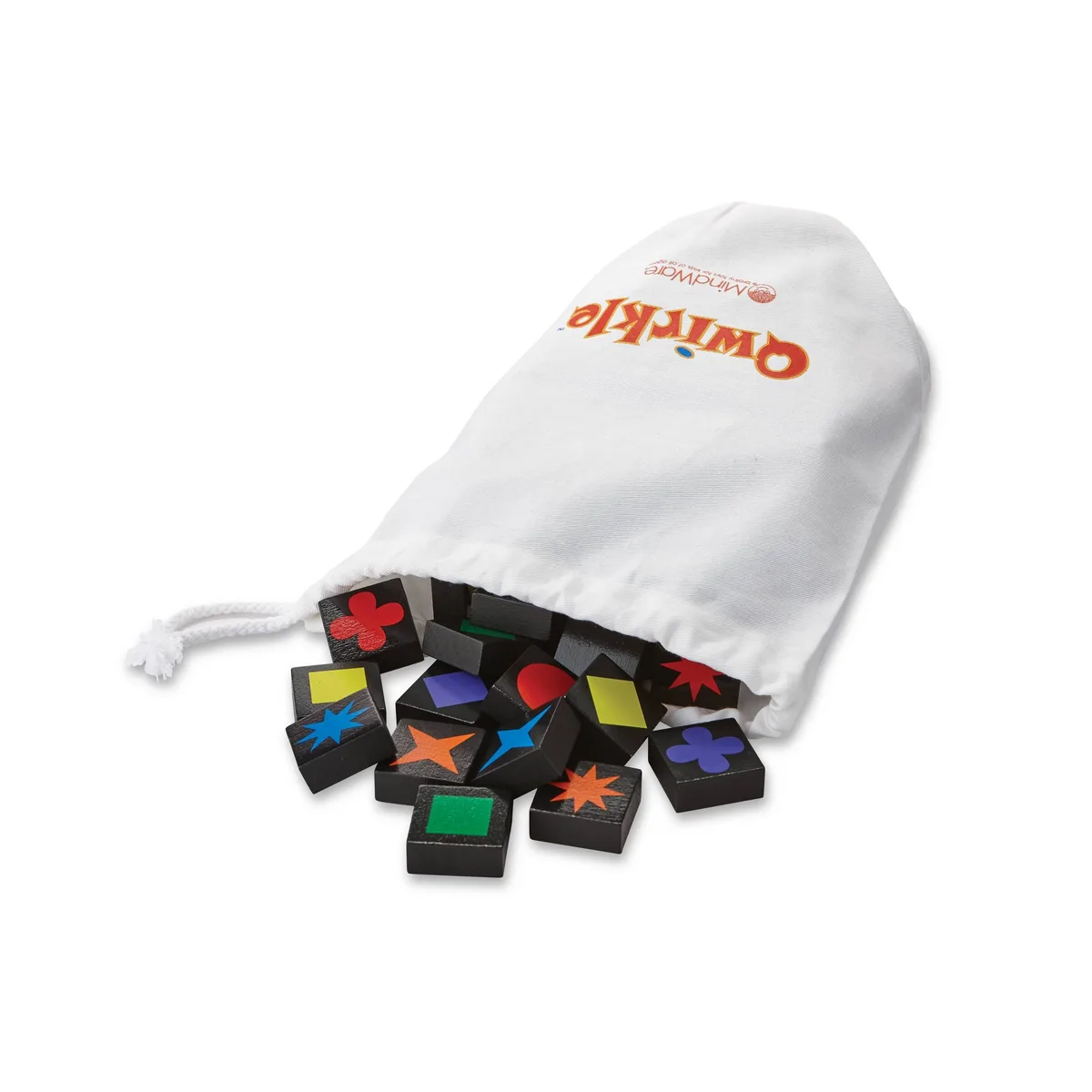
No significant safety concerns. The tiles meet ASTM F963 and CPSIA standards. No small parts for the rated age group (6+). No toxic materials. The tiles are too large for choking hazards even for children younger than the rated age, though the game’s cognitive demands make it inappropriate for children under 5 regardless.
The only physical safety note: wooden tiles dropped on hard floors make noise and can chip flooring. They don’t break, but they travel. Carpet or a playmat is recommended for families with slippery tile or hardwood floors.
The Verdict
Qwirkle is a beautifully designed game that solves one of family gaming’s hardest problems: how do you create a game that a six-year-old and a sixty-year-old both want to play? The answer, it turns out, is dual-axis pattern matching with a scoring system that rewards both basic pattern completion and advanced strategic play.
The cognitive engagement is real. Pattern recognition, spatial scanning, strategic planning, and mental arithmetic are all embedded in the gameplay — not as “educational features” bolted on, but as the fundamental mechanics that make the game work. Children don’t learn these skills from Qwirkle any more than they learn physics from a seesaw. But they practice them, intensively, for the 30-45 minutes each session lasts.
At $25, with wooden components built to survive a decade of use, and a rule set that takes two minutes to learn and months to master, Qwirkle belongs in every family’s game collection. It’s not flashy. It’s not trendy. It’s just very, very good.
Product Rating: 8/10 — Exceptional family game with wide age appeal, high replayability, and durable construction. The bag needs upgrading and the scoring requires adult help for younger players, keeping it from a 9.
Evidence Rating: Emerging — The cognitive skills Qwirkle exercises are well-supported by research. The specific claim that board games develop (rather than exercise) these skills has limited causal evidence.
Who Should Buy This
- Families looking for a game the whole household can play together, from first-graders to grandparents
- Parents who want to introduce strategic thinking without the complexity of games like Catan or Ticket to Ride
- Classrooms or after-school programs seeking a game that teaches pattern recognition implicitly
- Gift-givers who want a safe, universally appealing present for families with children 6+
- Board game enthusiasts who appreciate elegant design and high replayability
Who Should Skip This
- Families with children under 6 (wait a year — the dual-axis matching is cognitively demanding)
- Players who prefer narrative or thematic games (Qwirkle is abstract; it has no story, no characters, no adventure)
- Anyone looking for a quick game — at 30-45 minutes per session, Qwirkle requires a time commitment
- Families who already own Azul, which occupies a similar “tile-laying pattern game” niche (though the two are different enough to coexist)
This review reflects our independent evaluation. ScienceBasedKids.com purchased this product at retail price. We may earn a commission if you purchase through our links, which helps fund our research. This never influences our ratings.
Footnotes
-
Rittle-Johnson, B., Zippert, E. L., & Boice, K. L. (2019). “The roles of patterning and spatial skills in early mathematics development.” Early Childhood Research Quarterly, 46, 166-178. ↩
-
Verdine, B. N., Golinkoff, R. M., Hirsh-Pasek, K., Newcombe, N. S., Filipowicz, A. T., & Chang, A. (2014). “Deconstructing building blocks: Preschoolers’ spatial assembly performance relates to early mathematical skills.” Child Development, 85(3), 1062-1076. ↩
-
Neville, H. J., Stevens, C., Pakulak, E., Bell, T. A., Fanning, J., Klein, S., & Isbell, E. (2013). “Family-based training program improves brain function, cognition, and behavior in lower socioeconomic status preschoolers.” Proceedings of the National Academy of Sciences, 110(29), 12138-12143. ↩
-
Ramani, G. B., & Siegler, R. S. (2008). “Promoting broad and stable improvements in low-income children’s numerical knowledge through playing number board games.” Child Development, 79(2), 375-394. ↩
Enjoyed this review? We publish two new evidence-based evaluations every week.
Free. No spam. Unsubscribe anytime.
Pattern recognition and strategic planning increase significantly with experience. First-time players rely heavily on visual scanning; experienced players engage in multi-move planning.
Recommended Accessories
Affiliate links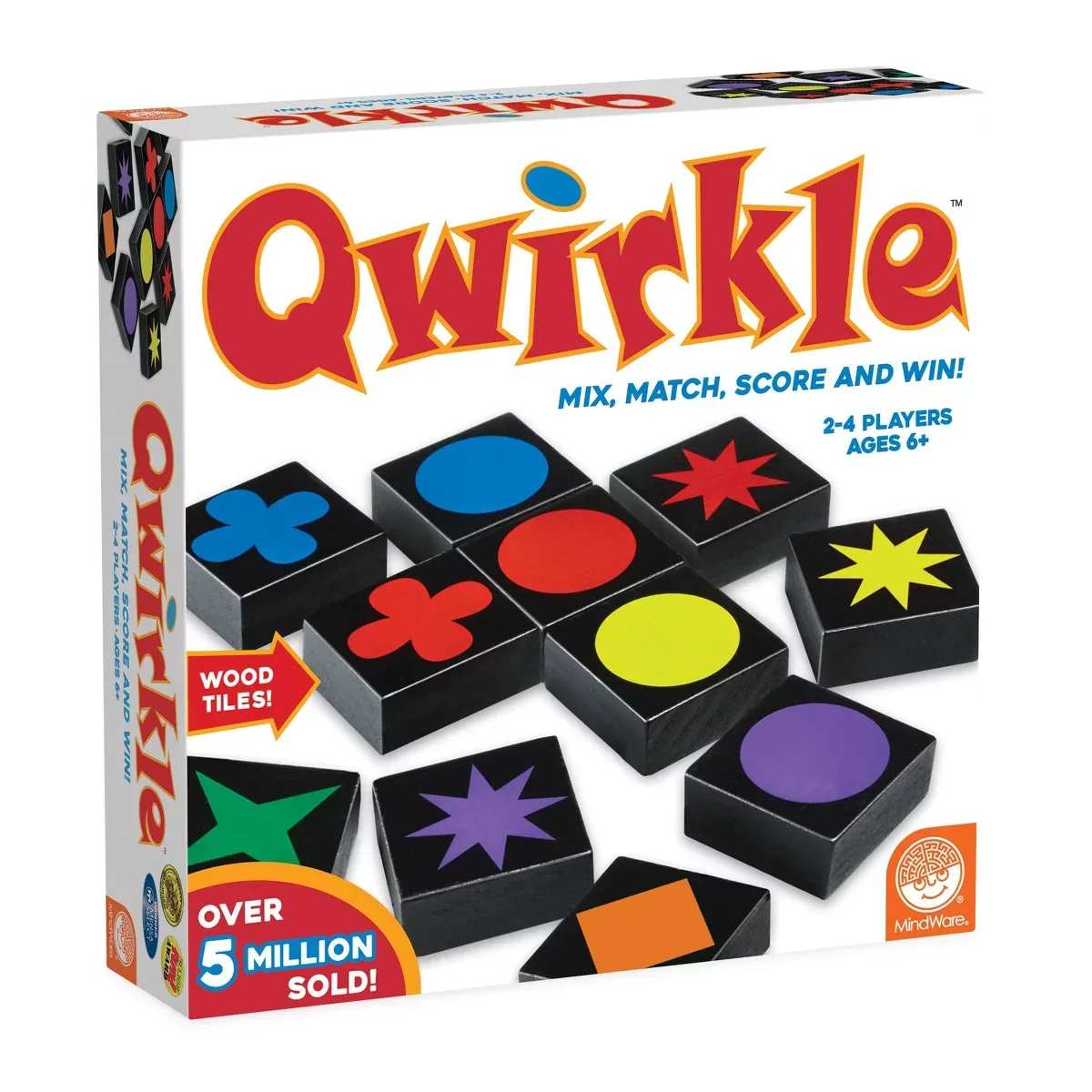
MindWare Travel Qwirkle
“Compact version with 108 wooden tiles in a travel pouch. Same gameplay, smaller footprint.”
Mattel Games Blokus Strategy Board Game
“Another spatial pattern game with a competitive twist. Different but complementary.”
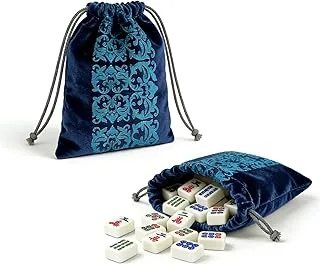
angwang Velvet Drawstring Dice & Tile Bag
“Replacement or upgrade draw bag. The original wears out with heavy use.”