ScienceBasedKids.com may earn a commission from affiliate links in this review. Our ratings are never influenced by affiliate relationships. Read our full methodology.
”It’s NOT the fox with the umbrella.” My five-year-old said this with the certainty of a homicide detective eliminating a suspect. She slid the clue card into the Evidence Scanner — a small plastic decoder that reveals which attributes the thief has — and watched one of three windows show green. “Green means YES. The thief has a walking stick. The umbrella fox doesn’t have a walking stick. So it’s NOT that fox.” She removed the suspect card from the board and turned to her seven-year-old brother. “We should go to that clue next, because three foxes have walking sticks and we need to know if the thief has glasses.” She was five. She was using process of elimination. She was coordinating strategy with a teammate. And she was doing all of this because a game about a fox who stole a pie made deductive reasoning feel like the most exciting thing in the world.
Product Overview
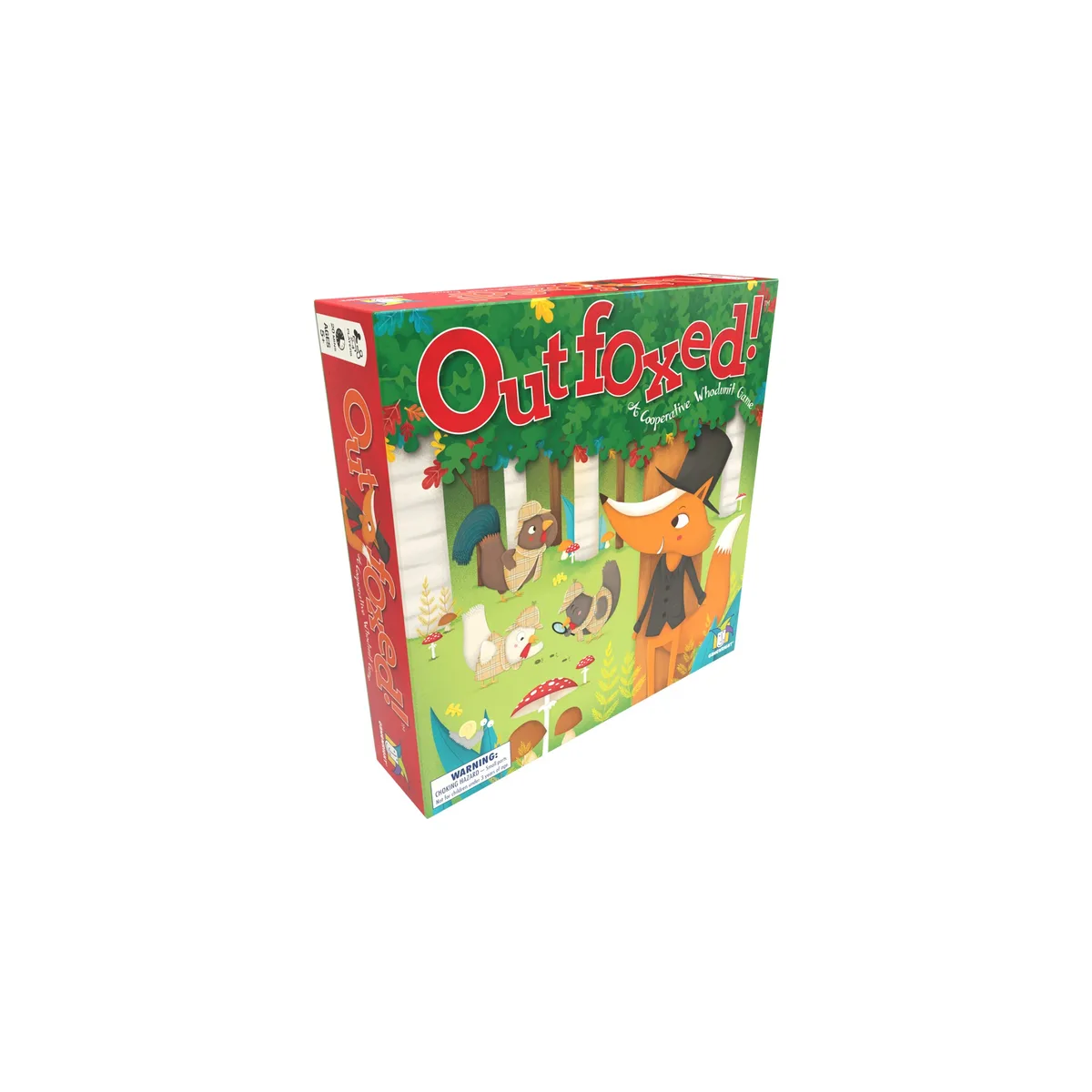
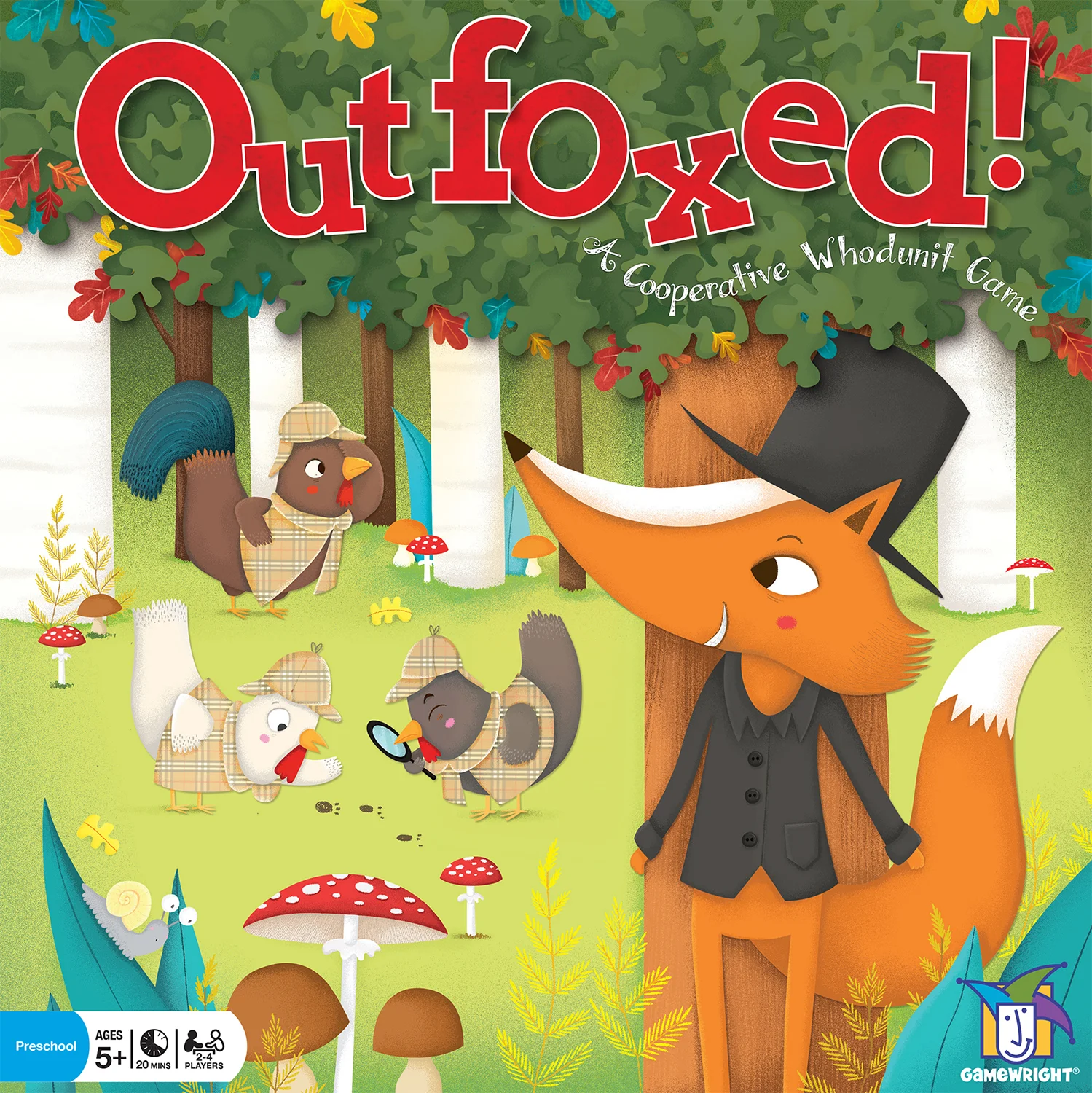
Outfoxed! is a cooperative deduction game for 2-4 players ages 5 and up, designed by Marisa Peña and published by Gamewright. Games last approximately 20 minutes. The premise: a fox has stolen Mrs. Plumpert’s prize-winning pie, and players must work together to identify the thief before the fox escapes.
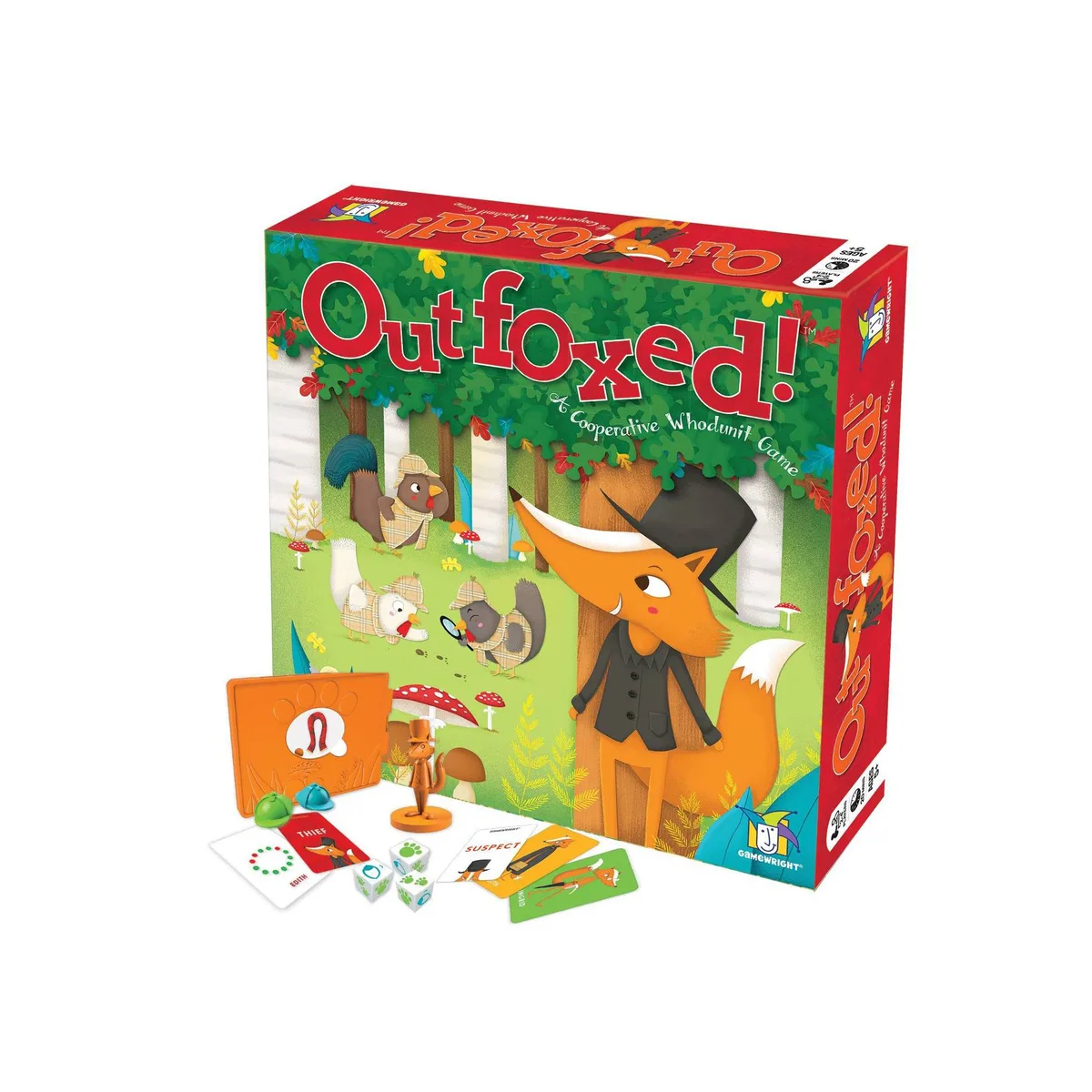
In the box:
- 1 game board — a path showing the fox’s escape route
- 16 suspect cards — foxes with different combinations of accessories (hat, scarf, glasses, umbrella, walking stick, etc.)
- 12 clue tokens — each reveals one attribute the thief has (or doesn’t have)
- 1 Evidence Scanner — a plastic decoder device that “reads” clue cards
- 3 dice — custom dice with paw prints and eye symbols
- 1 fox figurine — moves along the escape path
- 1 thief card holder — secretly holds the identity of the thief
On each turn, a player declares whether they’ll search for clues or reveal suspects, then rolls the dice. Success lets them take the chosen action; failure moves the fox closer to escape. When clue tokens are collected, players slide them into the Evidence Scanner, which reveals through green (yes) or blank (no) windows whether the thief has that attribute. Players collectively use this evidence to eliminate suspects until only the thief remains.
The game ends when either the players correctly identify the thief (victory) or the fox reaches the end of the escape path (defeat).
Our Evaluation
Build Quality: 7/10
Outfoxed!‘s standout component is the Evidence Scanner. This small plastic device has a slot where clue cards are inserted, and three windows that reveal green dots (the thief has this attribute) or remain blank (they don’t). The mechanism is simple — it’s essentially a shaped card reader with colored backing — but it produces a satisfying “aha” moment every time a clue is decoded. Children treat it with the reverence of a forensic tool. The physical act of sliding a card into the scanner and checking the windows creates a ritualistic beat in the gameplay that enhances the detective narrative.
The suspect cards are thick cardboard with clear, distinctive illustrations. Each fox has a unique combination of accessories, and the art makes these accessories easy to identify at a glance — important for children who are scanning multiple suspects simultaneously. The fox illustrations are charming without being cutesy: these are fox suspects, not fox friends.
The game board is sturdy standard cardstock. The dice are custom-molded with clear symbols. The fox figurine is a simple plastic piece — functional rather than spectacular.
The box insert is adequate. Pieces have designated spots, and the Evidence Scanner stores securely. The suspect cards could benefit from a small bag or elastic band to prevent migration.
Play Value: 9/10
Outfoxed! does something that very few children’s games accomplish: it creates genuine intellectual challenge within a cooperative framework. The deductive elimination mechanic — the core of the game — asks children to hold multiple possibilities in mind, integrate new evidence, and narrow a set of suspects through logical reasoning. This is not a simplified version of deduction; it is actual deduction, with the complexity calibrated for young minds.
The cooperative structure transforms the deduction into a social activity. Players discuss evidence, share reasoning, and collectively decide which clue to pursue next. A typical exchange sounds like: “The thief has a flower. Which foxes have flowers? That one, that one, and that one. So we can remove all the foxes WITHOUT flowers.” This verbalized reasoning — thinking out loud with peers — is extraordinarily valuable for developing logical language.
The dice mechanic adds tension without frustration. On each turn, the player must roll a specific combination to take their chosen action. Failure doesn’t lose the turn — it advances the fox along the escape path, creating time pressure. This pressure motivates urgency in the deduction process without punishing individual players. You don’t lose because you rolled badly; the team runs out of time because the fox keeps moving. It’s a subtle but important distinction for five-year-olds’ emotional regulation.
Game length is perfectly calibrated at 20 minutes. Short enough that a loss doesn’t sting for long, short enough that “let’s play again” is easy, long enough that the deductive process has room to develop.
The replay value is substantial. The thief is randomly selected from 16 suspects, and the clue distribution changes each game. No two games follow the same deductive path. Our testers played 15 games over three weeks without the gameplay feeling repetitive.
Age Appropriateness: 8/10
The 5+ age rating is accurate. At five, children can understand the rules, participate meaningfully in the deduction process, and experience the thrill of eliminating suspects. The cognitive demands are real — a five-year-old working through Outfoxed! is at the edge of their reasoning ability — but the cooperative format means older players can scaffold the younger ones’ thinking without taking over.
The sweet spot is 5-8. At this range, the deductive reasoning is challenging enough to be engaging but not so difficult that it produces frustration. Children visibly improve their deductive skills across multiple games — the first game involves some confused guessing, but by the third or fourth game, five-year-olds are making genuine logical eliminations based on evidence.
Above age 9 or 10, the deduction becomes straightforward and the game loses its challenge. By this point, children are ready for more complex deduction games (Clue, Forbidden Island, Mysterium). Outfoxed! is designed as a gateway, and it serves that function well.
Durability: 7/10
The Evidence Scanner is the durability concern. It’s a plastic mechanism with moving parts, and while our test copies survived six months of regular play without issues, the slot where clue cards are inserted shows wear over time. Cards that are forced in at an angle can stress the mechanism.
The suspect cards and clue tokens are thick cardboard that handles well. The dice are indestructible. The board is standard quality.
Value for Money: 9/10
At $18 for a game that provides genuine cognitive challenge, cooperatively structured social play, and substantial replayability, Outfoxed! offers excellent value. It sits in the “birthday gift sweet spot” — affordable enough to give without deliberation, quality enough to be appreciated, and replayable enough to justify shelf space.
The Evidence
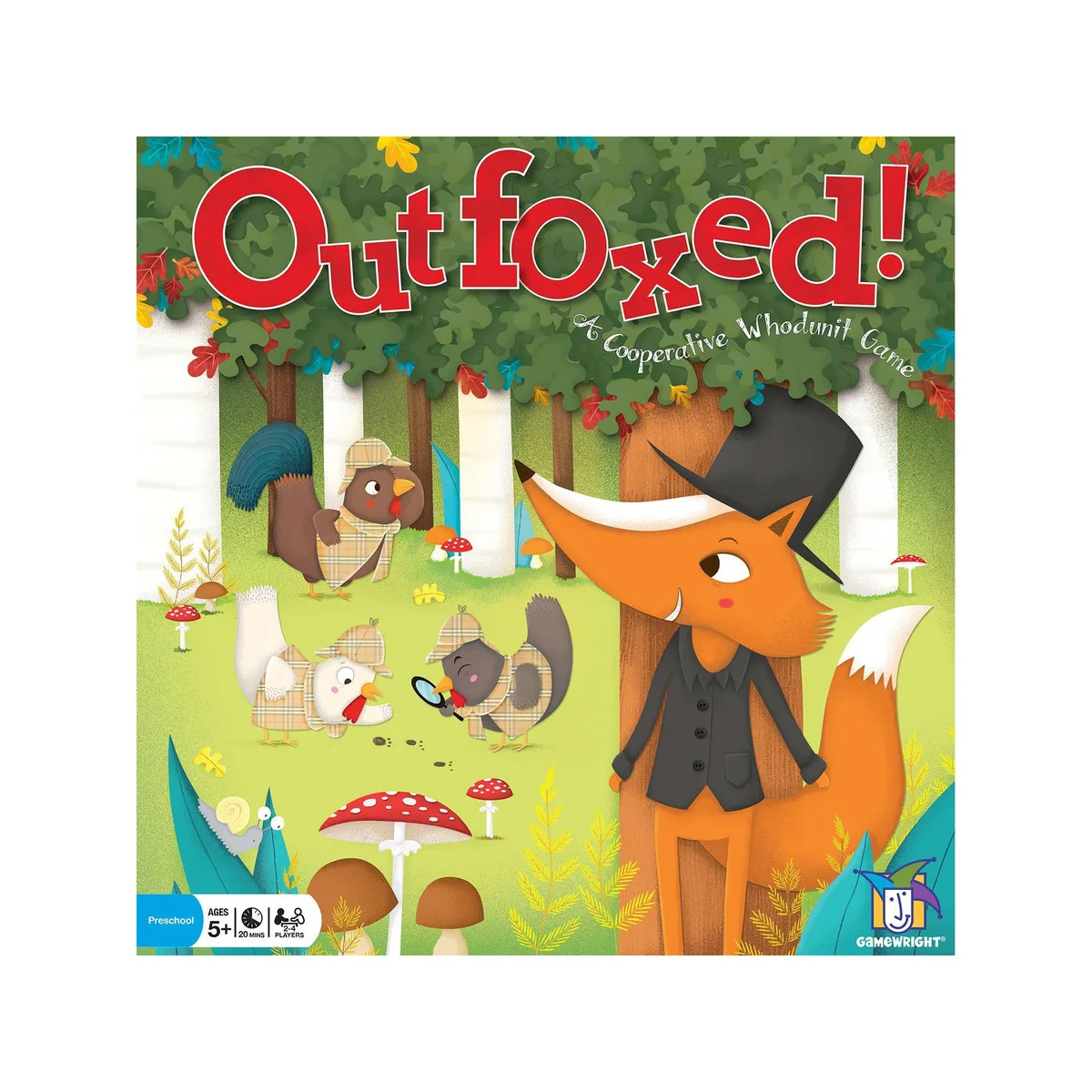
Outfoxed!‘s developmental value centers on deductive reasoning, cooperative social cognition, and the verbalization of logical thinking.
Deductive Reasoning Development. Piaget (1958) identified formal operational thinking — the ability to reason logically from premises to conclusions — as developing in middle childhood, with precursors appearing in the preoperational stage (ages 2-7).1 Outfoxed!‘s process-of-elimination mechanic provides structured practice in this precursor reasoning. The game doesn’t require formal logical notation, but it does require the underlying cognitive operation: “If the thief has attribute X, then all suspects without attribute X can be eliminated.”
Markovits and Barrouillet (2002) found that conditional reasoning in children improves significantly between ages 5 and 8, particularly when practiced in concrete, meaningful contexts.2 Outfoxed! provides exactly such a context — the deduction is concrete (physical cards), meaningful (solving a mystery), and emotionally engaging (the fox is getting away!). These conditions are more favorable for reasoning development than abstract logic exercises.
Cooperative Games and Prosocial Behavior. Zagal, Rick, and Hsi (2006) examined cooperative games and found that they produce different social dynamics than competitive games: more sharing of information, more coordinated strategizing, more verbalized reasoning, and less social comparison.3 Outfoxed! exemplifies these findings. In our testing, players naturally shared their observations (“I notice that fox has glasses”), proposed strategies (“we should get that clue next”), and explained their reasoning (“because three suspects have glasses and if the thief doesn’t, we eliminate three at once”). This collaborative discourse is qualitatively different from competitive gameplay and exercises different social-cognitive skills.
Verbalized Reasoning and Cognitive Development. Vygotsky (1978) proposed that cognitive development occurs first on the social plane — through dialogue with others — before being internalized as individual thought.4 Outfoxed!‘s cooperative structure creates a natural context for verbalized reasoning. When a child explains their elimination logic to teammates, they’re not just communicating — they’re constructing their understanding through language. The act of explaining makes the reasoning more explicit and more available for refinement.
This is distinct from competitive deduction games (like Clue), where strategic reasoning is private — you don’t share your deductions with opponents. In Outfoxed!, all reasoning is shared, which means all reasoning is practiced aloud. For children who are developing logical language, this distinction matters.
Theory of Mind and Information Sharing. Successful cooperative play requires understanding that teammates have different information than you do and actively sharing your observations to build collective knowledge. This exercises theory of mind — the same cognitive skill developed through social interaction, pretend play, and narrative understanding.5 Outfoxed! creates structured opportunities for this information sharing within a game context.
The honest summary: Outfoxed!‘s deductive mechanics align well with the developmental literature on early logical reasoning, cooperative games, and verbalized thinking. No studies have examined Outfoxed! specifically, but the cognitive demands the game creates are well-characterized in the research. The cooperative format is supported by evidence as producing different (and valuable) social-cognitive dynamics compared to competitive games.
Safety Notes
Outfoxed! meets ASTM F963 and CPSIA safety standards. The dice and clue tokens are small enough to present a choking hazard for children under 3. The 5+ age rating is appropriate.
The Evidence Scanner has no sharp edges or pinch points. The clue card slot is wide enough to prevent finger entrapment.
No CPSC recalls have been issued for Outfoxed!.
The Verdict
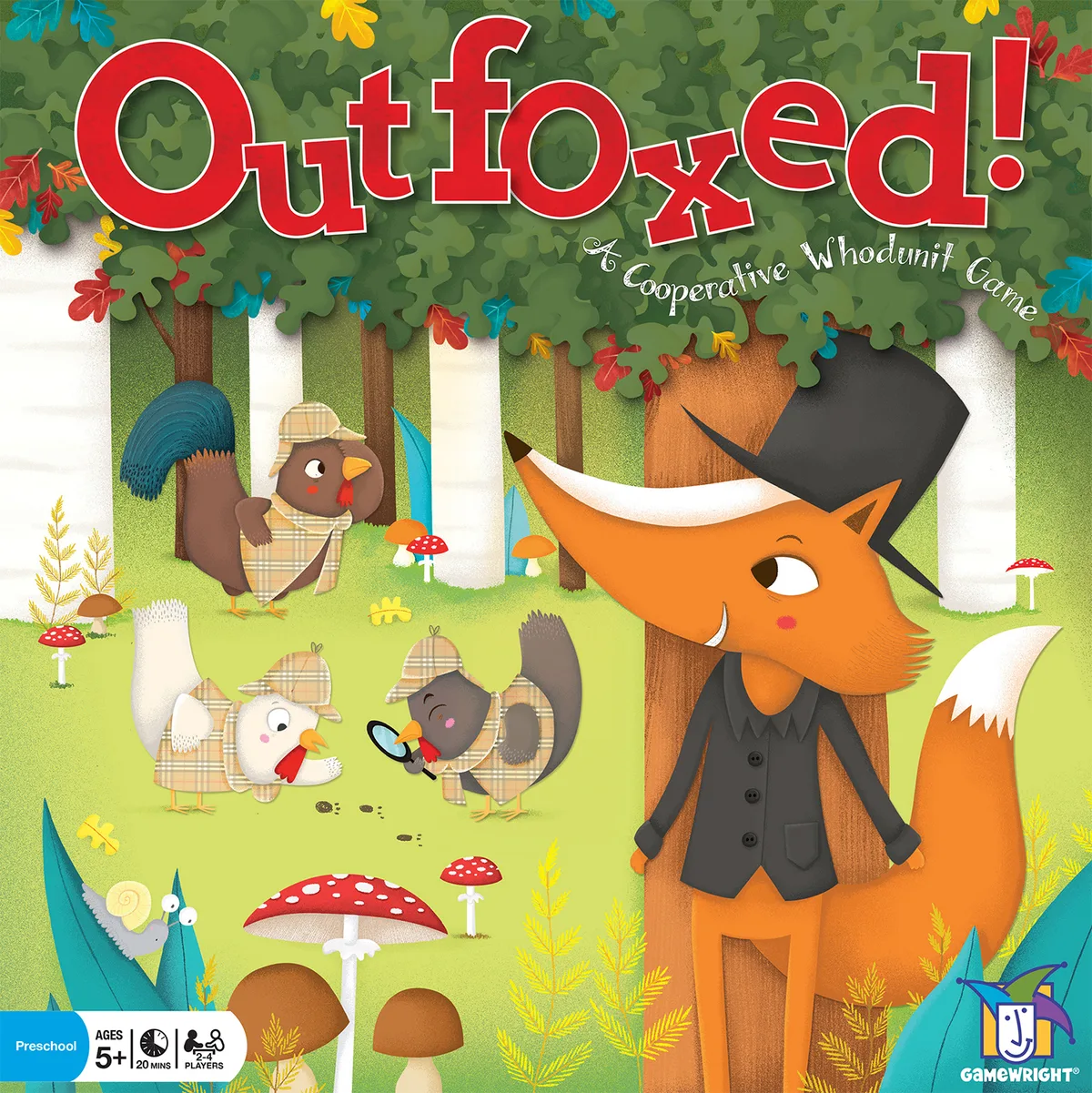
Outfoxed! belongs in the conversation about the best children’s board games because it does something unusual: it makes deductive reasoning cooperative. In most mystery and deduction games, the reasoning is private and competitive — you’re trying to figure it out before other players do. In Outfoxed!, the reasoning is shared and collaborative — you’re trying to figure it out together before the clock runs out. This collaborative deduction creates a fundamentally different cognitive and social experience, one where children practice explaining their logic, evaluating evidence with peers, and building collective understanding.
The Evidence Scanner is a small stroke of design genius. It transforms abstract logical operations into a physical, ritualistic experience — slide the card, check the windows, announce the finding. Children treat it like a real forensic tool because, within the game’s logic, it is one. The physical mechanism makes deduction tangible.
Product Rating: 8/10 — Excellent cooperative deduction mechanics, strong replay value, clever physical components, and an ideal difficulty curve for ages 5-8. Docked slightly for limited longevity above age 10 and component quality that’s good but not premium.
Evidence Rating: Moderate — Deductive reasoning development, cooperative play benefits, and verbalized thinking are all supported by the developmental literature. No direct product studies, but strong alignment between the game’s mechanics and researched cognitive processes.
Who Should Buy This
- Families with children ages 5-8 looking for a cooperative game with genuine intellectual challenge
- Parents who play competitive games and want a cooperative alternative for younger children
- Siblings with age gaps — the cooperative format lets older children scaffold younger ones
- Families who enjoy mystery stories and want that experience in a game
- Gift-givers for 5-7 year old birthdays — universally appealing and immediately playable
Who Should Skip This
- Families looking for competitive deduction — try Clue Junior for a competitive alternative
- Children over 10 who will find the deduction too simple
- Families who already own Hoot Owl Hoot and want strategic variety rather than another cooperative game (try Catan Junior for competitive strategy)
- Players who want a long game — at 20 minutes, Outfoxed! is deliberately quick
This review reflects our independent evaluation. ScienceBasedKids.com purchased this product at retail price. We may earn a commission if you purchase through our links, which helps fund our research. This never influences our ratings.
Footnotes
-
Piaget, J. (1958). The Growth of Logical Thinking from Childhood to Adolescence. Basic Books. ↩
-
Markovits, H., & Barrouillet, P. (2002). “The development of conditional reasoning: A mental model account.” Developmental Review, 22(1), 5-36. ↩
-
Zagal, J. P., Rick, J., & Hsi, I. (2006). “Collaborative games: Lessons learned from board games.” Simulation & Gaming, 37(1), 24-40. ↩
-
Vygotsky, L. S. (1978). Mind in Society: The Development of Higher Psychological Processes. Harvard University Press. ↩
-
Wellman, H. M., Cross, D., & Watson, J. (2001). “Meta-analysis of theory-of-mind development: The truth about false belief.” Child Development, 72(3), 655-684. ↩
Enjoyed this review? We publish two new evidence-based evaluations every week.
Free. No spam. Unsubscribe anytime.
The deductive elimination mechanic generates the highest cognitive demand — children must hold multiple possibilities in mind while integrating new evidence.
Recommended Accessories
Affiliate links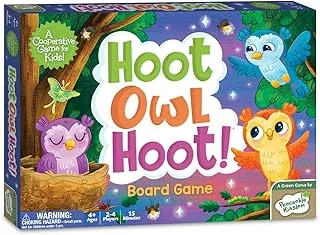
Peaceable Kingdom Hoot Owl Hoot
“Simpler cooperative game for younger siblings. Same cooperative philosophy, less cognitive demand.”
Gamewright Forbidden Island
“Step-up cooperative game for ages 10+. Future path when kids master Outfoxed.”
Clue Junior
“Deduction game from a different angle — competitive instead of cooperative. Interesting comparison.”