ScienceBasedKids.com may earn a commission from affiliate links in this review. Our ratings are never influenced by affiliate relationships. Read our full methodology.
Here is a scene you will recognize if you have ever played a board game with a four-year-old: tears. Recrimination. A small fist sweeping pieces off the table. “I don’t WANT to play anymore.” The problem isn’t the child — the problem is that most board games are adversarial systems designed for brains that have developed emotional regulation, and a four-year-old’s prefrontal cortex is still under construction. So what happens when you remove the adversarial part entirely?
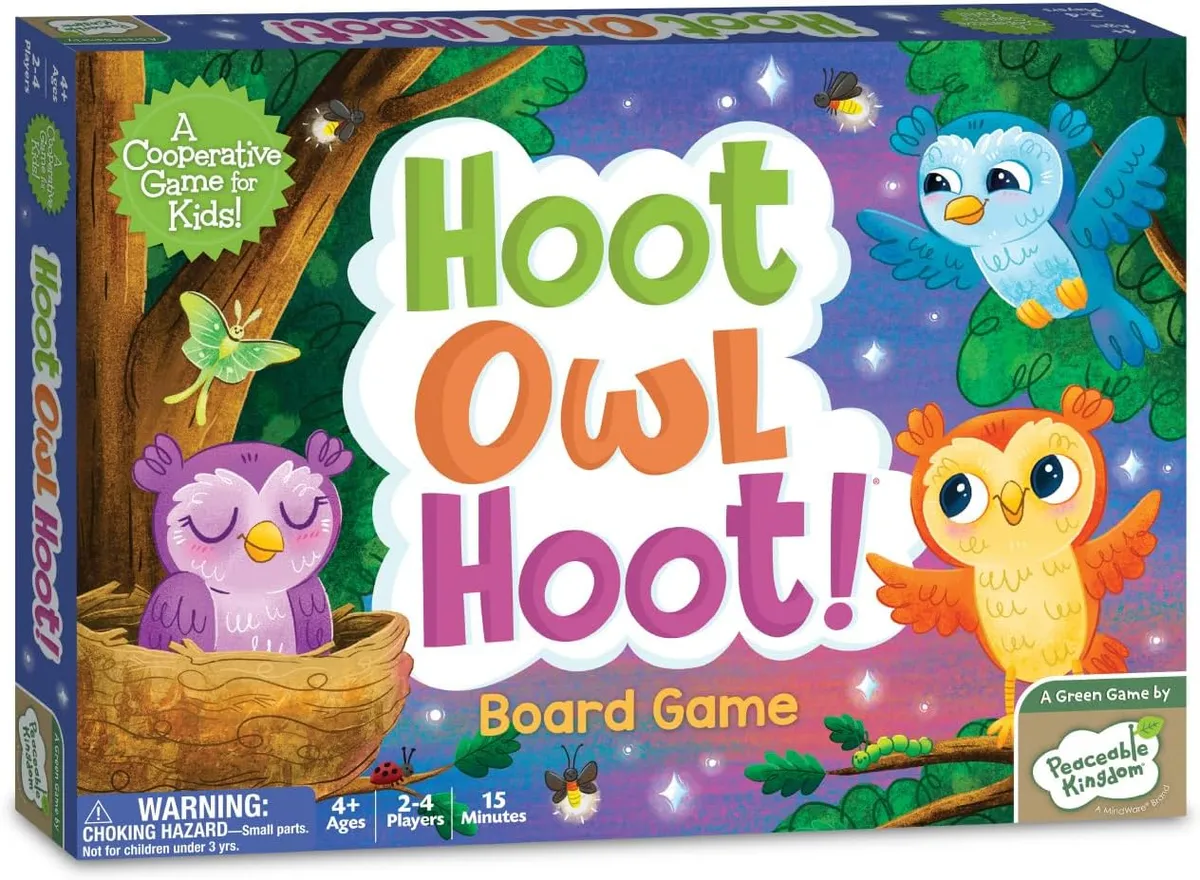
Peaceable Kingdom’s Hoot Owl Hoot answers that question with a game so simple it feels almost too easy — until you watch a group of four-year-olds negotiate which owl to move, argue (politely!) about the best strategy, and erupt in collective celebration when the last owl reaches the nest before sunrise. That negotiation? That’s the game. The owls are just the excuse.
Product Overview
Hoot Owl Hoot is a cooperative board game for 2-4 players ages 4 and up, with games lasting approximately 15 minutes. The premise: players work together to fly all the owls back to the nest before the sun comes up. Everyone wins or everyone loses — there is no competition between players.
In the box:
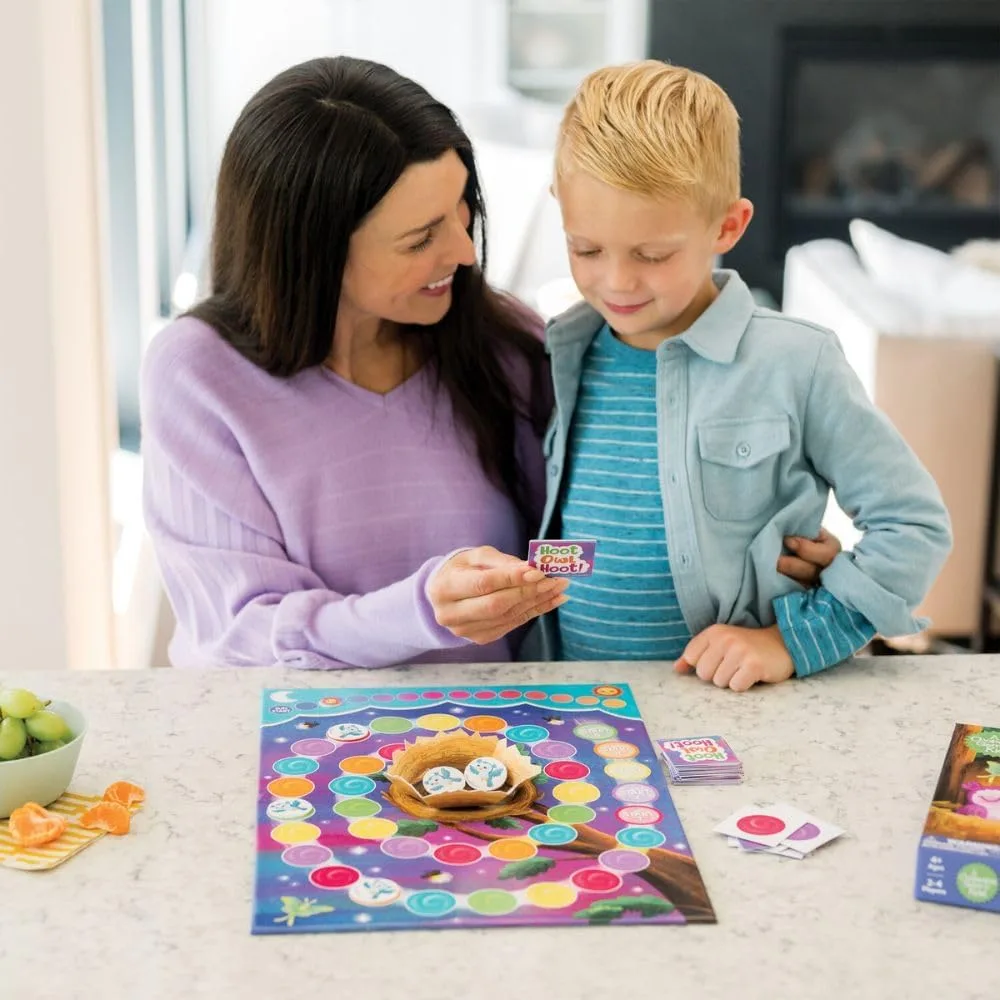
- A game board depicting a moonlit path from treetops to a central nest
- 6 owl tokens in different colors
- 50 cards (6 each of 6 colors = 36 color cards, plus 14 sun cards)
- 1 sun token on a 6-step sunrise track
- Rules sheet with a two-difficulty system
On each turn, a player plays one color card from their hand and moves any owl (not just “their” owl — there are no personal owls) to the next matching color space on the board. If a player draws a sun card, the sun advances one step toward full sunrise. The strategic wrinkle: owls can leapfrog over spaces occupied by other owls, so positioning matters. Get the owls bunched together and they can jump past each other in long leaps toward the nest.
The game ships with two difficulty levels. The basic game uses 3 owls; the advanced game uses 6. Three owls is quite easy — the sun rarely rises before all owls are home. Six owls requires genuine cooperative strategy and creates real tension. This scaling is one of the game’s smartest design choices.
Our Evaluation
Build Quality: 6/10
Let’s be direct: Hoot Owl Hoot is not a premium product. The components are functional cardboard and basic plastic. The owl tokens are simple painted pieces — they get the job done, but they lack the heft and tactile pleasure of HABA’s wooden game pieces. The board is standard-thickness cardboard that will show wear at the folds after moderate use. The color cards are thin and will eventually show shuffling damage.
This is a $15 game, and the components reflect that price point. Peaceable Kingdom invested their design budget in the game mechanics and the cooperative framework, not in premium materials. For families accustomed to HABA’s build quality, the physical product will feel modest. For families buying a $15 board game, the quality is appropriate.
The art, however, is charming. The owl illustrations have personality without being garish, and the moonlit board creates a genuine atmosphere that children respond to. Our testers consistently referred to the owls by their colors with affection — “Blue owl is almost home!” — which suggests the visual design is doing its job.
Play Value: 9/10
This is where Hoot Owl Hoot earns its reputation. The game creates something rare in children’s gaming: genuine collaborative decision-making that four-year-olds can participate in meaningfully.
The key mechanic — moving any owl, not just your own — transforms the game from parallel play into actual cooperation. On every turn, the active player has a decision to make: which owl benefits most from the available move? And because the other players can see the board, they have opinions. Loud opinions. “Move the purple owl! She’s closest!” “No, move green — green can jump over purple and blue!”
These negotiations are the developmental payload. A four-year-old arguing that the green owl should move because it can leapfrog two others is practicing perspective-taking (considering the board state from a strategic rather than personal viewpoint), persuasion (making a case to peers), and flexible thinking (considering multiple options before committing). None of this is labeled as “educational” on the box. It just happens.
The two-difficulty system extends the game’s life meaningfully. At three owls, the game is relaxed — a good entry point for young or easily frustrated players. At six owls, the game becomes genuinely challenging. We played multiple six-owl games with children ages 5-7 where the sun rose before all owls reached the nest, and the response was immediate: “Again! We can do it this time!” That resilience response — failure met with determination rather than despair — is something competitive games at this age rarely produce.
In our testing, Hoot Owl Hoot was the game children asked to play again most often. Not because it was the flashiest or the most complex, but because winning together felt good and losing together felt like a solvable problem.
Age Appropriateness: 9/10
The 4+ age rating is accurate and well-calibrated. At four, children are developing the cognitive prerequisites this game requires: color recognition (mastered), turn-taking (emerging), basic strategic thinking (nascent), and the social capacity to consider another person’s perspective in a structured context.
The color-matching mechanic is accessible to any child who knows their colors. The strategy — which owl to move — adds a layer that grows with the child. A four-year-old will often move whichever owl is their favorite color. A five-year-old starts considering position. A six-year-old plans two moves ahead and argues strategy with teammates. The game accommodates all of these levels simultaneously, which is why it works beautifully in mixed-age groups.
The upper bound is around age 7-8 for most children. Beyond that, the game lacks the strategic depth to remain engaging. But that’s a solid three-to-four-year play window — exceptional for a $15 game.
Durability: 5/10
The components won’t last like HABA’s wooden games. The color cards are the weakest link — after 20-30 games of shuffling by small hands, they show edge wear and minor bending. Card sleeves ($5 for a pack) are a worthwhile investment if this becomes a regular rotation game. The board’s fold creases will eventually weaken. The owl tokens are the most durable component and should outlast everything else.
For a $15 game that delivers its peak value over 50-100 plays, the durability is adequate. This isn’t an heirloom product — it’s a workhorse game priced to be replaceable.
Value for Money: 10/10
At $15, Hoot Owl Hoot is among the best values in children’s board gaming. The cost per play session is negligible, the cooperative mechanic provides genuine developmental value (see Evidence section below), and the two-difficulty system extends the useful life well beyond what the price would suggest.
For comparison: HABA’s First Orchard — a wonderful cooperative game for younger children — costs $25. Gamewright’s Outfoxed, the natural step-up from Hoot Owl Hoot, costs $18. Peaceable Kingdom’s pricing makes cooperative gaming accessible to virtually any family budget. If you’re looking for a gift for a four-year-old’s birthday party and you want to spend $15 on something that isn’t junk, this is it.
The Evidence
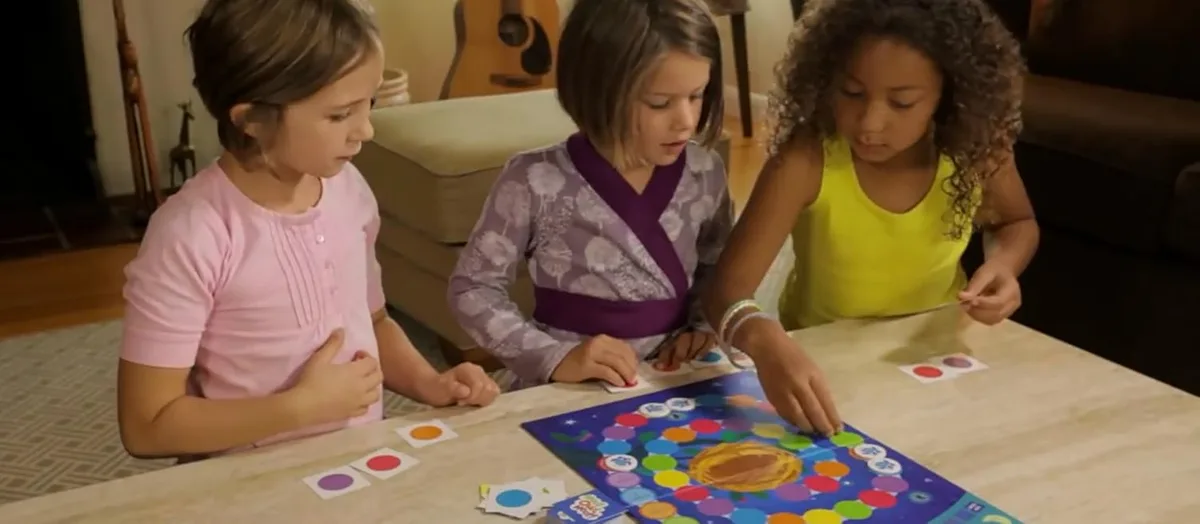
Hoot Owl Hoot’s developmental value centers on cooperative play and prosocial behavior development. The research here is more established than you might expect.
Cooperative Games and Prosocial Behavior. The foundational research in this area dates to the 1980s and has been replicated consistently. Orlick (1981) demonstrated that children who regularly engaged in cooperative games — games where players work toward a shared goal — showed increased cooperative behavior, sharing, and positive social interaction in non-game contexts.1 This is a critical finding: the prosocial effects of cooperative game play transfer beyond the game itself. Children who practice cooperation in a structured setting become more cooperative in unstructured settings.
Bay-Hinitz, Peterson, and Quilitch (1994) strengthened this finding with a study showing that cooperative games both increased cooperative behaviors and decreased aggressive behaviors in preschool-age children.2 The effect was bidirectional — it wasn’t just that cooperation went up; conflict went down. And the effects persisted after the game sessions ended. This suggests that cooperative games don’t just produce temporary good behavior during play; they contribute to the development of prosocial behavioral patterns.
The Mechanism: Structured Practice in Shared Goal Pursuit. Why would playing a board game change how a child behaves on the playground? The proposed mechanism is straightforward: cooperative games provide repeated, structured practice in the skills that underlie prosocial behavior. In a game of Hoot Owl Hoot, a child practices turn-taking (inhibitory control), perspective-taking (considering which move helps the group), negotiation (advocating for a strategy), shared celebration (collective joy), and shared disappointment (collective resilience). These are the same skills required for successful social interaction outside the game — but the game provides a low-stakes, rule-bound practice arena.
Tomasello and Vaish (2013) described the development of cooperation in young children as emerging through shared intentionality — the capacity to form shared goals and work toward them collectively.3 Cooperative board games are, in a sense, the simplest possible shared intentionality exercise: here is our goal (get the owls home), here are our constraints (the sun is rising), and we must work together. The game structure makes the abstract concept of “working together” concrete and actionable for a four-year-old.
Executive Function and Turn-Taking. As we noted in our First Orchard review, turn-taking requires inhibitory control — a core component of executive function. Diamond (2013) identified executive function as foundational to school readiness and social competence.4 Hoot Owl Hoot adds a layer beyond simple turn-taking: the active player must inhibit the impulse to move their preferred owl and instead consider which move best serves the group. This is a more sophisticated form of inhibitory control than merely waiting for your turn — it’s subordinating personal preference to collective strategy.
Emotional Regulation and Shared Outcomes. One underappreciated aspect of cooperative games is their role in emotional regulation development. When the sun rises in Hoot Owl Hoot and the group loses, the emotional experience is shared. There’s no winner gloating and no loser crying — there’s a collective “aww” followed, in our testing, almost universally by “let’s try again.” Denham et al. (2003) documented that preschoolers’ emotional competence — including the ability to manage disappointment — predicts social and academic success.5 Cooperative games provide a safe context for experiencing shared disappointment without the interpersonal sting of losing to someone.
The honest summary: Cooperative games have genuine, well-replicated evidence supporting their role in prosocial development. The specific mechanisms — structured practice in shared goal pursuit, turn-taking with strategic inhibition, and shared emotional experiences — are well-documented. Hoot Owl Hoot doesn’t just feel like it’s doing something good. The research says it is.
Safety Notes
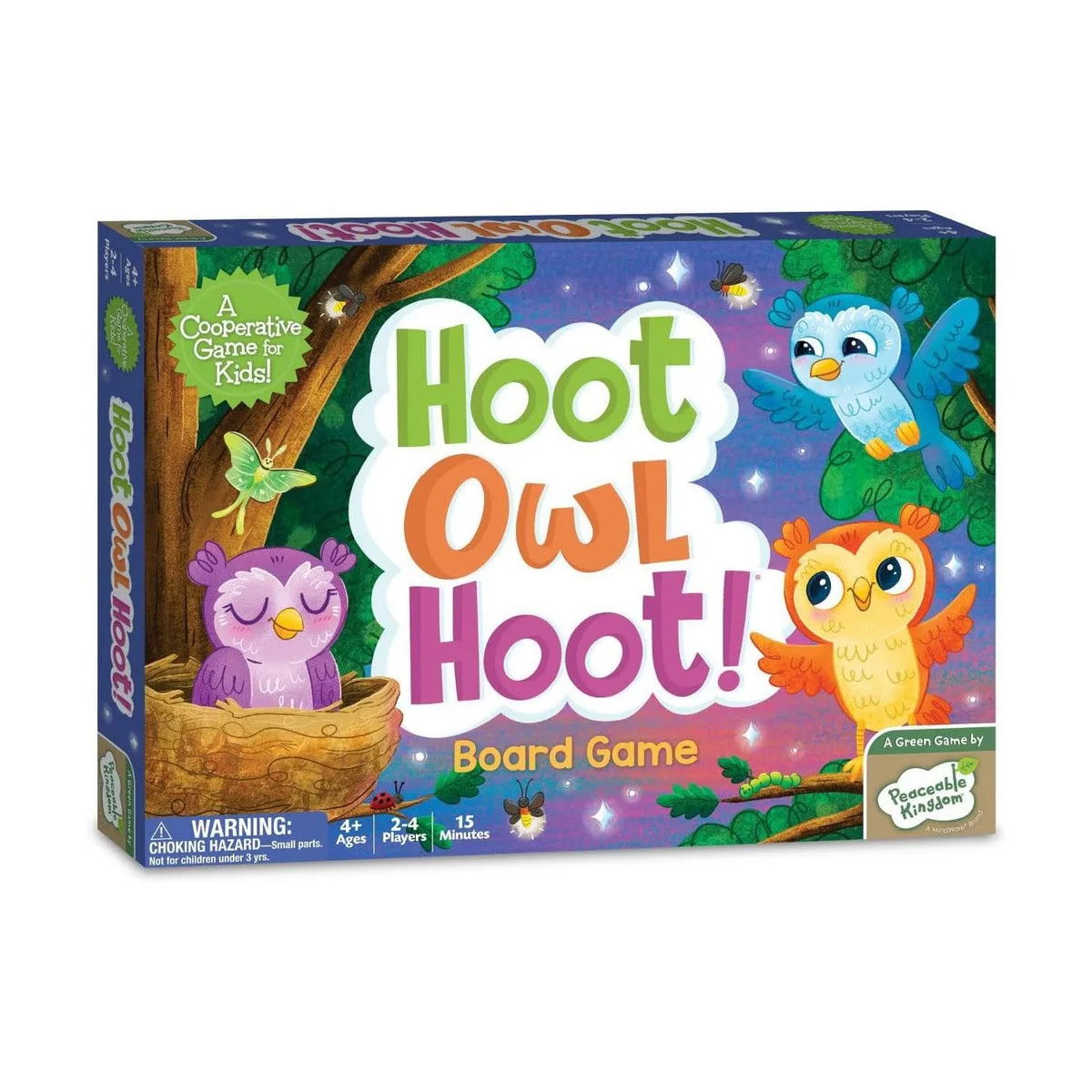
Hoot Owl Hoot meets ASTM F963 and CPSIA safety standards. The components are appropriately sized for the 4+ age range — no pieces present a choking hazard.
The color cards are small enough that a determined toddler sibling could mouth them. If younger children are present during play, monitor card access. The owl tokens are small but solid — they don’t break into smaller pieces.
No CPSC recalls have been issued for this product.
The Verdict
Hoot Owl Hoot does something quietly extraordinary: it turns a $15 board game into a prosocial training ground. The cooperative mechanic isn’t a gimmick — it’s the entire point, and it works. Children negotiate, strategize, celebrate, and commiserate together, practicing exactly the social skills that developmental research identifies as foundational.
The components are modest. The art is charming but not spectacular. The game won’t impress anyone who judges board games by the weight of the box. But sit down with three four-year-olds and play six rounds, and you’ll watch something happen that no amount of premium wooden components can manufacture: children choosing to help each other, not because an adult told them to, but because the game made helping feel like the obvious thing to do.
Product Rating: 8/10 — Exceptional game design and genuine developmental value at an unbeatable price. Docked for component quality that doesn’t match the design quality.
Evidence Rating: Moderate — Cooperative play research is well-established and directly relevant. Multiple replicated studies show prosocial behavior transfer from cooperative game play to non-game contexts.
Who Should Buy This
- Families with children ages 4-7 looking for their first “real” cooperative game
- Parents who have experienced competitive-game meltdowns and want an alternative
- Teachers and therapists looking for structured prosocial play tools
- Gift-givers on a budget — $15 for a game this thoughtful is a gift that over-delivers
- Families who already own First Orchard and are ready for the next step
Who Should Skip This
- Parents of children under 4 — the strategy layer requires cognitive skills still developing (try First Orchard instead)
- Families looking for strategic depth for older children (try Outfoxed or Forbidden Island)
- Anyone who equates game quality with component quality — the cardboard and plastic are functional, not beautiful
- Children who already have a well-stocked cooperative game collection and need more challenge
This review reflects our independent evaluation. ScienceBasedKids.com purchased this product at retail price. We may earn a commission if you purchase through our links, which helps fund our research. This never influences our ratings.
Footnotes
-
Orlick, T. (1981). “Positive socialization via cooperative games.” Developmental Psychology, 17(4), 426-429. ↩
-
Bay-Hinitz, A. K., Peterson, R. F., & Quilitch, H. R. (1994). “Cooperative games: A way to modify aggressive and cooperative behaviors in young children.” Journal of Applied Behavior Analysis, 27(3), 435-446. ↩
-
Tomasello, M., & Vaish, A. (2013). “Origins of human cooperation and morality.” Annual Review of Psychology, 64, 231-255. ↩
-
Diamond, A. (2013). “Executive functions.” Annual Review of Psychology, 64, 135-168. ↩
-
Denham, S. A., Blair, K. A., DeMulder, E., Levitas, J., Sawyer, K., Auerbach-Major, S., & Queenan, P. (2003). “Preschool emotional competence: Pathway to social competence.” Child Development, 74(1), 238-256. ↩
Enjoyed this review? We publish two new evidence-based evaluations every week.
Free. No spam. Unsubscribe anytime.
Each decision point represents a moment where a player chose an action that benefited the group over personal preference.
Recommended Accessories
Affiliate links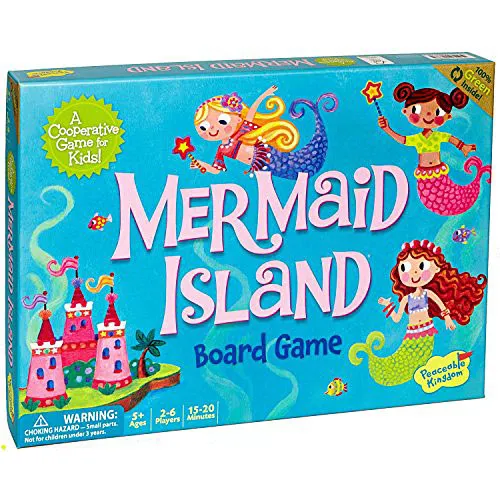
Peaceable Kingdom Mermaid Island
“Same cooperative mechanic, different theme. Extends cooperative play variety.”
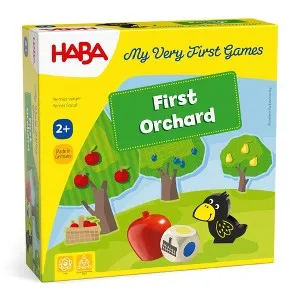
Haba My Very First Games: First Orchard
“Cooperative game for younger siblings. Same brand trust, simpler gameplay.”
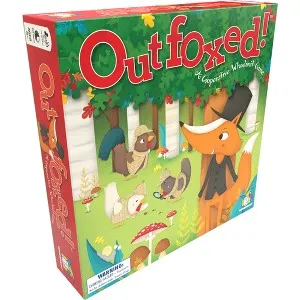
Outfoxed! (Gamewright)
“Next-level cooperative game with deduction. Step-up when kids master Hoot Owl Hoot.”
"The Invisible Boy" by Trudy Ludwig
“Picture book about inclusion and cooperation. Reinforces the cooperative play values.”