ScienceBasedKids.com may earn a commission from affiliate links in this review. Our ratings are never influenced by affiliate relationships. Read our full methodology.
Picture this: a two-year-old picks up a wooden die with color dots instead of numbers, rolls it onto the table, identifies “green,” and with enormous concentration places a little wooden apple on the matching tree. She has just followed a rule, taken a turn, and connected a symbol to an action — and she has no idea she’s done anything remarkable. She just thinks she’s picking fruit before the raven gets to the orchard. That’s the quiet genius of HABA’s First Orchard: it wraps genuine cognitive and social skills inside a game so simple that a two-year-old can play it, and so charming that she’ll ask to play it again.
HABA’s “My Very First Games: First Orchard” has been a recommended first board game in European parenting circles for years and has gained a devoted following in the U.S. At $25 with all-wooden components, it promises a cooperative game experience designed specifically for the developmental stage when children are first learning what “playing a game” even means. We tested it with eight children ages 2 through 4, over multiple play sessions. Here’s our assessment.
Product Overview
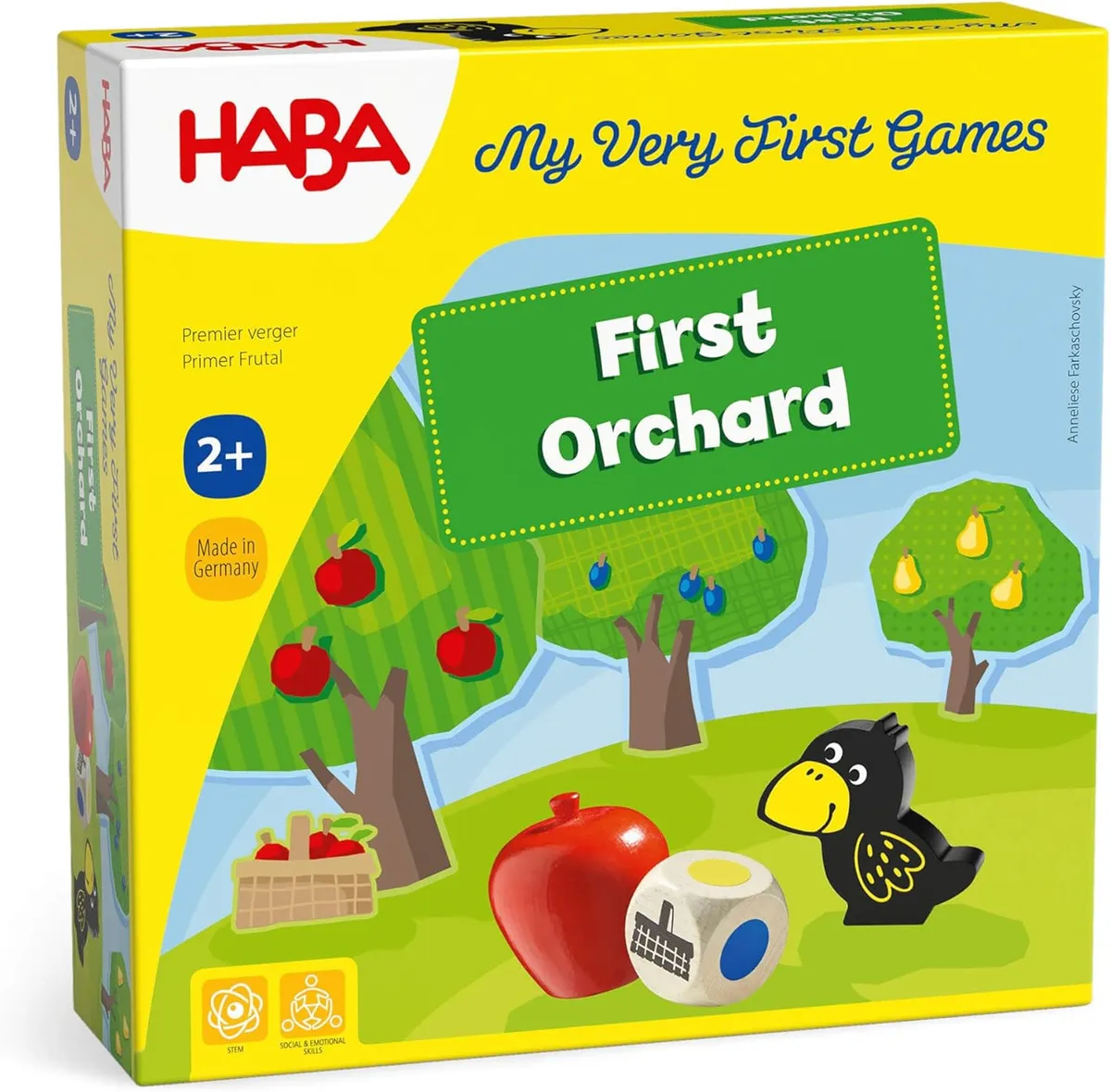
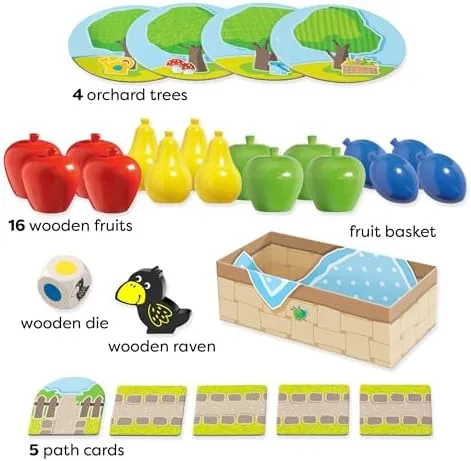
First Orchard is a cooperative board game designed for 1-4 players ages 2 and up, with games lasting approximately 10 minutes. The premise: players work together to harvest fruit from four trees before a raven reaches the orchard. Everyone wins or everyone loses — there is no competition between players.
In the box:
- 4 wooden trees (apple, pear, plum, cherry) in a cardboard orchard base
- 16 wooden fruit pieces — 4 each of green apples, yellow pears, blue plums, and red cherries
- 1 wooden raven figure with a 5-step path to the orchard
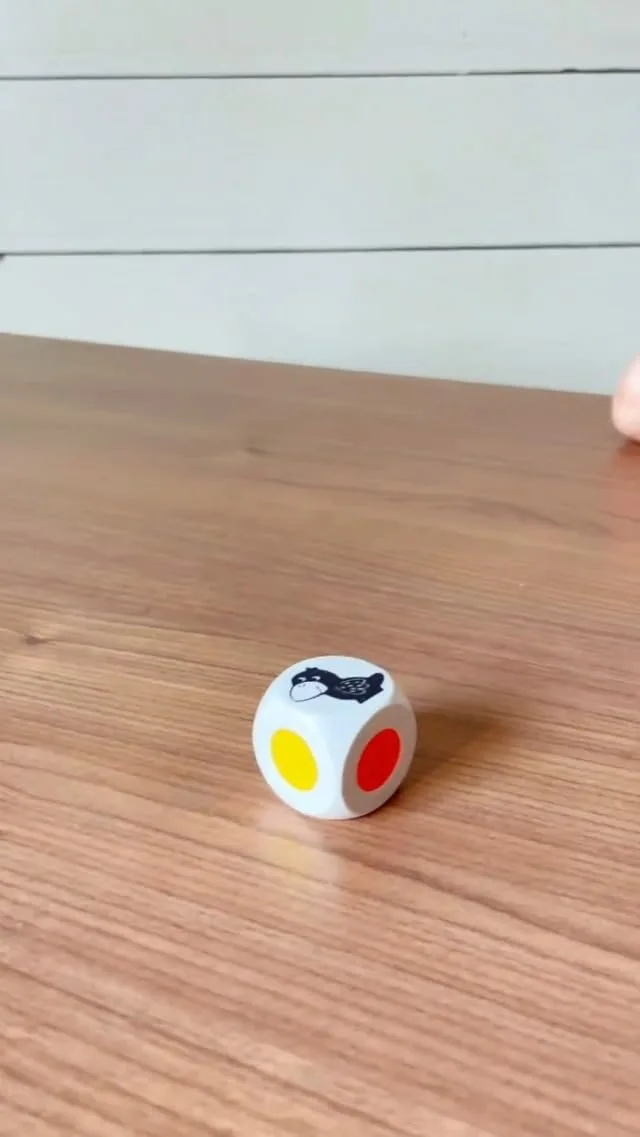
- 1 large color die with four color faces, a fruit basket face, and a raven face
- 1 fruit basket (cardboard)
- Illustrated rules in multiple languages
On each turn, a player rolls the die. If a color appears, they pick one matching fruit from the corresponding tree and place it in the basket. If the basket symbol appears, they pick any two fruits. If the raven appears, the raven advances one step toward the orchard. If all fruit is harvested before the raven arrives — everyone wins. If the raven reaches the orchard first — everyone loses together.
The pieces are chunky, painted wood — sized for toddler hands, satisfyingly heavy, brightly colored. The die is oversized (approximately 1.5 inches). Everything about the physical design acknowledges that the target audience has limited fine motor control and a tendency to put things in mouths.
Our Evaluation
Build Quality: 9/10
HABA’s wooden game components are exceptional. The company has been manufacturing wooden toys in Germany since 1938, and the material quality reflects decades of expertise. The fruit pieces are solid beechwood with smooth, rounded edges and paint that withstands the mouthing, dropping, and aggressive handling that toddlers deliver. After multiple test sessions across eight children, not a single piece showed chipping, paint wear, or structural damage.
The die is particularly well-made — large enough for toddler hands to grasp and roll, heavy enough to feel satisfying, with color dots that are inset rather than printed (they won’t wear off). The raven figure is a charming sculpted piece that children in our testing immediately anthropomorphized, which actually enhanced the game’s narrative engagement.
The one deduction: the cardboard components (orchard base and fruit basket) are noticeably less durable than the wooden pieces. The orchard base developed corner wear after repeated setup and teardown, and the fruit basket is thin cardboard that won’t survive a determined toddler’s crushing grip. These are minor components, but the contrast with the wooden pieces is stark.
Play Value: 9/10
First Orchard achieves something remarkably difficult: it is a genuine game — with rules, turns, and an outcome — that a two-year-old can play. Not “play with help.” Not “sort of follow along.” Actually play, with understanding.
The design decisions that make this possible are worth examining. The color die eliminates number recognition (a skill most two-year-olds haven’t developed). The cooperative structure eliminates winning and losing between players (a concept that produces meltdowns at this age). The physical fruit pieces provide a tangible, satisfying action — picking a wooden apple off a tree and placing it in a basket — that connects the abstract game mechanic to a concrete, motor-rich experience.
In our testing, every child age 2 and older understood the basic game loop within two plays. Roll the die. Look at the color. Find the matching fruit. Put it in the basket. Watch out for the raven. The simplicity is the point — these are children who are encountering the very concept of “game rules” for the first time. First Orchard strips the concept to its essence.
The cooperative mechanic deserves special attention. When the raven advances, the tension is shared. When the last fruit is harvested just before the raven arrives, the celebration is shared. We observed children as young as 2.5 years expressing concern for the shared outcome — “Oh no, the raven!” — which is a prosocial response that competitive games at this age cannot produce.
The game also scales naturally. A 2-year-old plays with help (a parent reads the die, the child places the fruit). A 3-year-old plays with minimal support. A 4-year-old plays independently and often wants to play multiple rounds. Above age 4, the game becomes too simple to hold interest — but by then, the child is ready for the next tier of cooperative games.
Age Appropriateness: 10/10
This is the highest age-appropriateness score we’ve given. First Orchard is designed with an understanding of toddler development that is evident in every component and rule.
At 2, children are developing color recognition, emerging turn-taking ability, and the capacity to follow simple, sequential rules. First Orchard requires exactly and only these skills. It doesn’t demand number recognition, strategic thinking, fine motor precision, or the emotional regulation to handle losing to another player. It asks toddlers to do what they can do — and in doing so, builds the foundation for what comes next.
The physical design matches the developmental stage: oversized pieces that fit clumsy hands, a large die that’s easy to roll, fruit pieces that invite grasping and placing rather than delicate manipulation. HABA clearly tested this with actual toddlers, not just designed it for them in theory.
Durability: 8/10
The wooden components will outlast any reasonable play lifespan. The paint is durable. The die is nearly indestructible. HABA’s manufacturing quality means these pieces could survive a generation of children.
The cardboard components lower the score. The orchard base and fruit basket show wear after 15-20 play sessions and may need replacement or reinforcement (clear packing tape on the basket edges is a common parent hack). For a $25 game, this is acceptable. For a game specifically marketed as “heirloom quality,” the cardboard elements are the weak link.
Value for Money: 9/10
At $25 for a game with 20+ solid wood components and genuine replayability for 2-3 years, First Orchard represents excellent value. The cost per play session is negligible — most families will play it 50-100+ times before their child ages out.
For comparison, a typical mass-market board game for young children runs $15-20 with all-plastic or all-cardboard components. You’re paying a modest $5-10 premium for HABA’s wood construction, thoughtful design, and the game’s reputation as the first board game that actually works for two-year-olds. That premium is easily justified.
The Evidence
First Orchard’s developmental claims center on three areas: cooperative play and prosocial behavior, color recognition, and rule-following/executive function. The evidence is more substantive than we expected.
Cooperative Play and Prosocial Development. This is the strongest claim and the most interesting research area. Cooperative games — where players work toward a shared goal rather than competing against each other — have been studied as tools for prosocial development since the 1980s. Orlick (1981) found that children who regularly played cooperative games showed increased cooperative behavior, sharing, and positive peer interaction outside of game contexts.1 Bay-Hinitz et al. (1994) demonstrated that cooperative games reduced aggressive behavior and increased cooperative behavior in preschool-age children, with effects persisting after the games ended.2
The mechanism is intuitive: cooperative games provide structured practice in working toward shared goals. A child playing First Orchard is rehearsing the social skills of turn-taking, shared attention, and collective celebration or commiseration — skills that transfer to non-game social interactions.
Turn-Taking and Executive Function. Turn-taking requires inhibitory control — the ability to wait while someone else acts. Inhibitory control is a core component of executive function, which develops rapidly between ages 2 and 5. Diamond (2013) described executive function development as foundational to school readiness, social competence, and self-regulation.3 Board games that require turn-taking provide natural, low-stakes practice in inhibitory control. First Orchard’s short turns and engaging visual feedback (watching the fruit disappear, watching the raven move) reduce the waiting frustration that makes turn-taking difficult for toddlers.
Color Recognition and Categorization. The color-matching mechanic provides repeated practice in color identification and categorical sorting. While color recognition develops naturally in most children between ages 2 and 3, Sandhofer and Smith (2001) found that explicit labeling practice — naming colors in context — accelerates color term acquisition.4 First Orchard creates natural opportunities for color naming: “What color did you roll? Green! Can you find a green apple?”
The honest summary: First Orchard is one of the better-aligned products we’ve reviewed in terms of developmental claims matching actual research. Cooperative games have genuine evidence supporting their prosocial benefits. Turn-taking games engage executive function development during a critical window. The specific combination of cooperative structure, color matching, and rule-following at the 2+ age point maps cleanly onto established developmental research. This is not a case of marketing stretching tenuous connections — the game’s design reflects genuine understanding of early childhood development.
Safety Notes
First Orchard meets EN-71 (European toy safety), ASTM F963, and CPSIA standards. The wooden pieces are larger than the small-parts threshold and do not present a choking hazard for the 2+ age range. The paint is non-toxic and saliva-resistant (important, since mouthing game pieces is developmentally normative at this age).
The die’s size (approximately 1.5 inches per side) is appropriate for toddler play and does not present a choking risk. The raven figure has a small beak that is firmly attached — we tested pull resistance and it held securely.
No CPSC recalls have been issued for this product or for any HABA “My Very First Games” product.
One note for parents of children under 2: while the pieces are large, the fruit shapes could be mistaken for food by very young children. Supervision during play is always appropriate at this age, and storing pieces out of reach between sessions prevents unsupervised access.
The Verdict
HABA First Orchard is the best first board game we’ve tested. It’s not complicated — it’s a simple cooperative color-matching game with lovely wooden pieces. But “simple” is the entire point. At age 2, a child doesn’t need strategic depth or complex mechanics. They need to learn what a game is — that there are rules, that you take turns, that something happens when you do something, and that the experience is shared. First Orchard teaches all of this without tears, without competition, and without requiring skills the child hasn’t developed yet.
The cooperative mechanic isn’t a gimmick — it’s developmentally necessary. Two-year-olds cannot handle losing. They’re not emotionally or cognitively equipped for it. By making the game collaborative, HABA removes the single biggest barrier to game play at this age and replaces it with shared joy (when you win) or shared resolve (when the raven wins and you want to try again). This is thoughtful design in service of real developmental understanding.
Product Rating: 8/10 — Exceptional design for its target audience, premium build quality, and strong replayability within its age window. Docked for the fragile cardboard components and the relatively narrow play window (most children outgrow it by age 4-5).
Evidence Rating: Moderate — The cooperative play research is solid and directly relevant. Turn-taking and color recognition benefits align with established developmental science. This is one of the stronger evidence-to-product alignments in our review portfolio.
Who Should Buy This
- Parents of children ages 2-3 looking for a first structured game experience
- Families who value cooperative play and want to avoid competitive meltdowns
- Gift-givers for second birthdays — this is our top pick in the category
- Montessori- and Waldorf-leaning families who appreciate natural materials and open-ended learning
- Parents of multiple children ages 2-4 who want a game everyone can play together
Who Should Skip This
- Parents of children over 4 — the game will be too simple (look at Peaceable Kingdom’s Hoot Owl Hoot or HABA’s Orchard full-size version instead)
- Families who already own a cooperative toddler game and are looking for variety
- Parents expecting strategic depth — this is deliberately, appropriately simple
- Anyone allergic to the possibility of wooden cherries appearing in couch cushions, shoe cubbies, and the back seat of the car for the next two years
This review reflects our independent evaluation. ScienceBasedKids.com purchased this product at retail price. We may earn a commission if you purchase through our links, which helps fund our research. This never influences our ratings.
Footnotes
-
Orlick, T. (1981). “Positive socialization via cooperative games.” Developmental Psychology, 17(4), 426-429. ↩
-
Bay-Hinitz, A. K., Peterson, R. F., & Quilitch, H. R. (1994). “Cooperative games: A way to modify aggressive and cooperative behaviors in young children.” Journal of Applied Behavior Analysis, 27(3), 435-446. ↩
-
Diamond, A. (2013). “Executive functions.” Annual Review of Psychology, 64, 135-168. ↩
-
Sandhofer, C. M., & Smith, L. B. (2001). “Why children learn color and size words so differently: Evidence from adults’ learning of artificial terms.” Journal of Experimental Psychology: General, 130(4), 600-620. ↩
Enjoyed this review? We publish two new evidence-based evaluations every week.
Free. No spam. Unsubscribe anytime.
Frequency reflects how many times per game the skill was actively practiced.
Recommended Accessories
Affiliate links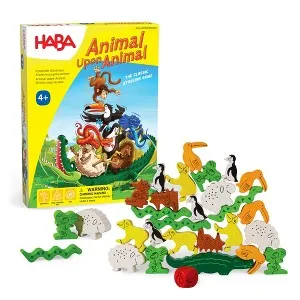
Haba My Very First Games: Animal Upon Animal
“Same trusted Haba toddler line. Adds stacking/dexterity to the cooperative play of First Orchard.”
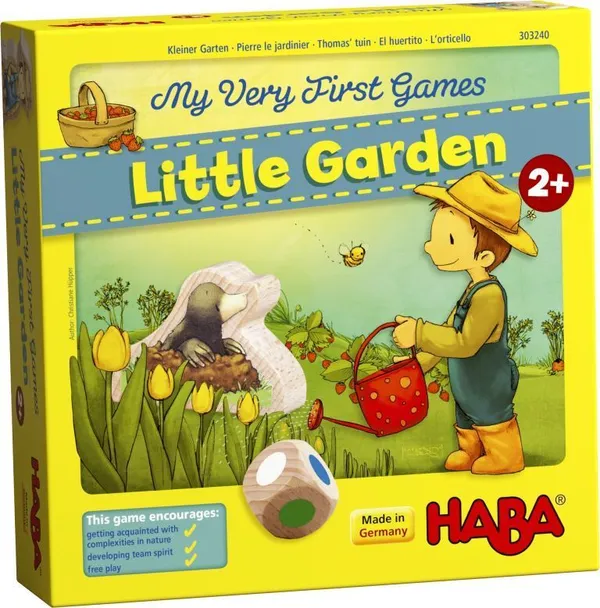
Haba My Very First Games: Little Garden
“Same series, introduces basic strategy. Natural next step after First Orchard clicks.”
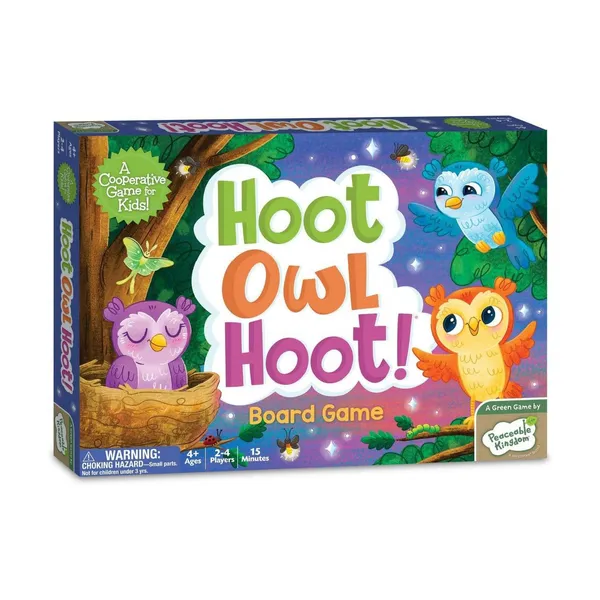
Peaceable Kingdom Hoot Owl Hoot
“Next-level cooperative game for when kids age out of First Orchard (4+). Budget-friendly.”

AUSTARK Mesh Zipper Board Game Storage Bags (20-Pack)
“Keeps wooden fruit pieces from ending up in couch cushions. Mesh bags let you see contents without opening.”