ScienceBasedKids.com may earn a commission from affiliate links in this review. Our ratings are never influenced by affiliate relationships. Read our full methodology.
The first launch always produces a scream. Not a fear scream — a delight scream. A three-year-old steps on a rubber bladder, a foam rocket shoots into the sky, and the child’s face cycles through surprise, awe, and an irrepressible urge to do it again immediately. There is no toy in our testing portfolio that produces a faster emotional payoff than the Stomp Rocket. Foot goes down, rocket goes up. Cause, meet effect.
The Stomp Rocket Original has been a backyard staple for over two decades, quietly doing what overcomplicated toys strain to achieve: making kids run, jump, and laugh outside. At $18, it costs less than a family lunch at a fast-casual restaurant. We tested it with nine children ages 3 through 11 across six weeks of outdoor sessions. Here’s why it earns a spot in every family’s outdoor rotation — and why, despite our enthusiasm, the evidence rating stays at zero.
Product Overview
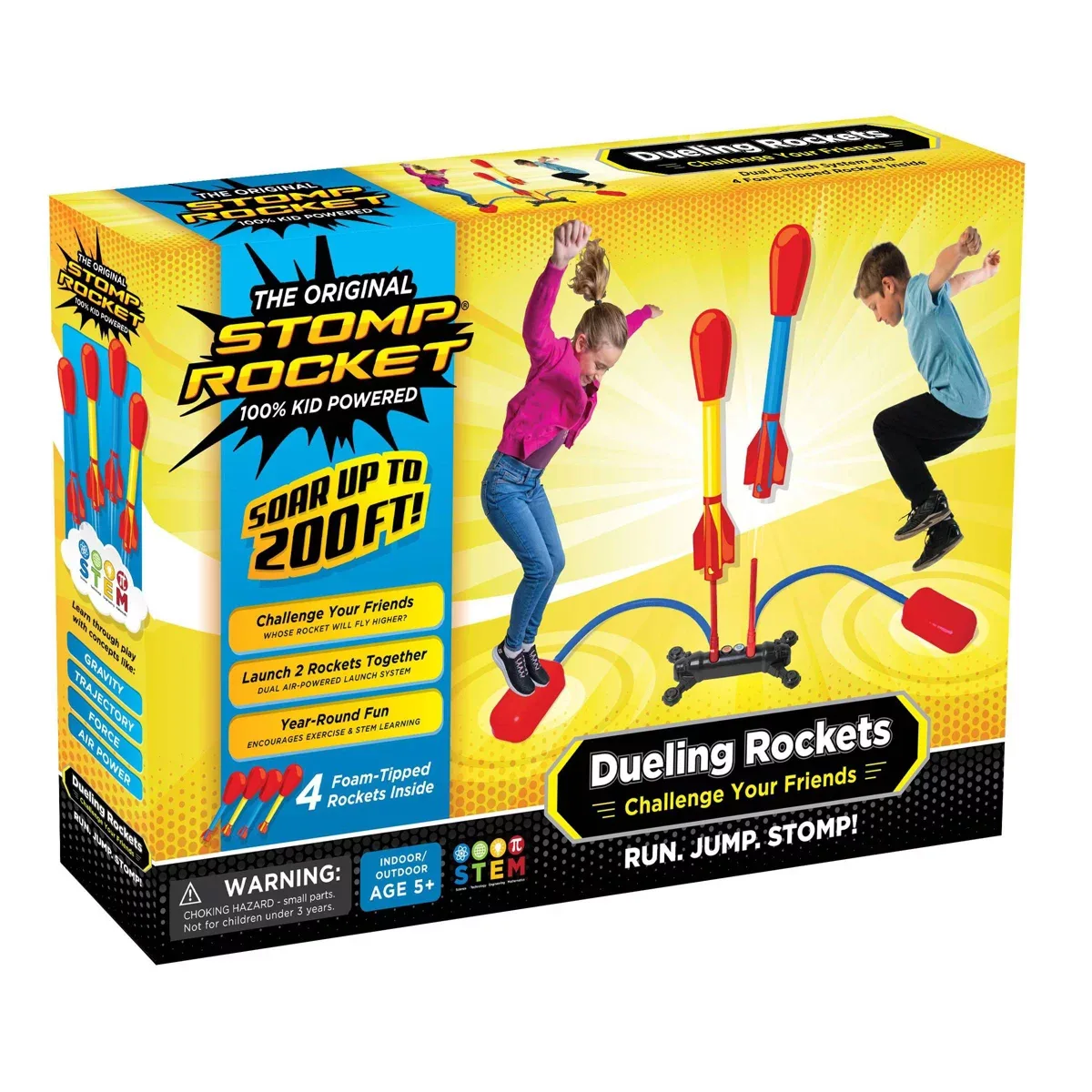
The Stomp Rocket is an air-powered launching system. No batteries. No apps. No assembly beyond connecting two pieces of plastic tube. The mechanism is pure pneumatics — Newton’s Third Law, packaged for preschoolers.
In the box:
- A flexible rubber air bladder connected to a vertical launch tube via plastic hose
- An adjustable launch tube on a foldable stand (angles from vertical to approximately 45°)
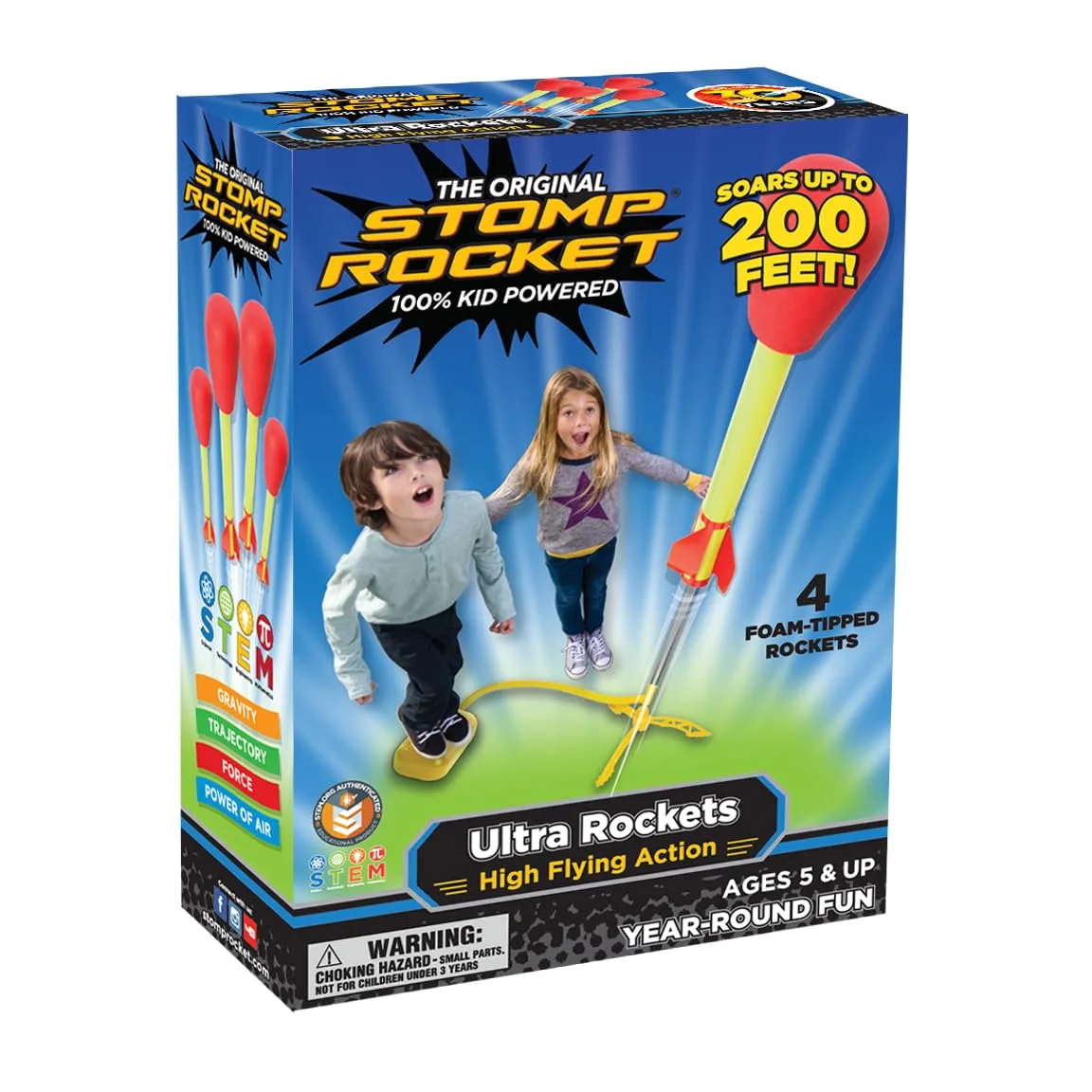
- 4 foam rockets — hollow foam cylinders with soft tips and plastic fin assemblies, roughly 12 inches long
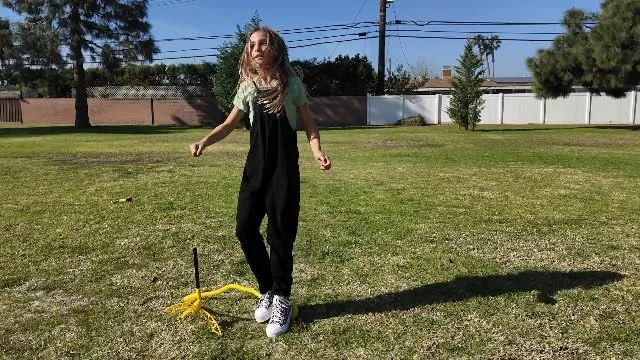
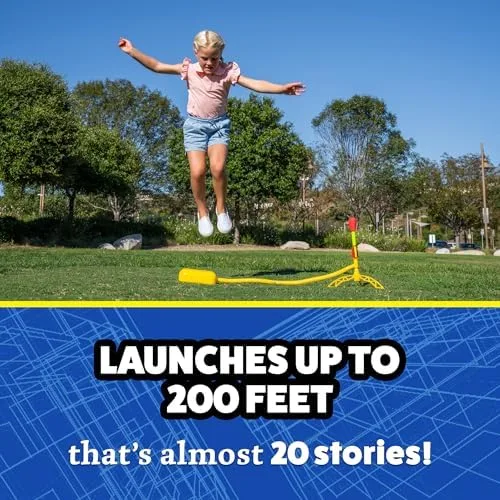
You place a foam rocket on the tube. You stomp on the bladder. Compressed air shoots through the hose and propels the rocket skyward. Stomp harder, rocket goes higher. The Original model reaches approximately 100 feet with a strong adult stomp. For younger children, gentle steps produce 15-25 foot launches — enough to trigger genuine delight without losing the rocket over the fence.
D & L Company, the maker, has been producing Stomp Rockets since the mid-1990s. They make exactly one kind of product — air-powered projectile launchers — in several variations. This focus shows in the engineering: the design has been refined over decades for exactly one purpose, and it shows.
Our Evaluation
Build Quality: 6/10
Let’s be direct: the Stomp Rocket is not a premium product. The plastic components are lightweight. The rubber air bladder is thin. The hose connection points feel like they’ll separate if yanked at the wrong angle. The foldable launch tube stand wobbles. Looking at the components fresh out of the box, your first thought is “this costs $18 and it looks like it.”
And yet — after six weeks of daily use by nine children, including several who jumped on the air bladder with both feet from a standing position, everything still works. The rubber bladder, which we expected to be the first failure point, showed no signs of cracking or air leakage. The hose connections, while feeling flimsy, held firm. The launch tube stand maintained its angle adjustments.
The foam rockets are the consumable element. Soft tips deform after repeated high-altitude impacts on hard surfaces. Plastic fin assemblies can crack. Of our four rockets, one developed a cracked fin after approximately 30 launches — it still flew, but with a noticeable wobble. Budget $10/year for the refill three-pack.
The overall impression: well-engineered budget design. Feels cheap in your hands, performs reliably under use. Function over aesthetics.
Play Value: 9/10
The Stomp Rocket’s play value is inversely proportional to its complexity. There is one thing to do — launch rockets — and children will do it for astonishing stretches of time.
In our testing, the average outdoor session with the Stomp Rocket was 35 minutes. That’s remarkable for a toy with a single mechanic. The explanation is the feedback loop: each stomp produces an immediate, visible, satisfying result, and the result varies based on the child’s effort. A gentle tap sends the rocket ten feet. A full-body jump sends it over the treeline. This proportional response — what game designers call a “juicy” mechanic — is intrinsically motivating because the child controls the outcome.
What we observed across age groups:
Ages 3-4: Gentle stomps, 15-25 foot launches. The primary satisfaction is the cause-and-effect discovery itself — I did that. These children launched repeatedly with consistent delight, typically 20-30 stomps before transitioning to chasing launched rockets across the yard. The retrieval run is its own gross motor workout.
Ages 5-7: The sweet spot. Children in this range start experimenting: adjusting the launch angle, trying different stomp intensities, competing for height, noticing that angle affects distance versus altitude. A six-year-old in our testing said, unprompted, “If I tilt it, it goes farther but not as high.” That’s projectile physics, learned through play, without a lesson plan.
Ages 8-11: The novelty of basic launching fades faster, but the experimental dimension sustains engagement. Older children designed distance competitions, built targets, and attempted to calculate launch angles for maximum range. One ten-year-old measured distances with a tape measure and graphed the results, which qualifies as an impromptu science experiment.
The social dimension amplifies everything. Stomp Rocket is inherently communal — children take turns, compete for height, chase rockets together, celebrate spectacular launches. In group settings, sessions extended to 45-60 minutes.
Age Appropriateness: 9/10
The 3-12 age range is honest and unusually broad for a toy this simple. The variable-force mechanic is the reason: a three-year-old’s gentle step and a twelve-year-old’s running jump both produce satisfying results, just at different scales.
The lower bound works because the launch pad requires minimal force. Our three-year-old testers launched rockets by simply stepping onto the bladder — no jumping required. The rockets are soft foam with no hard points, eliminating injury risk from falling rockets. The product is genuinely safe and functional at the stated minimum age.
The upper bound works because physics becomes the toy. The basic launch mechanic may bore a twelve-year-old, but the angle-distance-height relationships, wind effects, and precision aiming create engagement that the product doesn’t explicitly design for but naturally enables.
Durability: 6/10
The launch system is more durable than it appears (see Build Quality above). But rockets are consumable. Expect to lose 1-2 per month to trees, roofs, neighboring properties, and structural failure. The $10 refill pack makes this manageable, but it’s an ongoing cost.
The rubber air bladder is the long-term durability question. Online parent reports suggest 1-2 years of regular use before air leaks develop. UV exposure accelerates degradation — storing the bladder indoors between sessions extends its life significantly. At $18, replacing the entire set annually is still a bargain.
Value for Money: 10/10
This is the first perfect value score in our review portfolio, and we’re confident in it.
At $18, the Stomp Rocket delivers:
- Outdoor active play across a 3-12 age range
- Zero ongoing costs beyond occasional rocket refills (~$10/year)
- No batteries, no charging, no apps, no updates, no Wi-Fi
- Consistent play sessions averaging 30+ minutes
- Social play facilitation for groups of any size
The cost-per-hour math is almost unfair to other products. If a family uses the Stomp Rocket twice per week for one year (conservative), that’s roughly 100 sessions averaging 30 minutes each — 50 hours of outdoor active play for $18, or about $0.36 per hour. No toy in our testing portfolio, at any price point, matches this ratio.
The Evidence
Here’s where we have to be unusually straightforward: the Stomp Rocket has no evidence rating because there is no research on air-powered rocket launchers and child development. None. This is a toy, not an educational product, and it doesn’t pretend otherwise.
But the play behaviors the Stomp Rocket produces are worth examining against the developmental literature, because the absence of product-specific research doesn’t mean the play patterns are developmentally inert.
Cause-and-Effect Understanding. Gopnik et al. (2004) described young children as intuitive scientists who construct causal models through experimentation.1 The Stomp Rocket is a near-perfect causal learning apparatus: the cause (stomping) and the effect (rocket launch) are separated in space but connected by a visible, immediate mechanism. The proportional relationship — stomp harder, rocket goes higher — adds cognitive richness beyond a simple binary switch. But no study has examined whether playing with pneumatic launchers specifically affects causal reasoning development.
Gross Motor and Outdoor Play. Timmons et al. (2012) found associations between active outdoor play in early childhood and gross motor competence, bone health, and cardiovascular indicators.2 The Stomp Rocket requires whole-body movement — stomping, jumping, running to retrieve — that clearly qualifies as active outdoor play. But the research supports the category of activity, not the specific product. Any outdoor running game provides similar motor engagement.
Intuitive Physics. Children develop expectations about how objects move through observation and hands-on experience. Research on projectile understanding in children exists,3 and the Stomp Rocket certainly provides experience with projectile motion, launch angles, and gravity. But no study has connected air-rocket play to physics understanding. The intuitive physics angle is plausible but untested.
What we won’t claim: We won’t claim the Stomp Rocket “teaches physics” or “develops causal reasoning” in any measurable way, because no one has measured it. We’ve seen reviews and product descriptions that confidently assert “STEM learning” for products like this. We’d rather be honest: this toy produces play patterns that look like the play patterns associated with developmental benefits in the research literature. That’s a reasonable basis for buying a toy. It’s not a reasonable basis for claiming educational value.
The honest summary: No evidence supports developmental claims for the Stomp Rocket or air-powered launchers generally. The play behaviors it produces — active outdoor play, cause-and-effect exploration, implicit physics experimentation — align with well-researched developmental activities, but the connection is analogical, not empirical. We rate this “None” because intellectual honesty requires it, even though the developmental intuition is strong.
Safety Notes
The Stomp Rocket Original meets CPSC and ASTM F963 safety standards. The rockets are soft foam with flexible tips, designed to be safe if they land on people — and they will land on people. In our testing, direct hits from falling rockets caused no injury and minimal discomfort. The foam construction and light weight mean terminal velocity is manageable even from 100+ feet.
Key considerations:
- Play area. Rockets can travel 100+ feet vertically and 50+ feet horizontally depending on launch angle. Use in open areas away from roads, power lines, and neighboring property where retrieval could be problematic.
- Eye safety. While rockets are soft, a direct hit to the face at close range during launch (before gaining altitude) could be uncomfortable. The natural stomping position keeps the child’s body away from the launch trajectory, but teach children not to lean over the tube.
- Small parts. Plastic fin assemblies are small enough to be a concern for children under 3 if they detach from the foam body. Inspect rockets periodically for loose or broken fins.
- Roof hazard. This isn’t a safety issue for the child, but for your peace of mind: rockets will land on roofs. Accept this reality before purchasing.
No CPSC recalls have been issued for any Stomp Rocket product.
The Verdict
The Stomp Rocket is the kind of product that makes you wonder why anyone spends $200 on a toy. It’s $18. It has no batteries. It produces immediate, visceral, repeatable joy. It gets kids outside, running, jumping, and — without a single word of instruction — experimenting with the physics of projectile motion. It works for ages 3 through 12. It facilitates social play. And the launch pad is functionally indestructible, even if the rockets aren’t.
The build quality is modest. The rockets are consumable. The aesthetic is “colorful plastic from a hardware store endcap.” None of this matters when a five-year-old stomps on a rubber pad and watches a rocket disappear into the sky, then sprints across the yard, screaming, to find it and do it again.
We can’t give this toy an evidence rating. Nobody has studied it, and we won’t pretend otherwise. But we can tell you what we observed: nine children, ages 3 through 11, played outside for hours with a piece of rubber, a plastic tube, and some foam. If that isn’t what childhood is supposed to look like, we don’t know what is.
Product Rating: 8/10 — An exceptional play experience delivered through intentionally simple, budget-friendly design. Build quality keeps it from a 9; the sheer joy-per-dollar ratio prevents anything lower than an 8.
Evidence Rating: None — No research exists on air-powered launchers and child development. The play patterns align with well-supported developmental activities, but we won’t dress up analogy as evidence.
Who Should Buy This
- Every family with children ages 3-8 and access to outdoor space (parks count)
- Parents looking for a reliable way to get kids outside without screens
- Gift-givers who want an $18 present that will actually get used repeatedly
- Families who want siblings of different ages to play together outdoors
- Teachers and camp counselors seeking group outdoor activities
Who Should Skip This
- Families without reliable outdoor space (this is fundamentally an outdoor toy)
- Parents who will be stressed about rockets on roofs or in neighbor’s yards
- Anyone looking for a quiet, indoor activity
- Families in very windy climates where outdoor play is impractical most days
This review reflects our independent evaluation. ScienceBasedKids.com purchased this product at retail price. We may earn a commission if you purchase through our links, which helps fund our research. This never influences our ratings.
Footnotes
-
Gopnik, A., Glymour, C., Sobel, D. M., Schulz, L. E., Kushnir, T., & Danks, D. (2004). “A theory of causal learning in children: Causal maps and Bayes nets.” Psychological Review, 111(1), 3-32. ↩
-
Timmons, B. W., LeBlanc, A. G., Carson, V., et al. (2012). “Systematic review of physical activity and health in the early years (aged 0-4 years).” Applied Physiology, Nutrition, and Metabolism, 37(4), 773-792. ↩
-
Kim, S. H., & Spelke, E. S. (2022). “Infants’ and young children’s intuitive physics.” In The Oxford Handbook of the Development of Imagination. Oxford University Press. ↩
Enjoyed this review? We publish two new evidence-based evaluations every week.
Free. No spam. Unsubscribe anytime.
Height is approximate. Wind conditions controlled by testing on calm days only.
Recommended Accessories
Affiliate links
Stomp Rocket X-Treme Rocket Refills (3-Pack)
“Rockets get lost in trees, land on roofs, or get chewed by dogs. Refills are essential.”
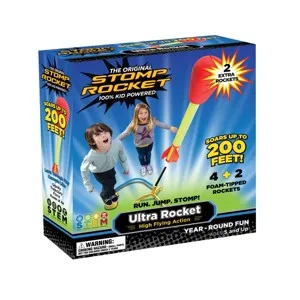
Stomp Rocket Ultra Rocket Launcher (4 Rockets)
“Bigger rockets that fly up to 200 feet. Upgrade when kids master the original.”
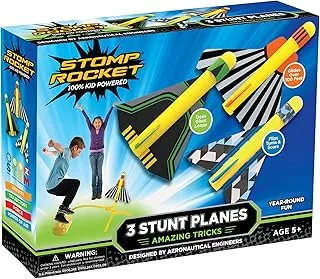
Stomp Rocket Stunt Planes (3 Planes)
“Same stomp mechanic with Looper, Glider, and Wildcat planes. Different flight physics.”
"Rocket Science for Babies" by Chris Ferrie
“Board book that turns launch play into a mini science lesson. Great for the younger end of the age range.”