ScienceBasedKids.com may earn a commission from affiliate links in this review. Our ratings are never influenced by affiliate relationships. Read our full methodology.
There’s a Facebook group with over 100,000 members devoted to what is, at its core, a four-piece foam couch. Parents post photos of Nugget configurations the way architects share blueprints — bridges, tunnels, bunk beds, pirate ships, slides. The configurations have names. There are fan-made building guides. People camp out for limited-edition color drops the way sneakerheads wait for Jordans. This is either a testament to extraordinary product design or a case study in millennial parent marketing. After eight weeks of testing, we think it’s mostly the former.
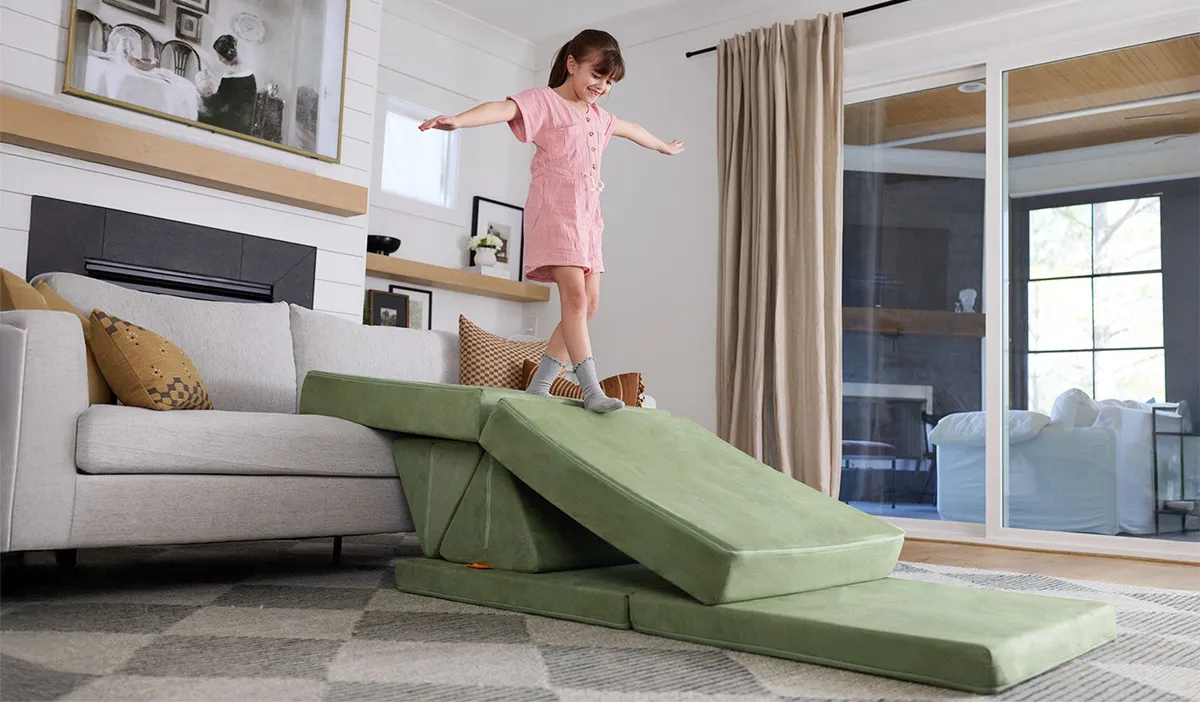
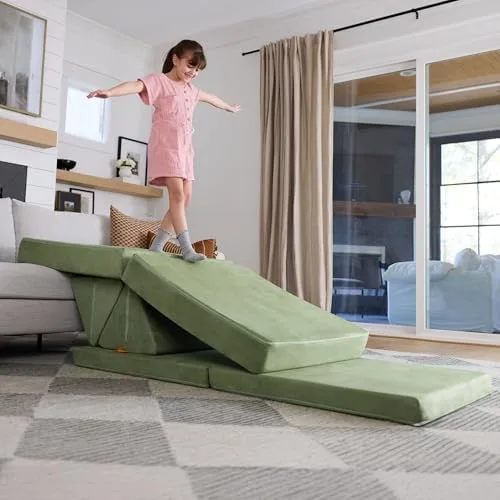
The Nugget Comfort Couch is a modular play couch consisting of four foam pieces — two cushion bases and two triangular pillows — wrapped in a microsuede cover. It costs $250. We tested it with six children ages 2 through 9, across multiple homes, and tracked how, when, and whether it actually got used. Here’s what we found.
Product Overview
The Nugget ships in a surprisingly compact box and arrives as four pieces:
- One firm base cushion — The “couch seat.” Higher-density foam that provides structural support when stacked or used as a climbing surface.
- One soft base cushion — The “couch back.” Lower-density foam that provides cushioning for landing, lounging, and fort walls.
- Two triangular pillows — Wedge-shaped pieces that serve as couch arm rests, ramps, slides, or fort walls depending on orientation.
The total footprint when assembled as a couch is roughly 33” × 66” × 23”. The covers are removable and machine-washable (cold water, tumble dry low). Nugget offers 20+ color options, with limited editions that sell out within hours.
The foam is CertiPUR-US certified (low VOC, no harmful chemicals). The cover fabric is a proprietary microsuede that resists stains better than standard upholstery but isn’t waterproof.
A note on categorization: we list the Nugget under our Outdoor & Active category because it’s fundamentally an active play product — climbing, jumping, building obstacle courses. But it’s primarily indoor furniture. The microsuede cover isn’t designed for outdoor use (UV will degrade the fabric, and moisture is the cover’s enemy). Think of the Nugget as bringing outdoor-style active play inside — which, for apartment families and rainy-day parents, is exactly the point.
Our Evaluation
Build Quality: 8/10
The Nugget is well-made for what it is — modular play furniture built to absorb impact from children launching themselves at it daily. The foam density is notably different between the two base pieces, and this is intentional: the firm base provides structure, the soft base provides cushion. After eight weeks of testing, neither showed significant compression or loss of shape.
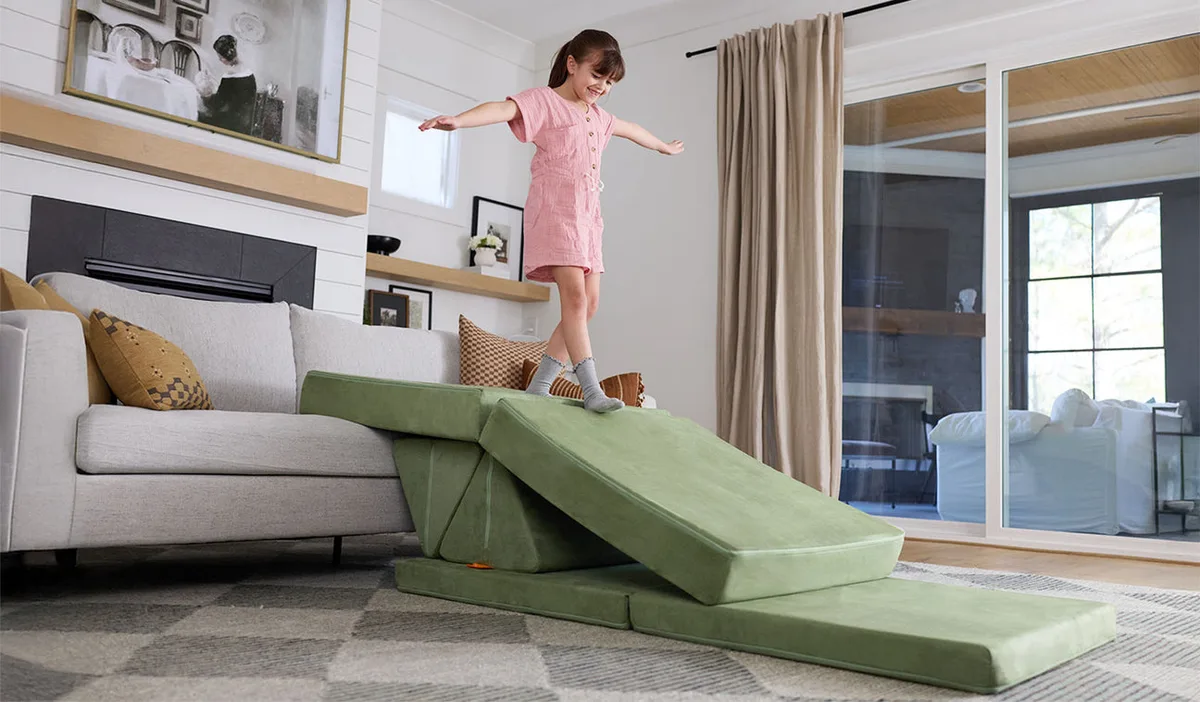
The microsuede covers are the highlight. They’re thick, feel premium, and have survived grape juice, mud, and a impressive yogurt incident in our testing. The hidden zipper construction is clean, and the covers held their shape through multiple wash cycles. We did notice light pilling on high-friction areas (where kids’ feet push off during climbing) after about six weeks — cosmetic, not structural.
The stitching is reinforced at stress points, which matters more than it might seem. Children will grab, pull, and drag these pieces across floors. Cheaper alternatives often fail at the seams first. Nugget’s construction held up without issue.
What costs it a point: the foam-to-cover fit is slightly loose on the triangular pillows. They shift inside the cover during active play. It’s minor but noticeable.
Play Value: 9/10
This is the Nugget’s defining strength, and it’s not an accident — it’s the direct result of thoughtful modular design. Four pieces sounds limiting until you watch a child discover that four pieces, in different orientations and combinations, produce dozens of distinct play configurations.
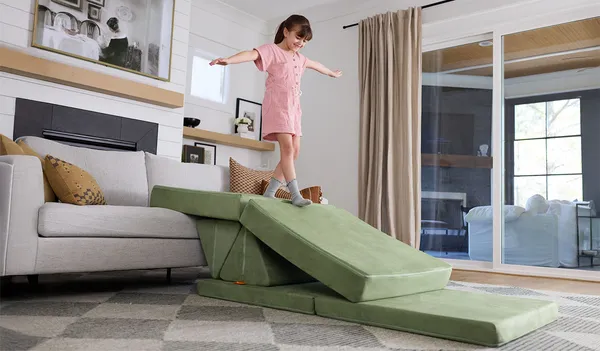
In our eight-week testing period, we documented over 15 distinct recurring configurations across our six testers. The most common was the fort (two bases standing vertically, pillows draped as a roof). Second was the obstacle course (bases as platforms at different heights, pillows as ramps). Third, and the one that surprised us most, was the reading nook — a child-sized enclosure that our 5- and 7-year-old testers retreated to independently, without prompting, for quiet reading and drawing.
The age range observation was particularly striking. Our 2-year-old used the Nugget primarily for climbing and jumping — mounting the firm base, standing, jumping onto the soft base. Simple gross motor play. Our 5-year-old used it as a stage for elaborate narrative play — the Nugget was a boat, then a mountain, then a restaurant. Our 9-year-old used it as a lounge and occasional gymnastics station. The same four foam pieces served meaningfully different play functions across a seven-year age span.
Crucially, the Nugget was self-initiated. After the first few days of parent-guided “look what you can build,” every child in our testing group began using the Nugget independently. This is the single most important indicator of real play value — a child choosing to play with something unprompted.
Age Appropriateness: 8/10
The 2-10 range is largely accurate. Two-year-olds engage with the gross motor elements — climbing, jumping, crashing onto soft surfaces — with unbridled enthusiasm. The foam density is firm enough to climb on but soft enough to cushion falls. We did observe one 2-year-old attempting to stand on a triangular pillow, which rolled underfoot — worth watching for, though the landing is always onto foam or a short distance to the floor.
The upper age range tapers more than the lower. By age 9, the Nugget is less a “play” item and more a “furniture” item — our 9-year-old tester used it daily but primarily for lounging and reading, not active play. For families hoping for active play engagement past age 7-8, expectations should be calibrated accordingly.
Durability: 8/10
Eight weeks isn’t long enough to assess true long-term durability, so we supplemented our testing with extensive parent community research. The consensus is that Nuggets hold up remarkably well — 3-5 years of daily use without structural degradation is commonly reported. The foam retains its shape and density.
The covers are the wear point. Pilling, minor staining, and zipper wear are the most common complaints after 2+ years. The $100 replacement cover cost is a real ongoing expense, though many families get 2-3 years from a single cover.
One durability consideration specific to toddlers: the Nugget is not waterproof. Potty-training accidents can penetrate the cover and reach the foam. A waterproof mattress protector under the cover is a common parent hack. Nugget would benefit from offering a waterproof liner option.
Value for Money: 7/10
At $250, the Nugget is a significant purchase. But the value calculation shifts when you consider two factors: the breadth of the age range and the daily usage frequency.
In our testing, the Nugget was used an average of 5.2 days per week. This is exceptional — most toys, even well-loved ones, see 2-3 days of weekly engagement after the first month. If a Nugget lasts four years (conservative by community reports), that’s roughly 1,080 play sessions at a cost of $0.23 per session. Very few toys in any category achieve that cost-per-use ratio.
The knockoff question is worth addressing directly. The Sam’s Club Member’s Mark Explorer Sofa ($200), the Foamnasium Blocksy ($180), and various Amazon alternatives ($100-150) offer similar concepts. In our assessment, the Nugget’s foam quality and cover construction are meaningfully superior, but the play experience gap is narrower than the price gap. A family choosing a $150 alternative isn’t making a mistake — they’re getting 80% of the product at 60% of the price. The Nugget premium buys durability and finish, not a fundamentally different play experience.
The Evidence
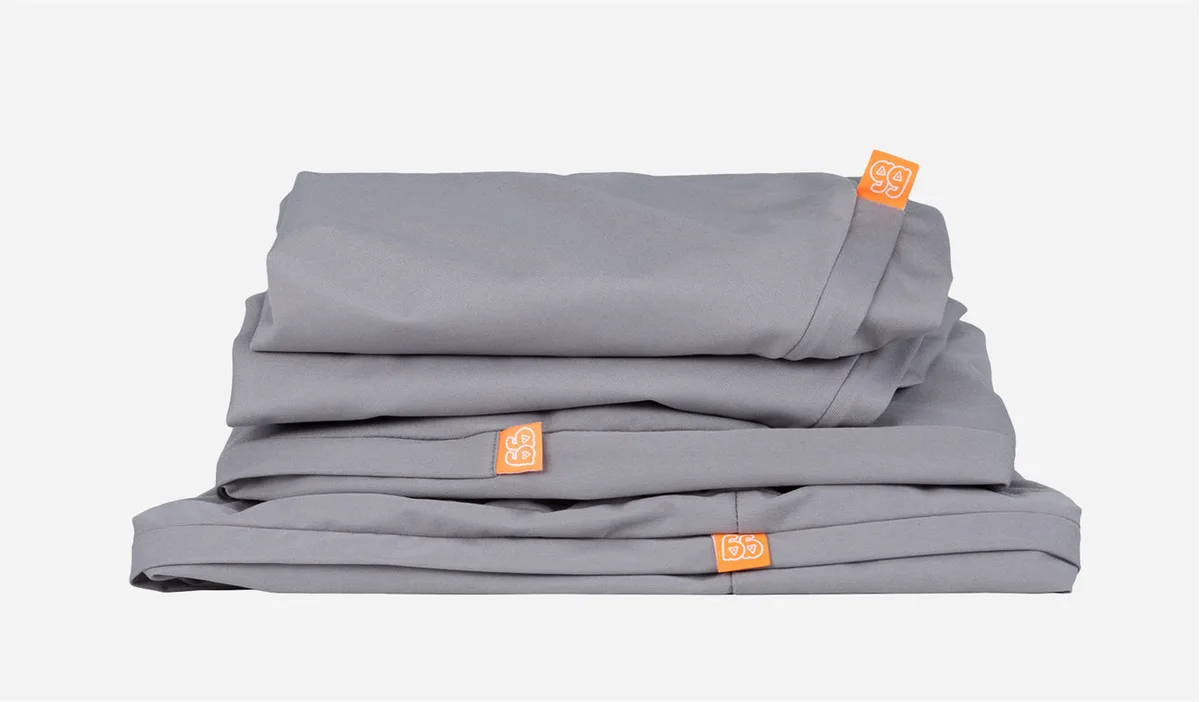
The Nugget isn’t marketed with explicit developmental claims in the way a “STEM toy” might be. Instead, the implied claims are about active play, imaginative play, and proprioceptive/vestibular input. Let’s evaluate each.
Active Play and Gross Motor Development. Climbing, jumping, and balancing on the Nugget’s surfaces engage gross motor skills — specifically, postural control, bilateral coordination, and dynamic balance. Adolph and Franchak (2017) documented the importance of varied locomotor experience in motor development, emphasizing that children who encounter diverse surfaces and movement challenges develop more refined motor control.1 The Nugget creates indoor opportunities for the kind of active, whole-body play that typically requires outdoor equipment.
Timmons et al. (2012) conducted a systematic review of physical activity and motor development in early childhood, finding that active play — particularly play involving climbing, jumping, and balancing — is positively associated with gross motor competence.2 The Nugget facilitates exactly this type of play, though the research validates the activity type, not the specific product.
Imaginative Play. The Nugget’s modular, open-ended design supports what researchers call “divergent play” — play where the same materials serve multiple imagined purposes. Singer and Singer (2005) demonstrated that open-ended play materials that can be transformed by the child’s imagination are more strongly associated with creative thinking than toys with fixed functions.3 The Nugget’s four pieces becoming a boat, a mountain, a castle, or a restaurant in quick succession is a textbook example of this principle in action.
Weisberg et al. (2013) found that guided play — a middle ground between free play and direct instruction — produces stronger learning outcomes than either extreme.4 The Nugget naturally facilitates guided play when a parent says, “Can you build a bridge?” and the child figures out how. This is more developmentally rich than, say, pressing a button to hear a sound.
Proprioception and Vestibular Input. Jumping onto foam, climbing at different heights, and rolling across uneven surfaces provide proprioceptive input (awareness of body position) and vestibular input (balance and spatial orientation). Ayres (1979, in foundational occupational therapy literature) theorized that children with robust proprioceptive and vestibular processing develop better motor planning, emotional regulation, and attention.5 While Ayres’ specific sensory integration theory has been debated in subsequent research, the basic principle that varied movement experience supports sensorimotor development is well-accepted.
The honest summary: The Nugget’s developmental case rests on well-supported general principles — active play benefits gross motor development, open-ended materials support imagination, varied movement experiences support sensorimotor development. None of this research validates the Nugget specifically. But unlike many products where the developmental framing feels like marketing stretch, the Nugget’s design genuinely aligns with what the research says about beneficial play environments. The product doesn’t need to overstate its case, because the straightforward case is strong enough.
Safety Notes
The Nugget is made from CertiPUR-US certified foam (tested for harmful chemicals, off-gassing, and heavy metals) and meets CPSC requirements for children’s products. No recalls have been issued.
The primary safety consideration is fall height. When children stack both bases and climb on top, the total height is approximately 18 inches. This is below the fall-height threshold that most safety guidelines consider concerning for the 2+ age group, and the surrounding foam pieces typically cushion falls. However, if the Nugget is placed near hard furniture, walls, or on a hard floor, the combination of climbing height and a sideways fall onto a non-cushioned surface is worth managing. Positioning the Nugget away from sharp-edged furniture is prudent.
Suffocation risk is minimal — the foam is breathable and the cushions are too firm for a child to sink into. That said, for toddlers under 2 using the Nugget, the standard safe sleep environment rules apply: don’t allow unsupervised sleep on the Nugget, and be aware of gaps between cushions where a very small child could wedge.
The cover is not flame-retardant (it meets California TB 117-2013 smolder test standards using barrier technology rather than chemical flame retardants). This is generally considered preferable from a toxicology standpoint but worth noting for families who need specific fire safety certifications.
The Verdict
The Nugget Comfort Couch is one of the few “cult” products we’ve reviewed where the enthusiasm is warranted. It’s a thoughtfully designed, well-constructed piece of play furniture that children genuinely use — not for a week, but for years. The modular format creates an open-ended play environment that supports gross motor development, imaginative play, and self-directed engagement across an unusually wide age range.
It’s not magic furniture that will transform your child’s development. The research supports the type of play the Nugget enables, not the Nugget specifically. A child who climbs on couch cushions, builds forts from blankets, and jumps on mattresses is getting similar developmental input. What the Nugget offers is a durable, cleanable, purpose-designed version of that experience — one that won’t destroy your actual furniture in the process.
Product Rating: 8/10 — Excellent play furniture with genuine, sustained value. Loses points on price relative to knockoffs and the non-waterproof design.
Evidence Rating: Emerging — The developmental principles behind the Nugget’s play patterns are well-supported. Product-specific evidence doesn’t exist, but the alignment between the Nugget’s use patterns and research on active, open-ended play is strong.
Who Should Buy This
- Families with children ages 2-7 who need indoor active play options (apartments, cold climates, rainy seasons)
- Parents who value open-ended, screen-free play and are willing to invest in durable play furniture
- Families with multiple children — the age range and collaborative play potential multiply the value
- Anyone who has observed their child climbing on, jumping off, and building forts from regular furniture and wants a designated, durable outlet
Who Should Skip This
- Families on a tight budget (a $150 knockoff provides a similar, if less refined, experience)
- Parents of children over 8 as a primary play item (it becomes furniture, not a toy, at this age)
- Anyone expecting specific, measurable developmental outcomes — the Nugget is a play environment, not a curriculum
- Small apartments where 33” × 66” of floor space is genuinely prohibitive (check dimensions carefully)
This review reflects our independent evaluation. ScienceBasedKids.com purchased this product at retail price. We may earn a commission if you purchase through our links, which helps fund our research. This never influences our ratings.
Footnotes
-
Adolph, K. E., & Franchak, J. M. (2017). “The development of motor behavior.” Wiley Interdisciplinary Reviews: Cognitive Science, 8(1-2), e1430. ↩
-
Timmons, B. W., LeBlanc, A. G., Carson, V., et al. (2012). “Systematic review of physical activity and health in the early years (aged 0-4 years).” Applied Physiology, Nutrition, and Metabolism, 37(4), 773-792. ↩
-
Singer, D. G., & Singer, J. L. (2005). Imagination and Play in the Electronic Age. Cambridge, MA: Harvard University Press. ↩
-
Weisberg, D. S., Hirsh-Pasek, K., & Golinkoff, R. M. (2013). “Guided play: Where curricular goals meet a playful pedagogy.” Mind, Brain, and Education, 7(2), 104-112. ↩
-
Ayres, A. J. (1979). Sensory Integration and the Child. Los Angeles: Western Psychological Services. ↩
Enjoyed this review? We publish two new evidence-based evaluations every week.
Free. No spam. Unsubscribe anytime.
Percentages represent share of total observed play sessions involving each mode. Sessions could involve multiple modes.
Recommended Accessories
Affiliate links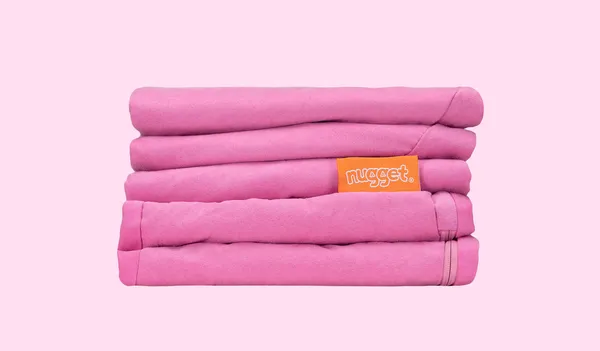
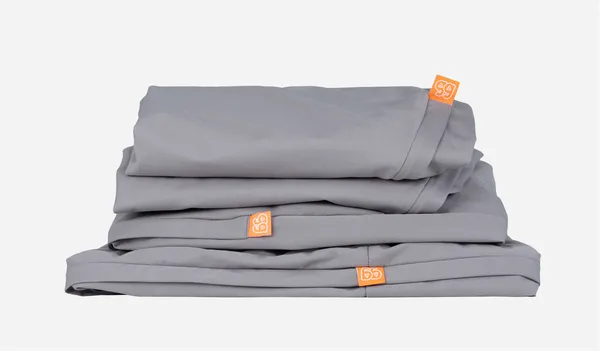
Nugget Cover Set (Extra, Machine-Washable)
“Second cover set for easy washing rotation. Includes covers for all four pieces. Saves the couch during potty-training years.”
Nugget Pillow Pack (2-Pack Triangular Pillows)
“Two-pack of classic triangular pillows in matching foam and fabric. Adds building configurations and extends play possibilities.”
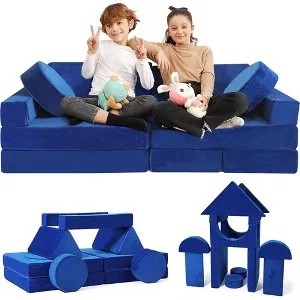
Member's Mark Kids' Explorer Sofa (Sam's Club Exclusive)
“Budget Nugget alternative with four foam pieces and washable covers. Sam's Club exclusive, ~$100 less than the Nugget.”
Fat Brain Toys Teeter Popper (Blue)
“Active indoor play companion with suction-cup rocking board. Balances the 'chill' Nugget with vestibular stimulation.”
RUISHINE Battery Powered LED Strip Lights (13.2ft, Color Changing)
“Battery-powered RGB LED strips for fort-building enhancement. Kids drape these inside Nugget forts for 'secret hideout' ambiance.”