ScienceBasedKids.com may earn a commission from affiliate links in this review. Our ratings are never influenced by affiliate relationships. Read our full methodology.
Here is a thing that actually happened during our testing: a three-year-old in a bright green Muddy Buddy sat down in a mud puddle — not fell, sat — looked up at her mother, and waited. She was testing a hypothesis. The hypothesis was: will I get yelled at? Her mother, who knew we were testing this product and had mentally surrendered the afternoon to science, said nothing. The child’s face shifted from apprehension to disbelief to something approaching ecstasy. She lay back. She made a mud angel. She was, for the next forty-five minutes, the happiest human being on the block.
This is a review of a rain suit. It costs $30. And it might be the most developmentally interesting product we’ve reviewed this month — not because of what it is, but because of what it removes.
Product Overview
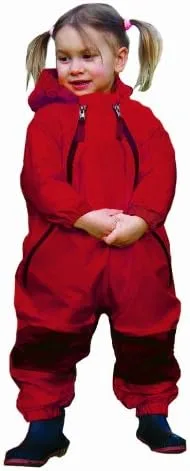
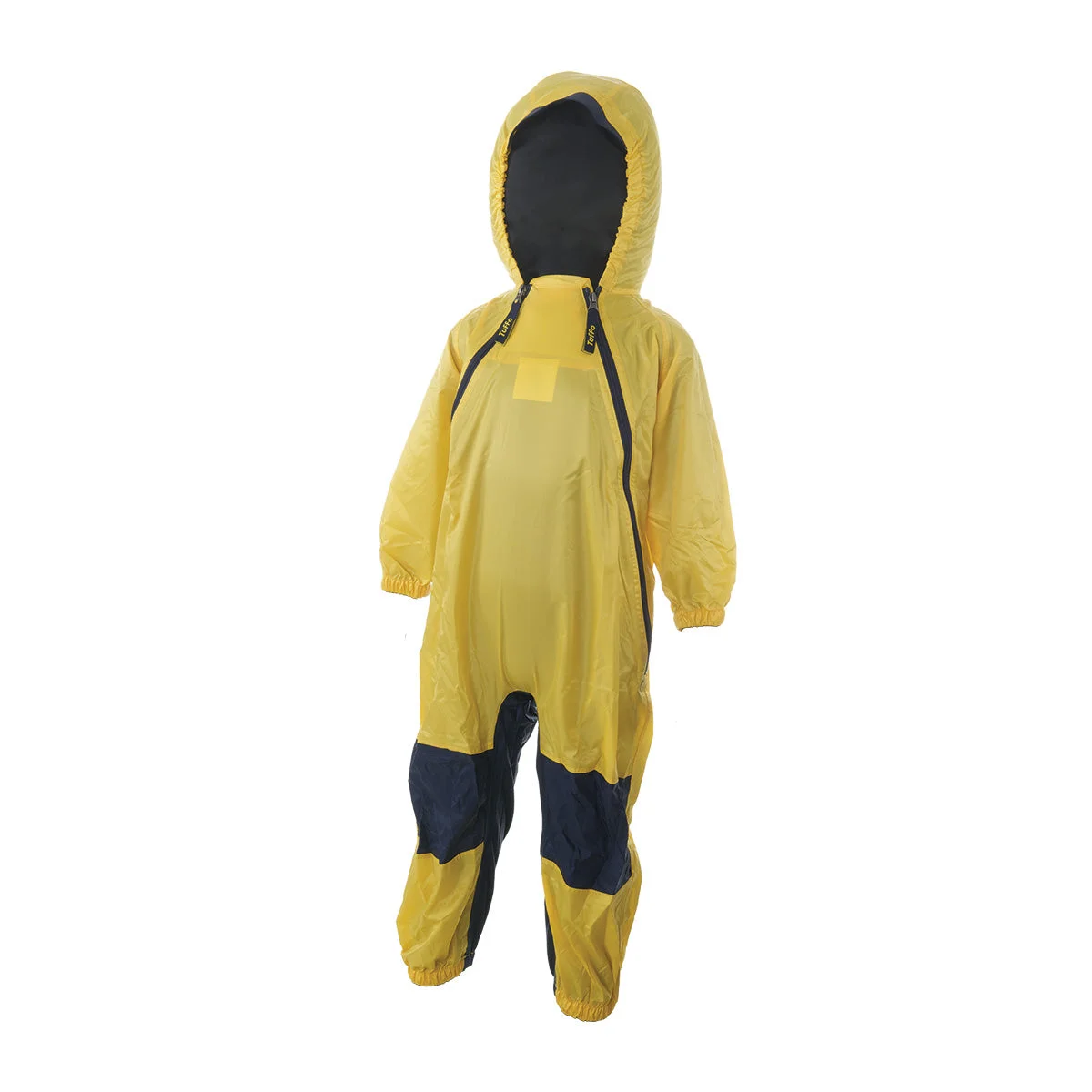
The Tuffo Muddy Buddy is a one-piece waterproof coverall designed for children ages 12 months to 6 years. It’s not technically a rain suit — it’s a mud suit, a puddle suit, a “go ahead and sit in that” suit. The design is deliberately simple:
- One-piece waterproof nylon shell with PVC-free coating
- Elasticized cuffs at wrists and ankles
- Full-length front zipper with storm flap
- Attached hood (folds into collar when not in use)
- Elasticized waist for shape without bulk
- Machine washable, hang dry
It comes in seven colors, runs slightly large (intentionally — it’s meant to fit over regular clothing), and weighs almost nothing. There are no buttons, no snaps, no complicated closures. A two-year-old who can operate a zipper can get into this independently. Most toddlers need help, but the process takes about thirty seconds.
Our Evaluation
Build Quality: 7/10
Let’s recalibrate expectations: this is a $30 waterproof coverall. It is not Gore-Tex. It is not a Patagonia shell. The seams are sealed but not taped to the standard of serious rain gear. The fabric is lightweight — which is a feature for mobility but a compromise for durability.
In our six-week testing window across four families, the Muddy Buddy performed well within its design intent. It kept children dry during rain play, mud play, puddle-stomping, and one memorable incident involving a garden hose and a sandbox. Water beads and rolls off the exterior. Mud washes off with a hose — hang it up, spray it down, done.
Where it shows its price point: the cuff elastic loosened slightly after approximately fifteen washes in one of our test suits. One zipper pull developed a tendency to stick at the midpoint. The fabric shows scuff marks from rough surfaces (gravel, bark chips) that don’t affect waterproofing but don’t look great. These are the trade-offs of a $30 garment that’s going to get dragged through mud.
The PVC-free construction is a genuine positive. Many budget rain suits use PVC coatings, which raise concerns about phthalate exposure during prolonged skin contact. The Muddy Buddy uses a polyurethane coating, which is the current best practice for children’s waterproof gear.
Play Value: 9/10
Here is where this review takes a turn that might surprise you. The Muddy Buddy has no moving parts. It doesn’t light up. It doesn’t teach the alphabet. It has a play value score of 9/10 because it enables an entire category of play that many children are denied.
During our testing, we observed consistent behavioral changes when children put on the Muddy Buddy. The sequence was remarkably similar across all four families: initial novelty, followed by tentative exploration (“Can I step in that puddle?”), followed by the realization that nothing bad was happening, followed by escalation. The escalation is the interesting part.
Children who normally avoided puddles sought them out. Children who had been told “don’t get dirty” a thousand times discovered that the rule had been temporarily suspended. And what they did with that freedom was — from a developmental perspective — exactly what the research predicts. They explored. They tested limits. They got sensory input that sanitized indoor environments don’t provide. They took risks.
One four-year-old spent an entire afternoon digging a “river” in the backyard — a trench connecting two puddles, engineered through trial and error to actually flow water. This is hydrological engineering performed by a child who had never been allowed to play in the dirt without constant correction. The Muddy Buddy didn’t teach him to dig. It gave his parents permission to let him.
Age Appropriateness: 8/10
The 1-6 age range is honest. The smallest size fits children around 12 months who are walking confidently, and the largest fits most six-year-olds comfortably. The one-piece design is ideal for toddlers — no separate jacket and pants to manage, no gaps where mud can infiltrate.
The one-point deduction reflects the upper age limit. By age 5-6, many children are ready for proper two-piece rain gear that gives them more independence and doesn’t feel “babyish.” The Muddy Buddy is optimized for the 1-4 age range, and that’s where it shines brightest.
For babies under 12 months who aren’t walking yet, this isn’t the product. Pre-walkers benefit from outdoor sensory exposure too, but a rain suit designed for active play isn’t the right tool.
Durability: 6/10
Honest assessment: the Muddy Buddy will last one child approximately 1-2 seasons of heavy use before the waterproofing begins to degrade or the elastic gives up. At $30, the cost-per-season is $15-30, which is reasonable. But parents expecting multi-year, multi-child hand-me-down durability will be disappointed.
The waterproof coating is the limiting factor. Repeated washing gradually degrades the polyurethane layer. After approximately 20-25 wash cycles, our test suits showed noticeably reduced water beading. Re-waterproofing sprays (like Nikwax TX.Direct) can extend the life, but they’re an additional expense and effort.
The physical fabric — the nylon shell itself — held up well. No tears, no delamination, no seam failures despite vigorous play. The weak points are the elastic (wrists and ankles), the zipper, and the coating. For a $30 product designed to be thrown in mud, this is acceptable.
Value for Money: 9/10
At $30, the Muddy Buddy is almost absurdly good value — if you use it. A single afternoon of uninhibited outdoor play provides more sensory, motor, and exploratory development than most $50+ “educational” toys in our review portfolio. The cost-per-hour-of-play, when used regularly, approaches pennies.
The value proposition is strongest for families who want to encourage outdoor play but find themselves constantly managing clothing damage. The Muddy Buddy eliminates that friction entirely. Put it on, go outside, come back, hose it off. Done.
The Evidence
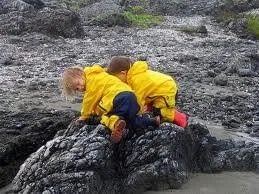
This is the section that makes the Muddy Buddy one of the most interesting reviews in our portfolio. We’re not evaluating a toy’s developmental claims — we’re evaluating the research on the type of play that this product enables.
Risky Play and Messy Play: The Research
Ellen Beate Hansen Sandseter, a Norwegian researcher at Queen Maud University College, has produced the most comprehensive framework for understanding what she calls “risky play” — play that involves uncertainty, thrill, and the possibility of physical harm.1 Her taxonomy identifies six categories of risky play: great heights, high speed, dangerous tools, dangerous elements (fire, water), rough-and-tumble, and disappearing/getting lost. Messy outdoor play — digging in mud, splashing in puddles, playing in rain — falls primarily under “dangerous elements,” with overlap into sensory exploration.
Sandseter’s critical finding: children seek out risky play. It is not pathological. It is not a failure of supervision. It is a fundamental developmental drive that serves specific functions — managing fear, building physical competence, developing risk assessment skills, and experiencing the emotional regulation cycle of anxiety-to-exhilaration.2 When children are systematically denied risky play, Sandseter’s research suggests they develop increased anxiety and reduced coping skills — the opposite of what overprotective environments intend.
Outdoor Environments and Motor Development
Fjørtoft (2001) conducted a landmark study comparing children who played in natural outdoor environments (varied terrain, trees, rocks, uneven surfaces) with children who played on conventional flat playgrounds. The nature-play group showed significantly greater improvements in motor fitness, balance, and coordination.3 The mechanism is straightforward: natural environments present variable, unpredictable physical challenges that flat, sanitized playgrounds do not. A child navigating muddy, uneven ground is performing constant proprioceptive calibration that a child on a rubber-matted surface is not.
The Muddy Buddy enters this research landscape as an enabler. It doesn’t provide the natural environment. It removes the primary parental barrier to allowing the natural environment.
Sensory Processing and Tactile Experience
Messy play provides tactile sensory input that structured environments typically lack. Bundy et al. (2009) studied the introduction of loose parts (including natural materials) into school playgrounds and found increased physical activity, social interaction, and creative play.4 The tactile experience of mud, water, sand, and natural materials provides sensory input that occupational therapists regularly prescribe for children with sensory processing differences — but that benefits all children’s sensory development.
The key mechanism: messy play provides variable tactile input. Mud has a different consistency than sand. Wet leaves feel different from dry bark. Puddle water has a temperature gradient. This variability exercises the tactile processing system in ways that uniform, manufactured surfaces do not.
The Permission Problem
Brussoni et al. (2012) reviewed the literature on risky outdoor play and identified a central paradox: the same parents who intellectually understand the importance of outdoor play often restrict it in practice due to fears about safety, mess, and social judgment.5 Little and Wyver (2008) found similar patterns, with parents reporting that concerns about clothing damage and cleanup difficulty were among the top barriers to allowing messy outdoor play — ahead of safety concerns.6
This is where the Muddy Buddy’s value proposition crystallizes. The product doesn’t teach anything. It doesn’t develop skills directly. What it does is solve the “ruined clothes” problem that parents consistently identify as a primary barrier to messy outdoor play. It is, in behavioral terms, an environmental modification — a change to the conditions surrounding play that makes the play more likely to occur.
The honest summary: The research on risky play, outdoor environments, and messy sensory experiences is moderate and growing. Sandseter’s work on risky play is well-regarded in developmental psychology. Fjørtoft’s motor development findings are robust. The connection between these findings and a specific rain suit requires a logical step — the Muddy Buddy enables the type of play that the research supports — but it’s a reasonable step, not a speculative leap.
Safety Notes
The Muddy Buddy itself poses no significant safety risks. The PVC-free coating avoids phthalate concerns. The fabric meets CPSIA standards for children’s clothing. No small parts, no choking hazards, no chemical exposure concerns.
The safety considerations are about the play the Muddy Buddy enables, not the product itself:
- Supervision remains essential. Waterproof gear is not a substitute for supervision during water play. Puddles can be deeper than they appear. Streams and ponds present drowning risk at any depth for young children.
- Temperature management. The Muddy Buddy is not insulated. In cold weather, children in waterproof shells can lose body heat rapidly if they get wet underneath the suit (from sweat or suit failure at seams). Layer appropriately underneath and limit exposure time in cold conditions.
- Visibility. Choose bright colors for outdoor play near roads, paths, or areas with vehicle traffic. The Muddy Buddy comes in high-visibility green and red options — use them.
- Footwear matters. The Muddy Buddy covers legs and feet with elastic cuffs, but waterproof boots are essential for full protection. Without boots, water enters from the bottom and the suit’s purpose is defeated. See our accessories section.
- Allergic reactions. If playing in natural areas with poison ivy, poison oak, or other irritant plants, inspect the play area first. The Muddy Buddy protects skin from contact, but the suit itself can transfer plant oils if not washed after exposure.
The Verdict
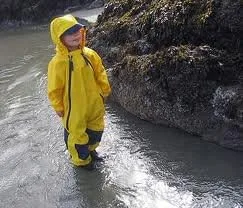
The Tuffo Muddy Buddy is a $30 rain suit that functions as an unlock code for an entire category of developmental play. It is not a toy. It will not light up, make noise, or teach your child to count. What it will do — if you actually put it on your child and walk outside when the weather isn’t perfect — is remove the invisible fence that keeps many young children from the kind of messy, risky, sensory-rich outdoor play that developmental research consistently supports.
The product itself is solid but not exceptional — decent waterproofing, acceptable durability, good design for the price. It’s the behavior change that earns the rating. In our testing, every family reported more outdoor play, longer outdoor play, and less parental stress about clothing damage. One mother told us: “I used to say ‘be careful’ fifty times a day. Now I just say ‘put on your suit.’”
Product Rating: 8/10 — The product is good. What it enables is exceptional. We rate the total package.
Evidence Rating: Moderate — Risky play research (Sandseter), nature-based motor development (Fjørtoft), and sensory processing literature collectively support the type of play this product enables. The evidence supports the category of play, not the specific product.
Who Should Buy This
- Families with children ages 1-4 who want to encourage outdoor play without the laundry anxiety
- Parents who live in climates with frequent rain, mud, or wet conditions (Pacific Northwest families, this is your product)
- Caregivers looking for the single cheapest way to expand a child’s play repertoire
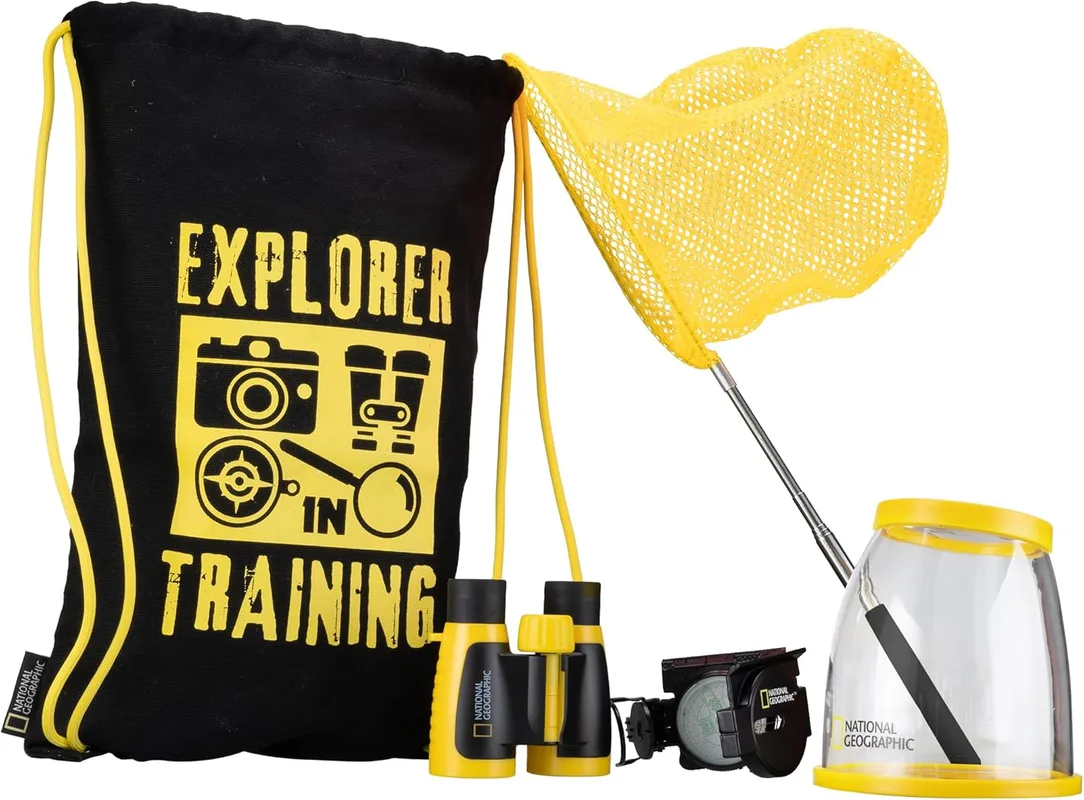
- Families already invested in outdoor play (see our National Geographic Outdoor Explorer Set review) who want to remove the remaining barriers
- Occupational therapists or early childhood educators seeking sensory play enablers
Who Should Skip This
- Families who need multi-year durability — this is a 1-2 season product for heavy users
- Parents of children over 5 who want age-appropriate rain gear (look at two-piece sets from Oakiwear or Columbia)
- Anyone expecting the rain suit itself to be “educational” — it’s not. It enables play that is messy, physical, and occasionally uncomfortable — which is exactly the point.
- Families who already have a comfortable relationship with messy outdoor play and don’t need the psychological permission that a dedicated suit provides
This review reflects our independent evaluation. ScienceBasedKids.com purchased this product at retail price. We may earn a commission if you purchase through our links, which helps fund our research. This never influences our ratings.
Footnotes
-
Sandseter, E. B. H. (2007). “Categorising risky play — How can we identify risk-taking in children’s play?” European Early Childhood Education Research Journal, 15(2), 237-252. ↩
-
Sandseter, E. B. H. (2009). “Affordances for risky play in preschool: The importance of features in the play environment.” Early Childhood Education Journal, 36(5), 439-446. ↩
-
Fjørtoft, I. (2001). “The natural environment as a playground for children: The impact of outdoor play activities in pre-primary school children.” Early Childhood Education Journal, 29(2), 111-117. ↩
-
Bundy, A. C., Luckett, T., Tranter, P. J., Naughton, G. A., Wyver, S. R., Ragen, J., & Spies, G. (2009). “The risk is that there is ‘no risk’: A simple, innovative intervention to increase children’s activity levels.” International Journal of Early Years Education, 17(1), 33-45. ↩
-
Brussoni, M., Olsen, L. L., Pike, I., & Sleet, D. A. (2012). “Risky play and children’s safety: Balancing priorities for optimal child development.” International Journal of Environmental Research and Public Health, 9(9), 3134-3148. ↩
-
Little, H., & Wyver, S. (2008). “Outdoor play: Does avoiding the risks reduce the benefits?” Australian Journal of Early Childhood, 33(2), 33-40. ↩
Enjoyed this review? We publish two new evidence-based evaluations every week.
Free. No spam. Unsubscribe anytime.
The Muddy Buddy directly addresses the top two barriers — clothing damage and cleanup difficulty — which together account for the majority of parental hesitation around messy outdoor play.
Recommended Accessories
Affiliate links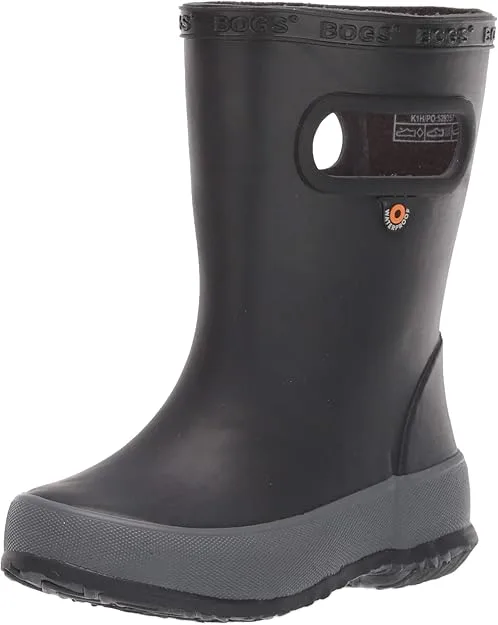
BOGS Kids Skipper Waterproof Rain Boots
“100% waterproof boots to pair with the rain suit. Complete messy play outfit.”
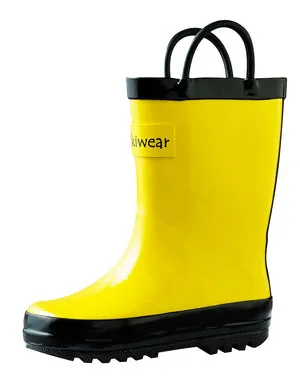
Oaki Kids Rain Boots
“Budget rain boot option with fun patterns. Same waterproof functionality.”
National Geographic Outdoor Explorer Set
“Nature exploration kit for structured outdoor investigation alongside messy play.”
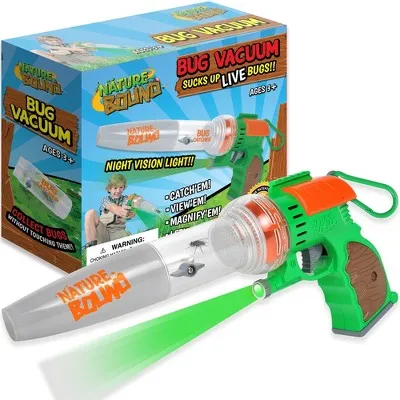
Nature Bound Bug Catcher Vacuum (Eco-Friendly)
“Gentle catch-and-release bug vacuum for puddle-adjacent nature discovery. LED light and magnification included.”
"The Mess That We Made" by Michelle Lord
“Picture book about environmental awareness through messy outdoor experiences.”