ScienceBasedKids.com may earn a commission from affiliate links in this review. Our ratings are never influenced by affiliate relationships. Read our full methodology.
The eight-month-old stood at the base of the triangle, both hands gripping the lowest rung, and pulled herself to standing. She swayed. She grinned. She let go with one hand to reach for the second rung, wobbled, sat down hard on the mat below, and immediately reached for the first rung again. No adult intervened. No one repositioned her hands or steadied her hips. This — the reaching, the wobbling, the falling, the trying again — is exactly what Emmi Pikler had in mind when she designed this piece of equipment in Budapest over seventy years ago.
The Pikler triangle has become something of a totem in certain parenting circles — Montessori families, RIE practitioners, the wooden-toy-and-linen-clothing cohort that populates a specific corner of Instagram. The aesthetics are undeniable. But at $200 for the Lily & River Little Climber (and up to $400 with accessories), you deserve to know whether the developmental philosophy holds up and whether the product itself justifies the price. We tested one for eight weeks with children ranging from six months to five years old.
Product Overview
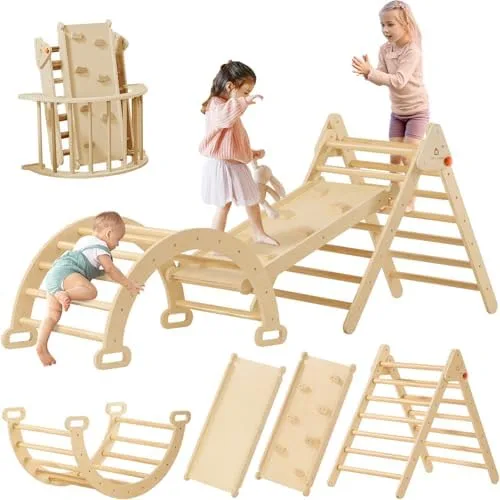
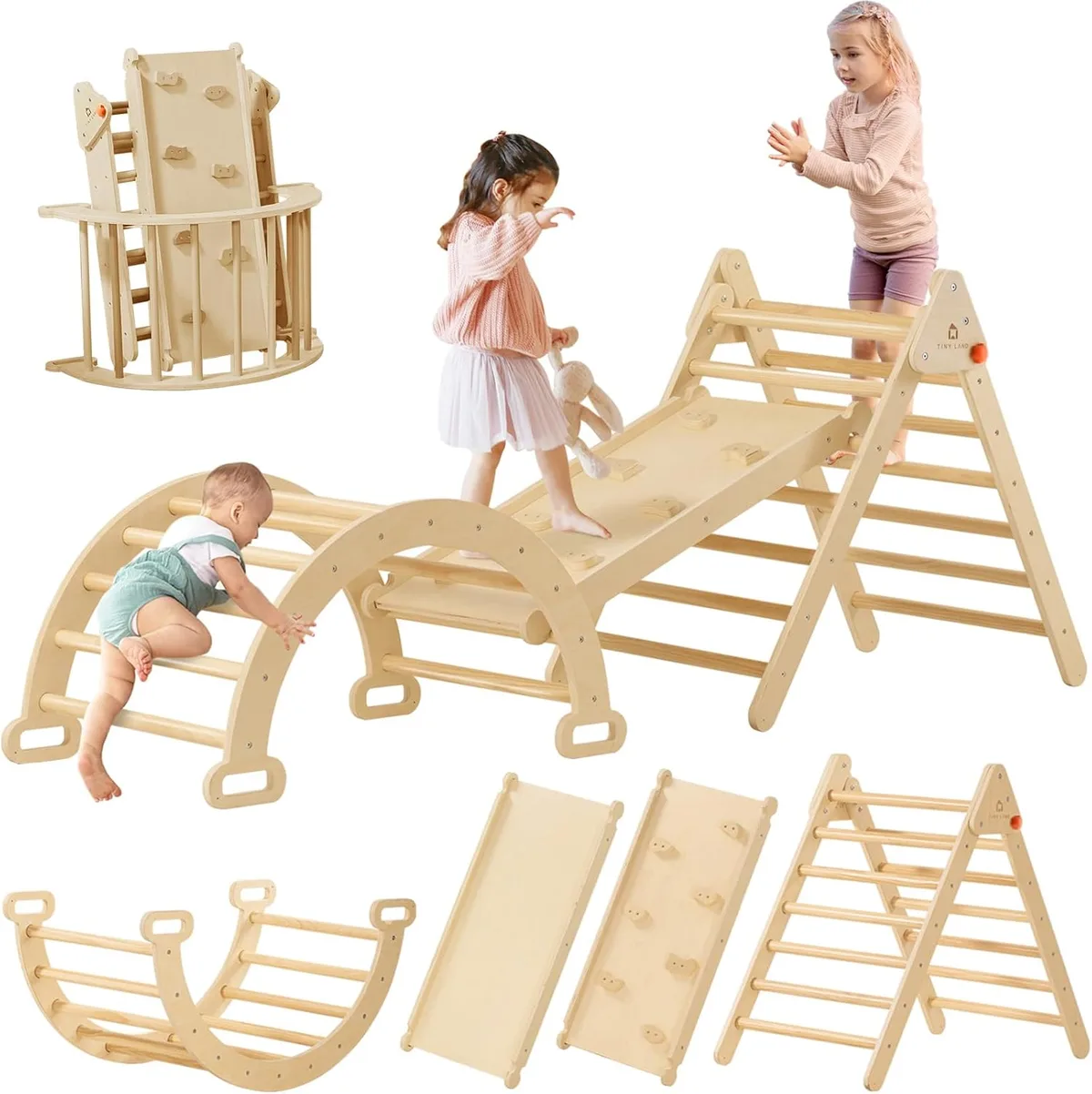
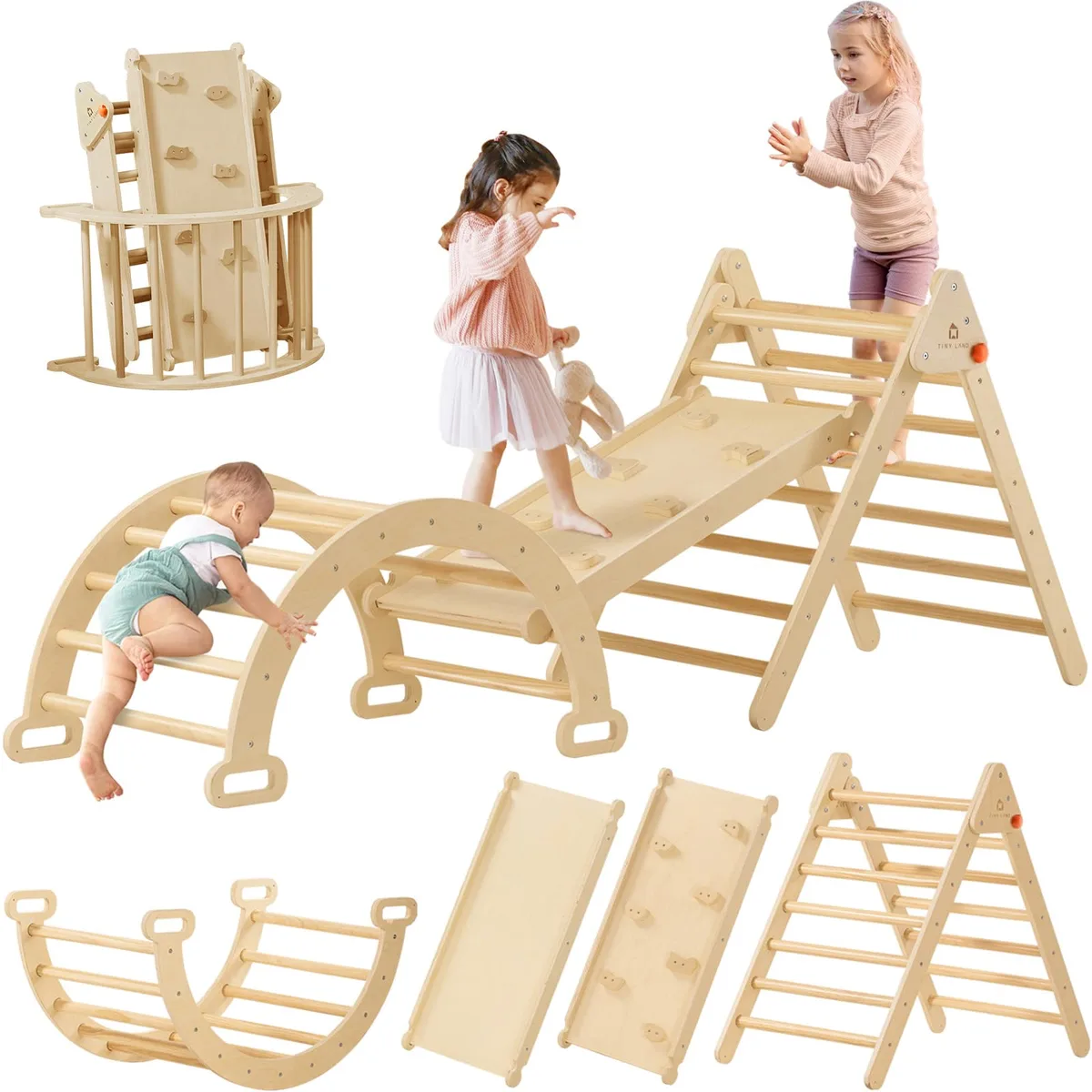
The Lily & River Little Climber is a triangular climbing frame made from sustainably harvested birch plywood and solid birch dowel rungs. It stands approximately 32 inches tall at its peak, with rungs spaced about 4 inches apart. The frame folds flat for storage — a meaningful consideration given that this is not a small object in a living room.
The construction is beautiful. The wood is sanded smooth, finished with a food-safe, non-toxic sealant, and the joints are recessed and rounded. There are no exposed hardware or pinch points. The triangle weighs about 17 pounds and feels substantial without being unwieldy for an adult to move. It ships flat-packed and requires about 20 minutes of assembly with basic tools.
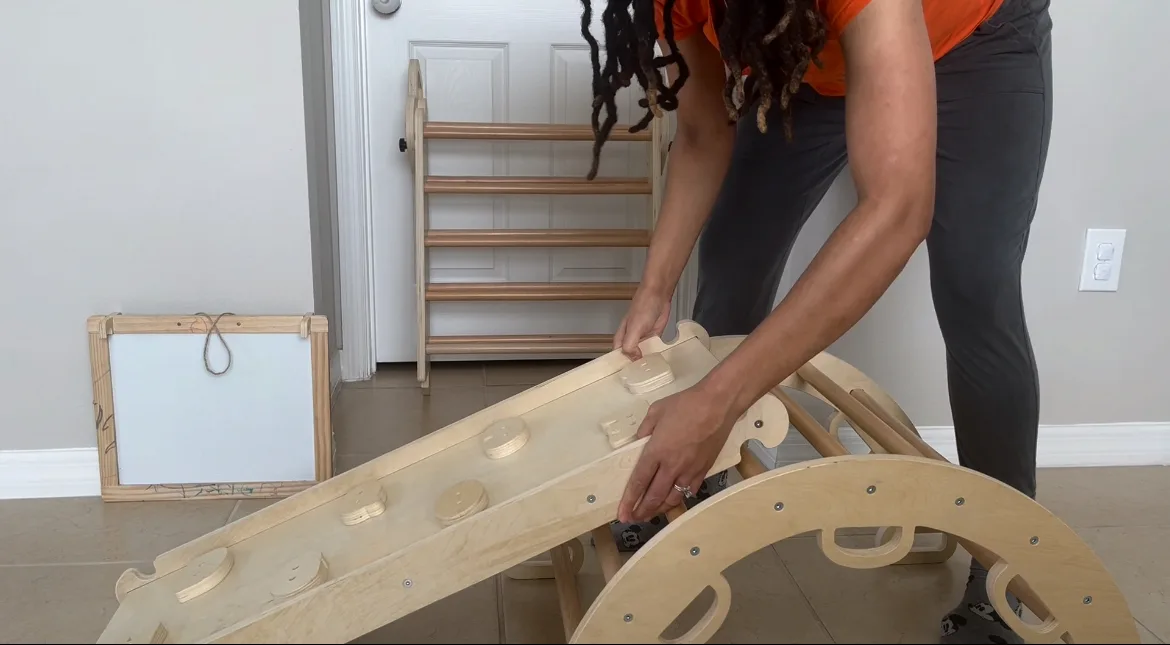
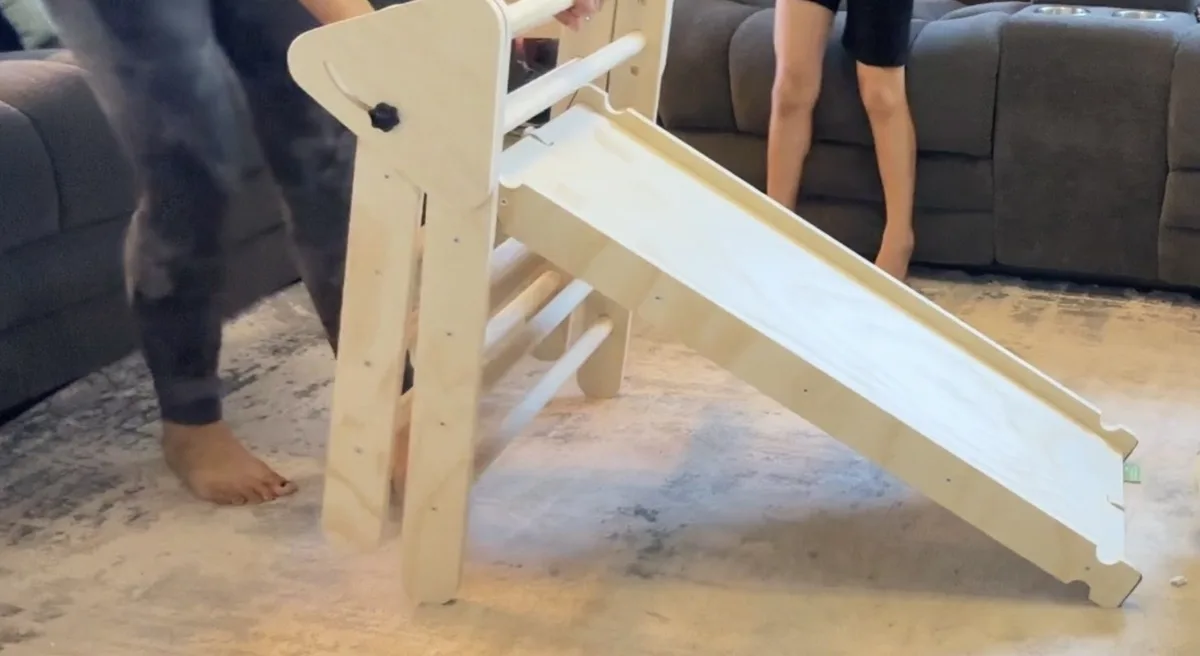
Lily & River is a small, U.S.-based company that makes their triangles domestically. At $200 for the base triangle (the slide/rock wall ramp attachment adds $90), it sits in the middle of the Pikler triangle market — cheaper than high-end European models like Ette Tete ($250+) but more expensive than Amazon imports ($80-120) that often use lower-grade materials and less precise construction.
Our Evaluation
Build Quality: 9/10
The Little Climber is impeccably made. The birch plywood side panels are thick, smooth, and show consistent grain. The dowel rungs are solid — not hollow — and fit tightly into the frame without any wobble or rotation. The folding mechanism uses a metal pin system that locks securely when open and releases cleanly when you need to collapse the frame.
We looked specifically for issues common to cheaper Pikler triangles: rough spots on the wood, loose rungs, unstable bases, splinters. We found none. After eight weeks of daily use by children who are not gentle, the finish showed minimal wear — a few surface marks where shoes had scuffed the rungs, but no structural degradation.
The one-point deduction is for the folding mechanism, which is functional but requires two hands and a deliberate motion that isn’t immediately intuitive. Not a flaw, exactly, but not as elegant as the rest of the design.
Play Value: 9/10
What makes the Pikler triangle remarkable is its developmental arc. Most toys have a relatively narrow window of peak engagement. The triangle’s window is enormous — we observed genuinely different play patterns across a five-year age span, and each was developmentally appropriate.
At six to nine months, infants used the lowest rungs to practice pulling to stand. The rung spacing is ideal for small hands, and the triangle’s weight prevents it from tipping when a baby pulls on one side. Three infants in our testing group used the triangle as their primary pulling-up surface, preferring it to furniture.
At twelve to eighteen months, toddlers began climbing. Not to the top — halfway up, pause, look around, descend. The descent is the interesting part. Going down requires a different motor plan than going up, and we watched toddlers work through this problem over days, experimenting with feet-first versus hands-first approaches.
At two years, climbers reached the apex. Sitting on the top rung, straddling the peak — this became a point of pride. Two-year-olds returned to this accomplishment repeatedly, the way a slightly older child might replay a level they’ve mastered in a video game.
At three to four years, the climbing itself became background. The triangle was now a fort, a house, a mountain, a jail. Blankets were draped over it. Stuffed animals were stationed on the rungs. When combined with the slide ramp attachment, it became an obstacle course. One three-year-old spent forty-five minutes inventing increasingly elaborate ways to go through, over, and around the triangle with a Nugget cushion positioned as a landing pad.
At five years, engagement started to taper — but didn’t disappear. The five-year-old in our group used the triangle less for climbing and more as a structural element in imaginative play. It’s not infinite, but five years of meaningful play from a single piece of equipment is exceptional.
Age Appropriateness: 9/10
The Pikler triangle is one of the rare products that genuinely serves a multi-year age range without compromise. From six months (with supervision) through five years, the triangle offers something developmentally meaningful at each stage. The lower age bound is earlier than many climbing toys, and the upper bound extends further than you’d expect.
The one-point deduction is for children under six months (too young to benefit) and over six years (largely outgrown), which limits the total lifespan slightly compared to the very widest-range toys we’ve reviewed.
Durability: 10/10
Solid birch, simple construction, no moving parts beyond the folding mechanism. There is very little to break. The finish is the most vulnerable element, and even that held up well under months of daily climbing. Parent communities report Pikler triangles lasting through multiple children across a decade or more. The resale value on secondhand markets reflects this — used Little Climbers regularly sell for 70-80% of retail, which tells you everything about long-term durability.
Value for Money: 7/10
Two hundred dollars for a wooden triangle is a real ask. There’s no getting around that. And unlike Magna-Tiles or LEGO, you can’t start small and expand — you buy the triangle or you don’t.
The math works out better than it first appears. Across a five-year lifespan, $200 is about $0.11 per day. The slide ramp attachment ($90) effectively doubles the play possibilities. And the resale value means your actual cost of ownership may be closer to $60-80 if you sell when your child outgrows it.
Budget alternatives exist. The Wiwiurka triangle ($180) is comparable. Amazon imports run $80-120 but often use lower-grade wood and less precise construction — we’d want to inspect one in person before recommending it. The Lily & River’s build quality justifies its price within the category, even if the category itself is expensive.
The Evidence

The Pikler triangle is named after Dr. Emmi Pikler (1902-1984), a Hungarian pediatrician who developed a philosophy of infant care centered on free movement and autonomous motor development. Pikler’s approach — now often grouped with RIE (Resources for Infant Educarers) parenting — holds that infants should be allowed to develop motor skills at their own pace, without adult positioning or assistance. The triangle was designed as a piece of equipment that supports this philosophy: it’s always available, it presents a scalable challenge, and it requires no adult intervention to use.
The Free Movement Hypothesis. Pikler’s core claim — that infants who develop motor skills without adult interference develop them more robustly and with greater body awareness — has some empirical support. Pikler and Tardos documented the motor development of children raised at the Lóczy Institute in Budapest, finding that children who were never propped, walked, or placed in positions they couldn’t achieve independently showed motor development that was well within normal ranges and, in some assessments, more coordinated than comparison groups.1
More recently, Adolph and colleagues have extensively studied infant motor learning and found that self-generated movement — rather than passive positioning — is critical for developing flexible, adaptive motor skills.2 Adolph’s “learning to learn” framework suggests that infants who practice motor skills through their own initiative develop better problem-solving approaches to novel motor challenges. This aligns directly with the Pikler philosophy.
Gross Motor Development and Climbing. Climbing, specifically, engages a complex set of motor skills: bilateral coordination, grip strength, weight shifting, spatial planning, and proprioceptive awareness. Gallahue, Ozmun, and Goodway (2012) classify climbing as a fundamental motor skill in early childhood that contributes to the development of more complex movement patterns later.3 Indoor climbing structures have been shown to increase physical activity levels in young children, which is associated with better motor competence and healthier weight trajectories.
Risk Assessment and Self-Regulation. Perhaps the most interesting line of research involves children’s self-assessment of physical risk. Sandseter (2009) studied “risky play” in young children and found that age-appropriate risk-taking — climbing, jumping from heights, playing at speed — is associated with decreased anxiety and improved self-regulation.4 The Pikler triangle, by design, allows children to self-select their level of challenge. A child who isn’t ready to climb to the top simply doesn’t climb to the top. This self-regulation of risk is a feature, not a limitation.
The honest summary: The Pikler philosophy has a genuine research base, though the evidence is stronger for the general principles (self-directed movement, free play, age-appropriate risk) than for the specific equipment. No randomized controlled trial has compared children who play on Pikler triangles with those who play on other climbing structures. But the developmental logic is sound, the motor skill research is supportive, and the philosophy of letting children move at their own pace has strong theoretical and observational backing. We rate the evidence as Moderate — real and meaningful, but not specific to this product.
Safety Notes
Climbing equipment for infants and toddlers requires careful attention to safety. The Lily & River Little Climber addresses most safety concerns through its design, but parents should be aware of the following:
Surface under the triangle. This is the single most important safety consideration. Place the triangle on a gymnastics mat, thick carpet, or foam play mat — never on hard floors. A 30-inch fall onto hardwood or tile can cause serious injury to a toddler. The Milliard gymnastics mat ($50) is our recommendation; it should extend at least 2 feet beyond the base on all sides.
Supervision by age. Children under 18 months should be actively supervised (within arm’s reach) during triangle play. Children 18 months to 3 years should be visually supervised (in the room, watching). Children over 3 with established climbing skills can play independently in most cases, though parents should use their judgment.
Rung spacing and entrapment. The 4-inch rung spacing on the Little Climber falls within safe parameters — wide enough that a child’s head cannot become trapped between rungs, narrow enough that a child’s body cannot fall through. This is a known risk with some cheaper triangles that use wider or irregular spacing.
Folding mechanism. Ensure the locking pin is fully engaged before each use. A partially locked triangle could collapse during climbing. Teach children not to play with the folding mechanism.
Weight limit. Lily & River rates the Little Climber for up to 150 pounds. We’d recommend limiting use to one child at a time regardless, as the triangle’s stability is designed for a single load point.
The Little Climber meets ASTM F963 toy safety standards and is CPSIA compliant. No recalls have been issued.
The Verdict
The Lily & River Little Climber earns its reputation as one of the best indoor climbing structures for young children. The build quality is excellent, the play lifespan is extraordinary, and the developmental philosophy behind the design is grounded in real research — not marketing. It’s a product that genuinely grows with a child from infancy through preschool, offering progressively complex physical and imaginative play at each stage.
The price is the barrier. At $200 (plus $90 for the slide ramp, which we’d consider nearly essential), this is a meaningful investment. It’s justified by the quality and longevity, but families on a budget should know that the developmental benefits of climbing are available through any safe climbing structure — including playground equipment at the local park.
Product Rating: 8/10 — Exceptional build quality and developmental breadth, with a price that limits accessibility.
Evidence Rating: Moderate — The Pikler/RIE free-movement philosophy has genuine research support. Evidence is stronger for the general principles than for this specific equipment.
Who Should Buy This
- Families with children 6 months to 3 years who want a long-lifespan indoor gross motor toy
- Parents who follow Montessori, RIE, or Pikler approaches to child-rearing
- Households without easy access to outdoor climbing structures (apartments, cold climates)
- Families with multiple young children — the age range means years of shared use
- Anyone who values beautiful, well-made wooden toys
Who Should Skip This
- Budget-conscious families (a playground is free; Amazon triangles start at $80)
- Parents of children over 4 who haven’t used a climbing triangle before (the window is closing)
- Families with very limited living space (even folded, it’s not small)
- Anyone expecting this to replace outdoor active play — it supplements, it doesn’t substitute
This review reflects our independent evaluation. ScienceBasedKids.com purchased this product at retail price. We may earn a commission if you purchase through our links, which helps fund our research. This never influences our ratings.
Footnotes
-
Pikler, E. (1972). “Data on gross motor development of the infant.” Early Child Development and Care, 1(3), 297-310. See also Tardos, A. (2010). “Introducing the Piklerian developmental approach.” The Signal, 18(3), 1-4. ↩
-
Adolph, K. E., & Hoch, J. E. (2019). “Motor development: Embodied, embedded, enculturated, and enabling.” Annual Review of Psychology, 70, 141-164. ↩
-
Gallahue, D. L., Ozmun, J. C., & Goodway, J. D. (2012). Understanding Motor Development: Infants, Children, Adolescents, Adults (7th ed.). New York: McGraw-Hill. ↩
-
Sandseter, E. B. H. (2009). “Affordances for risky play in preschool: The importance of features in the play environment.” Early Childhood Education Journal, 36(5), 439-446. ↩
Enjoyed this review? We publish two new evidence-based evaluations every week.
Free. No spam. Unsubscribe anytime.
Each stage builds on the previous — children don't abandon earlier behaviors, they layer new ones on top.
Recommended Accessories
Affiliate links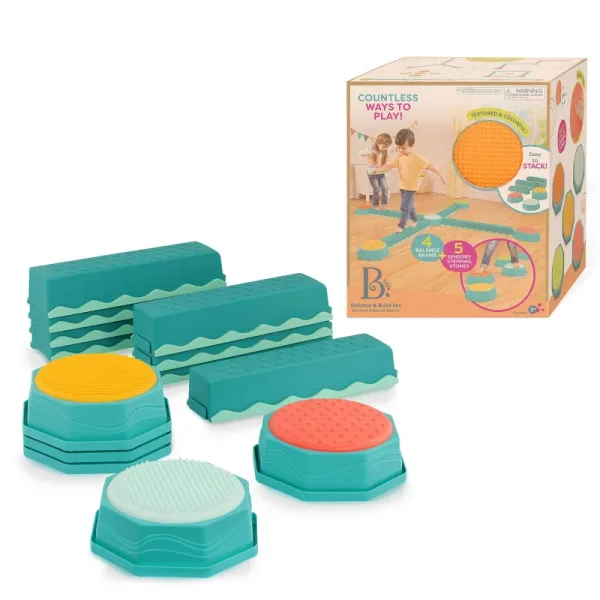
Lily & River Slide/Rock Wall Ramp Attachment
“Converts triangle into a slide or climbing wall. Doubles the play possibilities.”
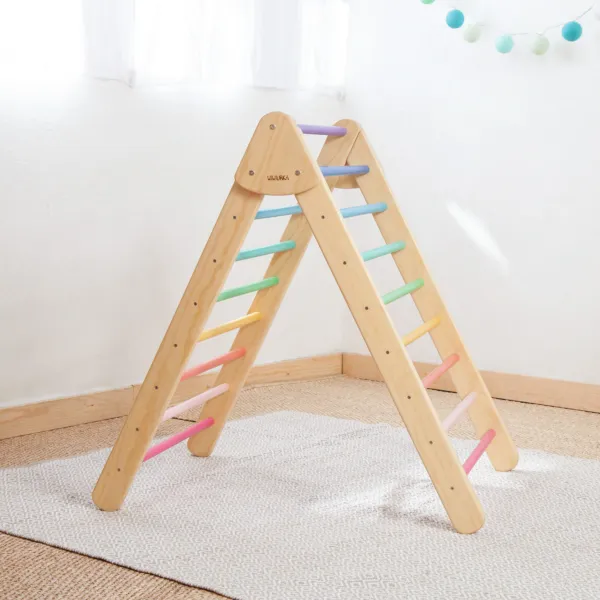
Wiwiurka Pikler Triangle
“Budget alternative with similar design. Foldable for smaller spaces.”
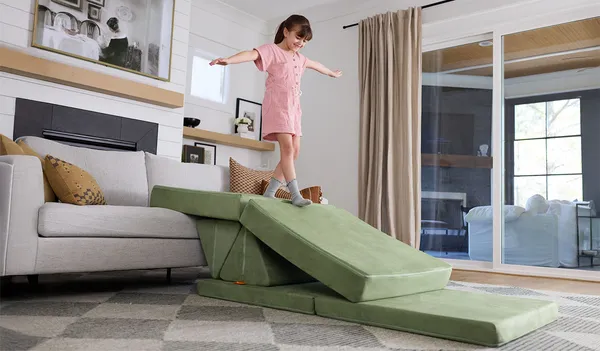
Nugget Comfort Couch
“The classic Pikler + Nugget combo. Soft landing zone and obstacle course building.”
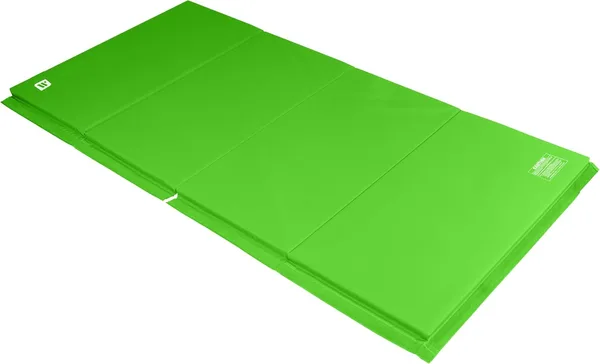
We Sell Mats Gymnastics Tumbling Mat (4'x8'x2")
“Safety mat underneath the triangle. Essential for hard floors. Folds for storage.”
Piccalio Arch Climber
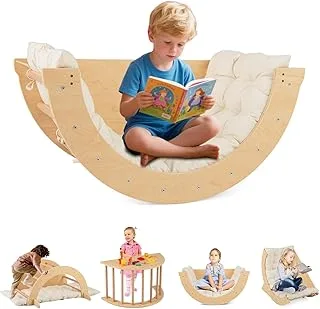
“Adds a rocker/climbing arch to create a full indoor gross motor course.”