ScienceBasedKids.com may earn a commission from affiliate links in this review. Our ratings are never influenced by affiliate relationships. Read our full methodology.
The board changes every turn. That single design decision — made by Max Kobbert in 1986 — is what separates Labyrinth from every other children’s board game on the shelf and what has kept it there for four decades. In most board games, the board is the constant and the players are the variables. In Labyrinth, you physically push a tile into the maze, which shifts an entire row or column, which opens some paths and closes others, which means the route you planned three seconds ago no longer exists. A child playing Labyrinth for the first time experiences something rare in the board game world: the ground moving beneath their strategy.
At $33, Ravensburger’s Labyrinth sits in the sweet spot of the family board game market — affordable enough to buy on impulse, complex enough to hold up across dozens of plays. We tested it with children ages 6 through 12 (and, inevitably, their parents) over four weeks. Here’s what we found.
Product Overview
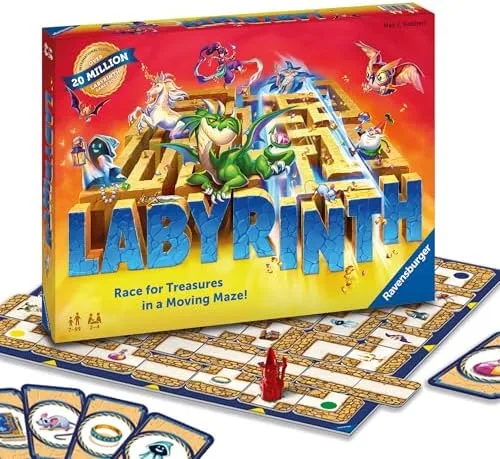
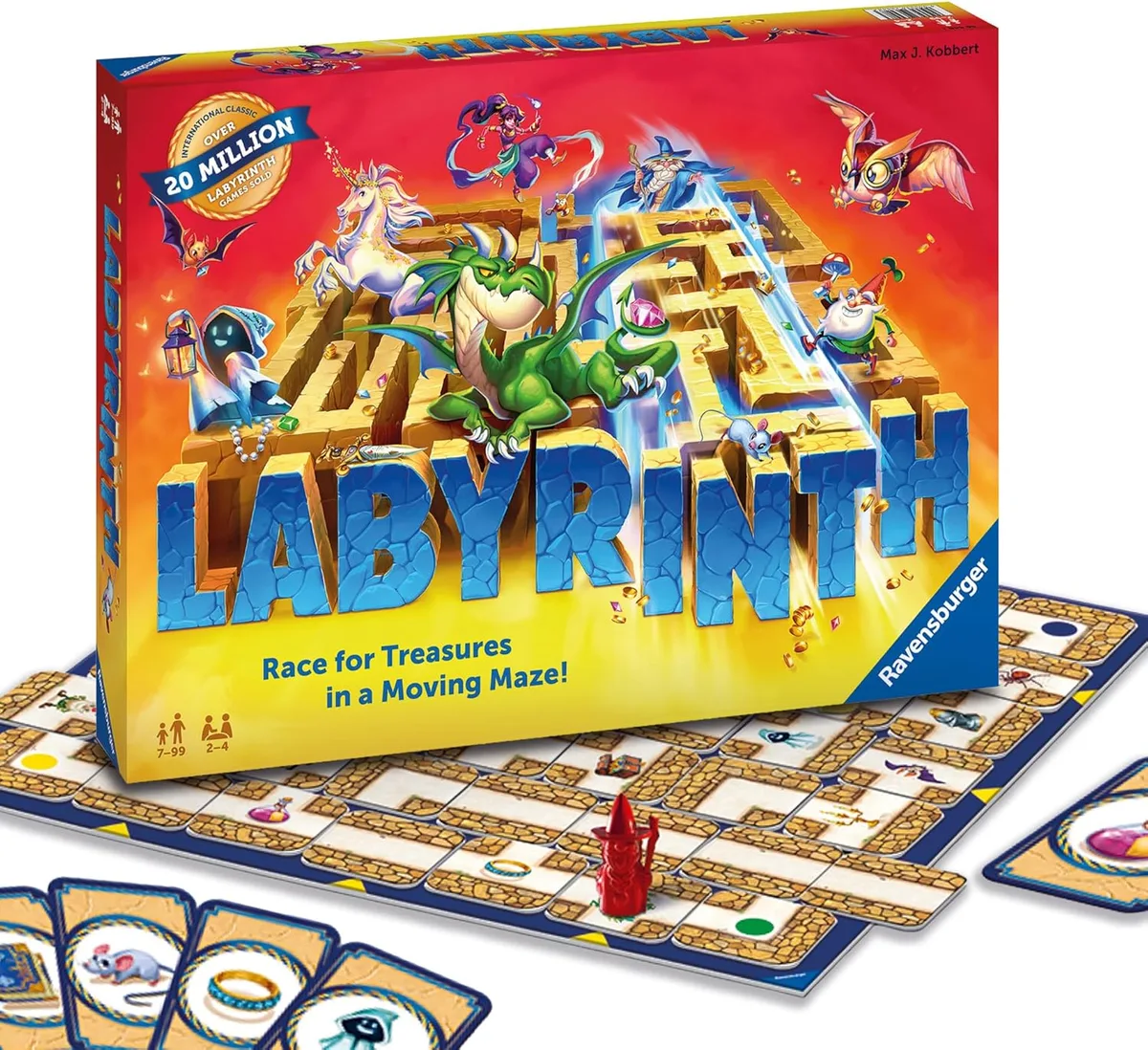
Labyrinth is a 2-4 player board game where players navigate a maze to collect treasures. The board is a 7×7 grid of tiles, some fixed and some movable. On each turn, a player takes the one extra tile, slides it into any open row or column on the board edge, and physically pushes the entire row one space — shifting every movable tile and potentially disrupting every other player’s position and plans. Then the player moves their pawn along any open path.
In the box:
- Game board with 16 fixed maze tiles
- 34 movable maze tiles (with various path configurations)
- 24 treasure cards
- 4 player pawns
- One extra tile (the one you slide in each turn)
The goal: collect all your assigned treasures (dealt face-down at the start) and return to your starting corner. First player to collect all treasures and return home wins.
A typical game takes 20-35 minutes, which is well-calibrated for the target age range — long enough to feel substantial, short enough to avoid the restless-child problem that plagues longer strategy games.
Our Evaluation
Build Quality: 8/10
Ravensburger’s production quality is consistent and reliable. The game board is thick, sturdy cardboard with a satisfying weight. The tiles are well-cut and slide smoothly along the board channels — this is critical for a game where the core mechanic is physically pushing tiles, and Ravensburger has clearly optimized the tolerances. In our four weeks of testing, the tiles never jammed, warped, or refused to slide.
The artwork is colorful and clear — each treasure is distinct and easily identified, which matters for younger players scanning a busy board. The player pawns are simple plastic pieces that do the job without delighting.
The one legitimate complaint: the treasure cards are thin. After heavy use, they show wear at the edges. For a game you’ll play dozens or hundreds of times, sleeving the cards is a worthwhile $3 investment.
Play Value: 9/10
This is where Labyrinth shines. The sliding-tile mechanic creates emergent complexity from simple rules. A new player can learn the rules in under five minutes — slide a tile, move your pawn — but mastering the strategic implications takes much longer. The gap between understanding the rules and understanding the game is where all the developmental richness lives.
We observed a clear skill progression across our testing sessions:
Sessions 1-2: Children focused on their own path, sliding tiles to create a route to their current treasure. They treated other players’ moves as random disruptions — something annoying that happened between their turns.
Sessions 3-5: Children began anticipating how their tile-slide would affect other players. They started blocking opponents deliberately, not just as a side effect. The concept of “my move changes your board” became internalized.
Sessions 6+: The strongest players began thinking two moves ahead — planning a tile-slide that would create their path and disrupt a competitor’s. This is executive function in action: holding multiple board states in working memory, inhibiting impulsive first moves, and flexibly updating plans when someone else shifts the maze.
The game also avoids the runaway-leader problem that plagues many children’s games. Because the board shifts every turn, a player who is “behind” is never strategically hopeless — a single clever tile-slide can leapfrog them forward. This keeps all players engaged until the end.
Age Appropriateness: 7/10
The box says 7+, and that’s honest — perhaps even slightly generous. Our six-year-old testers understood the rules but struggled with the spatial visualization required to predict how a tile-slide would alter the maze. They could play, but they played reactively rather than strategically, which reduced both the competitive experience and the developmental benefit.
Seven-year-olds hit the sweet spot for entry. They grasped the cause-and-effect of the tile-slide and began developing basic strategy within the first few sessions. By age 9-10, children were playing at a level that challenged their parents.
For younger children (ages 4-6), Ravensburger offers Labyrinth Junior ($20), which simplifies the maze, reduces the tile count, and shortens game length. It preserves the sliding-tile mechanic in a more accessible form. We recommend it as a genuine stepping stone, not a watered-down compromise.
The upper age range extends comfortably into adulthood. This is a game that parents can enjoy with their children, not just alongside them — a distinction that matters for family game night longevity.
Durability: 8/10
Cardboard board games have inherent durability limits, but Ravensburger builds to the top of those limits. The board and tiles have survived our testing period without warping, splitting, or losing their slide quality. The box insert keeps components organized, which extends life (loose components in a box lead to bending and damage).
The most common long-term issue reported by owners is tile edges softening after hundreds of games, which can make the slide action less smooth. This is a years-long degradation, not a months-long one.
Value for Money: 9/10
At $33 for a game that plays well from age 7 through adulthood, with high replay value and no consumables or batteries to replace, Labyrinth is exceptional value. The cost-per-play drops to pennies within the first year for most families. This is a buy-once, play-for-years product.
The Evidence

Labyrinth engages two cognitive domains with meaningful research support: spatial reasoning and executive function.
Spatial Reasoning. The core mechanic — visualizing how a tile insertion will reconfigure the maze — is a spatial transformation task. Newcombe and Frick (2010) established that spatial skills in early childhood are malleable and trainable, and that children who engage in spatial activities show improved performance on spatial assessments.1 Jirout and Newcombe (2015) demonstrated in a large sample that spatial play experiences predict spatial skill development, even controlling for SES and general ability.2
Labyrinth specifically exercises what researchers call “spatial visualization” — the ability to mentally manipulate 2D and 3D configurations. Uttal et al. (2013) conducted a meta-analysis of spatial training studies and found that spatial skills can be improved through practice, that improvements are durable, and — critically — that they transfer to novel spatial tasks.3 A child who improves at predicting Labyrinth board shifts isn’t just getting better at Labyrinth; they’re building spatial reasoning capacity that applies elsewhere.
Executive Function. The three core executive functions — working memory, inhibitory control, and cognitive flexibility — are all demanded by Labyrinth play. Diamond (2013) described executive functions as the cognitive processes essential for goal-directed behavior, and outlined how they develop throughout childhood.4
Working memory: a child must hold their current goal (which treasure they’re seeking), the current board state, and the predicted board state after their move — simultaneously. Inhibitory control: the impulse to grab the nearest tile and shove it in must be overridden by strategic planning. Cognitive flexibility: when an opponent’s move disrupts your plan, you must abandon the old plan and generate a new one on the spot.
Best et al. (2009) found that board games and structured play can support executive function development, particularly when the games require planning, rule-following, and adaptation to changing conditions.5 Labyrinth checks all three boxes.
The honest summary: The spatial reasoning evidence is strong and directly relevant to the tile-sliding mechanic. The executive function evidence is well-established at the category level (strategy board games), though no study has evaluated Labyrinth specifically. The game’s design maps remarkably well onto the cognitive processes that developmental researchers have identified as important — and trainable — in middle childhood.
Safety Notes

Labyrinth contains small pieces (player pawns, treasure cards) that present a choking hazard for children under 3. The 7+ age rating makes this largely academic, but households with younger siblings should store the game securely.
No sharp edges, no toxic materials, no batteries. The game meets standard EU and US toy safety requirements.
The Verdict
Ravensburger Labyrinth has earned its 40-year run. The sliding-tile mechanic is one of the most elegant designs in children’s board gaming — simple enough to learn in minutes, deep enough to reward hundreds of plays. The spatial reasoning demands are genuine and well-aligned with developmental research on how spatial skills can be trained through play. The executive function engagement is robust, particularly for children in the 7-10 range where these cognitive skills are actively developing.
The learning curve is the main barrier. Children under 7 will struggle to engage strategically, and Labyrinth played without strategy is Labyrinth without its developmental juice. Start with Labyrinth Junior if your child is 4-6, then graduate to the full version.
Product Rating: 8/10 — A brilliantly designed game that delivers genuine cognitive challenge in an accessible format. The spatial reasoning engagement is among the best we’ve seen in any board game.
Evidence Rating: Moderate — Strong research supports the trainability of spatial skills through spatial play. Executive function engagement is well-established for strategy games as a category.
Who Should Buy This
- Families with children ages 7+ looking for a game that challenges thinking, not just luck
- Parents who want a board game they’ll genuinely enjoy playing alongside their children
- Gift-givers looking for a classic that hasn’t been outmoded by screens
- Families already playing simpler board games who are ready to level up
Who Should Skip This
- Families with children under 7 (try Labyrinth Junior instead)
- Households looking for a quick filler game (20-35 minutes per game is a commitment for some families)
- Children who get frustrated by opponents disrupting their plans (the board-shifting mechanic can be emotionally challenging for some kids)
This review reflects our independent evaluation. ScienceBasedKids.com purchased this product at retail price. We may earn a commission if you purchase through our links, which helps fund our research. This never influences our ratings.
Footnotes
-
Newcombe, N. S., & Frick, A. (2010). “Early education for spatial intelligence: Why, what, and how.” Mind, Brain, and Education, 4(3), 102-111. ↩
-
Jirout, J. J., & Newcombe, N. S. (2015). “Building blocks for developing spatial skills: Evidence from a large, representative U.S. sample.” Psychological Science, 26(3), 302-310. ↩
-
Uttal, D. H., Meadow, N. G., Tipton, E., Hand, L. L., Alden, A. R., Warren, C., & Newcombe, N. S. (2013). “The malleability of spatial skills: A meta-analysis of training studies.” Psychological Bulletin, 139(2), 352-402. ↩
-
Diamond, A. (2013). “Executive functions.” Annual Review of Psychology, 64, 135-168. ↩
-
Best, J. R., Miller, P. H., & Jones, L. L. (2009). “Executive functions after age 5: Changes and correlates.” Developmental Review, 29(3), 180-200. ↩
Enjoyed this review? We publish two new evidence-based evaluations every week.
Free. No spam. Unsubscribe anytime.
Scores based on structured observation of 8 play sessions with children ages 7-11.
Recommended Accessories
Affiliate links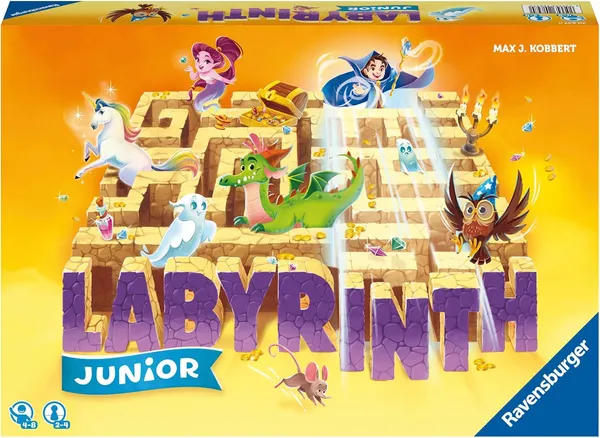
Ravensburger Labyrinth Jr.
“Simpler version for ages 4+. Same mechanic, fewer tiles, shorter games.”
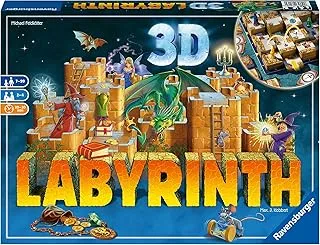
Ravensburger 3D Labyrinth
“Multi-level version for families who've mastered the original. Adds vertical strategy.”
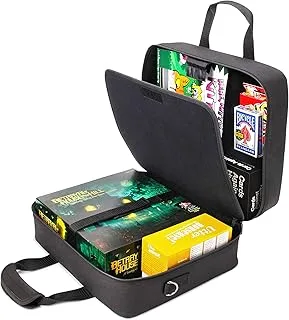
USA Gear Board Game Bag
“Padded bag with customizable interior and shoulder strap. Keeps Labyrinth's many tiles organized.”
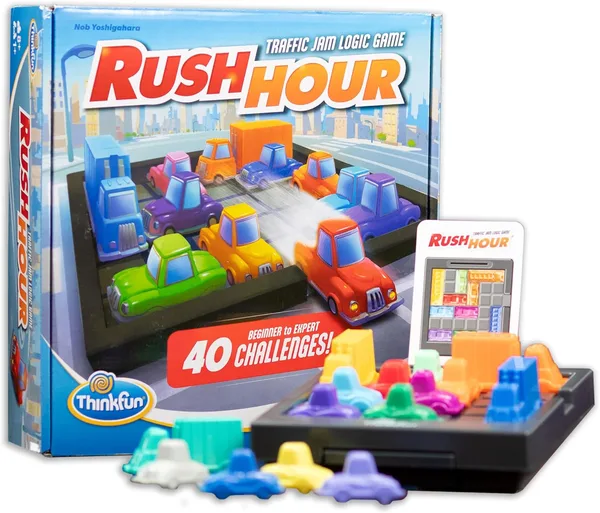
ThinkFun Rush Hour Traffic Jam Logic Game
“Solo sliding-puzzle logic game. Same spatial planning skills, different format.”