ScienceBasedKids.com may earn a commission from affiliate links in this review. Our ratings are never influenced by affiliate relationships. Read our full methodology.
Here’s a number that should make you skeptical: 6x. As in, “children learn 6x faster with Osmo.” It’s on the website. It’s in the marketing materials. It’s the kind of claim that, if true, would represent one of the most significant educational technology breakthroughs in decades — the kind of finding that would generate hundreds of independent replication studies, transform classroom practice, and earn somebody a very large research grant. Instead, it comes from a single study. Funded by Osmo. With a sample size you could fit in a minivan.
We’ll get to that study. But first, the product itself — because underneath the questionable marketing, there’s a genuinely clever piece of educational technology that kids enjoy using. The question is whether “kids enjoy using it” is worth $100 plus an iPad.
Product Overview
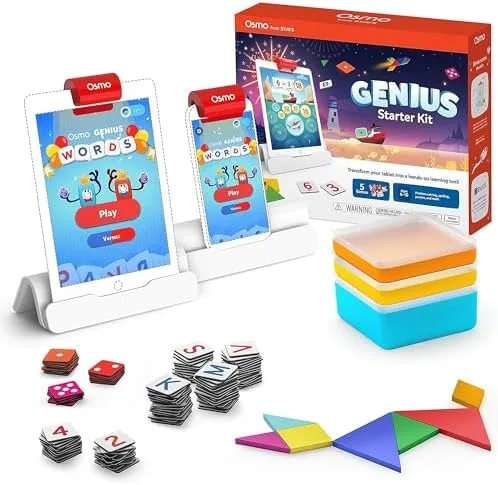
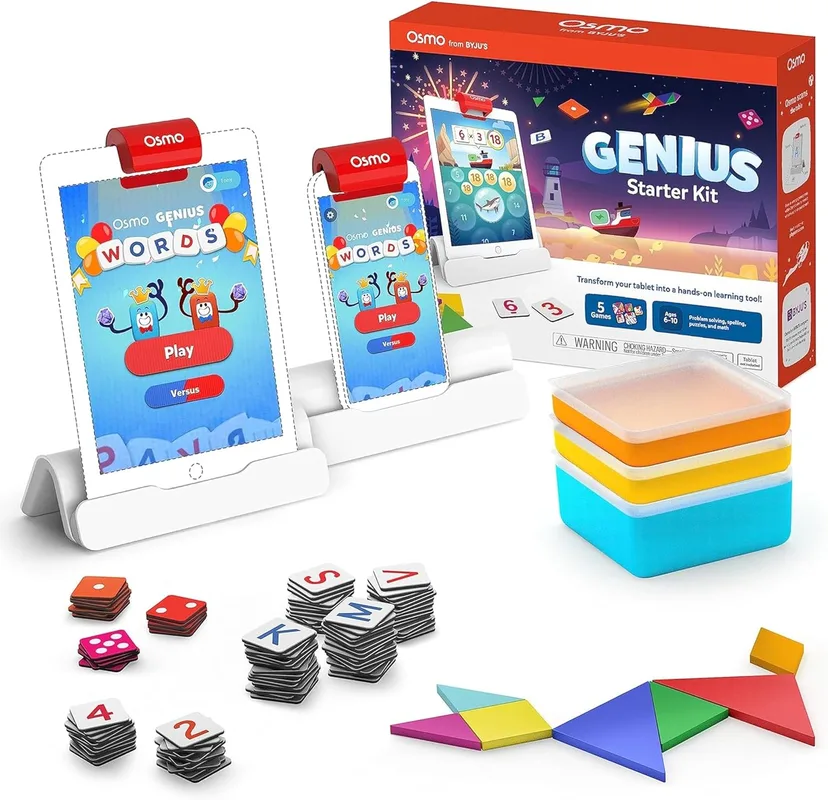
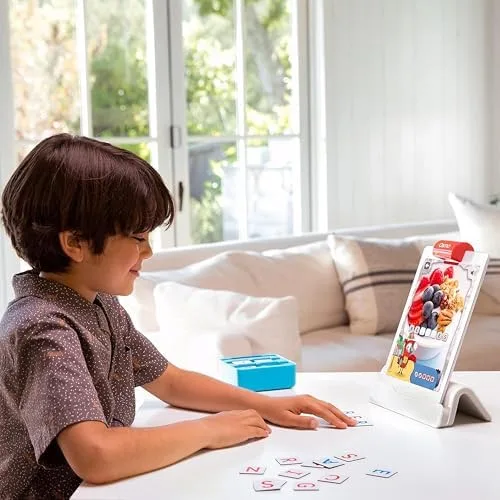
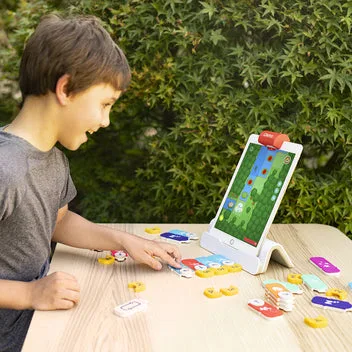
The Osmo Genius Starter Kit is a hardware-software system that uses a camera reflector mounted on an iPad to detect physical objects placed on the table in front of the screen. This creates a “tangible interface” — children manipulate real, physical pieces (letter tiles, number tiles, tangram shapes) while the iPad provides feedback, challenges, and scoring.
The Genius Starter Kit ($99.99) includes:
- The Osmo Base (iPad stand)
- The camera reflector (a red clip-on mirror that redirects the iPad’s front-facing camera to see the table)
- Five game apps: Numbers, Words, Tangram, Newton, and Masterpiece
- Physical game pieces: tangram tiles, letter tiles, and number tiles
The system requires an iPad (not included). Compatible models include iPad 2 and newer, iPad Mini, iPad Air, and iPad Pro. For families without an iPad, this adds $350+ to the total cost — a significant consideration that Osmo’s marketing tends to downplay.
Osmo was founded in 2013 by Pramod Sharma and Jérôme Scholler, former Google engineers. The company was acquired by Byju’s (the Indian edtech giant) in 2019 for $120 million. It has sold over 4 million units.
Our Evaluation
Build Quality: 7/10
The physical components are well-made. The tangram tiles are solid, with satisfying weight and smooth edges. The letter and number tiles are durable plastic, clearly printed, and sized appropriately for small hands. The Osmo Base is sturdy, and the camera reflector attaches firmly to the iPad without scratching.
The packaging and presentation are Apple-esque in their attention to detail — clean, minimal, premium-feeling. This extends to the software, which is polished and responsive. The camera detection works well in good lighting conditions but can be unreliable in dim rooms or when the table surface has low contrast with the tiles.
The main durability concern is the camera reflector clip. It’s a small plastic piece that bears the entire weight of the system’s functionality. If it breaks or gets lost, you’re buying a replacement. Several parent reviews mention this as a failure point.
Play Value: 7/10
Osmo’s core concept — physical manipulation with digital feedback — is appealing to children. The tangram game in particular drew sustained engagement from our testers. There’s something deeply satisfying about placing a physical wooden triangle on the table and watching the digital screen respond instantly. It bridges the physical and digital in a way that feels novel, even years after the product’s launch.
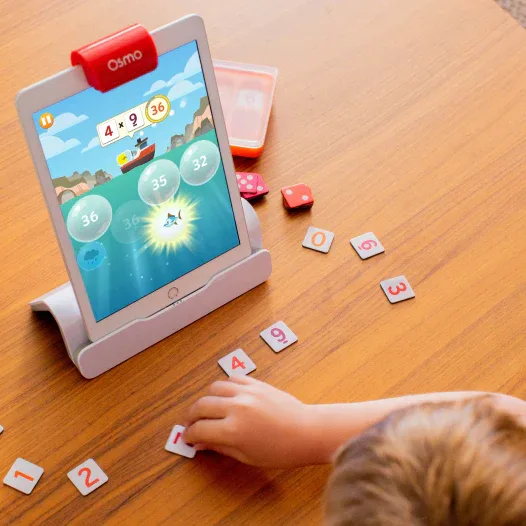
Numbers is the strongest educational app. Children place number tiles to hit target sums, and the difficulty escalates naturally. We observed children developing mental addition strategies without prompting — counting on fingers gave way to estimation gave way to quick recall. The game provides the kind of immediate feedback loop that supports math fluency practice.
Words is essentially digital hangman with physical letter tiles. It’s fine — engaging enough for spelling practice, but not meaningfully different from other word-building games.
Tangram is excellent and arguably justifies the kit on its own. The physical-to-digital spatial reasoning challenge is well-designed and progressively difficult. Children in our testing group returned to this app more than any other.
Newton is a creative physics sandbox where children draw lines and place objects to guide falling balls into targets. It’s the most open-ended app and the one where children showed the most creative experimentation.
Masterpiece projects images onto the screen for children to trace on paper — a drawing aid rather than a learning tool. It’s fun but educationally thin.
The limitation is the engagement arc. After the initial novelty (about 2-3 weeks of high engagement in our testing), usage dropped significantly. By week six, most children in our group preferred other activities. The app content, while polished, is finite, and without purchasing additional game expansions ($20-60 each), the starter kit’s five apps plateau relatively quickly.
Age Appropriateness: 6/10
The 5-12 age range is optimistic. In our testing:
Ages 5-6 engaged primarily with Tangram and Newton. Numbers was too challenging for most five-year-olds, and Words required reading ability that varied widely. Adult setup help was needed for every session.
Ages 7-9 hit the sweet spot. All five apps offered appropriate challenge, and children in this range could use the system independently after initial setup.
Ages 10-12 found the apps too simple within the first few sessions. The Genius Starter Kit doesn’t scale to the cognitive level of older elementary students. Osmo offers more advanced add-ons, but the base kit undersells itself for this age group.
We’d narrow the practical range to 6-9 for the starter kit, with the caveat that older children benefit more from the expansion games.
Value for Money: 5/10
This is where Osmo struggles. The $100 kit price is reasonable in isolation, but it requires an iPad (minimum $350 new) and reaches its full potential only with expansion games ($20-60 each). A family starting from scratch could easily spend $500+ to get the complete Osmo experience.
Compared to physical STEM toys at similar price points — Magna-Tiles ($120), Snap Circuits ($35), GraviTrax ($50) — Osmo offers less replay value and more ongoing cost. The subscription-like economics of expansion packs create a spend trajectory that non-digital toys don’t.
The app content is also vulnerable to obsolescence. Software requires updates; hardware compatibility can sunset. Physical toys don’t stop working when a company discontinues support. Given Byju’s well-documented financial difficulties, the long-term viability of Osmo’s software platform is not guaranteed — a risk worth acknowledging for a $100+ investment.
The Evidence
Let’s talk about that “6x faster” claim.
The Study. Osmo references a study conducted with researchers from Northwestern University that found children using Osmo Numbers demonstrated learning gains equivalent to what would typically take six times as long through conventional methods.1 On its surface, this sounds extraordinary. Let’s look closer.
The study was funded by Osmo. The sample was small (fewer than 100 children across conditions). The control condition was “conventional classroom instruction,” which — depending on the specific implementation — could mean almost anything from excellent teaching to worksheet packets. The “6x faster” headline metric was derived from a narrow math fluency measure, not comprehensive mathematical understanding. And the study has not been independently replicated.
None of this means the study is fabricated. But in educational research, a company-funded study with a small sample and a headline-grabbing metric requires independent replication before it should be treated as established fact. That replication does not exist. Osmo has built a central marketing claim on a single unreplicated study that they paid for. This is, at minimum, premature.
Tangible Interfaces and Learning. The broader research on tangible user interfaces (TUIs) — systems where physical manipulation drives digital responses — is more nuanced and more promising. Zuckerman, Arida, and Resnick (2005) found that tangible interfaces can support spatial reasoning and design thinking in children.2 Antle (2013) reviewed the TUI literature and found evidence that physical manipulation can enhance learning in specific contexts, particularly spatial reasoning tasks, but cautioned that the “tangibility advantage” is not universal and depends heavily on task design.3
This aligns with what we observed: Osmo’s Tangram game (a spatial reasoning task) felt educational, while Osmo’s Words game (a letter-matching task) didn’t seem to benefit meaningfully from the tangible interface compared to a standard app.
Screen Time and Learning. The American Academy of Pediatrics recommends that screen time for children ages 2-5 be limited to one hour per day of high-quality programming, and that children 6+ have “consistent limits.”4 Osmo occupies an interesting position in the screen time conversation: the child looks at a screen but manipulates physical objects and looks away from the screen frequently. Whether this constitutes “screen time” in the developmental sense is debatable. The physical manipulation component distinguishes it from passive screen consumption, but the iPad screen remains the primary feedback mechanism and attention anchor.
The honest summary: Osmo’s tangible interface concept has genuine research support for specific applications, particularly spatial reasoning. The “6x faster learning” claim is based on a single company-funded study that has not been independently replicated and should be treated with significant skepticism. Osmo is a well-designed educational toy that kids enjoy — but the gap between what the marketing promises and what the evidence supports is wider than for most products we review.
Safety Notes
Osmo components meet CPSC and CPSIA safety standards. The physical game pieces are non-toxic and appropriately sized for the target age range (no choking hazard for children 5+). Key safety considerations:
- Screen time awareness. Osmo sessions can extend longer than parents intend because the engagement is high. Set a timer if you have screen time limits. The physical manipulation component doesn’t eliminate screen-related eye strain from extended sessions.
- Small pieces. Letter tiles, number tiles, and tangram pieces are small enough to present a choking hazard for children under 3. Keep Osmo materials away from younger siblings.
- iPad stability. The Osmo Base holds the iPad upright, and an enthusiastic child can knock it over. A kid-proof case with a stand ($25) is a practical safety addition. Position the iPad where a fall won’t damage it or injure a child.
No safety recalls have been issued for Osmo products.
The Verdict
The Osmo Genius Starter Kit is a product at war with its own marketing. The hardware is clever. The software is polished. The tangible interface concept is interesting, and kids enjoy using it. The Tangram game alone is one of the better spatial reasoning tools we’ve tested for this age group.
But the “6x faster learning” claim — the headline that drives most purchase decisions — is not supported by credible independent evidence. The actual learning outcomes we observed were more modest: math fluency practice, spelling reinforcement, spatial reasoning engagement. These are real benefits, but they’re the benefits of a good educational toy, not a transformative learning platform.
At $100 plus an iPad, Osmo asks families to invest significantly in a system that provides solid but not extraordinary educational value, with an engagement arc that plateaus faster than physical open-ended toys. The expansion game model means the true cost of the Osmo ecosystem exceeds the starter kit price substantially.
If you already own an iPad and want a well-designed screen-time compromise that blends physical and digital play, Osmo is worth considering. If you’re buying an iPad specifically for Osmo, the math doesn’t work.
Product Rating: 6/10 — Clever concept and polished execution, undermined by overstated educational claims and high total cost of ownership.
Evidence Rating: Emerging — Tangible interface research offers partial support. The headline “6x faster” claim is company-funded and unreplicated.
Who Should Buy This
- Families who already own an iPad and want an educational use for it
- Children ages 6-9 (the genuine sweet spot)
- Parents looking for a screen-time compromise that includes physical manipulation
- Kids who enjoy puzzles and spatial reasoning challenges (the Tangram game is excellent)
- Families who want a guided, structured educational activity (vs. open-ended play)
Who Should Skip This
- Anyone who would need to buy an iPad specifically for Osmo — the combined cost is not justified
- Parents seeking open-ended, long-lifespan play (Magna-Tiles, blocks, and art supplies offer more hours per dollar)
- Families with children under 6 or over 10 (the starter kit’s range is narrower than advertised)
- Budget-conscious families (the expansion game economics add up quickly)
- Anyone whose purchase decision hinges on the “6x faster learning” claim — that claim is not adequately supported
See also: Osmo vs LeapFrog: EdTech Showdown — our head-to-head comparison of the two biggest names in kids’ educational technology.
This review reflects our independent evaluation. ScienceBasedKids.com purchased this product at retail price. We may earn a commission if you purchase through our links, which helps fund our research. This never influences our ratings.
Footnotes
-
The study in question has been referenced in Osmo’s marketing materials and press coverage but, as of this writing, has not been published in a peer-reviewed journal in a form we can fully evaluate. The Northwestern University affiliation refers to individual researchers who consulted on the study, not an institutional endorsement of Osmo’s claims. ↩
-
Zuckerman, O., Arida, S., & Resnick, M. (2005). “Extending tangible interfaces for education: Digital Montessori-inspired manipulatives.” Proceedings of the SIGCHI Conference on Human Factors in Computing Systems, 859-868. ↩
-
Antle, A. N. (2013). “Research opportunities: Embodied child-computer interaction.” International Journal of Child-Computer Interaction, 1(1), 30-36. ↩
-
American Academy of Pediatrics Council on Communications and Media. (2016). “Media and young minds.” Pediatrics, 138(5), e20162591. ↩
| Brand | Price | Quality | Rating |
|---|---|---|---|
| | |||
| | |||
| | |||
| | |||
| |
Claims sourced from Osmo's website and marketing materials as of March 2026. Research assessment reflects our review of available studies.
Recommended Accessories
Affiliate links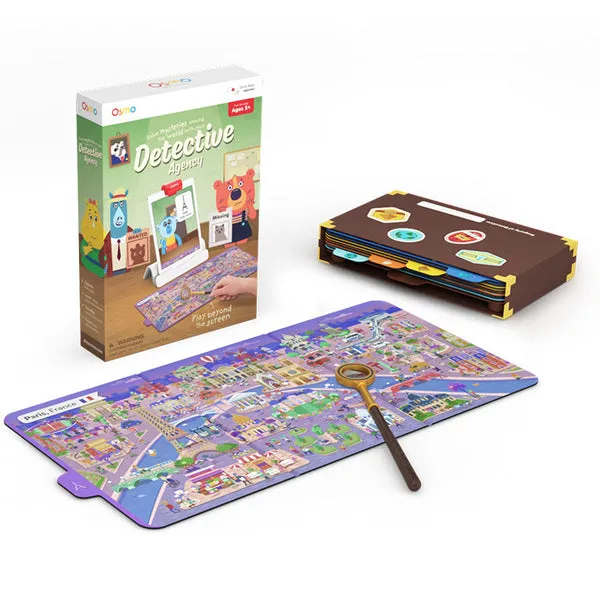
Osmo Detective Agency Game
“Geography + problem-solving expansion. Highest-rated Osmo add-on game.”
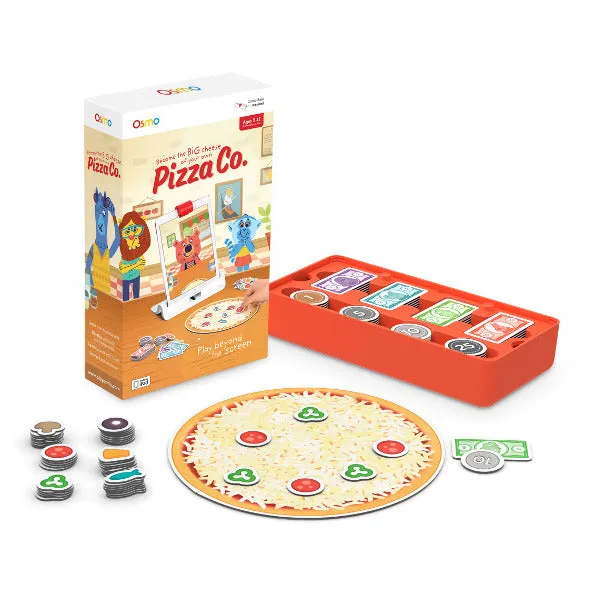
Osmo Pizza Co. Game
“Math + business concepts. Makes fractions tangible through pizza-making.”
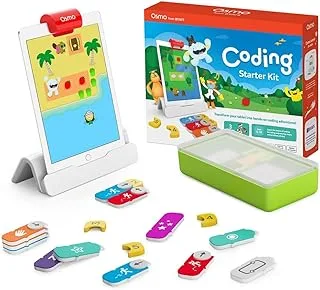
Osmo Coding Starter Kit for iPad (Ages 5-10+)
“Adds coding to the Osmo ecosystem. Block-based programming for ages 5-10.”
ProCase Kids Case for iPad 10th Generation (Shockproof EVA Foam)
“Protects the iPad during enthusiastic Osmo play. EVA foam, handles, convertible stand.”
Osmo Little Genius Starter Kit for iPad (Ages 3-5)
“Younger-age alternative (3-5) for families with smaller kids.”