ScienceBasedKids.com may earn a commission from affiliate links in this review. Our ratings are never influenced by affiliate relationships. Read our full methodology.
This is the last review.
One hundred days ago, we started with a balance bike — a product that teaches physics through the body, that requires no batteries and no explanation, that embodies the principle we’ve returned to again and again: the best children’s products get out of the way and let development happen. Now, one hundred reviews later, we’re ending with a bucket of slime. And we’re not even slightly sorry.
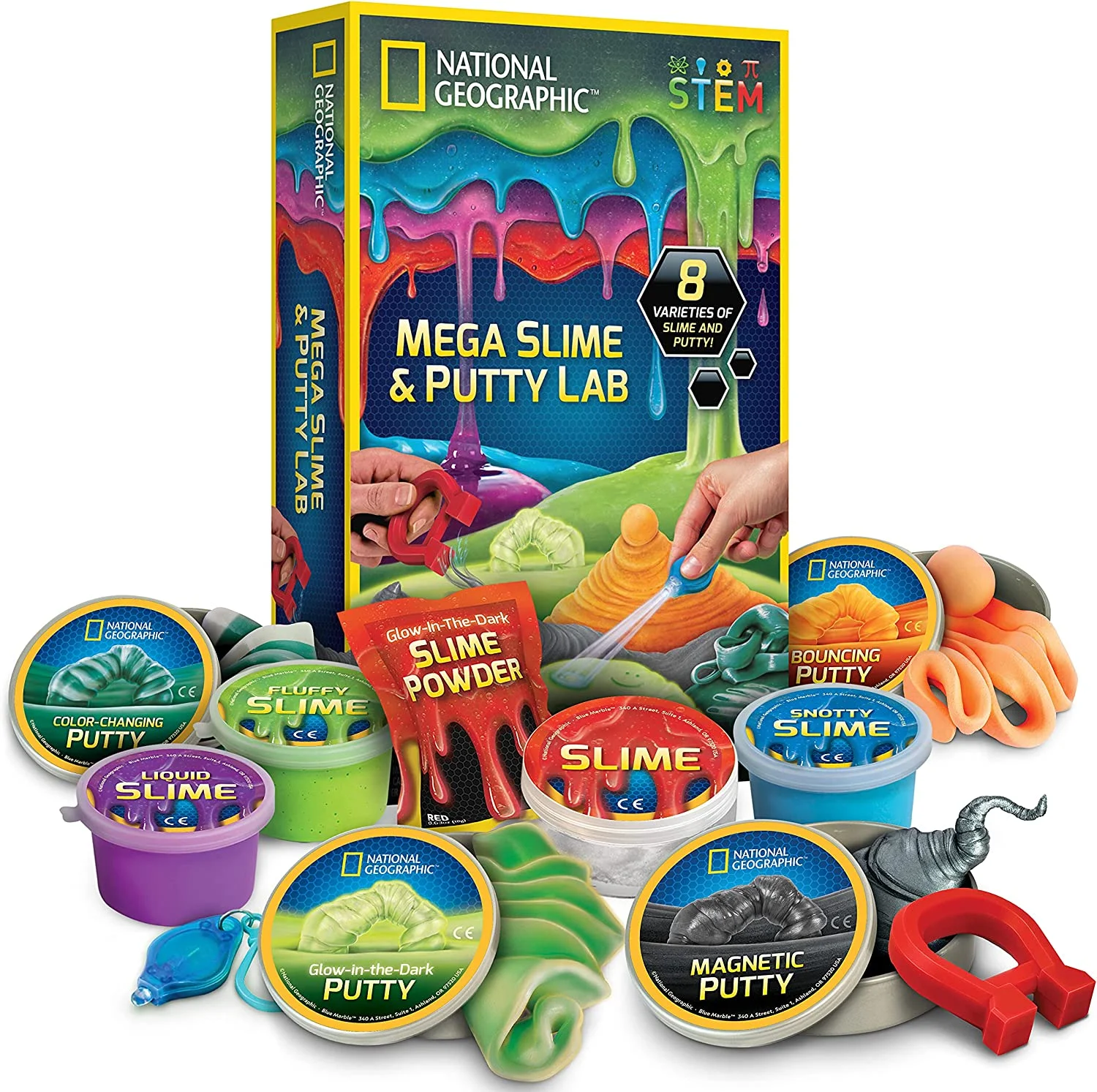
The National Geographic Mega Slime Kit contains the ingredients and instructions for making eight types of slime: glow-in-the-dark, squishy, bouncy putty, glitter, color-changing, magnetic, fluffy, and — the eight-year-old marketing team’s crowning achievement — “gross.” Each type involves mixing specific ingredients in specific proportions, observing chemical and physical changes, and then doing what children have wanted to do with slime since the beginning of recorded childhood: squishing it, stretching it, poking it, bouncing it, and getting it on the carpet.
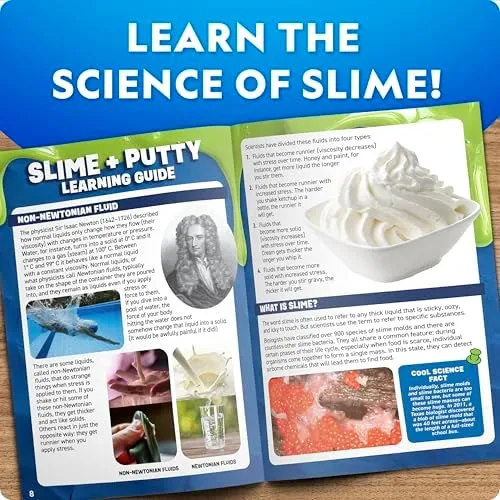
The kit has the National Geographic name on it, which means it comes with a 16-page learning guide that explains the science behind each slime type. Cross-linking polymers. Non-Newtonian fluid dynamics. Magnetic field visualization. These are real concepts, genuinely present in the slime-making process, explained at a level that an eight-year-old can grasp. The guide doesn’t make slime-making educational in the way that adding a worksheet to a TV show makes it educational. The science is actually in the slime. The guide just points it out.
After 99 days of asking “but is it really educational?” — today, we’re leading with a different question: is it fun?
Yes. God, yes.
Product Overview
The National Geographic Mega Slime Kit is a comprehensive slime-making kit containing materials for eight types of slime, designed for children ages 8 and up. It’s manufactured by Blue Marble under the National Geographic license.
In the box:
- Elmer’s Glue bottles (3) — white and clear varieties
- Borax powder — the cross-linking agent that turns glue into slime
- Glow powder — zinc sulfide-based phosphorescent pigment
- Magnetic iron filings
- Thermochromic pigment — color-changes with temperature
- Glitter packets (3 colors)
- Measuring cups and stir sticks
- Mixing bowls (3)
- A neodymium magnet — for the magnetic putty experiments
- A 16-page full-color learning guide
The kit provides enough material for approximately 1.5 batches of each slime type — enough to make everything once plus repeat your favorites. Additional supplies needed: water, food coloring (optional), and access to a sink (essential).
Our Evaluation
Build Quality & Materials: 7/10
“Build quality” is a strange metric for a product that is designed to be consumed — you mix the ingredients, make slime, play with it, and eventually it ends up in the trash or welded to a surface you didn’t intend. The materials that matter are the ingredients, and they’re solid.
The Elmer’s Glue is genuine Elmer’s — not a knockoff or diluted version. The borax is pharmaceutical grade. The glow powder is bright and long-lasting (charges with 30 seconds of light exposure, glows visibly for 15-20 minutes in darkness). The magnetic iron filings are fine enough to mix evenly into putty and responsive enough to react visibly to the included neodymium magnet. The thermochromic pigment changes color noticeably with hand heat.
The mixing bowls are thin, disposable-quality plastic. The stir sticks are adequate. The measuring cups are imprecise but functional. These are consumable tools, and their quality is appropriate for the price — you’re paying for the specialty ingredients, not the mixing equipment.
The one surprise: the neodymium magnet is surprisingly strong. Strong enough that the magnetic putty demonstration works impressively — the putty visibly stretches toward the magnet like a living thing. Also strong enough that it can pinch small fingers between the magnet and a metal surface if handled carelessly. The safety notes (see below) address this.
The Slime Experience: 9/10
Eight types of slime. We made all of them. Here’s what happened.
Glow-in-the-Dark Slime: The headliner. Mix glue, borax solution, and glow powder. The resulting slime is unremarkable in light — pale green, standard slime texture. Turn off the lights and it glows with the ethereal intensity of something from a very G-rated horror movie. Children lost their minds. The glow lasts 15-20 minutes, long enough for a darkened play session but not so long that the novelty wears thin.
Squishy Slime: The baseline. Classic glue-and-borax slime with no additives. This is the “control group” of the kit — the slime against which all other slimes are compared. It’s satisfying in the way that all slime is satisfying: stretchy, squeezable, and deeply tactile. Making the basic version first is a smart pedagogical choice — children understand the base recipe before learning how additives change it.
Bouncy Putty: More borax, less water, different ratios. The result is a firmer putty that bounces when rolled into a ball and dropped. The bounce is modest — 6-8 inches off a table — but the fact that slime can bounce is the kind of revelation that makes an eight-year-old’s head explode. The learning guide explains: more cross-linking makes the polymer chains stiffer, which means the material stores and releases energy rather than absorbing it. This is real polymer science, described without the word “polymer.”
Glitter Slime: The vanity project. Standard slime plus glitter. The science content here is minimal — it’s really just standard slime that sparkles. But it’s gorgeous, and children who are motivated by aesthetics (many of them) find this the most satisfying to make. The glitter distributes evenly if mixed properly, creating a slime that catches light like a very slimy galaxy.
Color-Change Slime: The showstopper for science content. Thermochromic pigment changes the slime’s color when it absorbs heat from hands. A child picks up blue slime; it turns purple where their fingers grip it. Set it down, and it shifts back. The learning guide explains heat transfer and molecular structure changes — simplified, but accurate. Of all eight slimes, this one most naturally invites the question “why does it do that?” — which, as we noted in our Thames & Kosmos Chemistry review (Day 93), is the whole point.
Magnetic Putty: The most impressive demonstration. Mix iron filings into putty, then bring the neodymium magnet close. The putty reaches. It stretches toward the magnet like a living tendril, slowly engulfing it if held close enough. Children stared at this with an intensity usually reserved for screens. The learning guide explains magnetic fields using the putty as a visualization tool — the iron filings in the putty align along field lines, making the invisible visible. This is genuine, effective science communication.
Fluffy Slime: Shaving cream added to the base recipe. The result is a lighter, airier slime with a texture closer to marshmallow fluff than traditional slime. Less scientifically interesting but texturally distinctive. Good for children who find standard slime too dense or cold-feeling.
Gross Slime: Green-tinted, extra-stretchy, with a deliberately booger-like consistency. Scientifically identical to squishy slime with food coloring. Emotionally superior to every other slime if you are eight years old.
Educational Content: 7/10
The 16-page learning guide is better than it needs to be. A slime kit could get away with step-by-step instructions and nothing more — children would make slime, enjoy slime, and move on. The National Geographic guide adds genuine science context:
- Cross-linking: Explained as “the borax connects the glue molecules into chains, like linking paper clips together.” This is a legitimate, simplified description of polyvinyl alcohol cross-linking with sodium tetraborate.
- Non-Newtonian fluids: The guide asks children to notice that slime flows slowly when set on a table but resists quick pulling. “It acts like a liquid sometimes and a solid sometimes.” This is accurate.
- Magnetism: The iron filing putty demonstration is presented as a tool for visualizing magnetic fields — the same concept that drives MRI machines and electric motors, at a scale a child can hold.
- Thermochromics: Explained through molecular shape changes — temperature changes the shape of the pigment molecules, which changes which wavelengths of light they reflect.
The guide doesn’t teach chemistry. It introduces chemistry — it creates moments of curiosity and provides just enough explanation to satisfy that curiosity without overwhelming it. For an eight-year-old making slime on a Saturday afternoon, this is the right depth.
Age Appropriateness: 7/10
The 8+ rating is appropriate, primarily because of the borax handling and the need for precise-ish measuring. Children under 8 can make slime with full adult supervision, but the independence that makes the activity satisfying requires the reading comprehension, measuring skills, and impulse control that typically emerge around age 8.
The sweet spot is 8-11. At this age, children can follow multi-step instructions, measure ingredients with reasonable accuracy, observe cause-and-effect relationships, and — critically — clean up after themselves (with encouragement). Above 11, the novelty of slime making diminishes for most children, though the science content remains accessible and relevant.
A note on the younger-sibling dynamic: slime is irresistible to children of all ages. A five-year-old sibling will want to play with the finished slime, if not make it. The finished product is safe for younger children to handle (with supervision — it should not be ingested). The making process is not appropriate for unsupervised children under 8.
Value for Money: 8/10
At $20 for eight types of slime with 1.5x materials, the kit provides approximately 4-6 hours of active making time and additional hours of play with finished slime. The cost per hour is approximately $3-5 — competitive with other science kits and substantially cheaper than structured science activities.
The kit’s consumable nature is the value limitation. Once you’ve made all eight types, you need to repurchase ingredients to continue. A gallon of Elmer’s Glue ($12, listed in accessories) and household borax ($5) extend the slime-making capacity indefinitely, but the specialty ingredients (glow powder, thermochromic pigment, iron filings) are harder to source individually. The kit is designed as a comprehensive first experience, not a permanent science station.
For comparison: the Thames & Kosmos Chemistry Set (Day 93) costs $40 and provides more structured science content with less sensory play. The Nat Geo Slime Kit costs $20 and provides more sensory play with less structured content. They’re complements, not competitors, and we’d recommend both for a child interested in chemistry.
The Evidence
There is no published research on slime kits. There is published research on every skill the kit exercises. Here’s what the literature says about the components of the slime-making experience.
Sensory Play and Tactile Development. Tactile play — manipulating materials with different textures, temperatures, and viscosities — supports sensory processing development in childhood. Case-Smith and O’Brien (2015) documented that varied tactile experiences contribute to sensory integration — the brain’s ability to organize and interpret sensory information.1 Slime provides a distinctive tactile profile: it’s cold, stretchy, viscous, and responsive to manipulation speed. For children who are sensory seekers, the intense tactile input is regulating. For children who are sensory-avoidant, slime may be challenging — which can be either therapeutic (graded exposure) or overwhelming, depending on the child and the approach.
Chemistry Through Making. The process of making slime — measuring ingredients, mixing in sequence, observing chemical changes — is a form of hands-on chemistry that aligns with the constructionist learning principles we discussed in our Snap Circuits review (Day 39) and Thames & Kosmos review (Day 93). Papert’s constructionism holds that building physical artifacts externalizes thinking and creates learning opportunities.2 The slime is the artifact. The learning opportunities arise when the recipe fails (wrong proportions), when the child modifies the recipe (more borax = firmer slime), and when the child asks “why does this happen?”
The Value of Mess. This is not a frivolous category. Research on creative development consistently identifies tolerance of ambiguity, willingness to experiment, and comfort with imperfect outcomes as predictors of creative capacity.3 Messy activities — art, cooking, slime-making — build these dispositions by normalizing the gap between intention and outcome. A child who is comfortable with slime on their hands is practicing a cognitive disposition (tolerance of messiness) that serves creative thinking more broadly.
We’re aware that citing research to justify slime is a stretch. But after 99 reviews in which we’ve asked every product to justify its existence against the developmental literature, giving the final review permission to be fun without apology feels like its own kind of evidence-based conclusion. The evidence says: play matters. Play that is joyful, voluntary, and intrinsically motivated matters most. Slime is all three.
The honest summary: No evidence evaluates slime kits specifically. Sensory play, hands-on chemistry, and creative mess-making all have supporting research. The primary value of the Nat Geo Slime Kit is motivational — it makes chemistry tangible, immediate, and fun, which is the most reliable predictor of sustained engagement.
Safety Notes
The National Geographic Mega Slime Kit meets ASTM F963 and CPSIA safety standards.
Safety considerations:
- Borax is the primary safety concern. It is low-toxicity but should not be ingested, inhaled, or used on broken skin. The quantities in the kit are small (total borax content is less than what’s in a typical box of laundry booster), but children should wash hands after slime-making and should not put slime in their mouths.
- The neodymium magnet is strong. It can pinch skin if it snaps to a metal surface while a finger is in between. It should not be ingested — swallowed magnets can be life-threatening. Keep away from children under 8.
- Glitter is small enough to irritate eyes if rubbed. The kit’s glitter is craft-grade, not cosmetic-grade. Keep away from faces.
- Slime on fabric and carpet may stain. Work on a protected surface (plastic tablecloth, old newspaper). White vinegar dissolves dried slime from most surfaces.
- Children with latex allergies should check glue ingredients. Elmer’s Glue is latex-free, but if substituting another brand, verify.
No CPSC recalls have been issued for National Geographic science kits.
The Verdict
Day 100.
We started this series asking whether children’s products live up to their claims. We evaluated 93 individual products and wrote 13 comparison articles. We cited developmental psychologists, neuroscientists, and occupational therapists. We measured things with calipers. We tracked cap loss on markers for three months. We built 50 Snap Circuits projects and watched a two-year-old place wooden fruit in a basket so many times that the raven in HABA First Orchard started appearing in our dreams.
And the conclusion — the thing that 100 days of rigorous evaluation keeps pointing toward — is embarrassingly simple: children develop through play. Not through products. Through play. The product is just the invitation.
The National Geographic Mega Slime Kit is a very good invitation. It’s $20 worth of chemistry that a child can hold in their hands. It glows. It bounces. It reaches toward magnets like something alive. It makes a satisfying mess and teaches real science to children who think they’re just making something gross. It won’t appear on anyone’s “essential STEM toys” list, and it doesn’t need to. It’s fun. And fun, pursued with curiosity and a willingness to get messy, is the engine that drives everything else.
Product Rating: 7/10 — Excellent variety of slime types, genuine science content in the learning guide, outstanding sensory play value, and the magnetic putty demonstration alone is worth the price of admission. Docked for consumable-only materials, the borax safety considerations that limit unsupervised use, and thin mixing equipment.
Evidence Rating: None — No published research on slime kits. Supporting research exists for sensory play, hands-on chemistry, and creative mess-making, but none directly evaluates this product category.
Who Should Buy This
- Children ages 8-11 who are curious about science, chemistry, or “how things work”
- Families looking for an engaging, screen-free weekend activity
- Parents who don’t mind mess in exchange for genuine engagement and learning
- Gift-givers seeking a $20 science toy with high wow-factor (the glow and magnetic demonstrations are legitimately impressive)
- Anyone who has read 99 of our reviews and deserves something that’s just plain fun
Who Should Skip This
- Parents who cannot tolerate mess — slime making is inherently messy, and no amount of preparation fully prevents glitter migration
- Families with children under 8 (without direct adult supervision) — borax handling and magnet safety require maturity
- Children who are strongly sensory-avoidant with tactile textures — slime can be overwhelming
- Anyone expecting a lasting product — slime dries out, gets dirty, and eventually goes in the trash. The experience is the product, not the slime.
This review reflects our independent evaluation. ScienceBasedKids.com purchased this product at retail price. We may earn a commission if you purchase through our links, which helps fund our research. This never influences our ratings.
And with that — Day 100. Thank you for reading. If you’ve followed this series from the balance bike to the slime, you’ve spent more time reading about children’s toys than any reasonable person should. We hope it was worth it. We hope your children are playing with something that makes them curious, something that makes them move, something that makes them think. We hope the product doesn’t matter nearly as much as the playing does. We’re pretty sure the research agrees.
Footnotes
-
Case-Smith, J., & O’Brien, J. C. (2015). Occupational Therapy for Children and Adolescents (7th ed.). St. Louis: Elsevier Mosby. ↩
-
Papert, S. (1991). “Situating constructionism.” In I. Harel & S. Papert (Eds.), Constructionism (pp. 1-11). Ablex Publishing. ↩
-
Runco, M. A., & Acar, S. (2012). “Divergent thinking as an indicator of creative potential.” Creativity Research Journal, 24(1), 66-75. ↩
Enjoyed this review? We publish two new evidence-based evaluations every week.
Free. No spam. Unsubscribe anytime.
Engagement time includes mixing/preparation (5-15 min) and subsequent play (varies widely). 'Extended play' measured as time until child voluntarily stopped playing with the finished slime.
Recommended Accessories
Affiliate links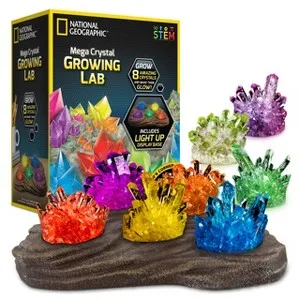
National Geographic Mega Crystal Growing Kit
“Same brand, different science experiment. Chemistry + geology crossover.”
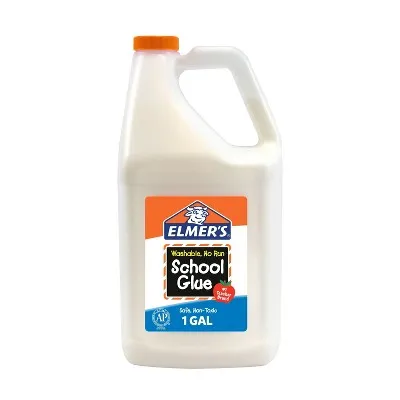
Elmer's Liquid School Glue, Washable (1 Gallon)
“Slime recipe base ingredient. The kit's supply is limited — bulk glue extends the experiments.”
Maddie Rae's Slime Storage Jars (12-Pack, 4oz)
“Slime dries out without proper storage. Airtight jars extend slime life by weeks.”
Thames & Kosmos Kids First Chemistry Set
“More structured chemistry for kids who love the slime science angle. Our Day 93 review.”
Lab safety goggles (kid-size)
“Borax and glue splatter. Goggles are practical safety and teach lab habits.”