ScienceBasedKids.com may earn a commission from affiliate links in this review. Our ratings are never influenced by affiliate relationships. Read our full methodology.
Here is a word that does a remarkable amount of heavy lifting in children’s educational product marketing: aligned. “Curriculum-aligned.” “Aligned with learning standards.” “Aligned with what kids learn in school.” It sounds authoritative. It sounds like someone in a lab coat checked. It implies — without ever stating — that using this product will produce educational outcomes equivalent to the curriculum it claims alignment with.
It does not mean any of those things.
“Curriculum-aligned” means that the content topics overlap with topics that appear in educational standards documents. A coloring book about the letter A is “curriculum-aligned” with kindergarten literacy standards. A placemat with a map of the United States is “curriculum-aligned” with third-grade geography. The alignment describes the content label, not the learning mechanism — and the mechanism is everything.
The LeapFrog LeapStart Learning System ($45) leans heavily on this word. Its marketing describes “curriculum-aligned” content across reading, math, science, and social skills. Its activity books ($13-15 each) are organized by grade level and Common Core-adjacent topics. The packaging radiates educational authority.
We went looking for the evidence behind it. We didn’t find any.
Product Overview
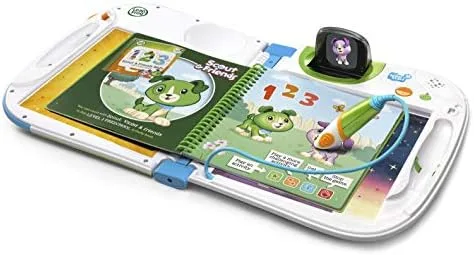
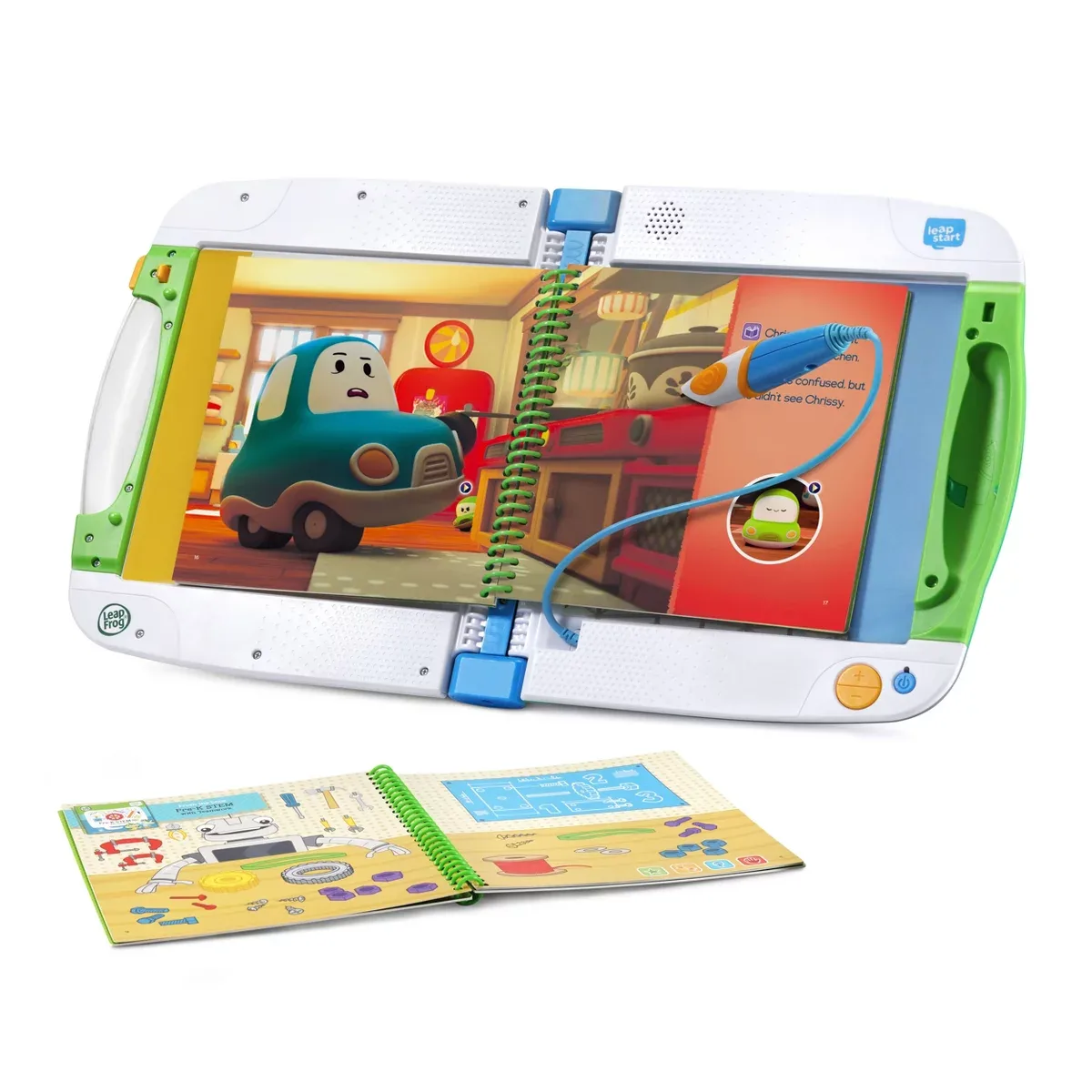
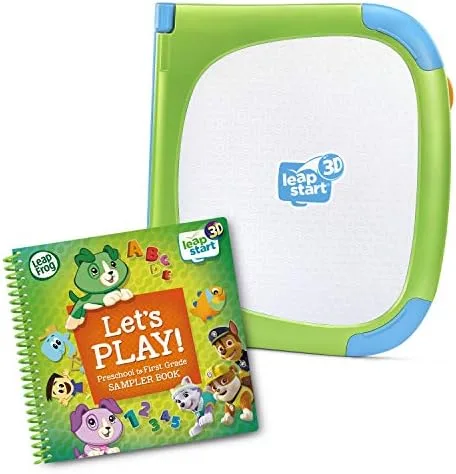
The LeapFrog LeapStart is a handheld electronic learning system shaped like a chunky laptop. It accepts proprietary spiral-bound activity books that sit in a recessed tray. A stylus, tethered to the unit, interacts with printed pages via touch-sensing technology — children touch the stylus to specific areas on a page, and the unit plays corresponding audio: instructions, questions, songs, sound effects, and verbal feedback.
- Price: $45 (unit with one included activity book); additional books $13-15 each
- Power: 4 AA batteries (not included)
- Book library: 25+ titles covering Pre-K through 1st Grade
- Content areas: Reading, math, problem-solving, science, social skills, creativity
- Size: Approximately 11 x 10 x 2 inches, 2 pounds with batteries
- Connectivity: WiFi for book downloads (audio content must be downloaded before first use of each book)
- Screen: None. This is a screenless device — all content is audio + printed pages.
The system has been in LeapFrog’s lineup since 2016, which in edtech years is roughly the Mesozoic era. It represents the company’s philosophy of “interactive learning without screen time,” bridging the gap between traditional books and tablet-based apps.
Our Evaluation
Build Quality: 7/10
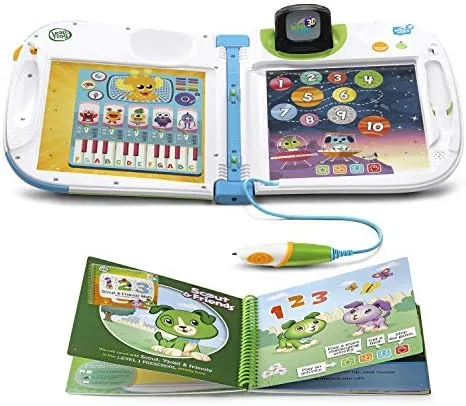
Credit where it’s earned: the LeapStart is built like a toy designed for two-year-olds, which is to say, it can survive being dropped, thrown, sat upon, and used as a step stool. The clamshell design is thick, rounded plastic with no sharp edges. The stylus tether is reinforced cord that resists the chewing and yanking that toddlers inevitably apply. The activity book tray holds pages securely without damage.
The touch-sensing technology works reliably — in our testing across four books, the stylus correctly identified the touched area approximately 95% of the time. The 5% failure rate was usually traceable to the stylus tip being slightly off-target rather than a technology failure, and children quickly learned the required precision.
Audio quality is adequate from the built-in speaker — clear enough for voice and music, though tinny at higher volumes. There’s a headphone jack, which is thoughtful for shared spaces.
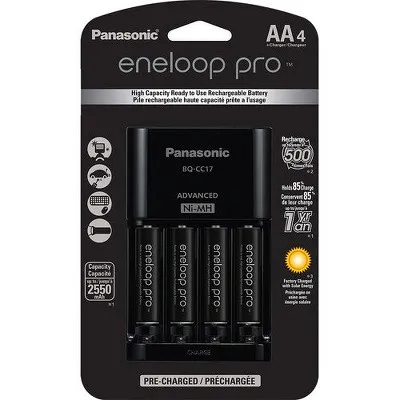
The battery life is acceptable. Four AA batteries last approximately 8-12 hours of active use, depending on volume. Rechargeable batteries are a near-essential accessory.
What doesn’t work well: the WiFi download process. Each new book requires connecting the unit to WiFi and downloading audio content before first use. This process is clunky, occasionally fails, and requires a parent’s phone to complete — turning what should be an “unwrap and play” experience into a 10-15 minute setup exercise that tests the patience of a child who just received a new book.
Play Value: 6/10
Children enjoy the LeapStart. This needs to be said clearly, because the rest of this review is going to be critical of its educational claims, and it would be unfair to pretend that the product isn’t engaging.
Our testers (ages 2, 3, 4, 5, and 6) all showed genuine interest in the novelty of touching a page and hearing audio responses. The youngest testers (2-3) were fascinated by the cause-and-effect — touch here, hear that — regardless of educational content. The 4-5 age group engaged more deeply with the questions and activities, often replaying pages multiple times to try different answers. The 6-year-old found it too simple and lost interest within a week.
Session lengths averaged 15-20 minutes for the 3-5 age range before children moved to other activities. This is consistent with typical attention spans for this age and with engagement data for similar interactive products.
The activity design follows a consistent pattern: a page introduces a concept (letter, number, shape), offers a guided activity (find the letter, count the objects, identify the shape), and provides audio feedback (praise for correct answers, gentle redirection for incorrect ones). It’s competent instructional design. It’s also not meaningfully different from what a parent does when reading an activity book aloud and asking the same questions.
Which brings us to the core issue.
The Evidence Problem
LeapFrog’s marketing for the LeapStart makes five primary claims:
- “Curriculum-aligned” content that maps to what children learn in school
- Reading readiness — the system helps children learn to read
- “School-ready skills” — preparation for kindergarten and beyond
- Interactive learning — touch-based interaction improves learning over passive consumption
- Developmental progression — content is organized by age-appropriate levels
We searched for evidence supporting each of these claims as applied to the LeapStart system or comparable pen-based interactive learning systems. Here is what we found:
Claim 1: “Curriculum-aligned.” As discussed above, this describes content labeling, not learning efficacy. The LeapStart’s reading content does cover letters, phonics, and sight words that appear in kindergarten literacy standards. So does a $5 workbook from the grocery store. Alignment tells you nothing about whether the delivery mechanism produces learning. Evidence: None (for the implied claim that alignment produces outcomes).
Claim 2: Reading readiness. No published, peer-reviewed study has evaluated the LeapStart system’s effect on reading readiness, emergent literacy, or phonological awareness. The National Reading Panel’s (2000) meta-analysis identified five components of effective reading instruction: phonemic awareness, phonics, fluency, vocabulary, and comprehension.1 The LeapStart touches on phonics and vocabulary through audio interaction but does not systematically address phonemic awareness, fluency, or comprehension — the components most predictive of reading success. Evidence: None.
Claim 3: “School-ready skills.” This phrase is marketing, not a measurable outcome. School readiness, as defined by the American Academy of Pediatrics, encompasses cognitive, social-emotional, and physical development domains.2 No evidence links the LeapStart to improvements in any of these domains beyond what ordinary play and parent-child interaction provide. Evidence: None.
Claim 4: Interactive learning. This is the strongest argument for the LeapStart, and it’s still weak. There is a body of research suggesting that interactive media can be more effective than passive media for young children’s learning (e.g., Kirkorian et al., 2016).3 However, this research compares interactive digital media (touchscreens, contingent video) to passive digital media (television), not interactive electronic toys to in-person adult instruction. The LeapStart’s competition isn’t passive screen time — it’s a parent reading a book, which remains the gold standard for early literacy development. When the comparison is “electronic toy vs. parent reading,” the electronic toy has never won in any study we could locate. Evidence: Emerging (for the general principle, not for this product).
Claim 5: Developmental progression. The books are organized by suggested grade level. This is a publishing decision, not an evidence-based developmental sequence. No longitudinal study has assessed whether children who progress through the LeapStart book series show developmental advantages over those who don’t. Evidence: None.
The Comparison That Matters
The fundamental question parents should ask about any electronic learning toy is: does this produce better outcomes than the non-electronic alternative at the same price point?
For $45 (the LeapStart) plus $60 (four additional books), a family spends $105. For $105, a family could purchase approximately 15-20 high-quality children’s books from a bookstore, or access an unlimited library through a public library card (free).
The research on shared book reading is vast, robust, and unambiguous: regular reading aloud to children is among the strongest predictors of language development, emergent literacy, and school readiness.4 The mechanism is well-understood — dialogic reading (asking questions, expanding on the child’s responses, connecting content to the child’s experience) creates a dynamic, contingent learning interaction that no electronic toy replicates.
The LeapStart does not harm learning. It may occupy children in ways that free parents to accomplish other tasks — a legitimate value proposition that shouldn’t be dismissed. But it is not a substitute for, an improvement on, or even an equivalent to a parent reading a book.
The Legacy Brand Question
LeapFrog has been making electronic learning toys since 1994. The brand carries enormous recognition and trust among parents, built over decades of products that feel educational. The LeapPad tablets. The LeapReader. The LeapStart. Each generation promises learning through technology, each generation sells well, and each generation produces approximately the same amount of published evidence for its educational claims: zero.
This is not unique to LeapFrog — the “educational toy” category broadly suffers from a claims-to-evidence gap that would be considered unacceptable in any regulated industry.5 But LeapFrog, as the category leader, bears particular scrutiny. When the most trusted name in electronic learning toys cannot point to a single peer-reviewed study demonstrating that its products improve learning, the entire category deserves skepticism.
The company has published internal “learning studies” on its website, but these are not peer-reviewed, do not include control groups, and use proprietary assessment methods. They are, at best, quality assurance testing; at worst, they are marketing materials dressed in research language.
The Verdict
ScienceBasedKids.com Rating: 5/10 Evidence Level: None
The LeapStart is a well-built, engaging interactive toy that children enjoy using. The 5/10 rating reflects a product that does its intended job — playing audio content in response to page touches — while failing to demonstrate the educational outcomes it prominently claims. It is not harmful. It is not useless. It is merely unproven, in a category where proof should be the minimum bar for the claims being made. The “None” evidence rating means exactly what it says: we found no peer-reviewed evidence that this product improves any educational outcome for any age group.
The Bottom Line
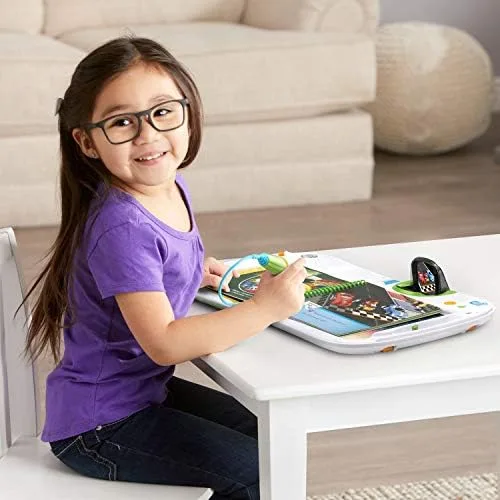
Buy this if: You want a screenless electronic toy that occupies children ages 3-5 with audio-interactive content, and you understand that the educational claims are unsubstantiated. As an engagement tool for car rides, waiting rooms, or independent play time, it works.
Skip this if: You’re buying it because you believe it will teach your child to read, prepare them for kindergarten, or provide meaningful educational advantages. The $45-105 would be better spent on books and 15 minutes of daily reading together.
Better alternatives: The Osmo Little Genius Starter Kit ($80) offers a more engaging interactive learning experience with tangible physical manipulation. For reading readiness specifically, a public library card remains the most evidence-supported and cost-effective intervention available. For screen-free audio, the Toniebox ($100) or Yoto Player ($70) deliver better content libraries without pretending to be educational systems.
Footnotes
-
National Reading Panel. (2000). Teaching children to read: An evidence-based assessment of the scientific research literature on reading and its implications for reading instruction. National Institute of Child Health and Human Development. ↩
-
High, P. C., & the Committee on Early Childhood, Adoption, and Dependent Care. (2008). School readiness. Pediatrics, 121(4), e1008-e1015. ↩
-
Kirkorian, H. L., Choi, K., & Pempek, T. A. (2016). Toddlers’ word learning from contingent and noncontingent video on touch screens. Child Development, 87(2), 405-413. ↩
-
Mol, S. E., Bus, A. G., de Jong, M. T., & Smeets, D. J. H. (2008). Added value of dialogic parent-child book readings: A meta-analysis. Early Education and Development, 19(1), 7-26. ↩
-
Hirsh-Pasek, K., Zosh, J. M., Golinkoff, R. M., Gray, J. H., Robb, M. B., & Kaufman, J. (2015). Putting education in “educational” apps: Lessons from the science of learning. Psychological Science in the Public Interest, 16(1), 3-34. This landmark paper found that most apps and products labeled “educational” had no evidence supporting their educational claims. ↩
Enjoyed this review? We publish two new evidence-based evaluations every week.
Free. No spam. Unsubscribe anytime.
Evidence levels scored 0-3: 'Strong' (3) = multiple RCTs showing effect; 'Moderate' (2) = some controlled studies; 'Emerging' (1) = preliminary or tangential research; 'None' (0) = no peer-reviewed evidence for this specific product or mechanism. We searched PubMed, ERIC, PsycINFO, and Google Scholar for studies on the LeapStart system specifically and on interactive pen-based learning systems generally.
Recommended Accessories
Affiliate links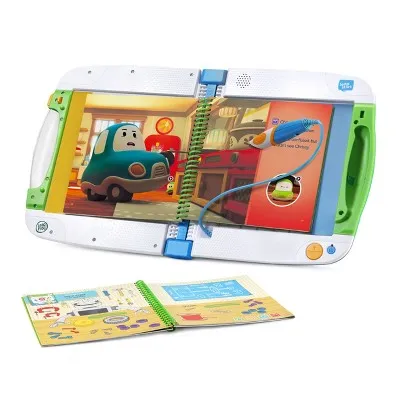
LeapFrog LeapStart Book: Kindergarten & 1st Grade
“Grade-level book expansion. The system needs books to function.”
LeapFrog LeapStart Book: STEM (Math)
“STEM-focused content for the LeapStart platform.”
Osmo Little Genius Starter Kit
“More engaging tablet-based learning alternative with tangible interaction. Better evidence base.”
Panasonic Eneloop Rechargeable AA Batteries (4-Pack)
“LeapStart runs on AA batteries. Eneloop 2100-cycle rechargeable set pays for itself within weeks.”