ScienceBasedKids.com may earn a commission from affiliate links in this review. Our ratings are never influenced by affiliate relationships. Read our full methodology.
The first time my daughter climbed to the top of the Gorilla Chateau’s fort deck — roughly seven feet off the ground — she froze. Hands white on the railing, feet planted, eyes wide. She looked down at me. I looked up at her. Neither of us said anything for about ten seconds that felt like ten minutes.
Then she grinned.
“I’m really high up,” she announced, as though I hadn’t noticed.
That moment — the freeze, the assessment, the grin, the triumph — is exactly what developmental psychologists mean when they talk about risky play, and it’s exactly what $1,200 buys you with the Gorilla Playsets Chateau Swing Set. Not the cedar. Not the swings. Not the slide. The opportunity for a child to stand somewhere high enough to feel genuinely uncertain, decide that the uncertainty is manageable, and discover that they were right.
Product Overview
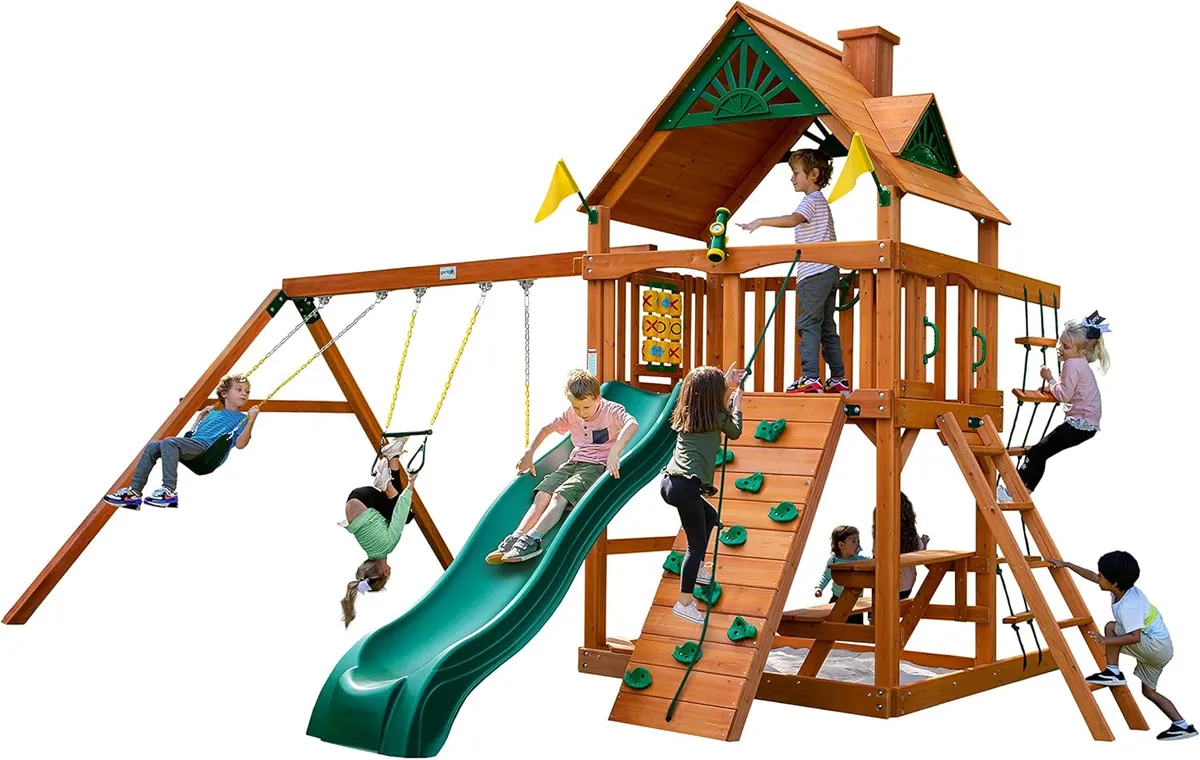
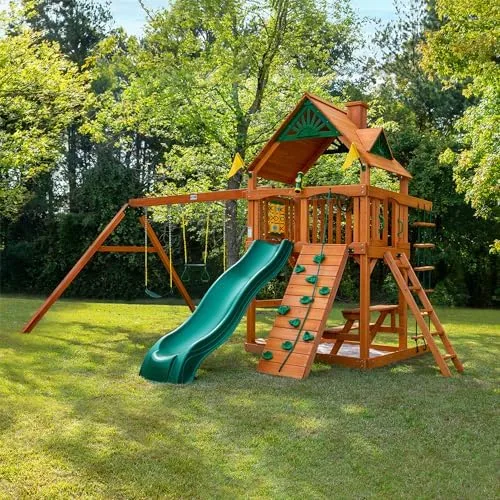
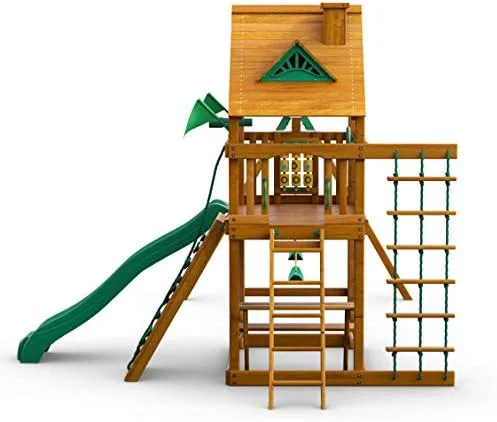
The Gorilla Playsets Chateau ($1,200) is a backyard play structure built from premium cedar lumber with a vinyl-dipped chain swing set, wave slide, rock climbing wall, sandbox area, and elevated fort deck with canopy. Key specifications:
- Material: Premium cedar with factory-applied wood stain and sealant
- Fort deck height: Approximately 5 feet (the roof peak reaches roughly 10.5 feet)
- Footprint: Approximately 19 feet wide x 10 feet deep (swing beam extends total width to ~19 feet)
- Swing beam: Three-position beam supporting two belt swings and one trapeze bar
- Slide: 10-foot wave slide (polyethylene)
- Climbing: Rock wall with colored hand holds on one side
- Additional features: Sandbox underneath the fort, wooden roof with sunbrella canopy, entry ladder
- Weight capacity: 800 pounds (total structure), 115 pounds per swing
- Assembly: Required. Gorilla estimates 12-16 hours with two adults. This is optimistic.
The Assembly Reality
Let’s address assembly first, because it will dominate your first weekend of ownership and possibly your feelings about the product for days afterward.
Gorilla estimates 12-16 hours with two adults. In our experience — and we’ve now heard from dozens of families who’ve built Gorilla sets — this is accurate only if both adults have construction experience, a full set of power tools, and the patience of monks. For most families, assembly takes a full weekend: 8-10 hours on Saturday, another 6-8 on Sunday, plus an hour on Monday evening for the things you forgot or installed backward.
The lumber is pre-cut and pre-drilled, which helps enormously. The hardware is sorted into numbered bags corresponding to assembly steps. The instruction manual is 40+ pages of illustrated steps that are mostly clear but occasionally ambiguous at critical junctions — particularly the swing beam attachment, where the angle of the A-frame supports must be precise or the whole structure develops a lean that’s cosmetic but psychologically disturbing.
Professional installation runs $400-800 depending on your region, and after assembling one myself, I understand why people pay it. The structure is heavy. The bolts are numerous. The moments where you’re holding a 6-foot beam overhead while trying to align pre-drilled holes with one hand and thread a carriage bolt with the other are the moments that test marriages.
That said: there’s something satisfying about building a play structure for your children. Watching them climb something you built with your own hands hits a primal satisfaction button that pre-assembled products never touch.
The Deep Dive
Build Quality: 8/10
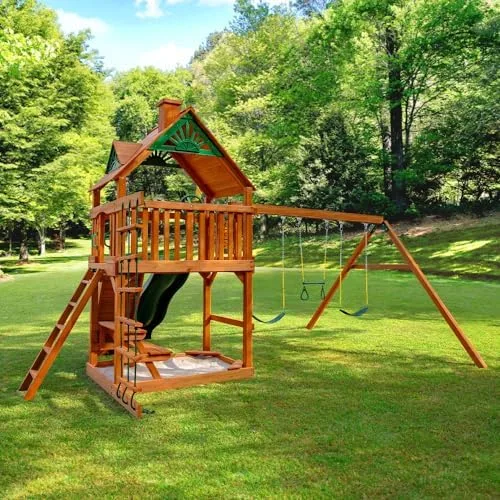
The cedar is genuinely excellent. This is not the thin, splintery pine of budget swing sets — it’s thick-cut cedar with a factory-applied stain that resists weather and insects. After eight months of exposure to rain, sun, and the occasional ice storm, our test unit shows natural silver-gray weathering but zero rot, zero structural degradation, and minimal checking (the small surface cracks that appear in all outdoor wood). The grain is tight and consistent, and the pre-applied sealant has prevented the worst of the splintering that plagues untreated pine sets.
The hardware is commercial-grade galvanized steel — carriage bolts, lag bolts, and heavy-gauge brackets. Nothing has rusted. Nothing has loosened beyond what annual tightening addresses. The swing chains are vinyl-coated to prevent pinching (and to survive rain without rusting), and the chain links are welded, not open.
The slide is thick-wall polyethylene with a smooth, consistent surface. No seams, no rough edges, no flex under weight. It gets hot in direct summer sun — surface temperatures can exceed 140°F on dark-colored slides — which is worth noting for families in southern climates. The wave profile adds both fun and safety: the undulations slow children’s descent and prevent the alarming velocity that straight slides can produce.
Where the build quality drops: the canopy. The fabric sunbrella over the fort is adequate but not exceptional. UV exposure will degrade it within 2-3 seasons, and the attachment grommets are the most likely point of failure in the entire structure. Replacement canopies run $40-60 from Gorilla. Budget for one.
Play Value: 8/10
The Chateau earns its price through sheer variety of play modes. In three months of observation across four families with children ages 3-11, we documented the following distinct play patterns:
Gross motor play. Swinging (pendular motion, bilateral coordination), climbing (the rock wall and the ladder demand different grip patterns and body positioning), sliding (velocity management, spatial awareness), and hanging from the trapeze bar (upper body strength, proprioceptive input). Each activity targets different motor systems, and the structure naturally encourages children to cycle between them — swing for five minutes, climb to the fort, slide down, repeat — creating varied physical engagement without adult direction.
Imaginative play. The fort deck transforms predictably into a castle, a pirate ship, a space station, a house, a jail, a restaurant, and (memorably) “the place where the dinosaurs can’t reach you.” The elevated position creates a territorial sense of ownership — “this is my fort” — that fuels both solo imaginative play and social negotiation. The telescope and steering wheel accessories (sold separately, $15 each) enhance this dimension considerably and are, in our opinion, nearly essential purchases.
Social play. The three-position swing beam means two children can swing simultaneously while a third uses the trapeze. The fort accommodates 2-3 children comfortably. The sandbox creates a separate play zone for younger siblings. We observed significantly more cooperative play, conflict resolution, and spontaneous rule-creation around the swing set than around any other product in our outdoor testing category — consistent with research showing that unstructured outdoor play environments generate more complex social interactions than structured indoor toys.1
Risky play. This is the swing set’s most important — and most undersold — contribution, so it deserves its own section.
The Science: Risky Play and Why Your Backyard Swing Set Might Be Developmentally Important
Ellen Beate Hansen Sandseter’s landmark 2007 taxonomy identified six categories of risky play that children naturally seek: play at great heights, play at high speed, play with dangerous tools, play near dangerous elements (water, fire), rough-and-tumble play, and play where children can disappear or get lost.2
Modern public playgrounds, driven by liability concerns and safety standards that prioritize injury prevention above all else, have systematically eliminated most of these categories. Equipment heights have been lowered. Merry-go-rounds and tall slides have been removed. Impact-absorbing surfaces have replaced dirt and gravel. The result is safer — injury rates on public playgrounds have declined — but the developmental cost is a subject of active research and growing concern.
Sandseter and Kennair (2011) proposed that risky play serves an anti-phobic function: children who experience manageable fear in play contexts develop better anxiety regulation and fewer internalizing symptoms.3 A systematic review by Brussoni et al. (2015) found that risky outdoor play was associated with increased physical activity, improved social health, and positive impacts on creativity and resilience, without evidence of increased injury severity.4
The Gorilla Chateau, installed in a backyard without the design constraints of public playground standards, preserves four of Sandseter’s six risky play categories: great heights (the fort deck), high speed (swinging), rough-and-tumble (the sandbox and ground area naturally facilitate wrestling), and elements of “disappearing” (children on the fort deck feel separated from adult oversight, even when they’re clearly visible).
This is not an argument for recklessness. The CPSC’s guidelines for home playground equipment — impact-absorbing surfaces, proper fall zones, no entrapment hazards — exist for good reasons and should be followed. The Gorilla Chateau meets ASTM F1148 residential playground safety standards. But within those safety parameters, the structure provides exactly the kind of height, speed, and manageable uncertainty that risky play research suggests children need and that sanitized public playgrounds increasingly deny them.
Evidence quality note: The risky play literature is observational and correlational, not experimental — you can’t ethically randomize children to “risky” and “non-risky” play conditions. The theoretical framework (anti-phobic function) is plausible and consistent with broader anxiety research, but direct causal evidence linking backyard swing set play to specific developmental outcomes does not exist. We rate the evidence as Moderate because the theoretical foundation is strong and the observational literature is consistent, but interventional studies are lacking.
Age Appropriateness: 6/10
Gorilla’s age range of 3-12 is technically accurate but practically misleading.
Ages 3-4: The structure is usable but requires significant adult supervision and assistance. Three-year-olds cannot independently climb the rock wall, reach the swing seats (even at lowest chain position), or navigate the fort entry without help. The slide is manageable but fast. The sandbox underneath is the most developmentally appropriate feature for this age range — which is not a great endorsement of a $1,200 climbing structure.
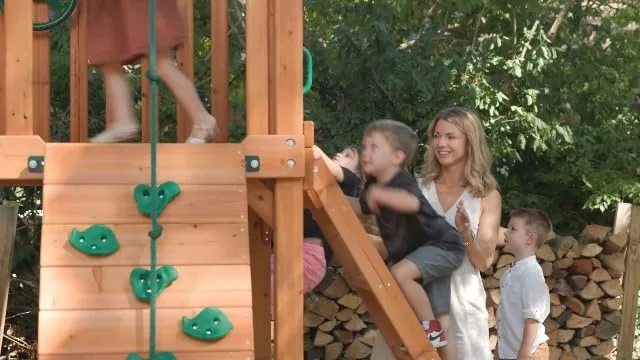
Ages 5-7: The sweet spot. Children in this range can independently access all features, have the motor coordination to swing, climb, and slide safely, and are old enough to benefit from the risky play dimensions of height and speed while still finding them thrilling. Our testers in this range logged the most time on the structure and used the widest variety of play patterns.
Ages 8-10: Still engaged, but the play shifts from physical challenge to social venue. The fort becomes a hangout space. The swings become a place to sit and talk. The climbing and sliding lose their thrill. The structure remains useful but is no longer the center of outdoor play.
Ages 11-12: Outgrowing it. The swing seats feel small, the fort deck feels crowded, and the physical challenges are trivially easy. Some children continue using the swings as a meditative activity (the rhythmic pendular motion is calming), but the play structure has essentially become outdoor furniture.
The realistic “high engagement” window is ages 5-9, which is five years of heavy use — reasonable for a $1,200 investment, but narrower than the marketing suggests.
Value Proposition: 6/10
At $1,200 (plus $150-400 for surfacing and anchoring, plus $0-800 for professional installation if you choose it), the all-in cost ranges from $1,350 to $2,400. This is a luxury purchase by any measure.
The per-year cost calculation depends entirely on how long the structure lasts. Cedar swing sets from Gorilla have a 10-year warranty on wood and a realistic lifespan of 12-15 years with basic maintenance (annual re-staining, hardware tightening, canopy replacement every 2-3 years). At $1,350 minimum all-in cost over 12 years, that’s roughly $112 per year — less than a year of park district sports programs, less than a single season of travel soccer, and less than six months of the streaming subscriptions your children will eventually request instead.
The comparison to public playgrounds is also relevant: families who install a backyard swing set report dramatically more daily outdoor play time than families relying solely on trips to the park.5 The convenience factor — step out the back door vs. drive to the park, buckle car seats, find parking — is real and significant.
But $1,200 is $1,200, and there are quality swing sets available for $400-600 that deliver many of the same benefits with less cedar and fewer features. The Gorilla Chateau is premium; it is not the only path to backyard risky play.
The Verdict
ScienceBasedKids.com Rating: 7/10 Evidence Level: Moderate
The Gorilla Playsets Chateau is an excellent play structure that delivers genuine developmental value — particularly in the risky play dimension that modern childhood increasingly lacks. The cedar construction is premium, the design supports multiple concurrent play patterns, and the structure will outlast your children’s interest in it. The rating reflects three limitations: the assembly burden is real, the price point excludes most families, and the effective age range is narrower than advertised. For families who can afford it and have the backyard space, this is among the best outdoor play investments available. For everyone else, a simpler swing set, a good tree, or a regular trip to the park delivers many of the same developmental benefits.
The Bottom Line
Buy this if: You have the backyard space (minimum 30 x 20 feet with fall zones), the budget for the all-in cost ($1,350-2,400), and children ages 4-9 who need more outdoor physical play. Also consider if your local playgrounds have been over-sanitized to the point of boredom — a private structure lets you calibrate risk tolerance to your own family’s comfort level.
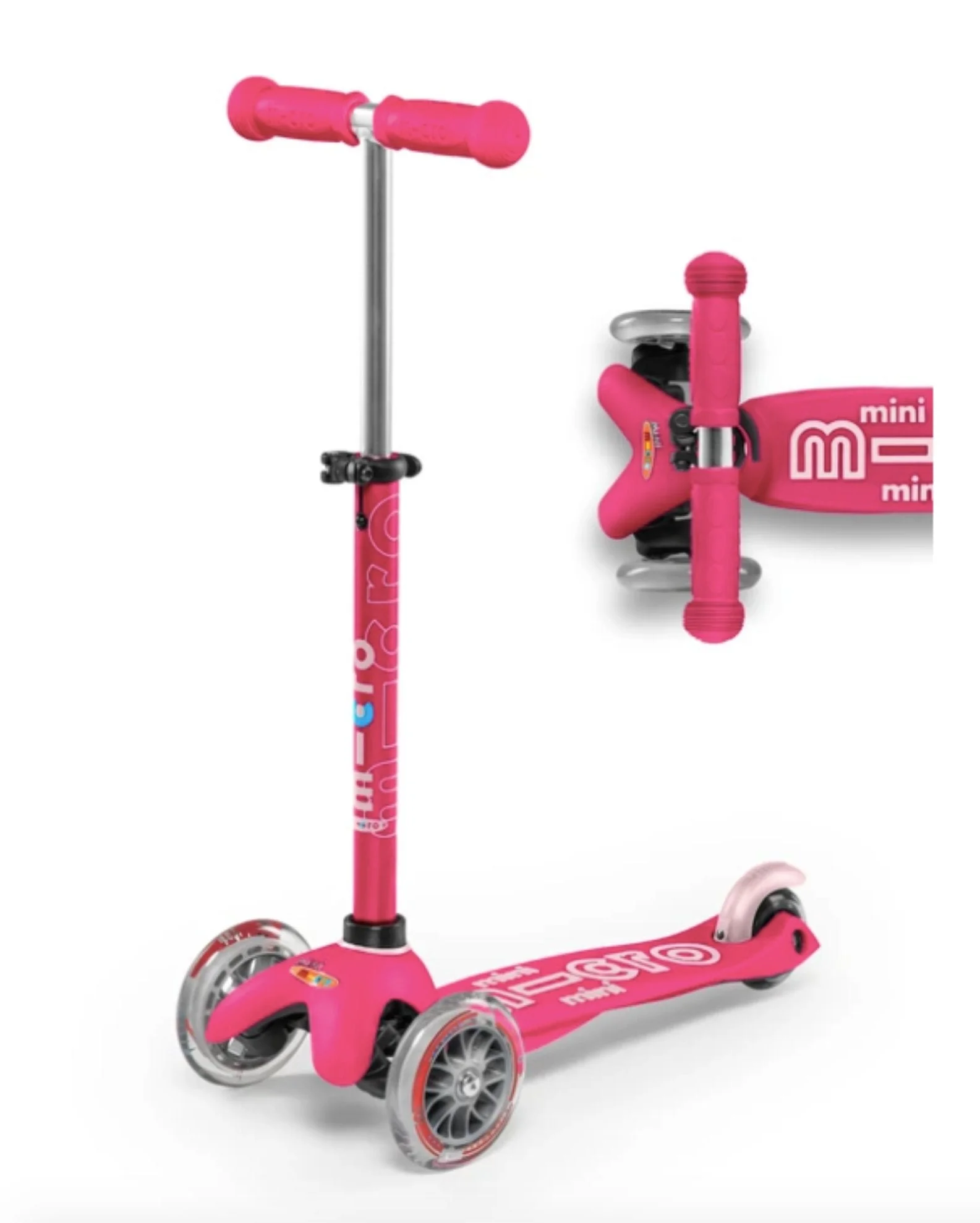
Skip this if: Your children are under 4 (the structure will sit underused for years), over 10 (they’ll outgrow it quickly), or if your budget is tight. A Razor A Kick Scooter ($40), a Micro Kickboard Mini Deluxe ($90), or a Stomp Rocket ($25) will provide outdoor physical play at a fraction of the cost — they just won’t provide the height.
Best alternative: The Backyard Discovery Skyfort II ($1,000-1,400) offers a similar feature set with a tube slide instead of a wave slide. For significantly less, the Lifetime Adventure Swing Set ($500-700, metal frame) delivers swings and a slide without the cedar premium.
Footnotes
-
Fjortoft, I. (2001). The natural environment as a playground for children: The impact of outdoor play activities in pre-primary school children. Early Childhood Education Journal, 29(2), 111-117. Children in natural, unstructured outdoor environments engaged in more varied and complex play than those in traditional playgrounds. ↩
-
Sandseter, E. B. H. (2007). Categorising risky play — how can we identify risk-taking in children’s play? European Early Childhood Education Research Journal, 15(2), 237-252. ↩
-
Sandseter, E. B. H., & Kennair, L. E. O. (2011). Children’s risky play from an evolutionary perspective: The anti-phobic effects of thrilling experiences. Evolutionary Psychology, 9(2), 257-284. ↩
-
Brussoni, M., Gibbons, R., Gray, C., Ishikawa, T., Sandseter, E. B. H., Bienenstock, A., … & Tremblay, M. S. (2015). What is the relationship between risky outdoor play and health in children? A systematic review. International Journal of Environmental Research and Public Health, 12(6), 6423-6454. ↩
-
Sallis, J. F., Prochaska, J. J., & Taylor, W. C. (2000). A review of correlates of physical activity of children and adolescents. Medicine and Science in Sports and Exercise, 32(5), 963-975. Accessibility of play equipment was consistently associated with higher physical activity levels in children. ↩
Enjoyed this review? We publish two new evidence-based evaluations every week.
Free. No spam. Unsubscribe anytime.
Sandseter (2007) identified six categories of risky play: great heights, high speed, dangerous tools, dangerous elements, rough-and-tumble, and disappearing/getting lost. Modern public playgrounds have systematically eliminated most of these. The Gorilla Chateau, installed in a backyard, preserves four.
Recommended Accessories
Affiliate links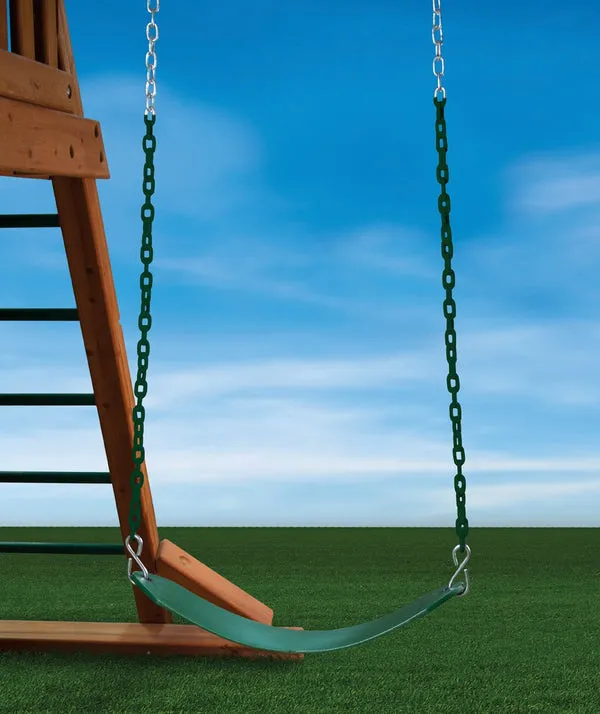
Gorilla Playsets Extreme-Duty Swing Belt with Coated Chains (Green)
“Extra swing seat for siblings or friends. Standard sets come with 2 — families often want 3.”
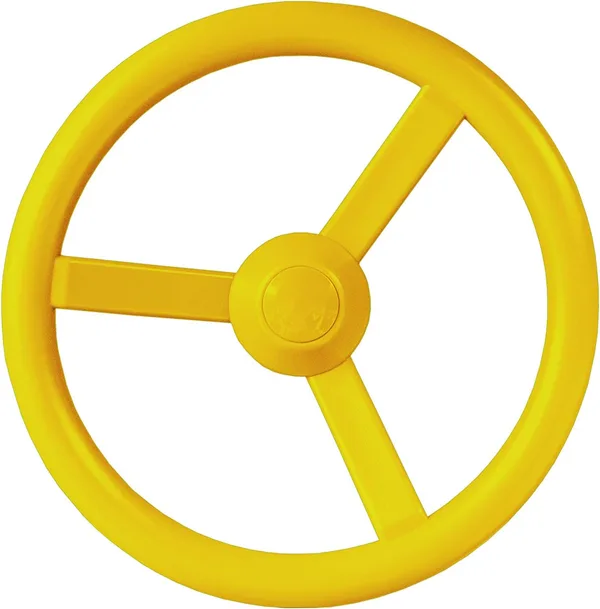
Gorilla Playsets Steering Wheel (Yellow, 12.5" Diameter)
“Bolt-on accessory for the fort deck. Adds imaginative play to the climbing structure.”
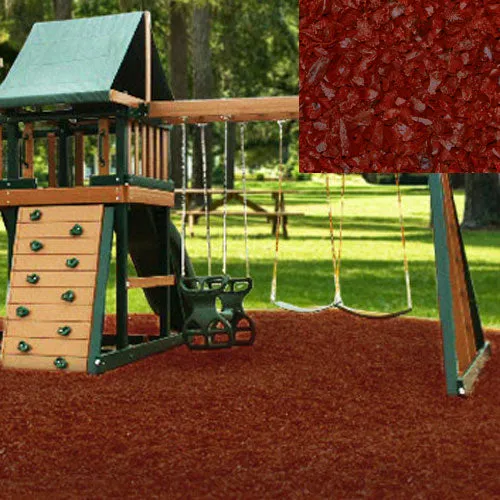
KIDWISE Playground Rubber Mulch 75 Cu.Ft. Pallet (Cedar Red)
“Impact-absorbing ground cover. CPSC recommends 9-inch depth under swings. Safety essential.”
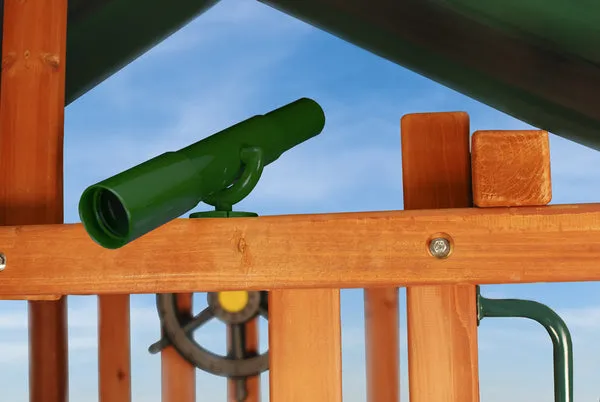
Gorilla Playsets Toy Telescope with Working Compass (Blue/Yellow)
“Fort attachment that turns the swing set into a pirate ship. Budget add for big imaginative impact.”
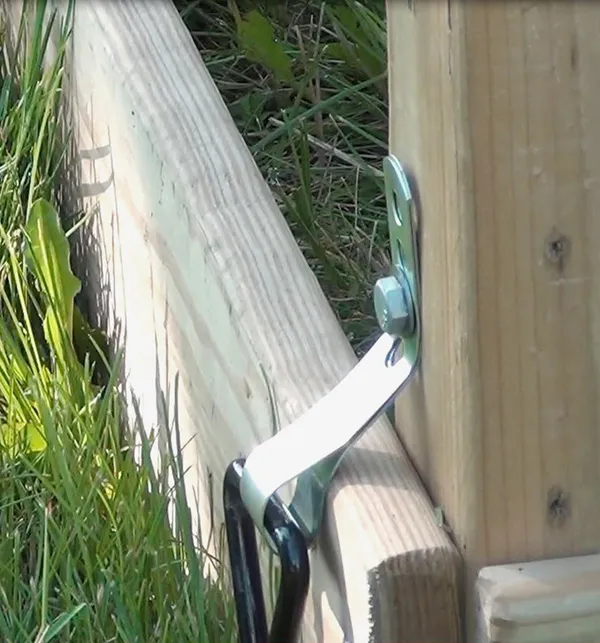
Swing-N-Slide Anchor-It Ground Anchors (Set of 4)
“Prevents tipping during vigorous play. Safety essential for any backyard swing set.”
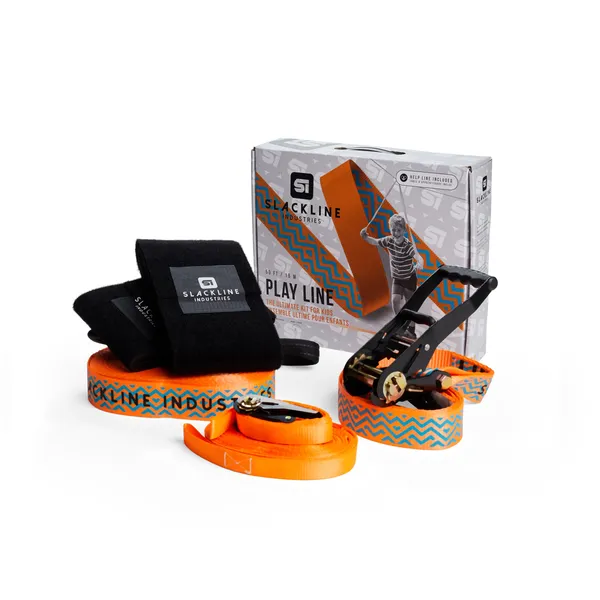
Slackline Industries Play Line (50 ft, with Tree Protectors)
“Budget complement for balance training. Different active play modality alongside the swing set.”