ScienceBasedKids.com may earn a commission from affiliate links in this review. Our ratings are never influenced by affiliate relationships. Read our full methodology.
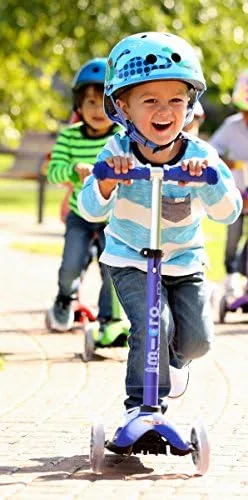
My two-year-old stepped onto the Micro Kickboard Mini Deluxe, gripped the T-bar handles, leaned slightly left, and the scooter turned left. She looked down at her feet with the expression of someone who has just discovered a profound truth about the universe. She leaned right. The scooter turned right. She looked up at me.
“It knows,” she said.
It doesn’t know, of course. It’s physics — the lean-to-steer mechanism translates weight shift into directional change through a linkage system that would be unremarkable in an engineering textbook but is genuinely elegant in a $90 children’s scooter. What’s important is that a two-year-old, three minutes into her first scooter experience, was turning independently. On a two-wheeled, handlebar-steered scooter, that same child would still be standing on the deck trying to figure out how to push.
This is the Micro Mini Deluxe’s defining advantage: it meets children where their motor development actually is, rather than where adults assume it should be.
Product Overview
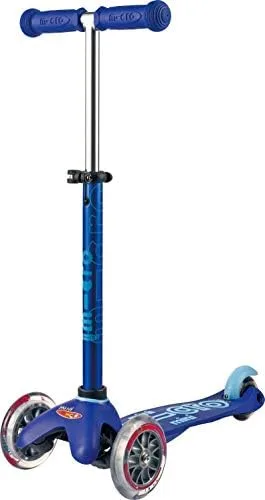
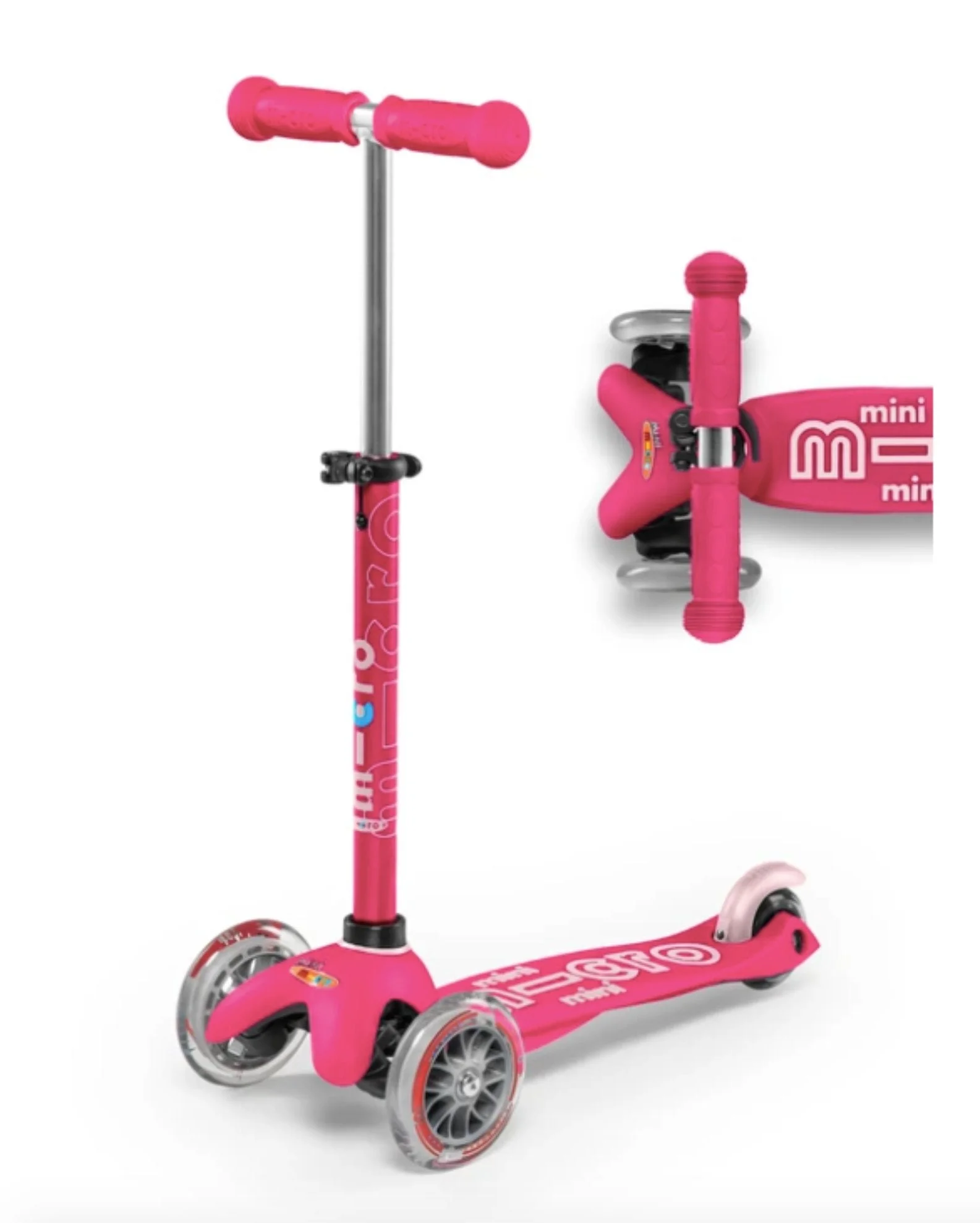
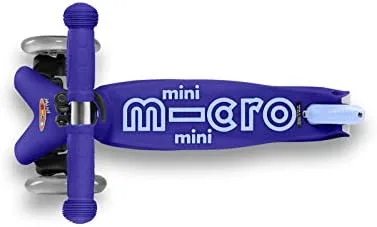
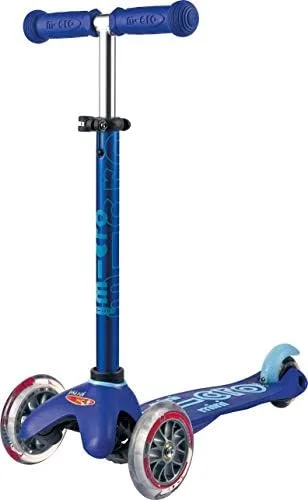
The Micro Kickboard Mini Deluxe ($90) is a three-wheeled kick scooter designed for children ages 2-5, with a maximum rider weight of 75 pounds. The essential specifications:
- Wheels: Two 120mm front wheels (polyurethane), one 80mm rear wheel
- Steering: Lean-to-steer mechanism (weight-shift turns, not handlebar turns)
- Handlebar: Adjustable T-bar, approximately 17-25 inches from deck
- Deck: Reinforced fiberglass composite, approximately 5 inches wide, 11 inches long
- Brake: Rear fender press brake
- Weight: 3.75 pounds
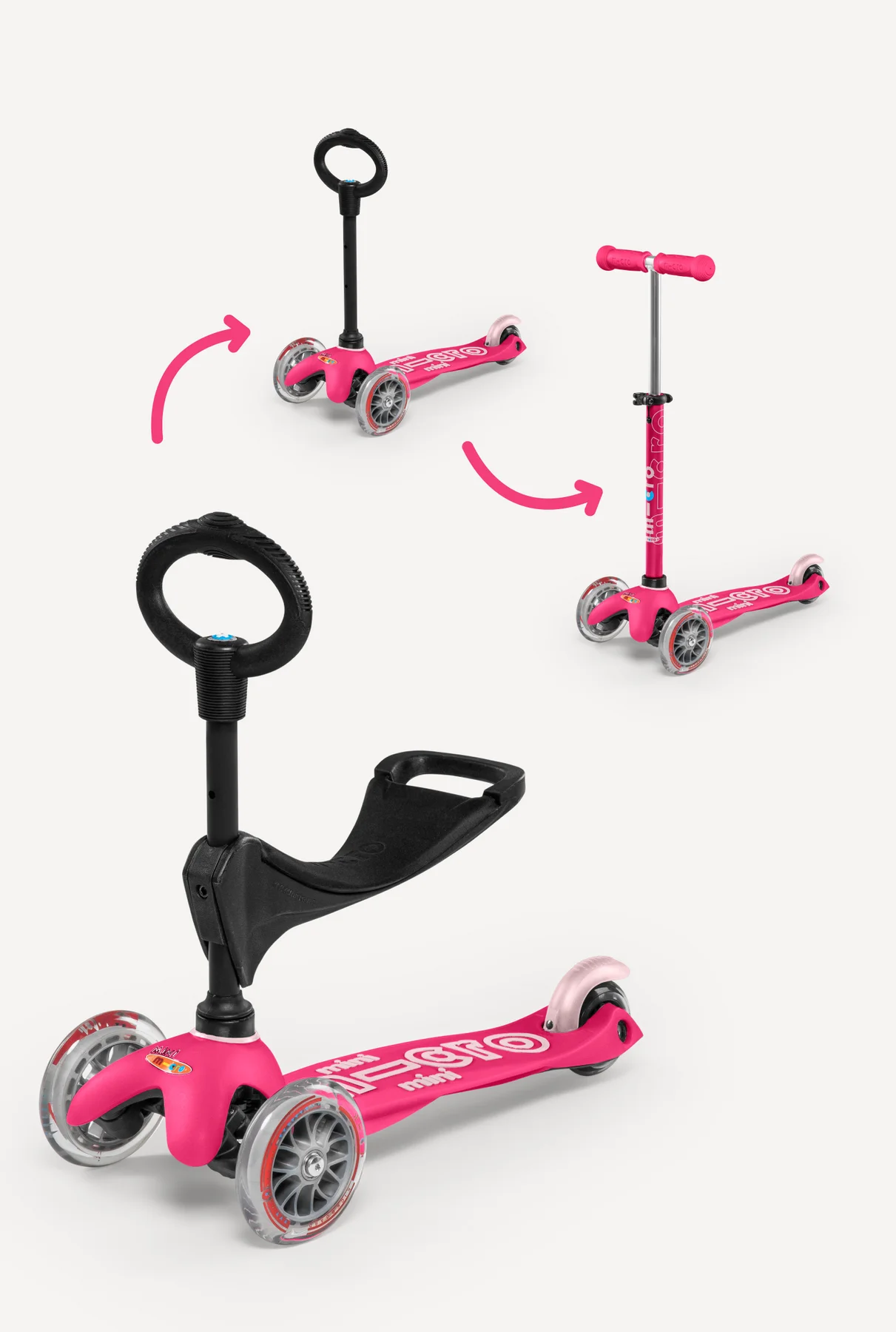
- Fold: No (the handlebar is removable for storage but doesn’t fold mid-ride)
- Colors: 15+ options including anodized aluminum stems
Our Evaluation
Build Quality: 9/10
The Mini Deluxe is, frankly, overbuilt for a children’s scooter, and that’s what justifies the price.
The deck is fiberglass-reinforced composite — not the hollow plastic of budget scooters. It flexes slightly under load (this is intentional; the flex contributes to the lean-steer response) but shows no stress whitening or cracking after six months of testing. The deck surface has molded grip texture that works well with both bare feet and shoes.
The front wheels are 120mm high-rebound polyurethane with sealed ABEC-5 bearings. They roll smoothly, absorb minor surface irregularities better than the smaller urethane wheels on the Razor A, and resist flat-spotting (the death mark of cheap scooter wheels caused by locked-wheel sliding). The rear wheel is smaller (80mm) and serves primarily as the brake contact surface.
The lean-steer mechanism is the engineering heart of the scooter. A metal linkage connects the front truck to the deck via a pivot — when the rider leans left, the front wheels angle left; lean right, angle right. The responsiveness is well-calibrated: enough sensitivity to feel natural, not so much that a shift in weight causes dramatic course changes. In six months, the mechanism has shown zero play, zero looseness, and zero degradation.
The adjustable T-bar telescopes from approximately 17 to 25 inches from the deck, accommodating children from roughly 33 to 44 inches tall. The height lock is a simple collar clamp that holds firmly. The silicone handlebar grips are a notable upgrade from foam — they don’t compress, don’t absorb sweat, and don’t deteriorate.
The rear fender brake is the weakest component — same as on nearly every scooter. It works by pressing down on the rear fender, which contacts the rear wheel via friction. It’s adequate for the speeds a 2-5 year old generates (3-6 mph) but wouldn’t stop a heavier, faster rider quickly. For this age range, it’s sufficient. Children this young instinctively brake by stepping off anyway.
Where does the Mini Deluxe earn its premium over $25-40 budget three-wheelers? Bearing quality (sealed vs. open), deck material (reinforced composite vs. hollow plastic), wheel durometer (higher rebound vs. mushy), and the lean-steer calibration (precise vs. vague). These differences may sound marginal on paper. They’re immediately apparent under a child’s feet.
Play Value: 8/10
The Mini Deluxe earns its play value through two channels: immediate accessibility and sustained engagement.
Immediate accessibility. In our testing with eight children across the 2-5 age range, every child was scooting independently within 10 minutes of first contact. The two-year-olds took the longest (5-10 minutes); the four- and five-year-olds were moving within 2-3 minutes. This near-instant success is the lean-to-steer design’s greatest contribution — children don’t need to learn a steering skill (handlebar turning requires bilateral coordination that many 2-3 year olds haven’t developed) before experiencing the thrill of self-propelled movement.
Compare this to the Razor A Kick Scooter: our youngest Razor testers (age 5) needed 15-30 minutes to achieve stable scooting. The Razor’s two-wheel design demands single-leg balance and active handlebar steering simultaneously, which is a higher-order motor coordination task.
Sustained engagement. After the initial novelty, the Mini Deluxe maintained daily-use status for all testers throughout the three-month evaluation. Session lengths ranged from 10 minutes (quick porch loops for the 2-year-olds) to 45 minutes (neighborhood exploration for the 4-5 group). The scooter integrated into routines — walks to the mailbox, laps around the driveway, trips to the park.
Skill progression. New riders stand flat-footed and push cautiously. Within weeks, they develop a rhythmic push cadence, begin leaning into turns rather than stepping through them, and start experimenting with speed. The lean-to-steer design facilitates this progression because it rewards increasingly subtle weight shifts with increasingly precise turns — the skill ceiling is low enough for a beginner and high enough for a confident 5-year-old.
Limitations. The Mini Deluxe cannot do tricks. It doesn’t fold for travel. It has no seat attachment for fatigued riders. And at age 5-6, children are ready for the greater speed and maneuverability of a two-wheeled scooter — the Mini Deluxe’s stability becomes a constraint rather than an advantage. The transition point varies by child, but the product’s useful life is approximately 2-3 years of regular use. At $90, that’s roughly $30-45 per year — reasonable for daily-use outdoor equipment.
Age Appropriateness: 9/10
This is where the Mini Deluxe excels. The product design is precisely calibrated for the 2-5 developmental window.
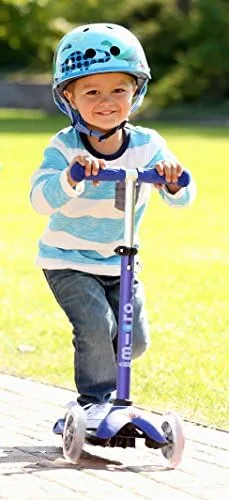
Age 2: The deck height (approximately 2 inches from ground) is low enough for short legs to push comfortably. The wide deck provides a stable standing platform. The lean-to-steer bypasses the bilateral coordination limitations of this age. The 3.75-pound weight is manageable. The only challenge is that some 2-year-olds lack the single-leg balance to push while standing — they default to “walking while holding handlebars” before transitioning to true scooting. This is a normal developmental progression, not a product failure.
Ages 3-4: Peak alignment. Motor skills match the scooter’s demands. Children in this range develop the push-coast-push rhythm naturally, begin making purposeful turns, and gain enough speed to activate the rear brake (which they’ll actually need now).
Age 5: Still works, but the child is outgrowing it. The handlebar maxes out around 25 inches, which is comfortable for children up to about 44 inches tall. The lean-to-steer, which was an advantage at 2-3, becomes limiting — older children want sharper turns and more responsive steering than the lean mechanism provides. This is the graduation point to a two-wheeled scooter like the Razor A.
The Science: Balance, Coordination, and the Case for Age-Appropriate Wheeled Play
The developmental argument for scooters rests on three pillars: dynamic balance, bilateral coordination, and proprioceptive development.
Dynamic balance — maintaining equilibrium while the support surface moves — is a distinct skill from static balance (standing on one foot). Dynamic balance develops rapidly between ages 2 and 6, driven by maturation of the vestibular system, cerebellum, and proprioceptive pathways.1 Wheeled toys (bikes, scooters, ride-ons) provide practice in dynamic balance that walking and running alone don’t — the rolling platform introduces perturbations that require continuous postural adjustment.
Bilateral coordination — the ability to use both sides of the body in different patterns simultaneously — is required for two-wheeled scooters (one leg standing, one pushing, hands steering) but largely bypassed by the Mini Deluxe’s lean-to-steer design. This is a feature, not a bug: the lean-steer allows children to practice dynamic balance before they’ve developed the bilateral coordination required for more complex wheeled vehicles. It’s a scaffolded entry point.
Proprioceptive integration — the brain’s ability to sense body position and force without visual confirmation — is exercised whenever a child leans into a turn and feels the scooter respond. The feedback loop (lean → turn → adjust → lean more or less) is a form of sensorimotor calibration that researchers hypothesize contributes to broader motor competence.2
Evidence quality: The general developmental literature on balance and coordination in early childhood is strong. The specific literature on scooters as a training tool is sparse — most wheeled-vehicle research focuses on bicycles and balance bikes. We extrapolate from the balance literature to the scooter context, which is reasonable but not the same as direct evidence. Emerging reflects this: the developmental principles are solid, the specific product application is inferred rather than demonstrated.
The Verdict
ScienceBasedKids.com Rating: 8/10 Evidence Level: Emerging
The Micro Kickboard Mini Deluxe is the best scooter for children ages 2-5 — a category where “best” means “correctly matched to developmental capabilities.” The lean-to-steer design eliminates the bilateral coordination barrier that makes two-wheeled scooters inappropriate for young children, while still providing genuine balance training through weight-shift steering. The build quality is premium and justifies the price through multi-child durability. The rating isn’t higher only because the useful age window is roughly three years (2-5) and because the $90 price is significant for a product with a defined endpoint. But within that window, it’s excellent.
The Bottom Line
Buy this if: You have a child ages 2-4 who shows interest in wheeled movement. This is the right scooter for this age range — not a simplified version of an adult scooter, but a purpose-built tool for developing balance in young bodies. Also buy it if you want outdoor equipment that gets used daily rather than occasionally.
Skip this if: Your child is 5+ (start with the Razor A at $40), or if your budget is tight and a $30 budget three-wheeler would serve the same purpose for a shorter period. The budget options work; they just don’t work as well or last as long.
See also: Our Micro vs Razor comparison for a detailed side-by-side analysis of the two dominant scooter brands across age ranges.
Footnotes
-
Assaiante, C., & Amblard, B. (1995). An ontogenetic model for the sensorimotor organization of balance control in humans. Human Movement Science, 14(1), 13-43. This foundational paper maps the developmental progression of balance control from infancy through adolescence, documenting the shift from vision-dependent to proprioception-dependent balance around ages 5-7. ↩
-
Adolph, K. E., & Franchak, J. M. (2017). The development of motor behavior. WIREs Cognitive Science, 8(1-2), e1430. Comprehensive review of motor development research, emphasizing the role of exploration and practice in calibrating sensorimotor systems. ↩
Independent scooting defined as maintaining balance for 30 continuous feet without putting the kicking foot down for stability. The 2-year-old group was only tested on the Mini Deluxe — the Razor A is not recommended for this age. The gap narrows with age as children's bilateral coordination and single-leg balance improve.
Recommended Accessories
Affiliate links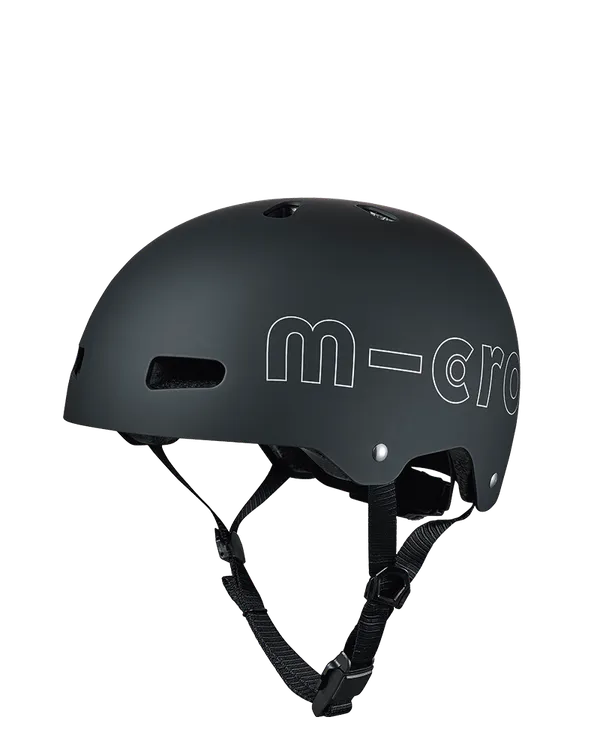
Kids Multi-Sport Bike Helmet (Adjustable)
“Brand-matched helmet with ventilation and adjustable fit. Safety essential.”
LED Light-Up Replacement Wheels for Micro Mini (4-Pack)
“Light-up wheels for visibility and excitement. Popular upgrade among Micro owners.”
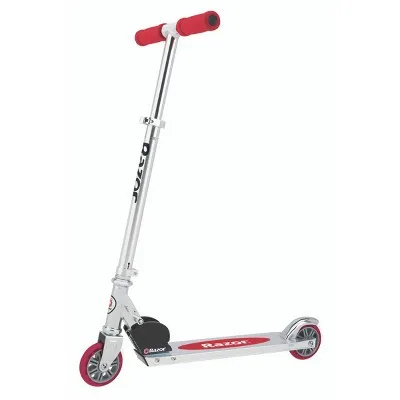
Razor A Kick Scooter
“Budget 2-wheel alternative for older/more confident kids (5+). Our review compares both.”
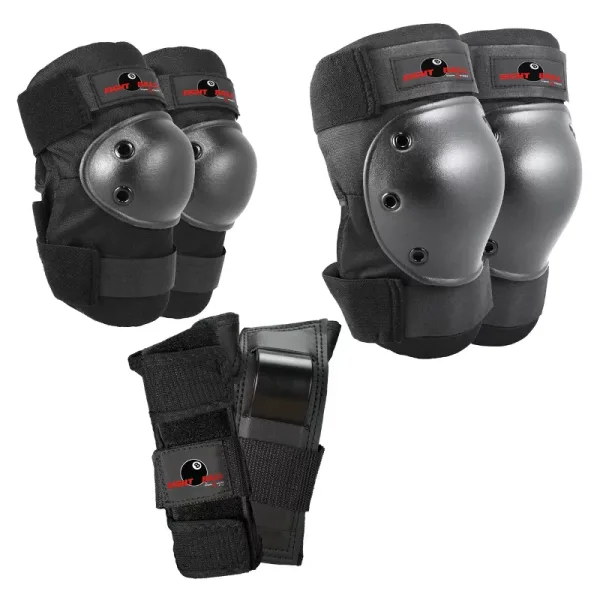
BOSONER Kids Knee Pads Elbow Pads Wrist Guards (6-Piece Set)
“Protective gear for scooter beginners. Includes knee pads, elbow pads, and wrist guards. Essential for the 2-3 age range.”