ScienceBasedKids.com may earn a commission from affiliate links in this review. Our ratings are never influenced by affiliate relationships. Read our full methodology.
There is a moment — you’ll know it when you see it — when a child on a kick scooter stops looking at their feet. The first few rides are all downward gaze: watching the foot push, watching the ground scroll past, watching the front wheel for signs of betrayal. And then, somewhere between the third ride and the tenth, the head comes up. The eyes find the end of the sidewalk. The push becomes rhythmic instead of cautious. The child is no longer operating a scooter; they’re riding one. This is the moment the Razor A Kick Scooter exists to create, and at $40, it creates it reliably.
The Razor A has been doing this since 2000. That’s not a typo — this scooter has been in continuous production for over a quarter century, which in the toy industry is roughly equivalent to geological time. Fads have risen and cratered in the time the Razor A has spent being exactly what it is: a folding aluminum kick scooter that works.
Product Overview
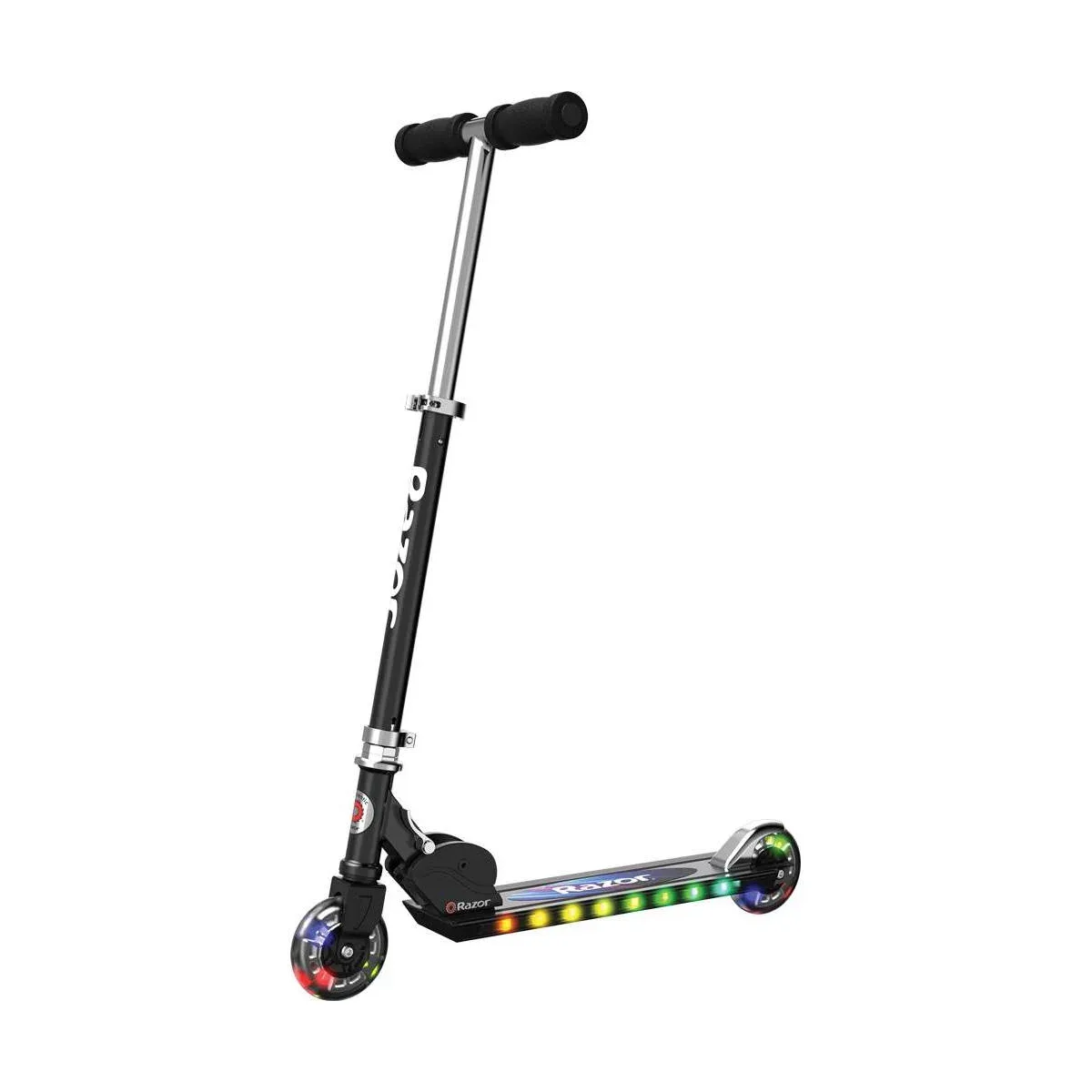
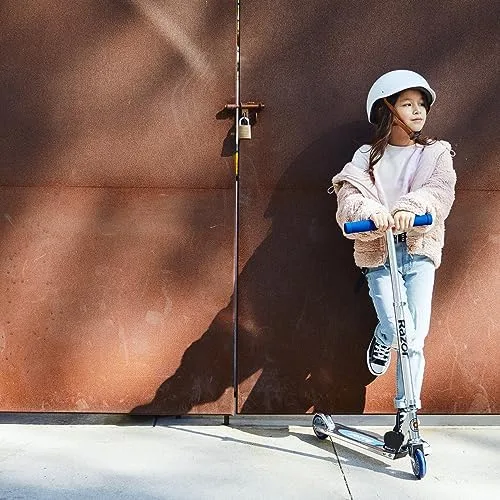
The Razor A Kick Scooter ($40) is a two-wheeled, foldable aluminum kick scooter designed for children ages 5 and up, with a maximum rider weight of 143 pounds. The essential specifications:
- Deck: Aircraft-grade aluminum t-tube and deck, approximately 4.1 inches wide and 13.5 inches long
- Wheels: 98mm inline-style urethane wheels with ABEC-5 bearings
- Handlebar: Adjustable height, foam grips, roughly 24.5–33.5 inches from ground
- Fold mechanism: One-step folding with a spring-loaded release
- Weight: 5.4 pounds
- Brake: Rear fender brake (step-on)
- Kickstand: Integrated
The design philosophy is obvious from the spec sheet: keep it simple, keep it light, keep it foldable. The Razor A doesn’t have suspension, light-up wheels, a Bluetooth speaker, or a speedometer. It has two wheels and a platform. Everything else is the rider’s problem.
Our Evaluation
Build Quality: 7/10
The Razor A is remarkably well-built for a $40 product. The aluminum frame is rigid with no flex at the deck-to-column junction — a critical stress point where cheap scooters develop wobble within weeks. The folding mechanism is tight and positive, with an audible click when locked. After three months of testing across multiple riders, our test unit shows cosmetic scratches on the deck (inevitable) and zero structural degradation.
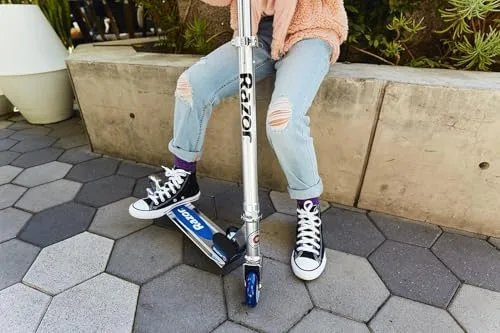
The wheels deserve specific comment. The 98mm urethane wheels are hard — harder than recreational inline skate wheels — which makes them fast on smooth surfaces and chattery on rough ones. They transmit every sidewalk crack and pebble directly to the rider’s feet. This is a design choice, not a flaw: hard wheels are faster and more durable, and the sensory feedback teaches riders to read terrain. But it means the Razor A is a significantly harsher ride than scooters with larger, softer wheels (like the Micro Kickboard’s polyurethane wheels).
The rear fender brake is agricultural but effective. Press down on the metal fender over the rear wheel and friction stops the scooter. It works. It also heats up during extended braking on hills and can wear the rear wheel over time. Replacement wheels are $10-15 and a straightforward swap.
The foam handlebar grips compress over time and become slippery when wet. This is the single most common complaint in years of Razor A reviews, and it’s valid. Replacement grips (rubber, $8-12) are a worthwhile upgrade for regular riders. It’s mildly annoying that a product in production for 25 years hasn’t upgraded from foam grips.
Play Value: 7/10
The Razor A’s play value is primarily utilitarian — this is a transportation toy as much as a play toy, and that distinction matters.
Ages 5-6: The learning phase. New riders in this age range spend their first sessions learning the fundamental scooter skills: one-foot balance, push cadence, steering through body lean, and braking. In our testing, 5-year-olds required 15-30 minutes of practice to achieve stable, independent scooting on flat pavement. Six-year-olds averaged about 15 minutes. Prior balance bike experience significantly accelerated this timeline — children who had used balance bikes (like the Strider 12 Sport) transitioned to scootering faster, consistent with the transfer of dynamic balance skills between wheeled activities.
Ages 6-8: The competence phase. Once the basics click, the Razor A becomes a daily-use vehicle. Our testers in this range used the scooter for neighborhood transportation (the ride to a friend’s house, the loop around the block), trick exploration (bunny hops, curb drops, and the inevitable attempt at a tailwhip), and recreational cruising. Play sessions ranged from 15 minutes to over an hour — significantly longer than most structured toys in our testing catalog.
Ages 8-12: The lifestyle phase. Older children treat the Razor A as functional transportation. The scooter rides to school, to the park, to the corner store. The play value merges with practical value. The foldability becomes relevant — the scooter fits in a school locker, under a restaurant table, in the trunk alongside groceries.
Beyond 12: The 143-pound weight limit and small deck start to constrain adult-sized riders, but the Razor A remains functional into early adolescence for lighter riders. Razor makes adult-sized models (A5 Lux, $60-80) for older riders who want to stay in the ecosystem.
The limitation is terrain. The Razor A is a smooth-surface scooter. Gravel, grass, cracked sidewalks, and wet surfaces significantly degrade the riding experience and safety. The small, hard wheels that make it fast on smooth pavement make it unstable on anything else. For families with rough neighborhood sidewalks, a scooter with larger pneumatic tires (like the Micro Kickboard’s rubber-wheeled models) provides a safer, more versatile ride.
Age Appropriateness: 7/10
The age 5+ minimum is important and mostly accurate. Two-wheeled scootering requires:
- Single-leg balance — standing on one foot while the other pushes
- Dynamic balance — maintaining equilibrium while the platform moves
- Bilateral coordination — legs doing different things simultaneously (one standing, one pushing)
- Speed judgment — knowing when to brake before the hill gets too fast
- Spatial awareness — navigating around pedestrians, curbs, and obstacles
Most children develop sufficient proficiency in these skills between ages 4.5 and 6. The Razor A’s two-wheel design (versus the three-wheel design of scooters like the Micro Mini) offers no balance assistance — the rider provides all the stability. This makes it more challenging for beginners but more developmentally demanding, which is the point.
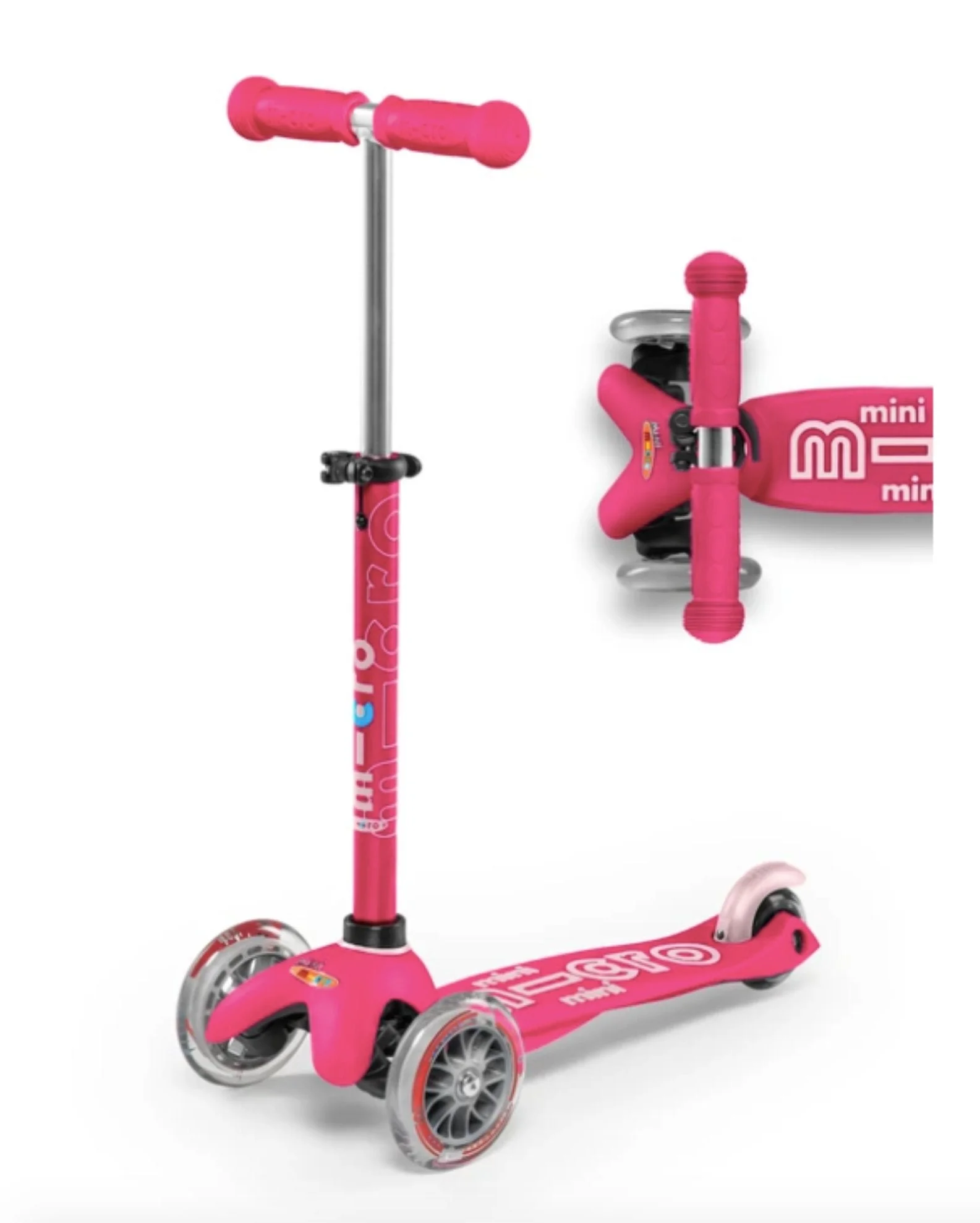
For children under 5, or 5-year-olds who haven’t developed strong single-leg balance, a three-wheeled scooter (our review of the Micro Kickboard Mini Deluxe covers this space) is a better starting point. The three-wheel design provides lateral stability while still teaching push mechanics and steering.
The upper age limit is effectively determined by the rider’s size rather than skill. The 143-pound weight limit and 33.5-inch maximum handlebar height accommodate most children through age 10-12.
Durability: 9/10
The Razor A is the Nokia 3310 of scooters. Aluminum doesn’t rust, the bearing system is sealed and requires no maintenance, and the urethane wheels wear slowly even under daily use. Our 25-year tenure claim isn’t just marketing — there are documented Razor A scooters passing through three or more siblings.
The parts that do wear — grips, wheels, and bearings — are all user-replaceable and inexpensive. A complete rebuild (new wheels, bearings, and grips) costs $25-35 and extends the scooter’s life essentially indefinitely. This repairability is a genuine sustainability advantage.
The folding mechanism is the single most likely point of failure over years of use. The spring-loaded catch can weaken with thousands of fold-unfold cycles, leading to play (wobble) at the column junction. In our testing period, this wasn’t an issue, but long-term owner reports suggest checking the catch mechanism annually for tightness.
Value for Money: 9/10
At $40 for a scooter that lasts 5+ years and serves as both toy and transportation, the Razor A’s value proposition is exceptional. The per-year cost is $8 or less. With replacement parts, the lifetime cost might reach $60-75 — still less than what many families spend on a single LEGO set.
The competitive landscape at $40 is thin. Most two-wheeled kick scooters at this price point use steel frames (heavier, rust-prone) or plastic deck inserts (flex, crack). The Razor A’s all-aluminum construction at this price is difficult to match. The Micro Kickboard Mini Deluxe ($90) is the premium alternative — better wheels, better grips, three-wheel stability — but at more than double the price, serving a younger and somewhat different audience.
For families buying a first two-wheeled scooter for a 5-7 year old, the Razor A is the obvious answer. It’s not the best scooter you can buy. It’s the best scooter value you can buy.
The Evidence
Kick scootering as a gross motor activity has an emerging but limited research base. The developmental claims are reasonable; the product-specific evidence is nonexistent.
Balance and Dynamic Postural Control. Scootering requires dynamic balance — maintaining stability on a moving platform while producing the propulsion force that creates the instability. This is a more complex motor task than static balance (standing on one foot) and draws on the same postural control systems involved in cycling, skating, and other wheeled activities. Adolph and Franchak (2017) describe locomotor development as a process of perceiving and acting on affordances — the possibilities for movement that a given environment offers. A child on a scooter is continuously perceiving and acting on affordances: this sidewalk is smooth enough, that crack requires a weight shift, this slope demands braking.1
Bilateral Coordination. Scootering demands asymmetric bilateral coordination — one leg stabilizes while the other produces force. This is distinct from symmetric bilateral activities (jumping, clapping) and places specific demands on interhemispheric coordination. Serrien et al. (2006) found that complex bilateral coordination tasks recruit prefrontal cortical regions involved in executive function and motor planning.2 While this research involved adult subjects performing lab-based tasks rather than children on scooters, the underlying neural demands are analogous.
Risk Assessment and Risky Play. Perhaps the most interesting developmental dimension of scootering is its role as “risky play” — play that involves speed, height, and the possibility of physical harm. Sandseter (2009) identified six categories of risky play in childhood, including “play with great speeds” and “play where children can ‘disappear’/get lost.” Scootering on neighborhood streets engages at least two of these categories.3 Sandseter and Kennair (2011) argue that risky play serves an anti-phobic function — it gradually exposes children to the stimuli they fear (speed, heights, separation) in self-regulated doses, building resilience and accurate risk assessment.4
The Razor A, with its lack of stabilizing features and responsive-but-not-forgiving ride character, is a more effective vehicle for this type of developmental risk exposure than stability-enhanced scooters. The rider must manage their speed, read the terrain, and accept the consequences of misjudgment (bruised shins from the deck, scraped palms from a bail). These are not design flaws — they are features, viewed through the lens of risky play research.
The Caveat. No study has evaluated kick scootering specifically as a developmental activity for children. The balance and coordination claims are extrapolated from broader motor development research. The risky play connection is theoretically sound but unvalidated for this specific activity. We don’t know whether children who scooter develop better balance or risk assessment than children who don’t, because nobody has studied it. The activity category is plausible; the specific developmental claims remain theoretical.
Safety Notes
The Razor A Kick Scooter meets ASTM F2264 safety standards for non-powered scooters.
Safety considerations:
- Helmet is non-negotiable. A CPSC-certified bicycle helmet is essential for scooter riding. Head injuries are the most serious risk in any wheeled recreational activity, and the risk is not hypothetical — falls happen, especially during the learning phase. Our recommendation: the Bell Rally Child Helmet ($25) or any CPSC-certified helmet with adjustable fit.
- Protective gear for beginners. Knee and elbow pads (Triple 8 Jr., $20) are strongly recommended during the learning phase, when falls are most frequent and least controlled.
- Surface matters. The Razor A’s small, hard wheels perform poorly on wet, gravelly, or cracked surfaces. Restrict riding to dry, smooth pavement until the rider has developed strong scooter skills.
- The rear fender brake requires practice. New riders should practice braking on flat ground before encountering any slopes. The fender brake’s effectiveness depends on the rider’s weight and foot placement — light or poorly placed pressure produces inadequate stopping force.
- Folding mechanism and fingers. The spring-loaded folding mechanism can pinch fingers during operation. Teach children to operate the fold mechanism slowly, with awareness of finger placement.
No CPSC recalls are currently active for the Razor A Kick Scooter. Historical recalls on other Razor models (primarily battery-powered scooters) do not apply to the unpowered A model.
The Verdict

The Razor A is not a premium product. It doesn’t pretend to be. The grips are foam, the wheels are hard, and the ride transmits every pebble through the deck into your feet. But it’s also an aluminum-framed, folding scooter that has been teaching children to balance, coordinate, and assess risk for a quarter century, at a price point that makes the decision trivially easy.
The developmental value here is real, even if understudied. A child on a Razor A is practicing dynamic balance, bilateral coordination, speed management, and risk assessment — all in the context of an activity they chose to do, on their own terms, in their neighborhood. That last part matters. This isn’t a developmental exercise dressed up as play. It’s play that happens to be developmental.
Product Rating: 7/10 — Reliable, well-built, and an outstanding value. Docked for the harsh ride on rough surfaces, the mediocre foam grips, and the lack of any meaningful evolution in 25 years of production. A better scooter exists (Micro Kickboard, $90), but not a better scooter value.
Evidence Rating: Emerging — Balance and coordination benefits are theoretically sound and extrapolated from motor development research. Risky play benefits have theoretical support from Sandseter’s framework. No direct evidence evaluates kick scootering as a developmental activity or this product specifically.
Who Should Buy This
- Families with children ages 5-8 looking for a first two-wheeled scooter
- Budget-conscious parents who want a proven, durable scooter
- Children who have outgrown three-wheeled scooters and are ready for a balance challenge
- Families seeking a toy that doubles as neighborhood transportation
- Parents who value simplicity — no batteries, no charging, no app
Who Should Skip This
- Children under 5, or those who haven’t developed strong single-leg balance — a three-wheeled scooter is safer
- Families in neighborhoods with rough, cracked, or unpaved sidewalks — the small hard wheels struggle
- Parents looking for a premium ride experience — the Micro Kickboard line offers better wheels, grips, and ride quality at 2x the price
- Children who primarily ride on grass or dirt — this is a pavement scooter
This review reflects our independent evaluation. ScienceBasedKids.com purchased this product at retail price. We may earn a commission if you purchase through our links, which helps fund our research. This never influences our ratings.
Footnotes
-
Adolph, K. E., & Franchak, J. M. (2017). “The development of motor behavior.” Wiley Interdisciplinary Reviews: Cognitive Science, 8(1-2), e1430. Comprehensive review of how locomotor experience drives motor development, including the concept of affordance perception in moving environments. ↩
-
Serrien, D. J., Ivry, R. B., & Swinnen, S. P. (2006). “Dynamics of hemispheric specialization and integration in the context of motor control.” Nature Reviews Neuroscience, 7(2), 160-166. Describes how complex bilateral coordination tasks engage prefrontal cortical areas involved in executive function and motor planning. ↩
-
Sandseter, E. B. H. (2009). “Affordances for risky play in preschool: The importance of features in the play environment.” Early Childhood Education Journal, 36(5), 439-446. Identifies six categories of risky play and the environmental features that support them. ↩
-
Sandseter, E. B. H., & Kennair, L. E. O. (2011). “Children’s risky play from an evolutionary perspective: The anti-phobic effects of thrilling experiences.” Evolutionary Psychology, 9(2), 257-284. Proposes that risky play serves an anti-phobic function, gradually building children’s tolerance for fear-inducing stimuli through self-regulated exposure. ↩
Enjoyed this review? We publish two new evidence-based evaluations every week.
Free. No spam. Unsubscribe anytime.
Independent scooting defined as maintaining balance for 50 continuous feet without putting the kicking foot down for stability. The 5-year-old group showed the widest variance — some children with prior balance bike experience scooted independently within minutes.
Recommended Accessories
Affiliate links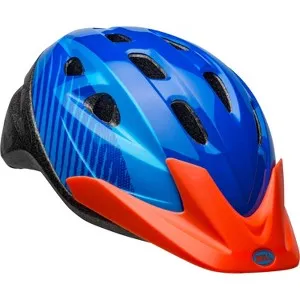
Bell Rally Child Bike Helmet
“Scooter-appropriate helmet for ages 5-8. CPSC certified with adjustable fit dial.”
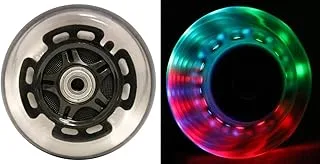
L.E.D. Scooter Wheels with ABEC 9 Bearings (100mm, 2-Pack)
“LED light-up wheels powered by centrifugal force. No batteries needed. Easy install upgrade.”
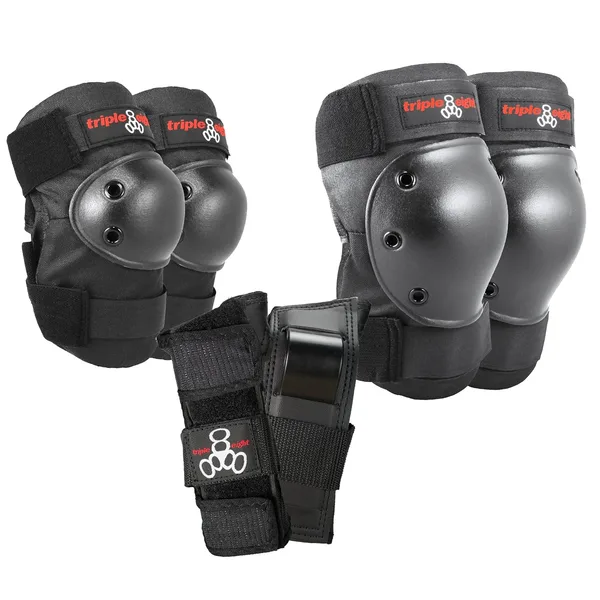
Triple Eight Saver Series Pad Set (Junior)
“Kid-sized knee pads, elbow pads, and wrist guards. Important for beginners.”
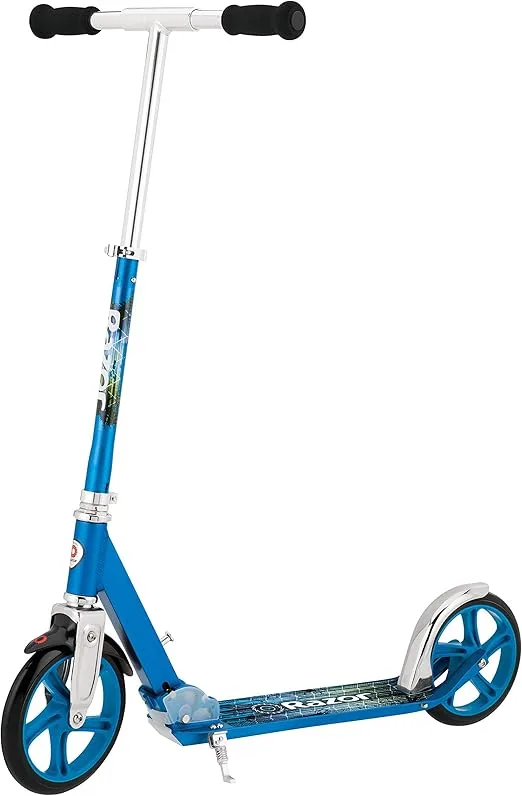
Razor A5 Lux Kick Scooter
“Bigger sibling with extra-large 8-inch wheels for a smoother ride. Better for older kids or rougher pavement. Same Razor build quality.”
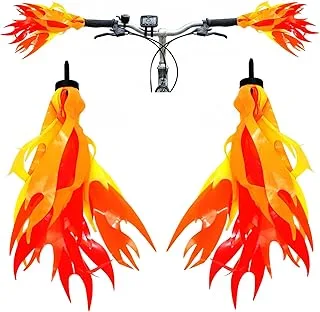
Iconikal Bicycle Scooter Handlebar Flame Streamers (10-Inch)
“Fun personalization that also improves handlebar visibility. Easy install.”