ScienceBasedKids.com may earn a commission from affiliate links in this review. Our ratings are never influenced by affiliate relationships. Read our full methodology.
I have a bias, and I should name it. When a board game has a cartoon character on the box, I expect disappointment. Licensed children’s games have trained me to expect exactly this: thin cardboard, rules that make no sense, gameplay that lasts either two minutes or two hours, and a branded veneer over mechanics that a first-year game design student would fail for submitting. The licensing fee went to the IP holder. The design budget went to printing the character’s face on every surface. The playtesting budget went to lunch.
Bluey Shadowlands surprised me. Not because it’s a masterpiece of game design — it isn’t — but because someone at Moose Games apparently asked: “What if we made this actually fun to play?”
Product Overview
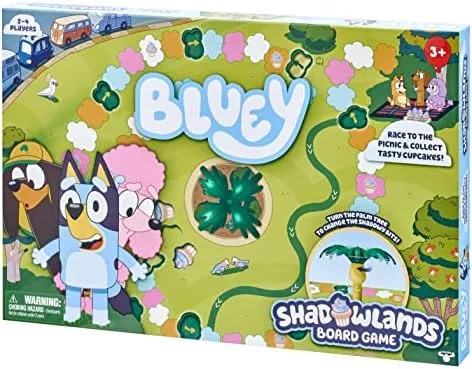
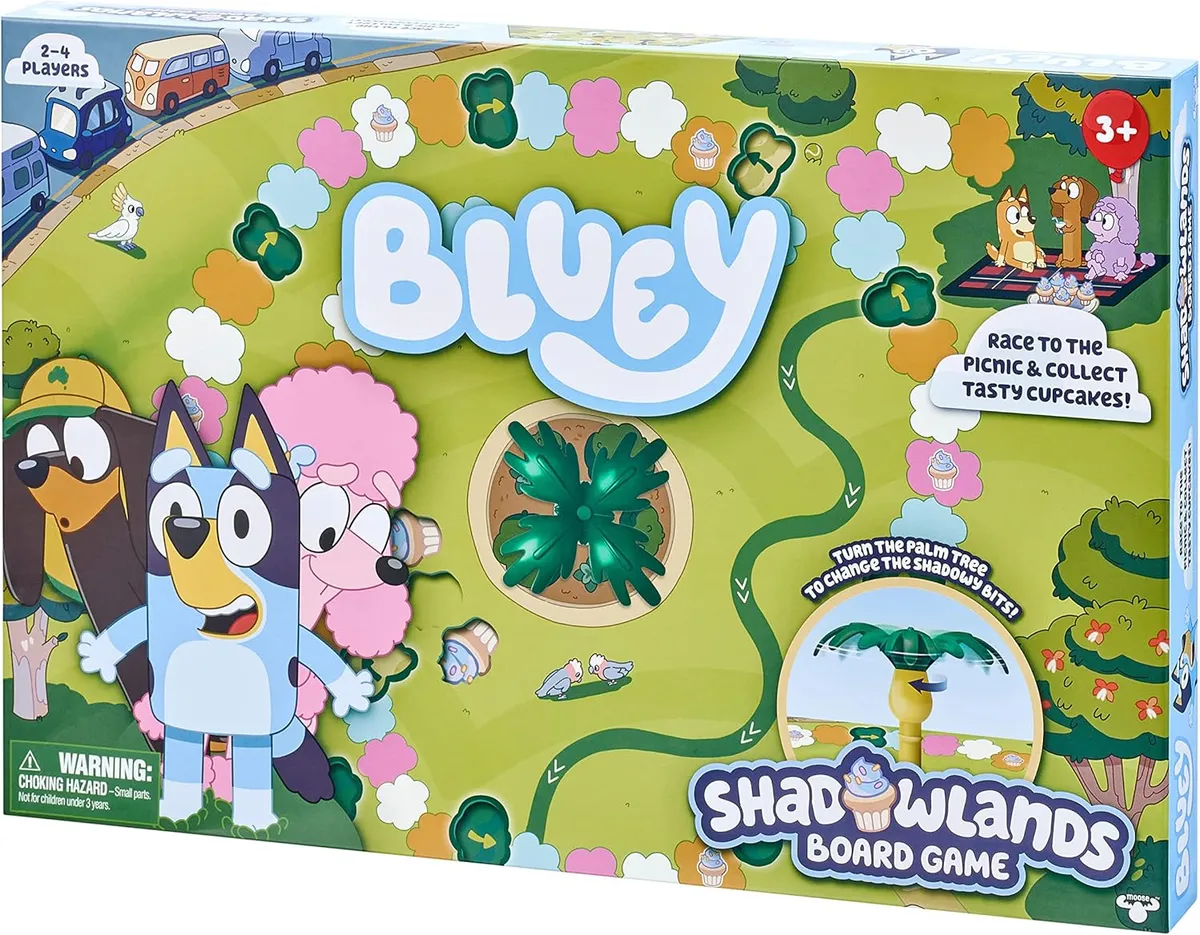
Bluey Shadowlands is a cooperative board game for 2-4 players, ages 3 and up, based on the Australian animated TV show Bluey. The game’s central mechanic involves matching shadow silhouettes to character cards. Players work together to match all the shadows before the “Shadow Monster” reaches the end of a track.
In the box:
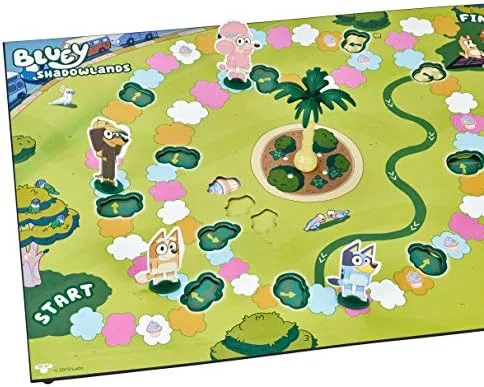
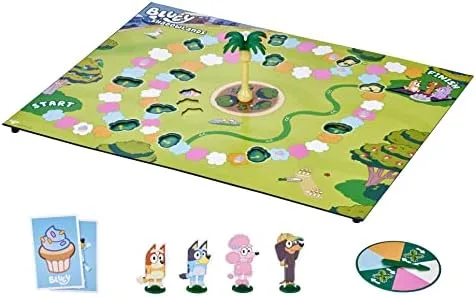
- A game board featuring a backyard scene from the show
- 24 shadow cards showing silhouettes of Bluey characters and objects
- 24 matching character cards with full-color illustrations
- A shadow monster token and track
- A spinner (not a die — the spinner determines player actions)
- Rules sheet — one page, both sides
The game plays in 8-12 minutes. Setup takes about 2 minutes. These are not incidental details — for a game targeting three-year-olds, the ratio of playing time to setup time is a core design parameter.
Our Evaluation
Design & Component Quality: 6/10
The components are adequate but not premium. The board is standard game-weight cardboard — it lies flat and doesn’t warp, but it lacks the thickness and linen finish of a HABA or Gamewright product. The cards are thin enough that a determined three-year-old can bend them, and they will, because three-year-olds are determined about everything.
The spinner is the weakest component. It’s a plastic arrow on a cardboard base, and it doesn’t spin freely — it catches and stutters, requiring the exaggerated flick that preschoolers naturally provide but that feels imprecise. A die would have been more reliable, but a spinner is more accessible for the youngest players who may struggle with throwing dice and reading pips.
The art, predictably, is the highlight. Moose Games uses official Bluey artwork, and the show’s distinctive watercolor-and-outline style translates beautifully to card format. The shadow silhouettes are clear and distinct — each one is recognizably different, which is essential for the matching mechanic. Young children can identify silhouettes by shape alone, which means the core gameplay works even for pre-readers.
Gameplay & Mechanics: 7/10
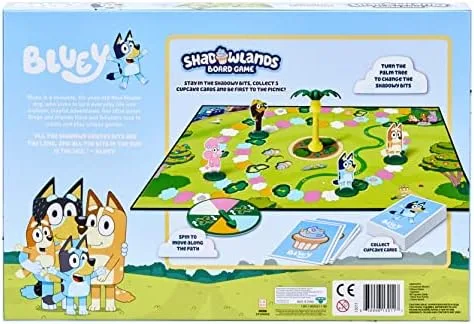
The mechanic is simple: shadow cards are laid out face-up on the board. On your turn, spin the spinner. If it lands on “match,” pick up a character card and try to find its matching shadow. If the shadow is face-up on the board, you’ve matched a pair. If the spinner lands on “Shadow Monster,” the monster advances one step on its track.
The cooperative goal: match all the shadow pairs before the Shadow Monster reaches the end of the track. Everyone wins or loses together.
This is a cooperative matching game with a time pressure element — the advancing monster creates urgency without the interpersonal stakes of competition. For three-year-olds, this structure is developmentally on-target. The matching mechanic exercises visual discrimination (can you identify which shadow belongs to which character?). The cooperative structure eliminates the emotional regulation challenge of losing to another person. The spinner introduces chance, which means outcomes aren’t determined by skill alone — a feature, not a bug, when skill levels vary dramatically in the target age group.
The game’s best design choice is that matching requires both recognition and comparison. A child doesn’t just flip a card and find an identical match (like Memory). They see a full-color Bluey character and must identify the corresponding silhouette — a different representation of the same object. This cross-representational matching is a genuine cognitive skill that few games in this age range exercise.
The game’s weakness is replay variability. The shadow-character pairs are fixed — the same 24 pairs every time. After 5-6 plays, most children have memorized the matches. The game doesn’t become boring — the spinner-driven pacing creates different experiences each time — but the matching challenge diminishes. This is a 15-20 play product for most families, not a 100-play one.
Age Appropriateness: 8/10
The 3+ rating is accurate and well-calibrated. Three-year-olds can:
- Spin a spinner (with help keeping it on the base)
- Identify silhouette shapes and match them to colored illustrations
- Understand the concept of “we all work together”
- Follow a single rule per turn (spin, then match or move monster)
- Sustain attention for 8-12 minutes
The game would be too simple for most five-year-olds. The matching challenge that is engaging at 3 is trivial by 5. This gives the game a relatively narrow sweet spot — ages 3-4 — which is honest but limiting. If you’re buying a game to grow with your child, Outfoxed! (ages 5-8) or Hoot Owl Hoot (ages 4-6) offer more developmental runway.
The Bluey IP extends the effective age range slightly upward. Children who love the show will play the game past the point where the mechanics alone would sustain interest, because the characters maintain engagement that the gameplay doesn’t. This is the legitimate value of a licensed IP — not gameplay enhancement, but motivational extension.
The Licensed IP Question: A Sidebar
Licensed board games occupy a strange position in the children’s game market. The economics are clear: the IP holder charges a licensing fee, which typically comes out of the game’s design and component budget. The marketing is handled by the IP’s existing recognition. The result is usually a product where the brand does the selling and the game does the disappointing.
Bluey is an exception for two reasons. First, the show itself is unusually well-designed — it depicts play, cooperation, and family interaction with a warmth and intelligence that most children’s media doesn’t attempt. The game inherits this ethos, at least tonally. Second, the shadow-matching mechanic is genuinely related to the show — the Shadowlands episode is about using shadows to play pretend, and the game translates that concept into a mechanic rather than just slapping characters onto a generic game template.
This doesn’t make Shadowlands a great game. It makes it a good licensed game, which is a much rarer thing.
Value for Money: 8/10
At $15, Bluey Shadowlands is priced correctly. The components aren’t premium, but the price doesn’t ask them to be. The game delivers 15-20 solid play sessions for a household with a 3-4 year old, which works out to roughly $0.75-1.00 per session. For a game that provides structured cooperative play with zero screen time, that’s excellent value.
The comparison to non-licensed alternatives is instructive. HABA First Orchard ($25) has better components and deeper developmental value, but costs 67% more. Hoot Owl Hoot ($15) is the same price with better replay value but targets a slightly older age range. Bluey Shadowlands is the best $15 cooperative game we’ve found for three-year-olds specifically — a narrow claim, but a defensible one.
The Evidence
There is no published research on Bluey Shadowlands specifically, and the broader research on licensed children’s games is thin. We can, however, evaluate the game’s mechanics against developmental research on the skills it exercises.
Visual Discrimination and Cross-Representational Matching. The game’s core mechanic — matching a full-color illustration to its silhouette — exercises visual discrimination and cross-representational matching. Frick, Möhring, and Newcombe (2014) found that spatial matching tasks in early childhood are associated with the development of spatial skills that predict later STEM ability.1 While shadow matching is simpler than the spatial tasks studied, the fundamental skill — recognizing that two different visual representations refer to the same object — is the same.
Cooperative Play in Early Childhood. The cooperative structure aligns with the research on prosocial game design reviewed in our Cooperative vs Competitive Games comparison (Day 91). Bay-Hinitz et al. (1994) demonstrated that cooperative game play increases prosocial behavior and decreases aggression in preschool-age children.2 The effect is strongest in the 3-5 age range — precisely where Bluey Shadowlands operates.
IP Familiarity and Engagement. Calvert (2008) found that familiar media characters increase children’s attention to and engagement with educational content, even when the content itself is identical.3 A matching game with Bluey characters holds a Bluey fan’s attention longer than an identical matching game with generic characters. This isn’t a developmental benefit — it’s a motivational one — but motivation determines whether a game gets played at all.
The honest summary: No direct evidence supports or evaluates this specific product. The mechanics exercise visual discrimination skills that have developmental value in early childhood. The cooperative structure is research-supported for the target age. The licensed IP provides motivational engagement but not developmental advantage.
Safety Notes
Bluey Shadowlands meets ASTM F963 and CPSIA safety standards. All components are larger than the CPSC small-parts standard.
Safety considerations:
- The spinner has a small plastic arrow that could detach if aggressively manipulated. Inspect periodically.
- Thin cardboard cards can produce paper cuts. Relevant for enthusiastic three-year-olds who grab cards quickly.
- No small parts, no batteries, no magnets.
No CPSC recalls have been issued for this product.
The Verdict
Bluey Shadowlands is not the best board game for three-year-olds. That distinction belongs to HABA First Orchard, which has better components, deeper developmental design, and broader applicability. What Bluey Shadowlands is: a licensed board game that doesn’t insult its audience. The shadow-matching mechanic is clever. The cooperative structure is age-appropriate. The game length is realistic. And the Bluey art is genuinely beautiful.
For a household with a Bluey-obsessed three-year-old — and there are many — this is the rare licensed product we can recommend without caveat. It won’t be the last board game your child plays, but it’s a perfectly fine first one. And at $15, the risk is low enough that even our skepticism about licensed games can’t argue against trying it.
Product Rating: 7/10 — A surprisingly well-designed licensed game with a clever matching mechanic and appropriate cooperative structure. Docked for thin components, limited replay variability, and a narrow age sweet spot.
Evidence Rating: None — No published research on this product or licensed board games for preschoolers specifically. Mechanics align with developmental research on visual discrimination and cooperative play, but no direct evaluation exists.
Who Should Buy This
- Parents of Bluey-loving 3-4 year olds looking for a first or second board game
- Families wanting a short (10-minute), cooperative game for the youngest players
- Gift-givers looking for an affordable, safe bet for a preschooler who loves the show
- Parents skeptical of licensed products who are willing to be pleasantly surprised
Who Should Skip This
- Families looking for a board game with longer developmental runway — Hoot Owl Hoot or Outfoxed! will last years longer
- Parents of children over 5 — the matching challenge is trivial by this age
- Anyone who doesn’t know Bluey — the IP does meaningful motivational work, and without it, the game is merely adequate
- Parents who prioritize premium components — the cardboard and spinner are functional but not built to last through years of preschooler handling
This review reflects our independent evaluation. ScienceBasedKids.com purchased this product at retail price. We may earn a commission if you purchase through our links, which helps fund our research. This never influences our ratings.
Footnotes
-
Frick, A., Möhring, W., & Newcombe, N. S. (2014). “Picturing perspectives: Development of perspective-taking abilities in 4- to 8-year-olds.” Frontiers in Psychology, 5, 386. ↩
-
Bay-Hinitz, A. K., Peterson, R. F., & Quilitch, H. R. (1994). “Cooperative games: A way to modify aggressive and cooperative behaviors in young children.” Journal of Applied Behavior Analysis, 27(3), 435-446. ↩
-
Calvert, S. L. (2008). “Children as consumers: Advertising and marketing.” The Future of Children, 18(1), 205-234. ↩
Enjoyed this review? We publish two new evidence-based evaluations every week.
Free. No spam. Unsubscribe anytime.
Licensed games in our sample (n=3) averaged lower than non-licensed (n=8), but Bluey Shadowlands outperformed two non-licensed games. Sample too small for statistical inference.
Recommended Accessories
Affiliate links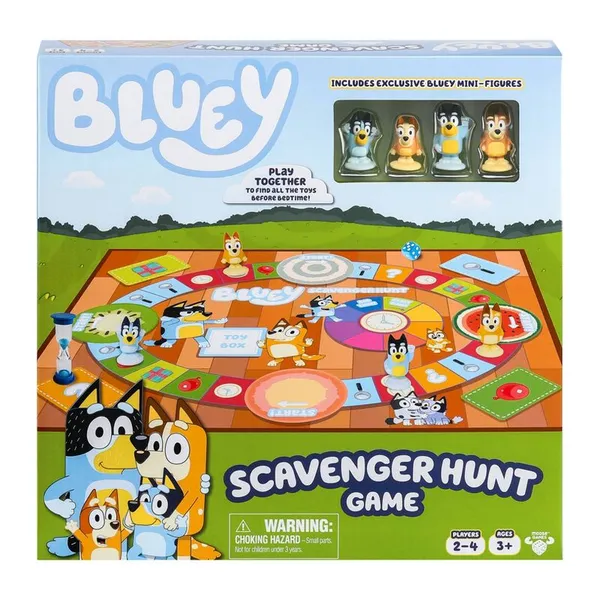
Moose Games Bluey Scavenger Hunt Board Game
“Another Bluey-licensed game. Tests whether the 'good licensed game' pattern holds.”
Moose Games Bluey Bingo's Bingo Card Game
“Simple matching game for younger kids. Same IP, different skill level.”
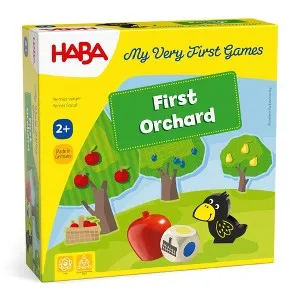
HABA My Very First Games - First Orchard
“Non-licensed cooperative game alternative. Proves that quality gameplay doesn't need an IP.”