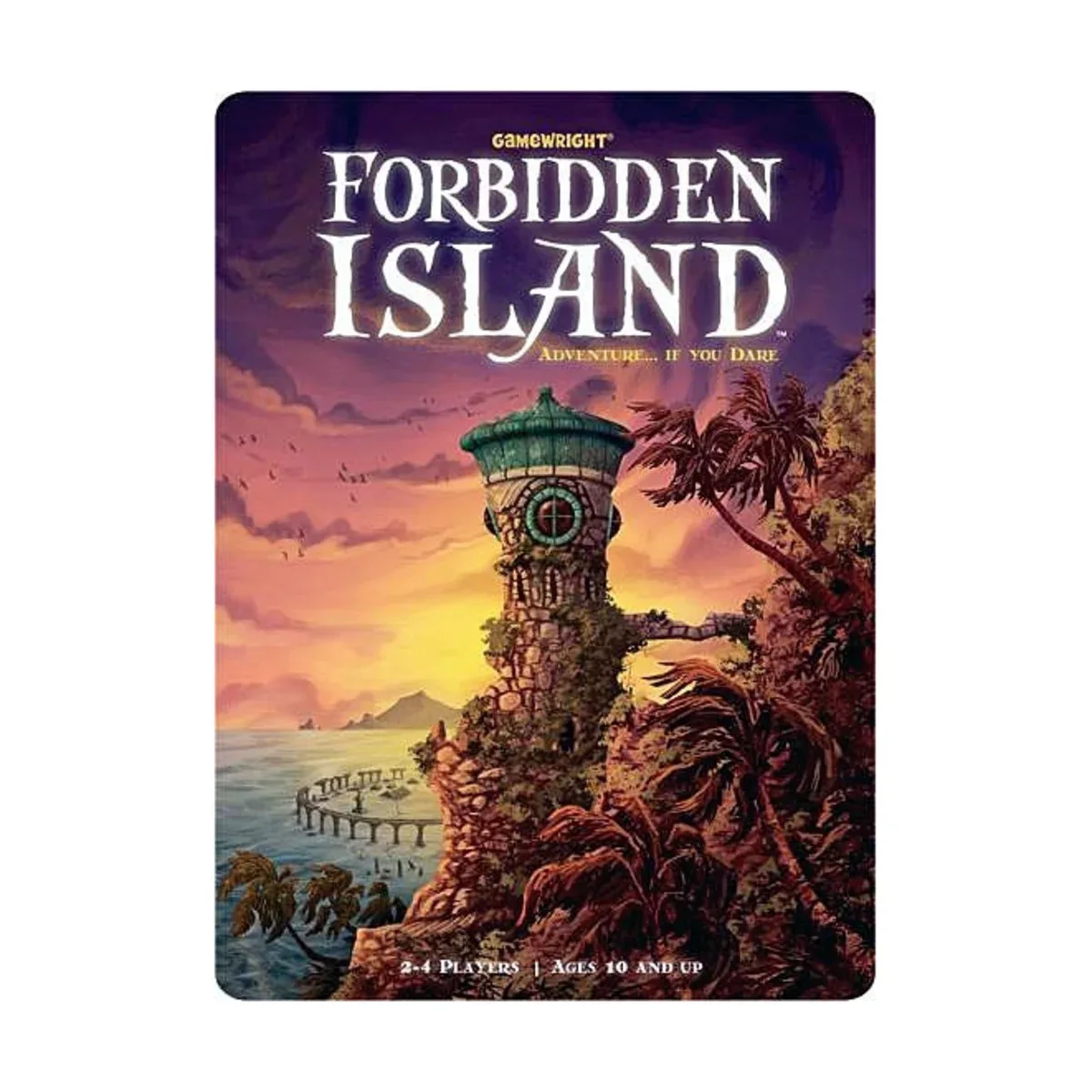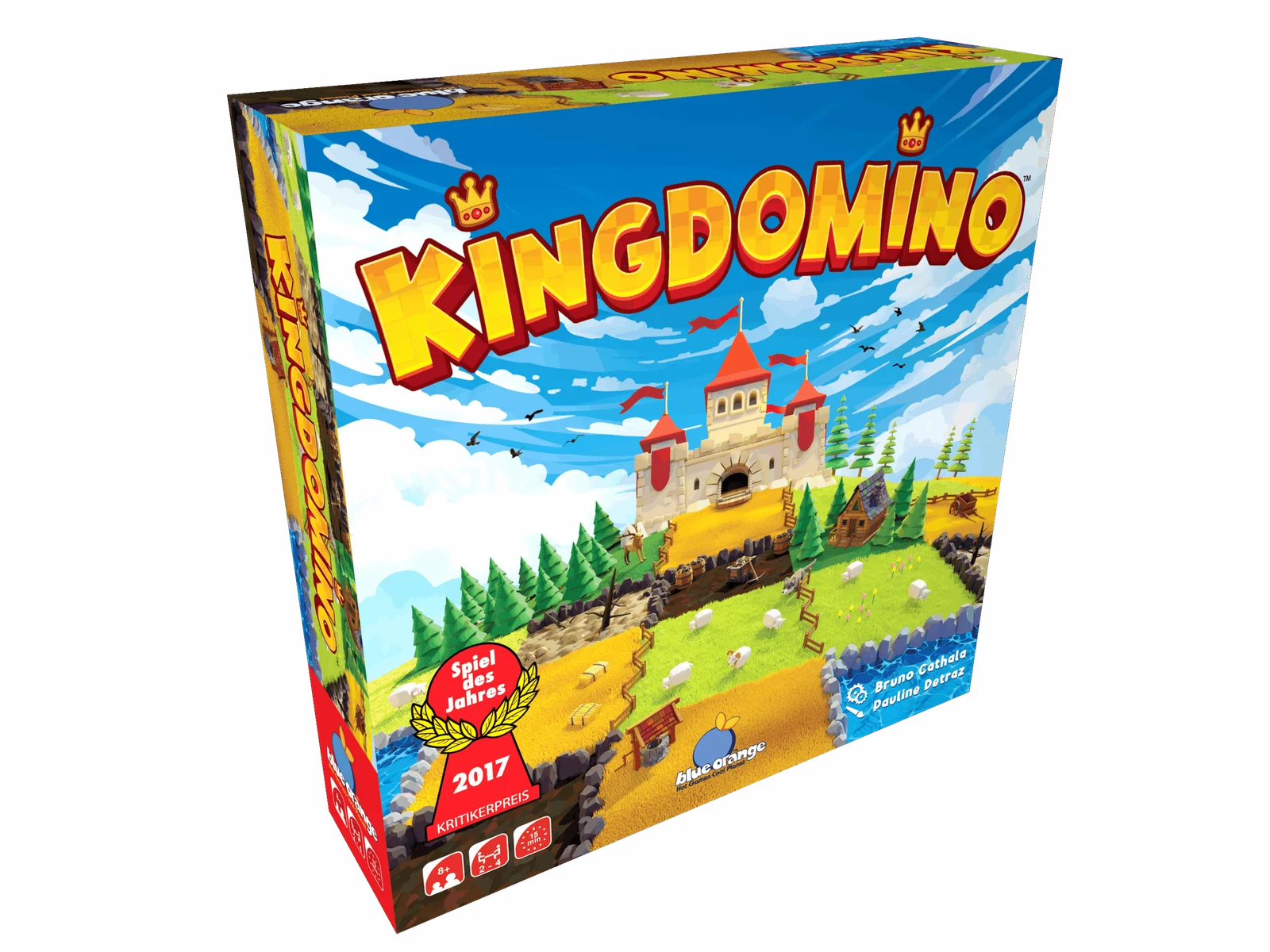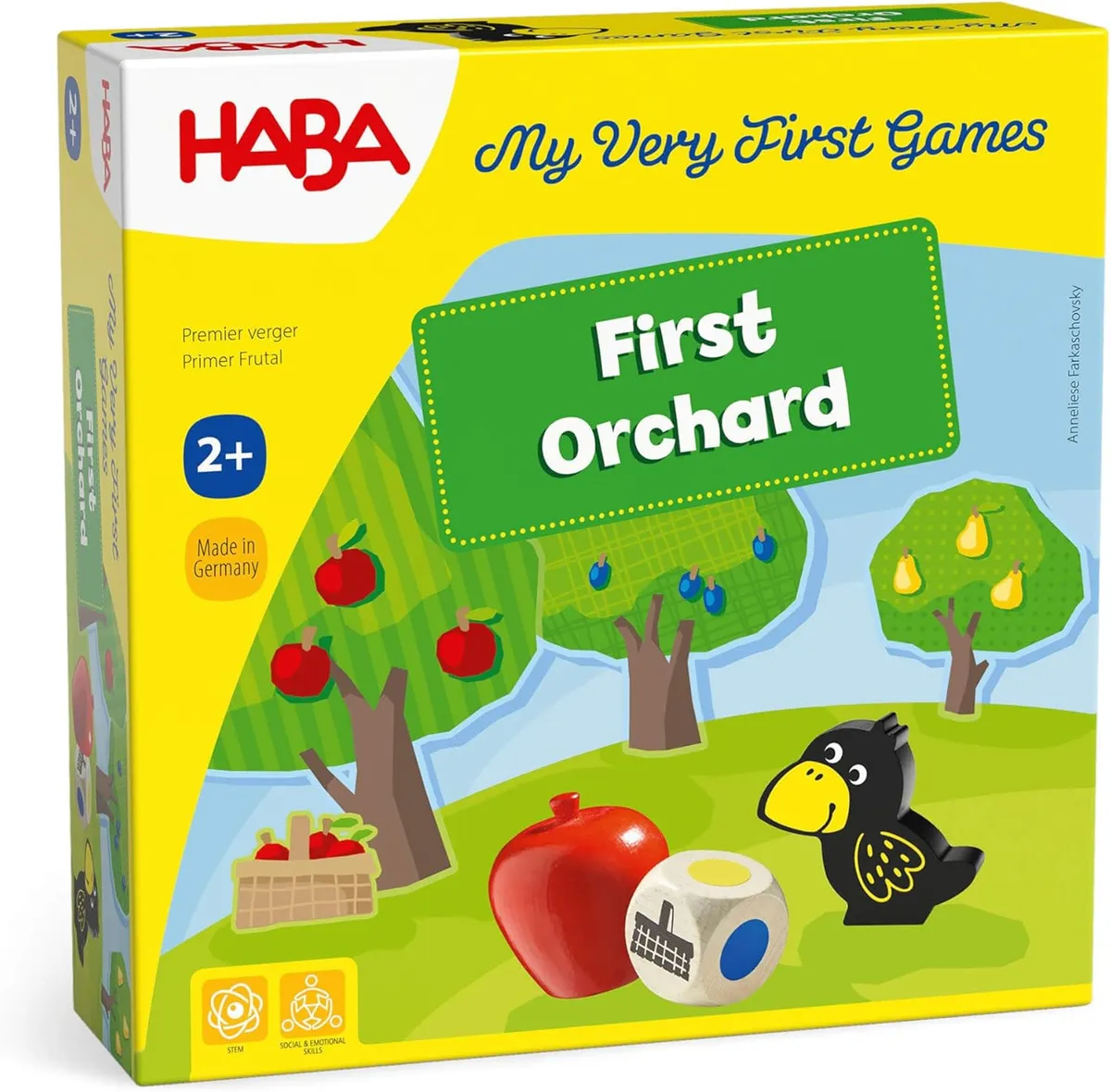
ScienceBasedKids.com may earn a commission from affiliate links in this review. Our ratings are never influenced by affiliate relationships. Read our full methodology.
Here’s the moment. Your eight-year-old picks up a piece — five connected squares shaped like a zigzag — and holds it over the board. She rotates it ninety degrees. Flips it. Rotates again. She’s not looking for a spot where the piece fits (many spots would work); she’s looking for the spot where this specific piece, in this specific orientation, touches only the corner of her previous piece while simultaneously blocking her brother’s most promising expansion path while preserving her own future access to the center of the board. She is, in other words, thinking five moves ahead in three spatial dimensions. She places the piece. Her brother groans. The eight-year-old grins. She doesn’t know the term “spatial reasoning” but she’s been doing it so intensely for twenty minutes that her brain has that pleasant, stretched-out feeling that adults get from a good crossword puzzle. Blokus does this. Reliably, repeatedly, for twenty dollars.
Product Overview
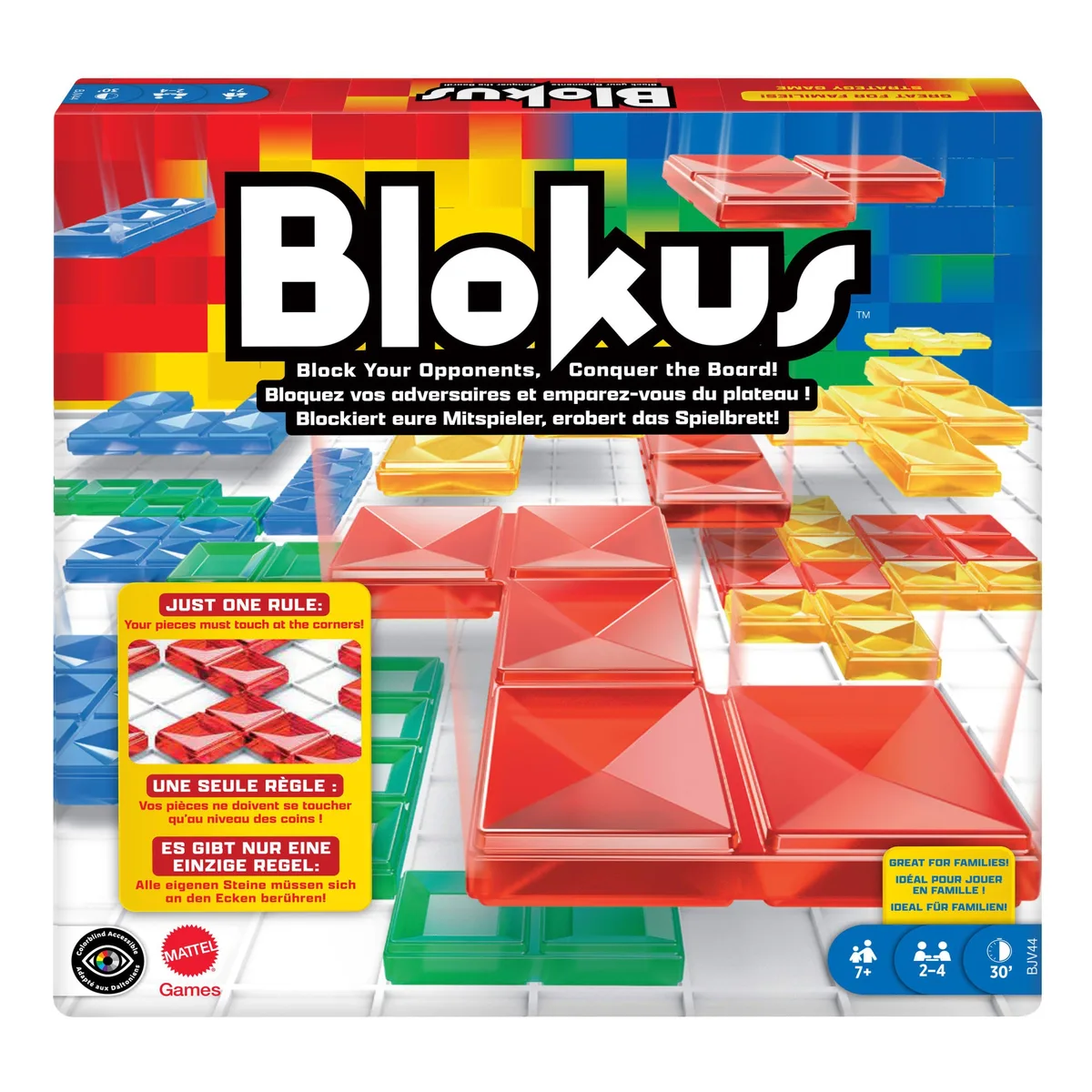
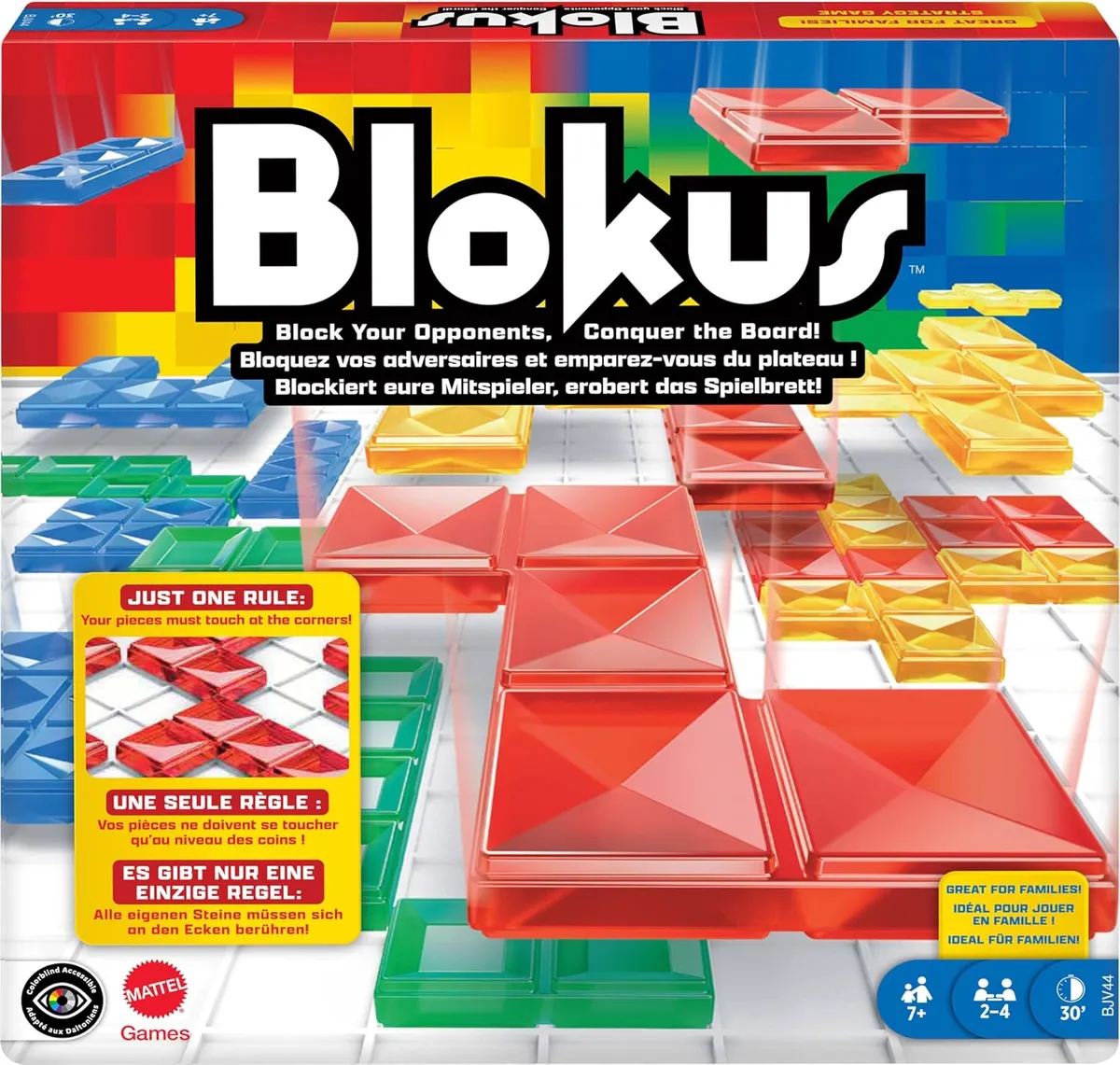
Blokus is a territory-control strategy game for 2-4 players ages 7 and up, designed by Bernard Tavitian and currently produced by Mattel. Games last approximately 20-30 minutes. The premise is abstract and elegant: each player has 21 pieces of different shapes (made from connected squares, like Tetris pieces) in their assigned color. Players take turns placing one piece on the board. The only rule: each new piece must touch at least one corner of a piece you’ve already placed, but it cannot share an edge. The game ends when no player can place any more pieces. The player who has placed the most pieces (or most squares) wins.
In the box:
- 1 game board — a 20×20 grid of squares with a satisfying raised border
- 84 game pieces — 21 pieces per player in four colors (blue, yellow, red, green)
- Each player’s 21 pieces include every possible shape made from 1-5 connected squares (a monomino, a domino, two triominoes, five tetrominoes, and twelve pentominoes)
That’s it. No dice, no cards, no chance elements, no hidden information. Blokus is pure strategy — the player who thinks most effectively in spatial terms wins. This absence of randomness is both the game’s greatest strength and its most important consideration for families.
Our Evaluation
Build Quality: 8/10
Blokus’s components are excellent for a $20 mass-market game. The plastic pieces are translucent, jewel-toned, and satisfying to handle. Each piece has a slight flexibility that prevents snapping under pressure — important when an excited seven-year-old squeezes their pieces during tense moments.
The game board is thick, with recessed squares that hold placed pieces securely. This is a critical design feature: Blokus pieces must sit precisely on the grid for the corner-touching rule to be visually clear. A flat board would allow pieces to slide and create disputes about whether corners are actually touching. The recessed grid eliminates ambiguity.
The pieces fit snugly into the grid squares without being so tight that they’re difficult to place or remove. This Goldilocks tolerance is the mark of thoughtful manufacturing.
Each player’s 21 pieces can be stored in a compartment within the box, though the storage solution is merely adequate — pieces tend to migrate between compartments during transport. A small plastic bag per color would improve organization.
Play Value: 9/10
Blokus is one of those rare games where the rules can be explained in two minutes and the strategy reveals itself over months. The corner-touching constraint seems almost trivially simple until you experience its consequences: every piece placement opens some corners and closes others. A piece that secures territory in one direction may eliminate your access to territory in another. The game forces you to think not just about where to place a piece, but about which corners each placement creates, which corners it eliminates, and which of your remaining pieces can exploit those corners.
The strategic layers emerge through play:
Layer 1: Expansion. New players focus on placing pieces and reaching new territory. They discover that larger pieces cover more ground but create different corner patterns than smaller pieces.
Layer 2: Blocking. Intermediate players realize they can block opponents by placing pieces adjacent (edge-to-edge) to their opponents’ pieces — this doesn’t violate any rule, because you only need corner-to-corner with your own pieces. Edge-to-edge contact with opponents prevents their expansion in that direction.
Layer 3: Piece economy. Advanced players recognize that larger pieces should be played early (while there’s room for them) and smaller pieces saved for late-game squeezing. A 5-square piece that could fit on turn 3 may not fit on turn 15. But a 1-square piece can fit almost anywhere on turn 15.
Layer 4: Corner management. Expert players think about corners as resources. Each piece placement generates corners; each piece placement consumes corners. Managing your corner inventory — ensuring you always have accessible corners for future pieces — becomes the meta-game.
These layers are discoverable through play, not instruction. Children don’t need to be told about blocking strategy; they discover it when an opponent blocks them and they think, “I can do that too.” This natural strategic evolution through experience is Blokus’s pedagogical genius.
Game length is well-calibrated. Twenty to thirty minutes is long enough for meaningful strategy to develop but short enough that a loss doesn’t sting for long. The game’s abstract nature also reduces the emotional intensity of losing — you’re not losing a narrative (your army was defeated, your settlers were robbed) but a geometric contest. Children generally handle Blokus losses better than narrative-game losses.
Age Appropriateness: 8/10
The 7+ age rating is accurate. At seven, children can understand the rules and play legal moves. The spatial demands — mentally rotating and flipping pieces, identifying corner connections, visualizing placements before committing — are at the edge of a seven-year-old’s spatial reasoning capability. This is the productive struggle zone: challenging enough to be engaging, achievable enough to avoid frustration.
By age 9-10, children begin developing genuine strategic thinking — placing pieces with future moves in mind, blocking opponents intentionally, and managing piece economy. At this age, Blokus games between children and adults become competitive. An adult who plays casually will not reliably beat a ten-year-old who plays regularly.
Blokus remains challenging and enjoyable through adulthood. This is the hallmark of a great family game: parents don’t need to pretend to try. The game demands genuine strategic effort from all players, regardless of age.
Below age 7, the spatial rotation demands are typically too challenging. Children under 7 can place pieces legally but rarely develop strategic play. If you’re looking for spatial reasoning games for younger children, consider Melissa & Doug Pattern Blocks (Day 84) or Magna-Tiles (Day 15).
Durability: 8/10
The plastic pieces are durable and resistant to damage. The game board is thick and sturdy. The only vulnerability is the small, single-square monomino piece (one per player), which can be lost. A game with a missing monomino is still playable but competitively imbalanced. Store pieces carefully.
Value for Money: 9/10
At $20, Blokus provides infinite replayability, genuine cognitive challenge, and a competitive experience that scales from children to adults. No game in our review portfolio offers a better strategy-depth-to-price ratio. The two-player variant (Blokus Duo, $15) provides a compact option for smaller families or travel.
The upgrade path to Blokus Trigon ($25) offers geometric variety — triangle pieces instead of squares — for families who exhaust the standard version.
The Evidence
Blokus’s cognitive demands align directly with spatial reasoning research — one of the better-established areas of cognitive development science.
Spatial Reasoning and Mathematical Achievement. Wai, Lubinski, and Benbow (2009) analyzed longitudinal data from over 400,000 participants and found that spatial ability measured in adolescence predicted achievement in STEM fields decades later, independent of verbal and mathematical ability.1 Spatial reasoning isn’t just correlated with mathematical talent — it appears to be a distinct cognitive capacity that contributes to mathematical and scientific thinking independently.
The implication for Blokus is direct: the game demands spatial rotation (mentally flipping and turning pieces), spatial visualization (imagining how a piece will fit on the board before placing it), and spatial relations (understanding how pieces relate to each other through corner connections). These are the specific spatial skills that the research identifies as predictive.
Mental Rotation and Practice. Uttal et al. (2013) conducted a meta-analysis of spatial training studies and found that spatial skills are malleable — they improve with practice, the improvements transfer to novel spatial tasks, and the improvements are durable over time.2 This finding contradicts the old assumption that spatial ability is fixed and genetic. If spatial skills improve with practice, then games that provide systematic spatial practice have genuine developmental potential.
Blokus provides exactly this kind of practice. Every piece placement requires mental rotation (flipping and turning the piece to find the right orientation) and spatial embedding (fitting the piece into a complex geometric context). A child who plays twenty games of Blokus has performed hundreds of mental rotations in a motivated, enjoyable context.
Geometric Thinking. Van Hiele (1986) described levels of geometric thinking, from visual recognition (identifying shapes) through analysis (understanding properties) to informal deduction (reasoning about relationships).3 Blokus engages multiple Van Hiele levels simultaneously: children visually recognize piece shapes (Level 1), understand properties like symmetry and rotation (Level 2), and reason about how pieces relate through corner connections (Level 3). This multi-level engagement with geometry through gameplay is unusual and valuable.
Strategic Planning and Executive Function. The strategic demands of Blokus — planning ahead, managing piece inventory, balancing offensive expansion with defensive blocking — exercise the same executive function skills that Diamond (2013) identified as central to cognitive development: working memory (tracking placed and remaining pieces), inhibitory control (resisting impulsive placements to save strategic options), and cognitive flexibility (adapting when opponents block your planned path).4
The honest limitation: No published studies have examined Blokus specifically as a spatial reasoning training tool. The alignment between the game’s demands and the research on spatial reasoning development is strong, but it’s an inference rather than a direct finding. We rate the evidence as “Emerging” because the cognitive mechanism is well-supported but the product-specific evidence doesn’t exist.
Safety Notes
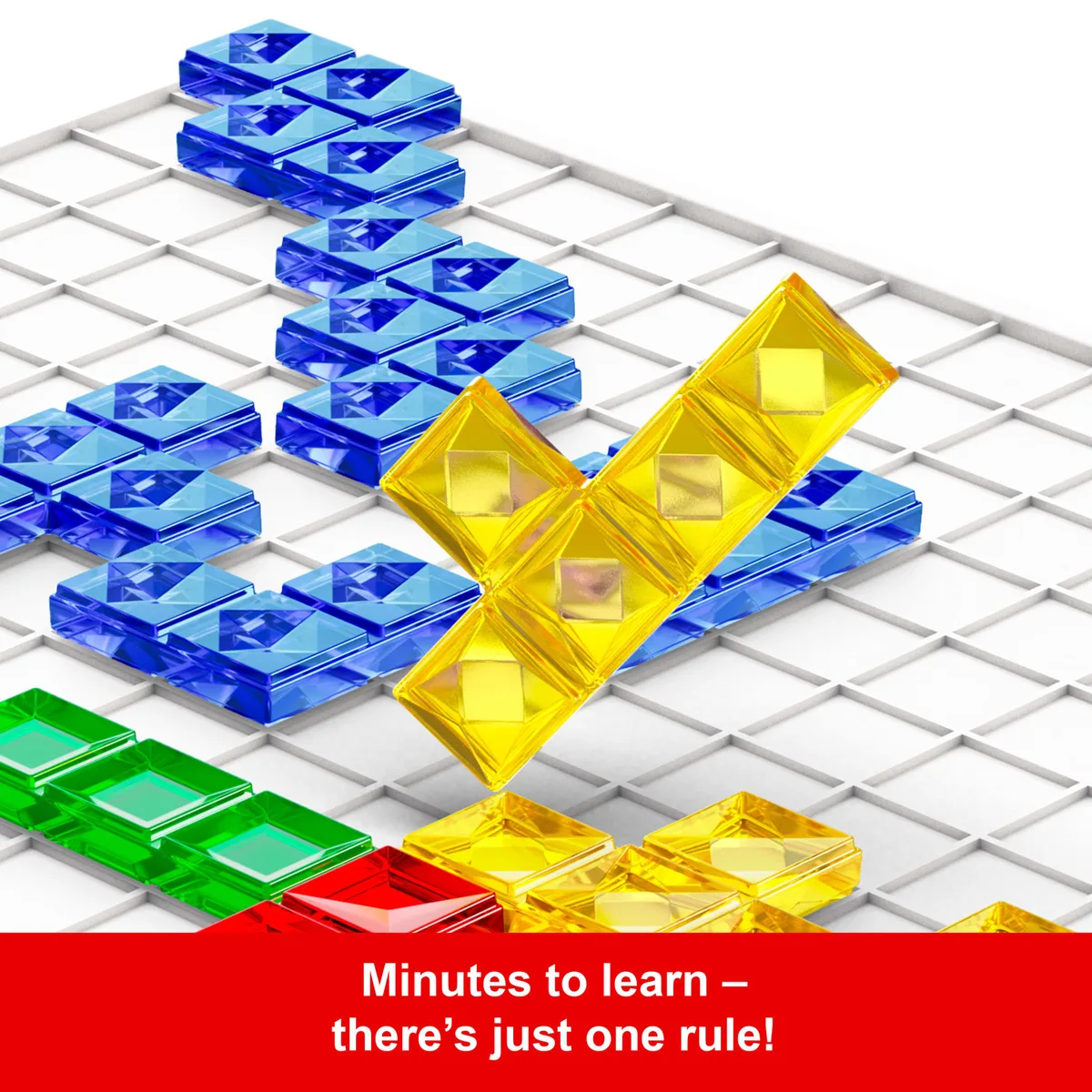
Blokus meets ASTM F963 and CPSIA safety standards. The smallest piece (the single-square monomino) is approximately 1.5 cm × 1.5 cm — small enough to present a choking hazard for children under 3. The 7+ age rating is appropriate.
All pieces are smooth plastic with no sharp edges. No CPSC recalls have been issued for Blokus.
The Verdict
Blokus is one of the best abstract strategy games ever designed for families, and at $20, it’s probably the most underpriced quality game in the market. The corner-touching rule creates emergent strategic complexity from a single, simple constraint. The spatial demands — mental rotation, spatial visualization, geometric reasoning — are genuine and aligned with the research on spatial skill development. The game scales naturally from children to adults, meaning families can play together at a level where everyone is genuinely trying.
There’s no narrative wrapper, no theme, no characters. It’s colored shapes on a grid. And it’s brilliant. The absence of narrative decoration puts all the cognitive demand on spatial and strategic thinking — there’s nowhere to hide from the geometry. A child either sees the play or they don’t, and with practice, they see more and more. This is how spatial skills develop: through repeated, motivated, enjoyable practice with spatial challenges.
Product Rating: 8/10 — Exceptional strategic depth, genuine spatial reasoning demands, elegant design, and intergenerational appeal. Docked for the absence of chance (which means stronger spatial thinkers always win, potentially discouraging weaker players) and for the 4-player-optimal design (the 2-player variant is good but loses some strategic richness).
Evidence Rating: Emerging — Spatial reasoning, mental rotation, and geometric thinking are well-supported in the developmental and cognitive literature. No Blokus-specific studies exist, but the game’s demands are a strong match for the researched skills.
Who Should Buy This
- Families with children ages 7+ looking for a genuine strategy game
- Parents who enjoy abstract strategy games and want to play with their children at full effort
- STEM-minded families looking for spatial reasoning practice that doesn’t feel like practice
- Gift-givers for 8-10-year-old birthdays — universally playable, endlessly replayable
- Teachers looking for a spatial reasoning and strategic thinking tool
Who Should Skip This
- Families with children under 7 — the spatial demands will exceed most younger children’s capability
- Children who are deeply frustrated by losing — Blokus has no luck component, so the better spatial thinker wins nearly every time (cooperative games like Outfoxed! may be better)
- Families looking for a narrative or themed game experience — Blokus is pure abstraction
- Families who only have 2 players regularly — Blokus Duo ($15) is the better purchase for 2-player households
- Anyone looking for a quick game — Blokus requires 20-30 minutes of sustained concentration
This review reflects our independent evaluation. ScienceBasedKids.com purchased this product at retail price. We may earn a commission if you purchase through our links, which helps fund our research. This never influences our ratings.
Footnotes
-
Wai, J., Lubinski, D., & Benbow, C. P. (2009). “Spatial ability for STEM domains: Aligning over 50 years of cumulative psychological knowledge solidifies its importance.” Journal of Educational Psychology, 101(4), 817-835. ↩
-
Uttal, D. H., Meadow, N. G., Tipton, E., Hand, L. L., Alden, A. R., Warren, C., & Newcombe, N. S. (2013). “The malleability of spatial skills: A meta-analysis of training studies.” Psychological Bulletin, 139(2), 352-402. ↩
-
Van Hiele, P. M. (1986). Structure and Insight: A Theory of Mathematics Education. Academic Press. ↩
-
Diamond, A. (2013). “Executive functions.” Annual Review of Psychology, 64, 135-168. ↩
Enjoyed this review? We publish two new evidence-based evaluations every week.
Free. No spam. Unsubscribe anytime.
Spatial rotation — mentally flipping and rotating pieces to find legal placements — is the dominant cognitive demand and the skill most directly exercised by repeated play.
Recommended Accessories
Affiliate links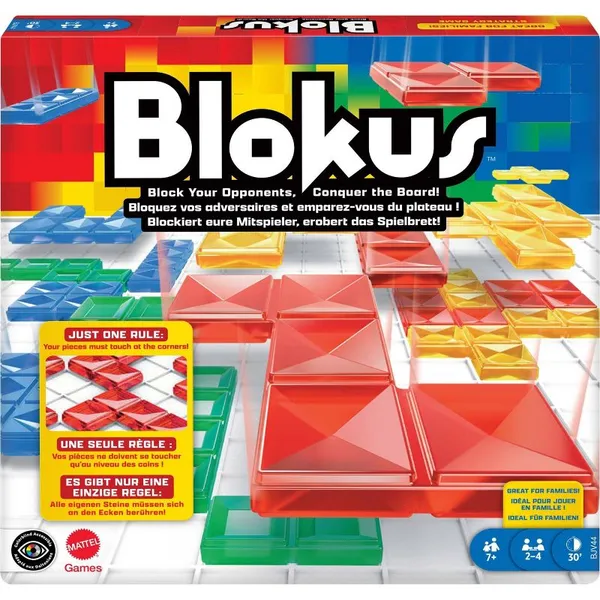
Blokus Duo 2-Player Strategy Board Game
“Compact version for travel or when only 2 players are available. Same mechanic, smaller board.”
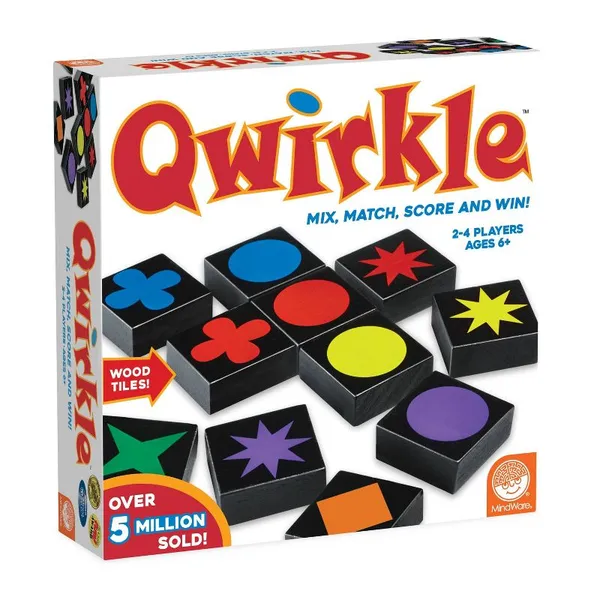
MindWare Qwirkle Board Game
“Different spatial pattern game — tile-laying vs piece-placing. 108 solid-wood tiles.”
Mattel Games Blokus Trigon Strategy Board Game
“Triangle pieces instead of squares on a hexagonal board. Different geometry, same strategic depth.”