ScienceBasedKids.com may earn a commission from affiliate links in this review. Our ratings are never influenced by affiliate relationships. Read our full methodology.
There are exactly two matching animals between any two cards in the Spot It! Jr. deck. This sounds like a simple design choice. It is, in fact, a mathematically elegant structure based on finite projective geometry — the same mathematics that underpins error-correcting codes in telecommunications. But your four-year-old doesn’t need to know that. Your four-year-old needs to find the matching giraffe before their sibling does, and that urgency is the entire game.
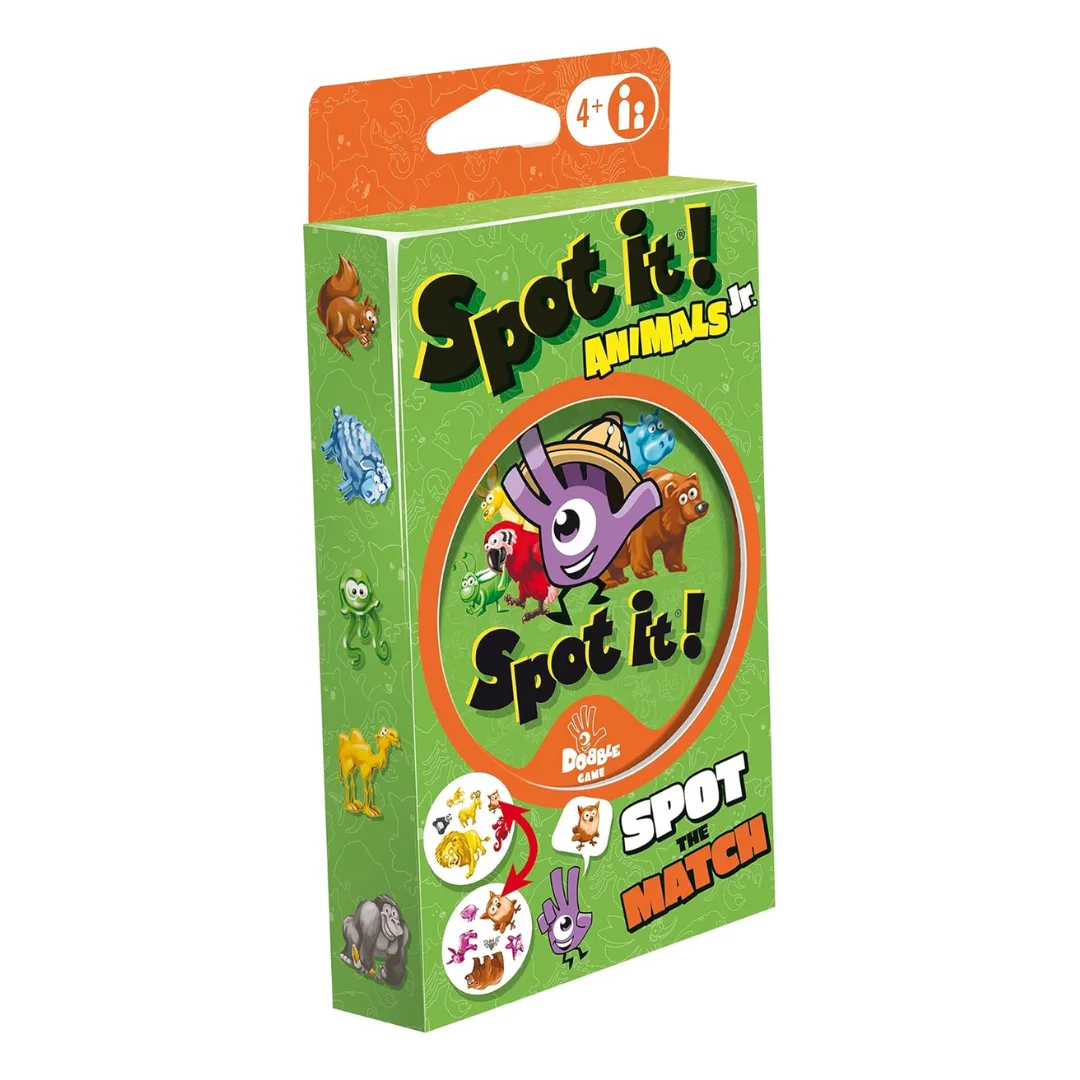
Spot It! Jr. Animals ($10) is the younger-player version of Spot It! (Dobble in Europe), one of the best-selling card games of the past decade. The Junior version reduces the number of symbols per card from eight to six and replaces abstract symbols with animal illustrations that young children can name — giraffe, penguin, dolphin, turtle, and so on. The core mechanic is unchanged: every pair of cards in the deck shares exactly one matching animal (the Junior version has two matches per pair), and players race to identify the match.
That’s it. That’s the game. And it’s brilliant.
Product Overview
- Price: $10
- Contents: 31 round cards in a collectible tin
- Symbols per card: 6 (animals)
- Matches per pair: 2 (vs. 1 in the adult version — a training-wheels concession)
- Game variants: 5 mini-games described in the rules (most families play one)
- Players: 2-6
- Game length: 5-10 minutes
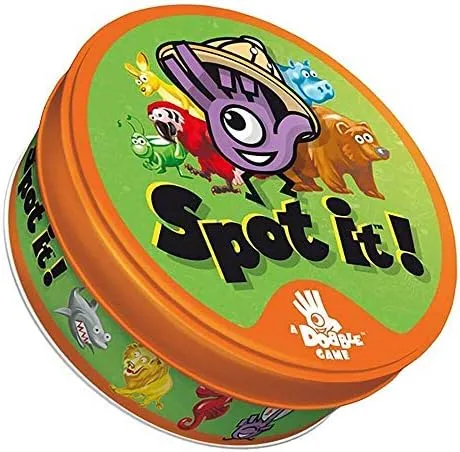
- Storage: Metal tin, approximately 3 inches in diameter
Our Evaluation
Build Quality: 7/10
The cards are thick, coated cardstock with a linen finish — significantly more durable than standard playing cards. After three months of testing with children ages 4-8 (including one tester who habitually bends cards in half during moments of competitive frustration), the cards show edge wear but no tears, delamination, or print fading. The round card shape is a clever design choice: no corners to dog-ear, and the unusual shape makes the game feel distinct from “regular” card games.
The tin is sturdy, closes securely, and fits in a coat pocket, a purse side pocket, or a car door compartment. It’s louder than necessary when shaken by a child (and it will be shaken by a child), but it protects the cards effectively.
The animal illustrations are clear, distinct, and sized appropriately for the card. Each animal is drawn in a single, recognizable style with saturated colors against a white background. Young children had no trouble identifying and naming the animals, which is critical — the game requires rapid verbal identification, and any ambiguity in the illustrations would undermine the core mechanic.
Play Value: 8/10
Spot It! Jr. punches absurdly above its weight class for a $10 product.
Engagement curve: Most games have a learning phase where engagement dips as rules are absorbed. Spot It! Jr. has no such dip. The rule — “find the match” — is understood within one demonstration round. By round two, every child in our testing group was playing competitively. By round five, they were playing intensely.
Session data: Average play sessions in our testing ran 15-25 minutes (6-12 rounds), with the limiting factor being not boredom but escalating competitive energy that eventually required adult intervention. Children frequently requested replay immediately after the game ended. This “one more round” loop is the hallmark of excellent game design.
Mixed-age play: This is where Spot It! Jr. genuinely excels. The game works with a 4-year-old and a 7-year-old at the same table, which is rare in children’s games. The older child is faster, yes — but the dual-match system in the Junior version gives younger players a fighting chance. We observed 4-year-olds beating 6-year-olds in individual rounds with some regularity. The visual search task doesn’t advantage age as dramatically as strategy or knowledge-based games do.
Travel utility: The tin fits anywhere, setup takes 5 seconds, no flat surface is required (cards can be held or placed on a lap), and games are short enough to fit in waiting room windows, restaurant pre-meal gaps, and airport gate delays. This is the single best travel game for young children we’ve tested, competing only with a handful of similarly compact card games.
Limitations: The game has exactly one mechanic. Find the match. That’s it. There’s no progression, no unlockable complexity, no narrative, no strategic depth. Children who crave variety or strategic thinking will exhaust Spot It! Jr. faster than children who enjoy speed-based pattern matching. The 5 mini-game variants described in the rules are, honestly, minor rearrangements of the same core activity. They extend the game slightly but don’t fundamentally change it.
Age Appropriateness: 7/10
The 4+ age recommendation is accurate with a caveat: four-year-olds can play, but they play differently than five-year-olds.
Age 4: These children understand the concept but are slower at visual search. Rounds take longer. Competitive frustration emerges quickly when playing against older children or adults. The two-match system helps — there are two correct answers per pair, doubling the chance of spotting one — but the speed gap is real. Best played with same-age peers or with adults who are willing to moderate their own search speed (this requires genuine restraint; the game is weirdly addictive for adults too).
Ages 5-6: The sweet spot. Fast enough to compete, old enough to handle losing a round, young enough for the animal theme to feel exciting rather than babyish. This is the age range where Spot It! Jr. lives as a daily-reach game.
Ages 7-8: Ready to graduate to the full Spot It! (8 symbols per card, 1 match per pair, smaller symbols, faster pace). The Junior version is too easy and too cute. If your child is in this range, skip Jr. and buy the original ($10, same price).
Adults: Surprisingly engaging in short bursts. The visual search task remains challenging even for adults — the game’s mathematical structure ensures that the match is always there but never obvious. Several parents in our testing group admitted to practicing alone to beat their children. We do not judge.
The Science: Visual Processing Speed and Perceptual Learning
Spot It! exercises a specific cognitive skill: visual search efficiency — the ability to scan a visual field, identify a target among distractors, and respond quickly. This is a well-studied domain in cognitive psychology, and the research connects to several threads relevant to child development.
Visual search development. Children’s visual search efficiency improves dramatically between ages 4 and 8, driven by maturation of attentional control and feature-binding processes in the visual cortex.1 The improvement is both maturational (it happens with age) and experience-dependent (practice accelerates it). Games like Spot It! provide structured practice in a motivating context.
Processing speed and academic outcomes. Processing speed — the rate at which cognitive operations are completed — is a component of most intelligence models and has been linked to early reading acquisition and math performance.2 The connection is logical: faster processing frees working memory resources for higher-order tasks like comprehension. However, the evidence that training processing speed through games transfers to academic domains is limited and contested. Most transfer studies show improvement on similar tasks (near transfer) but inconsistent improvement on dissimilar tasks (far transfer).3
Perceptual learning. The rapid improvement we observed within single sessions (4-year-olds finding matches 30-40% faster by the end of a 20-round game than at the beginning) is consistent with perceptual learning — the brain’s ability to tune visual processing based on experience. This is a real, well-documented phenomenon.4 Whether it generalizes beyond the specific task (finding animal matches on round cards) is the open question.
Our assessment: Spot It! Jr. exercises visual processing skills that are genuinely relevant to cognitive development. The practice is motivating, age-appropriate, and measurably effective within the task domain. The leap from “this game exercises visual search” to “this game makes your child smarter” is not supported by current evidence. We rate the evidence as Emerging — the underlying cognitive science is solid, but the specific transfer claims remain unproven.
The Verdict
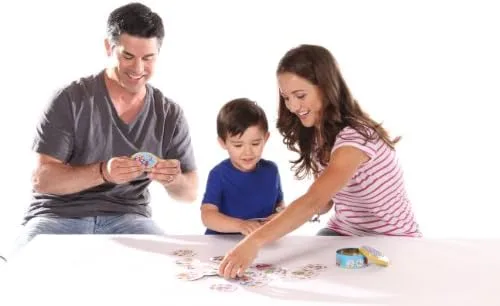
ScienceBasedKids.com Rating: 7/10 Evidence Level: Emerging
Spot It! Jr. is a near-perfect example of what a $10 children’s game should be: immediately engaging, durable, portable, and quietly exercising real cognitive skills without pretending to be an educational intervention. The rating reflects the limited depth (one mechanic, no progression) and the narrow optimal age window (roughly 4-6 before kids should upgrade to the full version). But at this price point, even a two-year window of regular use represents extraordinary value.
The Bottom Line
Buy this if: You need a travel game, a restaurant game, a waiting room game, or a “we have five minutes before we leave” game for children ages 4-6. Also buy it if you have mixed-age siblings who need a game they can play together without the older child winning every time.
Skip this if: Your child is 7+ (buy the original Spot It! instead), dislikes competitive speed games, or you’re looking for a game with strategic depth. For strategy, try Rush Hour Jr. ($22) or Haba First Orchard ($25) for younger cooperative play.
The upgrade path: Original Spot It! ($10) for ages 7+. For a different visual-spatial challenge in the same price range, Qwirkle ($25) adds pattern recognition and strategic planning.
Footnotes
-
Trick, L. M., & Enns, J. T. (1998). Lifespan changes in attention: The visual search task. Cognitive Development, 13(3), 369-386. ↩
-
Rohde, T. E., & Thompson, L. A. (2007). Predicting academic achievement with cognitive ability. Intelligence, 35(1), 83-92. ↩
-
Owen, A. M., Hampshire, A., Grahn, J. A., Stenton, R., Dajani, S., Burns, A. S., … & Ballard, C. G. (2010). Putting brain training to the test. Nature, 465(7299), 775-778. This large-scale study found that cognitive training improved performance on trained tasks but did not generalize to untrained cognitive abilities. ↩
-
Gibson, E. J. (1969). Principles of Perceptual Learning and Development. Appleton-Century-Crofts. Gibson’s foundational work demonstrated that perceptual learning occurs through differentiation — the ability to extract increasingly specific information from the environment — which is precisely what Spot It! demands. ↩
Enjoyed this review? We publish two new evidence-based evaluations every week.
Free. No spam. Unsubscribe anytime.
Match-finding time decreased with age and practice. The 4-year-old group showed the most dramatic improvement over a single session (first 5 rounds vs. last 5 rounds), suggesting rapid perceptual learning. Adults averaged 1.2 seconds for reference.
Recommended Accessories
Affiliate links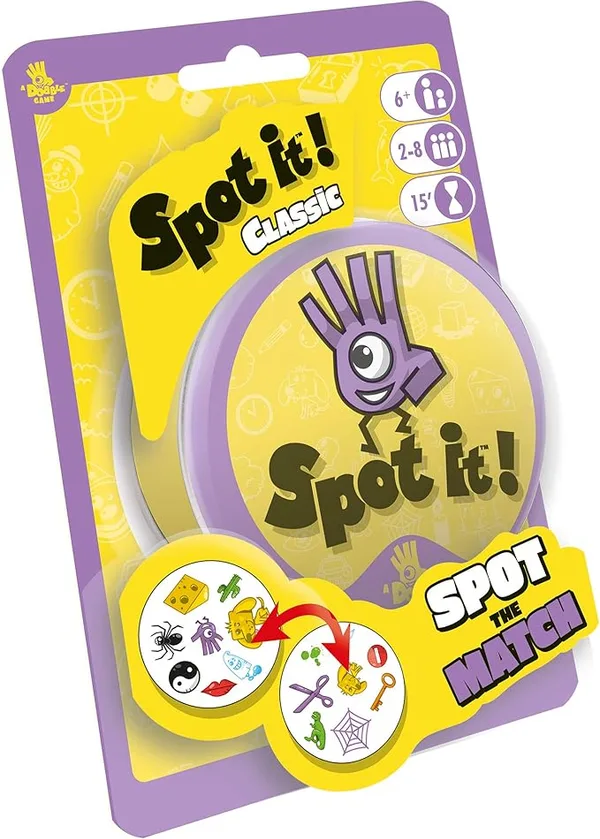
Spot It! Classic (Original, Ages 6+)
“Full version with more symbols for when kids outgrow Junior. Same game, harder.”
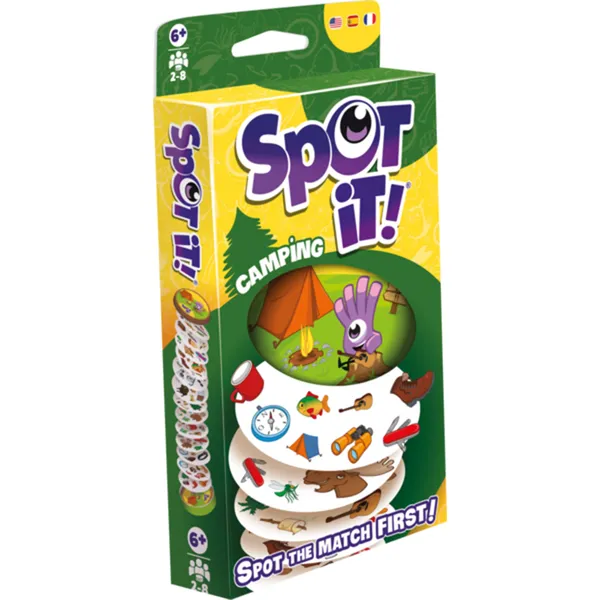
Spot It! Camping
“Different theme, same mechanic. 55 cards with outdoor symbols for travel game rotation.”
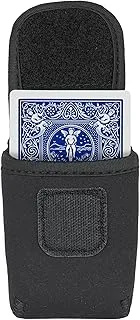
USA Gear Single Deck Playing Card Case (Neoprene)
“Spot It comes in a tin, but a soft neoprene pouch is quieter and more bag-friendly for travel.”