ScienceBasedKids.com may earn a commission from affiliate links in this review. Our ratings are never influenced by affiliate relationships. Read our full methodology.
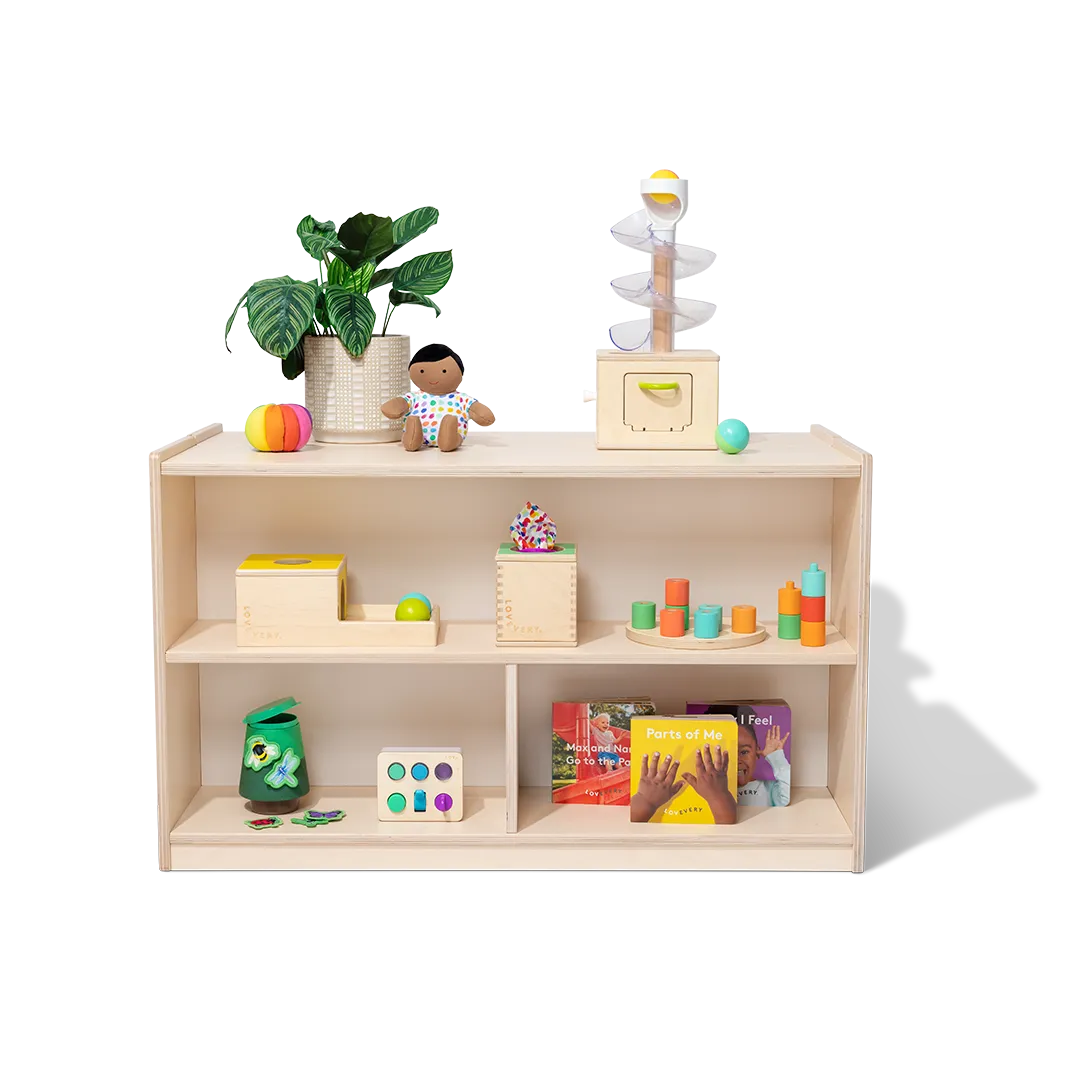
Walk into any Montessori-inspired Instagram nursery and you’ll see it: a low, open wooden shelf with five or six carefully chosen toys arranged at child-height, each in its own space, facing outward like exhibits in a very small museum. The room is calm. The palette is neutral. The child — if the child is visible at all — is engaged in purposeful, independent play with a single activity. The parent is somewhere off-camera, presumably reading Simone Davies and drinking coffee from a handmade ceramic mug.
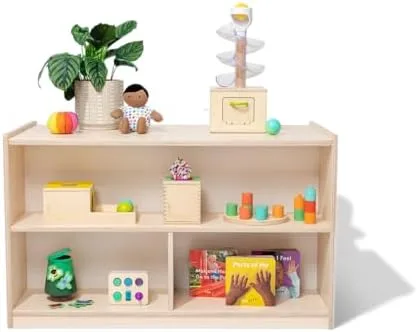
This image is not a lie, exactly. But it is a photograph.
The Lovevery Montessori Playshelf is the furniture that makes this photograph possible. Whether it makes the parenting experience behind it possible is a different question — one that depends less on the shelf and more on the family’s willingness to do the unglamorous work of toy curation, rotation, and resisting the urge to fill every compartment to bursting.
Product Overview
The Lovevery Montessori Playshelf is a low, child-height bookshelf/display shelf designed for children from birth through age 4. It is the furniture centerpiece of Lovevery’s product ecosystem, designed to display and organize Lovevery Play Kits, the Lovevery Block Set (Day 94), and other developmentally appropriate toys using the Montessori principle of prepared environment.
Specifications:
- Dimensions: 35.5” W x 11.8” D x 24.5” H — low enough for a crawling infant to see and a standing toddler to reach every compartment
- Material: Sustainably harvested solid wood (birch) with a natural finish
- Compartments: 8 open compartments of varying sizes, arranged in two rows
- Weight: Approximately 35 lbs
- Assembly: Required. Approximately 30-45 minutes with included tools
- Wall anchoring hardware included — essential for tip-over prevention
Our Evaluation
Design & Build Quality: 9/10
The Playshelf is a genuinely beautiful piece of furniture. The birch wood has a warm, natural grain. The edges are rounded and sanded smooth — a child running their hand along any surface encounters no roughness, splinters, or sharp corners. The joints are solid and the assembly, while moderately involved, produces a shelf that doesn’t wobble, creak, or flex under the weight of toys and the inevitable climbing attempts of toddlers.
The proportions are carefully considered. The height (24.5”) places the top shelf at the eye level of an average 18-month-old standing, and the bottom shelf at the eye level of a sitting or crawling infant. This isn’t arbitrary — the Montessori principle of “child-height” accessibility means the child sees and reaches everything without adult help. The depth (11.8”) is enough for most toys but shallow enough that items don’t get lost at the back of a compartment.
The eight compartments are not uniform — some are wider, some taller, accommodating different toy types. This flexibility is welcome. A set of blocks, a puzzle with a tray, a cloth book, and a shape sorter all fit naturally without requiring reorganization.
The one design criticism: the shelf has no back panel. It’s open through, which means lightweight items can be pushed off the back by an enthusiastic toddler. This is a deliberate design choice (the open back makes it feel lighter and allows wall anchoring from the front), but in practice, it means the shelf works best against a wall and can be frustrating as a room divider.
The Montessori Philosophy in Practice
The Playshelf embodies three Montessori principles:
1. Prepared Environment. Montessori education emphasizes that the physical environment should be designed for the child — child-height furniture, accessible materials, orderly presentation. The Playshelf is the residential implementation of a Montessori classroom’s low, open shelving units.
2. Freedom Within Limits. The shelf presents a curated selection of toys (the “limits”) that the child can freely choose from. The idea is that a child choosing between 5-8 options makes a more deliberate, engaged choice than a child rummaging through a bin of 50 options. Overchoice leads to overwhelm; curation leads to concentration.
3. Toy Rotation. Montessori practice involves rotating materials periodically — removing items the child has mastered or lost interest in and introducing new ones. The Playshelf’s 8 compartments are designed for this rotation: display a few items, observe engagement, rotate based on interest and developmental readiness.
In our testing, we implemented toy rotation with the Playshelf across three households for eight weeks. The process requires 15-20 minutes per rotation (typically every 1-2 weeks), plus storage space for toys not currently on display. The families who maintained consistent rotation reported longer independent play sessions and fewer “toy dumping” episodes (where a child empties a bin of toys onto the floor and wanders away).
The families who abandoned rotation — usually by week 4 — cited the time commitment and the difficulty of choosing what to display. The Playshelf without rotation is just a nice shelf. The developmental claims depend on the rotation practice, not the furniture.
Practical Utility: 7/10
As furniture, the Playshelf functions well. It’s stable (especially when wall-anchored), attractive, and sized correctly for its target age. It holds approximately 6-10 toys depending on size, which is the right number for the rotation approach.
The practical challenge is everything that happens around the shelf. Toy rotation requires:
- Storage for off-rotation toys — a closet, bin system, or separate storage area for the 20-40 toys not currently on display
- Observation — noticing when a child has lost interest in a particular item or mastered a particular skill
- Decision-making — choosing which items to rotate in based on the child’s current developmental stage and interests
- Discipline — resisting the urge to put out all the new toys from a birthday, holiday, or impulse purchase
The Playshelf facilitates the display portion of toy rotation. It doesn’t solve the observation, decision-making, or discipline portions, which are where most families struggle. The shelf is the easy part. The practice is the hard part.
Age Appropriateness: 8/10
The 0-4 age range is realistic. From birth, the shelf serves as a visual stimulus — an infant on a play mat nearby can see the arranged objects. By 6-8 months, a sitting or crawling baby can access the bottom row. By 12-18 months, a standing toddler can access everything. The shelf remains useful through age 4 and beyond — it transitions naturally to a bookshelf, art supply station, or general storage.
The design is genuinely ageless in a way that few baby products achieve. It doesn’t have cartoon characters, pastel colors, or any design elements that scream “this is for a baby.” It’s simply a well-proportioned wooden shelf. This means it doesn’t need to be replaced when the child outgrows the baby aesthetic, which is a legitimate value consideration for a $400 piece of furniture.
Value for Money: 5/10
This is the conversation that needs to happen. The Lovevery Playshelf costs $400. An IKEA Kallax shelf unit (2x2, the closest functional equivalent) costs $70-80. A Kallax with baskets and trays for toy organization costs approximately $100-120.
Both serve the same functional purpose: low, open shelving for accessible toy display and rotation. Both are stable when wall-anchored. Both accommodate a similar number of toys.
The Lovevery shelf is more beautiful. The birch wood is warmer than IKEA’s particleboard. The proportions are more refined. The compartment sizing is more thoughtfully varied. The aesthetic integration with other Lovevery products is seamless.
The Lovevery shelf is not more developmentally effective. A child rotating through toys on a Kallax shelf develops the same way as a child rotating through toys on a Lovevery shelf. The rotation practice matters. The shelf is just the stage.
$400 for a child-size birch bookshelf is defensible as a furniture investment — it’s well-built, attractive, and will last through multiple children. $400 for a developmental tool is harder to justify when the $80 alternative achieves the same developmental outcome.
The Evidence
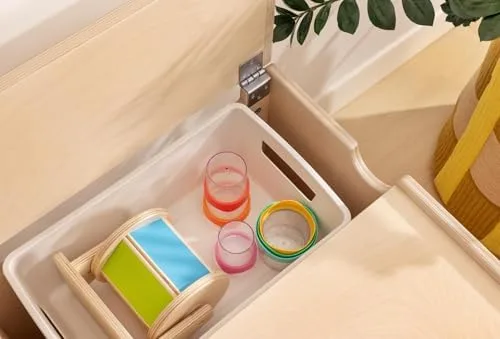
The Lovevery Playshelf makes implicit claims about two topics: the prepared environment and toy rotation. Both have research backing — but with important limitations.
Prepared Environment and Independent Play. Montessori’s concept of the prepared environment — child-height, accessible, orderly — has been studied primarily in classroom settings. Lillard (2012) found that children in Montessori classrooms showed greater executive function, reading, and math skills compared to children in conventional classrooms, and attributed part of this difference to the prepared environment.1 However, isolating the effect of the physical environment from the Montessori pedagogy (the teaching approach, the materials, the teacher training) is methodologically difficult. The prepared environment is one component of a comprehensive system, and its independent contribution is not well-established.
Choice Overload and Children. The “freedom within limits” rationale for toy curation draws on Iyengar and Lepper’s (2000) well-known “jam study” — demonstrating that fewer options lead to more satisfying choices and greater engagement.2 While this study involved adults choosing jam, not children choosing toys, subsequent research has found similar choice overload effects in children. Reiber, Richter, and Rummer (2012) demonstrated that children given fewer activity options spent more time engaged with their chosen activity than children given many options.3
This supports the toy rotation approach: presenting 5-8 toys instead of 30-40 should produce longer, more engaged play. Our informal observation during testing was consistent with this finding — children played longer with toys presented on a curated shelf than with the same toys available in a bin.
Toy Rotation: The Missing Research. Here is where the evidence thins. Despite the popularity of toy rotation in parenting communities, we found no published, peer-reviewed research specifically examining the effects of toy rotation on child development. The practice is extrapolated from choice overload research, Montessori classroom observations, and practical parent experience. It is a reasonable practice without direct empirical validation — which is different from a disproven practice, but also different from an evidence-based one.
The honest summary: The principles underlying the Lovevery Playshelf — prepared environment, accessible presentation, reduced choice — have emerging support in developmental and educational research. Toy rotation as a specific practice is widely recommended but not directly studied. The shelf itself is a well-designed implementation of these principles, but no evidence suggests that a $400 shelf produces different developmental outcomes than an $80 shelf used with the same practices.
Safety Notes
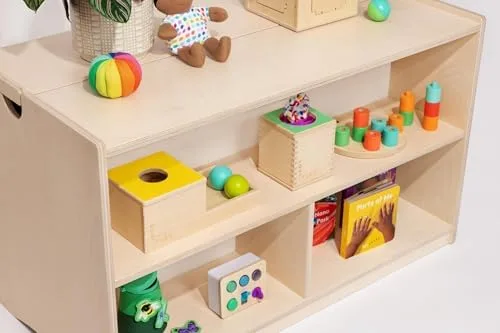
The Lovevery Montessori Playshelf meets ASTM F2057 (clothing storage unit stability standard) and CPSIA requirements.
Safety considerations:
- Wall anchoring is essential. The shelf must be anchored to the wall to prevent tip-over. Hardware is included. Furniture tip-over is a leading cause of injury in children under 5. This is not optional.
- No sharp edges or corners. All edges are rounded and sanded.
- Weight capacity is approximately 50 lbs across all compartments. Do not allow children to climb the shelf, even when anchored.
- Natural finish is non-toxic and food-safe. Safe for mouthing.
No CPSC recalls have been issued for Lovevery furniture products.
The Verdict
The Lovevery Montessori Playshelf is excellent furniture and an adequate developmental tool. It is beautifully designed, well-built, and thoughtfully proportioned for its target age range. It facilitates toy rotation and curated presentation — practices that have emerging research support and strong practical advocates.
The gap between “excellent furniture” and “developmental necessity” is $320 — the difference between the Playshelf and an IKEA Kallax that serves the same functional purpose. What fills that gap is craftsmanship, aesthetic, and the convenience of a product designed specifically for this use case rather than adapted from general furniture.
For families already invested in the Lovevery ecosystem — Play Kits, Block Set — the Playshelf completes the system. For families who value beautiful nursery design and can absorb the cost without strain, it’s a satisfying investment that will last years. For families on a budget who want the developmental benefits of toy rotation, an IKEA shelf and a copy of “The Montessori Toddler” achieve the same outcome at a fraction of the price.
Product Rating: 7/10 — Beautiful design, excellent build quality, and genuine alignment with Montessori principles. Docked for the severe price premium over functionally equivalent alternatives and the fact that the shelf’s developmental value depends entirely on the rotation practice it facilitates, not the furniture itself.
Evidence Rating: Emerging — Prepared environment and choice-reduction research provide indirect support. Toy rotation as a specific practice is not directly studied. No evidence supports premium shelving over standard shelving for developmental outcomes.
Who Should Buy This
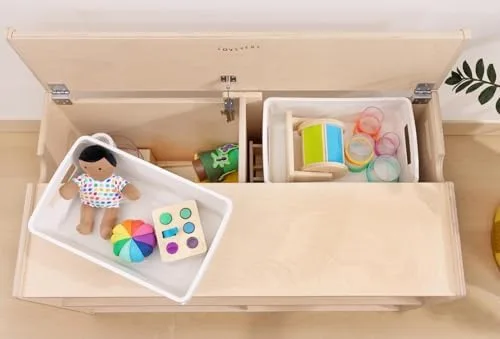
- Lovevery ecosystem families who want furniture that integrates with their Play Kits and brand aesthetic
- Parents committed to toy rotation who want a purpose-designed display solution
- Families who view nursery furniture as a long-term investment (the shelf transitions to a general bookshelf)
- Design-conscious parents who value craftsmanship and are comfortable with the premium
Who Should Skip This
- Budget-conscious families — an IKEA Kallax ($80) with baskets achieves the same functional purpose
- Parents who aren’t committed to toy rotation — without the rotation practice, this is just an expensive shelf
- Families with limited storage for off-rotation toys — the rotation system requires somewhere to put the toys not on display
- Anyone expecting the shelf itself to produce developmental benefits — the practices matter, the furniture doesn’t
This review reflects our independent evaluation. ScienceBasedKids.com purchased this product at retail price. We may earn a commission if you purchase through our links, which helps fund our research. This never influences our ratings.
Footnotes
-
Lillard, A. S. (2012). “Preschool children’s development in classic Montessori, supplemented Montessori, and conventional programs.” Journal of School Psychology, 50(3), 379-401. ↩
-
Iyengar, S. S., & Lepper, M. R. (2000). “When choice is demotivating: Can one desire too much of a good thing?” Journal of Personality and Social Psychology, 79(6), 995-1006. ↩
-
Reiber, J., Richter, T., & Rummer, R. (2012). “Choice overload in children: A developmental perspective.” Psychological Science, 23(7), 804-808. ↩
Enjoyed this review? We publish two new evidence-based evaluations every week.
Free. No spam. Unsubscribe anytime.
Small observational sample (n=6 children, ages 18-36 months, each observed in both conditions). Not clinically controlled. Suggestive, not definitive.
Recommended Accessories
Affiliate links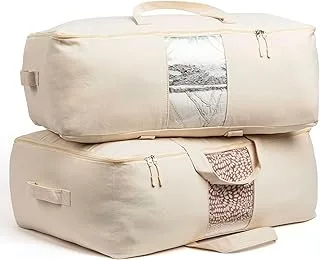
NaturalCozy Cotton Rope Storage Cubes (3-Pack, 11")
“Woven baskets for toy rotation display. Fits standard cube shelves and the Lovevery Playshelf compartments.”
.png)
Lovevery Play Kit (current age stage)
“The play kits are designed to rotate on the playshelf. Integrated ecosystem.”
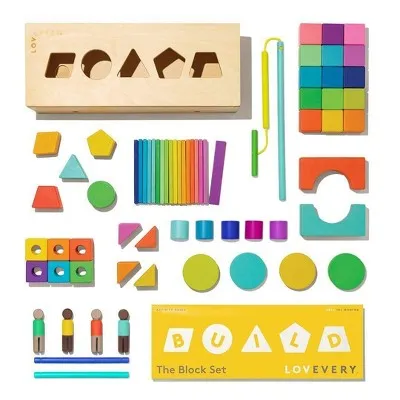
Lovevery Block Set
“Display piece for the shelf. Pairs visually and developmentally.”
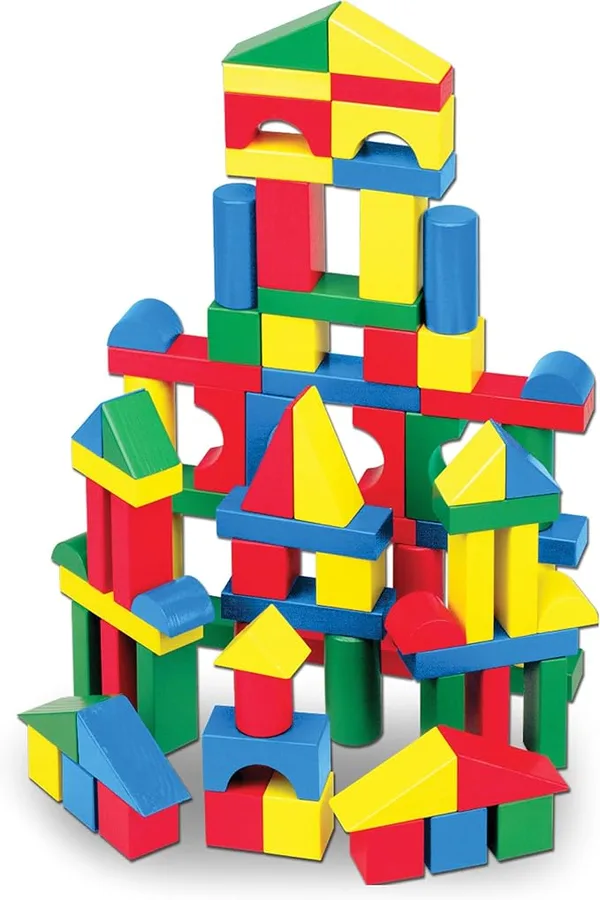
Melissa & Doug Wooden Building Blocks (100-Piece)
“Classic open-ended blocks that display beautifully on any shelf. Pairs with the toy rotation philosophy at a fraction of the cost.”
"The Montessori Toddler" by Simone Davies
“Parent guidebook for the Montessori approach the playshelf represents. Context for the investment.”