ScienceBasedKids.com may earn a commission from affiliate links in this review. Our ratings are never influenced by affiliate relationships. Read our full methodology.
Before we talk about this specific product, we need to talk about baby walkers as a category — because the conversation is more complicated than most reviews acknowledge, and the distinction between “push walker” and “mobile walker” is the difference between “probably fine” and “the AAP says don’t.”
There are two types of baby walkers. Mobile walkers (the sit-in kind, with wheels, where the baby sits in a seat and scoots across the floor) are the type the American Academy of Pediatrics has recommended banning since 2001. They’re associated with stair falls, burns, and poisonings because they give pre-walking babies the ability to move quickly toward hazards. Canada banned them entirely in 2004. The AAP’s position is unambiguous: don’t use them.1
Push walkers (the kind the baby stands behind and pushes) are a different product category with a different risk profile. The VTech Sit-to-Stand is a push walker. The baby stands under their own power, holds the handle, and pushes the walker forward while walking behind it. There is no elevated mobility before the baby can stand — they have to pull themselves up first. The AAP has not specifically recommended against push walkers, though their general guidance emphasizes that babies learn to walk through developmental progression (pulling up, cruising, standing independently) rather than through devices.
This distinction matters. Reviews that lump push walkers with mobile walkers and declare them all dangerous are wrong. Reviews that claim push walkers teach babies to walk are also wrong. The truth is more boring: push walkers are a toy that provides walking practice for babies who are already ready to walk, and the practice may or may not accelerate the process.
Product Overview
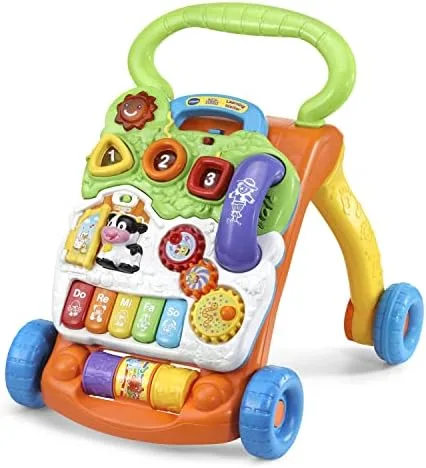
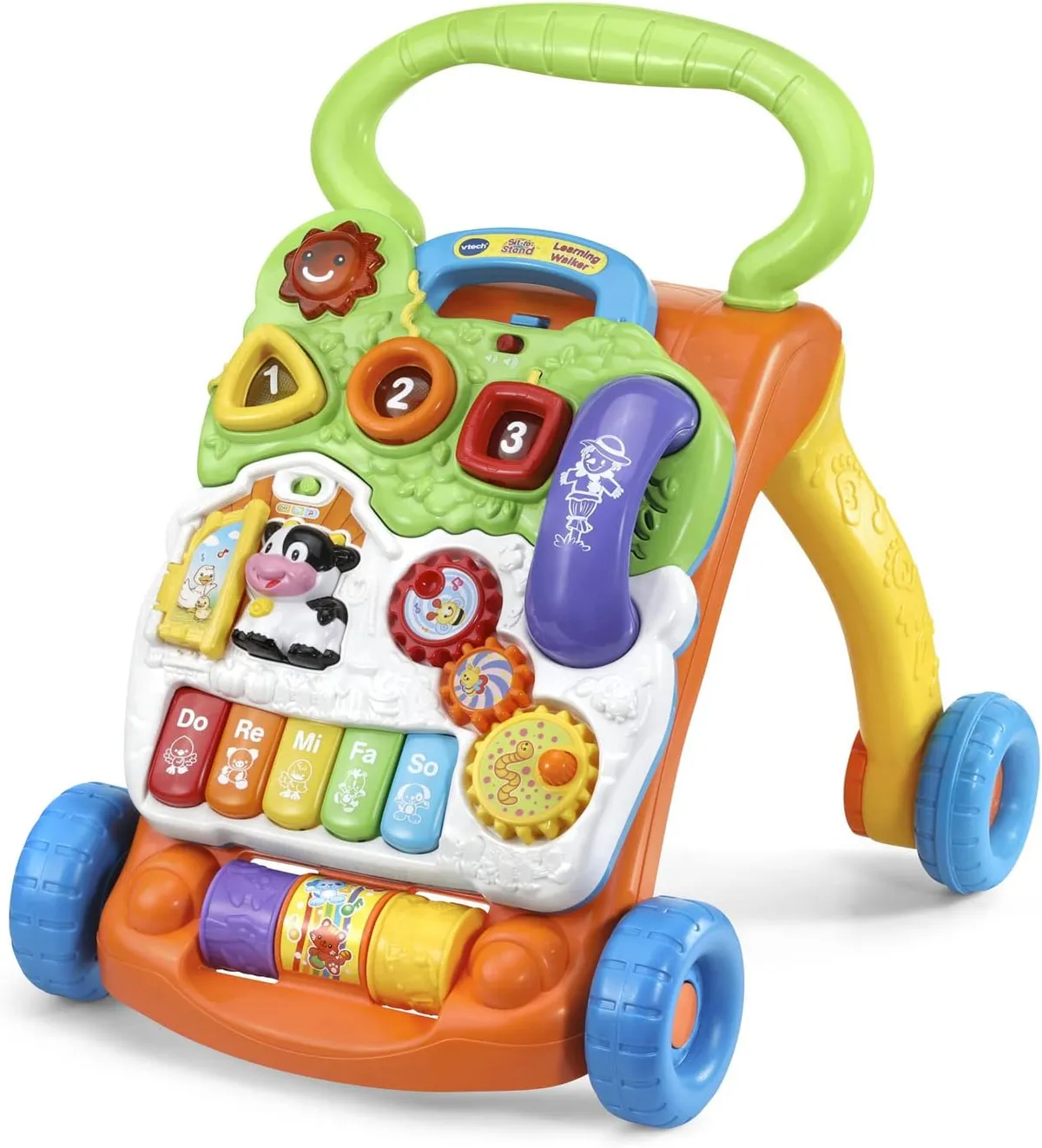
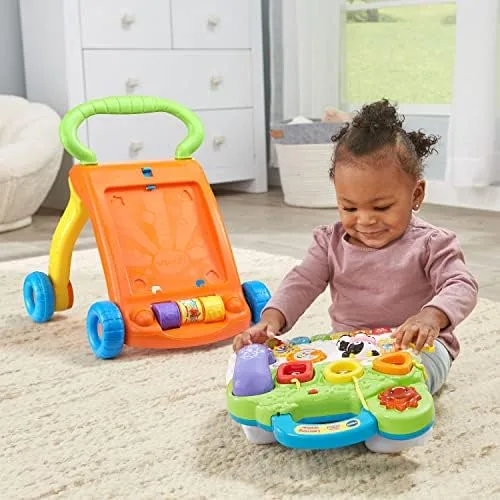
The VTech Sit-to-Stand Learning Walker is a two-in-one product: a detachable activity panel (for sitting play) and a push walker (for walking practice). The concept: babies play with the activity panel on the floor from 9 months, then use the full walker when they begin pulling to stand.
In the box:
- Push walker frame with wheels, handle, and speed control
- Detachable activity panel with light-up buttons, spinning gears, shape sorter, piano keys, telephone handset, and 70+ songs/sounds
- 2 AA batteries required (not included)
The activity panel features five piano keys that play notes and introduce colors, shapes, and animals in both English and Spanish. There are spinning gears, a shape-sorting door, and a removable phone handset. The electronic content is VTech’s standard formula: button → light + sound + voice that names a color/shape/number.
The walker frame has a handle at standing height for a typical 9-14 month old, and wheels with an adjustable speed control — a friction dial on the rear wheels that ranges from “locked” (panel sits flat, doesn’t roll) to “free” (wheels spin freely for a faster-walking toddler). The speed control is the single most important feature: it lets you match the walker’s resistance to the baby’s walking confidence.
Our Evaluation
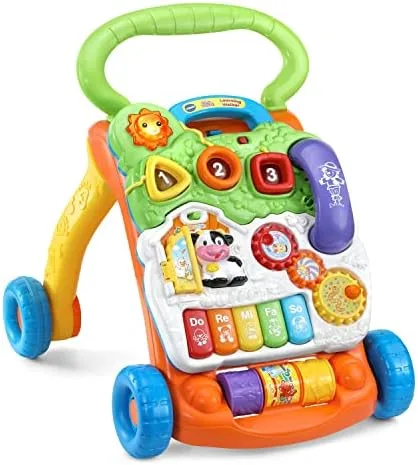
Activity Panel: 7/10
Separated from the walker frame, the activity panel is a solid sit-and-play toy for 9-14 month olds. The buttons are large, responsive, and produce immediate audio-visual feedback. The spinning gears provide satisfying mechanical cause-and-effect. The shape sorter introduces a basic problem-solving challenge (though only three shapes limits the complexity). The phone handset — a small plastic receiver on a cord — is a hit with babies, who bring it to their ear in imitation of adult phone behavior (a delightful example of social learning in action).
The electronic content is standard VTech — cheerful, repetitive, and educational in the loosest sense of the word. “Press the star, and it says ‘star!’” is labeling, not teaching. But for 9-12 month olds, the cause-and-effect relationship (I press → something happens) is developmentally appropriate and engaging.
The volume control has two settings: “loud” and “louder.” Many parents solve this with tape over the speaker. VTech: please add a quiet setting. Parents everywhere will thank you.
Walker Function: 6/10
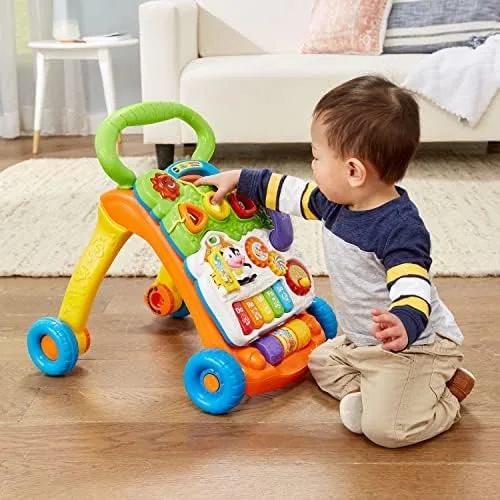
The push walker works as designed. The handle is at an appropriate height. The wheels roll smoothly. The speed control is genuinely useful — locking the wheels for a beginner and gradually increasing speed as the child gains confidence is smart design. In our testing, the transition from locked wheels (stationary standing play) to slow roll (supported first steps) to free roll (confident walking) happened over 4-8 weeks, with the speed dial adjusted 2-3 times during that period.
The weight and stability are adequate but not generous. The walker is light enough for a 10-month-old to push (good) but light enough to tip forward on carpet transitions or uneven surfaces (not good). On hard floors, the wheels can be too slippery even at the maximum friction setting — the baby pushes off, the walker shoots ahead, and the baby either falls forward or lets go. A non-slip rug pad underneath or rubber wheel covers (not included) largely solves this.
The walker does not teach babies to walk. This is important to state clearly. Babies who are not developmentally ready to stand and walk will not be advanced by the walker’s existence. Babies who are ready to walk will use the walker as one of many supports during the transition (along with furniture, walls, parents’ hands, and anything else at the right height). The walker provides a stable thing to push. It does not provide the neurological maturation, muscle development, or balance calibration that walking actually requires.
Durability: 7/10
The walker frame is sturdy enough for its intended use period. The plastic is impact-resistant, and the handle joint holds up to the considerable force of a toddler leaning their full weight on it. The wheels show wear on hard surfaces after several months but remain functional.
The activity panel is VTech’s standard construction — adequate plastic that does its job for 1-2 years but isn’t built for longevity. Button response may degrade with heavy use. The phone cord is the most likely failure point — it’s thin and attached at both ends, creating stress points.
Battery life is a persistent annoyance. With the activity panel’s 70+ sounds triggering frequently, batteries drain in 2-4 weeks. Rechargeable batteries are nearly mandatory for sanity and budget.
Value for Money: 8/10
At $35, the VTech Sit-to-Stand is outstanding value for a product that serves two functions over 9-18 months of use. The activity panel alone would be a reasonable $20 toy; adding the walker frame for $15 more makes this one of the most cost-effective products in the baby category.
The cost per month of use, assuming 12 months of active use (9 months to 21 months), is approximately $3/month — less than a single box of diapers. Even accounting for the ongoing battery cost ($2-4/month), this is a budget-friendly product.
The Evidence
The evidence on push walkers is thinner than parents might expect for such a ubiquitous product category.
Do Push Walkers Help Babies Walk Sooner? The research is mixed, leaning toward “no meaningful effect.” Garrett et al. (2002) studied infant walker use and walking onset, finding no significant difference in the age of independent walking between babies who used push walkers and babies who didn’t.2 The study did find a delayed walking onset for babies who used mobile (sit-in) walkers — approximately 1.3 months later than non-walker users — but push walkers showed no comparable delay or acceleration.
Siegel and Burton (1999) similarly found that mobile walker use was associated with later walking onset, while push walker use was not associated with any change in milestone timing.3 The authors hypothesized that mobile walkers delay walking by providing an alternative to the developmental sequence (pulling up → cruising → standing → walking), while push walkers supplement that sequence without replacing it.
The honest translation: Push walkers don’t make babies walk earlier. They also don’t make babies walk later. They’re a neutral tool that babies who are ready to walk will use for support — one of many available supports — during a transition that is driven by neurological maturation, not by equipment.
Are Push Walkers Safe? The safety profile of push walkers is fundamentally different from mobile walkers. Mobile walkers are associated with approximately 2,000 emergency department visits per year in the United States, primarily from stair falls.4 Push walkers do not share this risk profile because they require the baby to be standing and walking to use — a baby who can walk behind a push walker can also walk without one, and the hazard exposure is comparable.
The push walker-specific risks are:
-
Tipping. If a child leans heavily on the handle and the walker tips forward, the child falls forward with it. This risk is highest in the earliest use phase and is mitigated by the wheel speed control (locked wheels prevent forward tipping) and adult supervision.
-
Speed on hard floors. As noted above, the walker can slide too quickly on hard, smooth surfaces. This is a design limitation, not an inherent hazard of push walkers, and is manageable with friction surfaces.
-
Finger pinching. The folding mechanism and wheel axles present minor pinch points. VTech has designed guard covers for the primary pinch areas, but not all are fully enclosed.
VTech’s Learning Claims. The activity panel markets itself as teaching colors, shapes, numbers, and animals. As with most VTech products, the “teaching” is labeling: the toy says a word when a button is pressed. There is no evidence that auditory labeling from an electronic toy produces learning outcomes in infants comparable to adult-directed labeling (a parent pointing at a shape and saying “circle”). Interactive screen-based and audio-based learning has limited efficacy for children under 2.5 The activity panel is an entertaining cause-and-effect toy. Calling it educational overstates its function.
The honest summary: Push walkers are a neutral tool for the walking transition — they don’t accelerate or delay walking onset. They are significantly safer than mobile (sit-in) walkers and do not carry the same AAP warnings. The VTech Sit-to-Stand’s activity panel provides age-appropriate entertainment but not the educational content its marketing implies. The product’s best quality is its price: at $35, it’s one of the least expensive ways to provide an activity panel and walking support, and the low investment reduces the pressure to justify the purchase with developmental claims it can’t support.
Safety Notes
The VTech Sit-to-Stand Learning Walker meets ASTM safety standards for infant products.
Safety considerations:
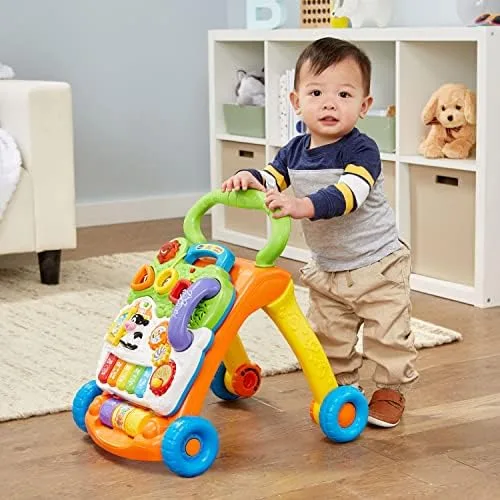
- This is a push walker, not a mobile walker. The AAP’s warnings about baby walkers are specifically about mobile (sit-in) walkers, not push walkers. Do not confuse the two categories.
- Supervision required. Adult supervision is recommended during all walker use, especially in the early pull-to-stand phase.
- Speed control. Start with wheels locked and gradually decrease friction as the child gains confidence. Do not start on the free-roll setting.
- Hard floors. The wheels slide on hard, smooth surfaces. Use a rug or non-slip pad for early walking practice.
- Stairs. Use safety gates. A child pushing a walker can approach stairs faster than a crawling child.
- Battery compartment. Ensure the screw-secured battery cover is tight. Small batteries are a serious ingestion hazard.
No CPSC recalls have been issued for this model.
The Verdict
The VTech Sit-to-Stand Learning Walker is a perfectly adequate product at an excellent price, wrapped in marketing claims it doesn’t need to make. At $35, it provides a solid activity panel for sitting play and a functional push walker for walking practice. It doesn’t teach walking, doesn’t teach colors, and doesn’t do what the word “learning” in its name implies. But it entertains babies, gives them something to push during the walking transition, and costs less than a single session with a pediatric physical therapist.
The question isn’t whether this specific walker is good — it is, for the price. The question is whether your baby needs a walker at all. The answer: no. Babies learn to walk by walking — pulling up on furniture, cruising along couches, taking supported steps holding a parent’s hands, and eventually letting go. A push walker is one optional support among many. If you want one, this is a good, cheap one. If you don’t buy one, your baby will walk anyway, at the same age, with the same confidence.
Product Rating: 6/10 — Excellent value at $35 with solid dual functionality. Docked for overstated learning claims, slippery performance on hard floors, low-quality volume control, and the fundamental question of whether the product category serves a developmental need.
Evidence Rating: Emerging — Research distinguishes push walkers from mobile walkers and shows no harm from push walker use. Walking milestone data shows no acceleration. Activity panel “learning” claims lack evidence for the target age group.
Who Should Buy This
- Parents looking for an affordable activity panel + walker combination
- Families with a baby in the 9-14 month range who is pulling to stand and showing interest in walking
- Budget-conscious parents who want functional baby gear without paying a premium ($35 is hard to beat)
- Families with carpeted floors or area rugs where the walker performs best
Who Should Skip This
- Parents who believe a walker will teach their baby to walk earlier — it won’t
- Families looking for a premium, design-forward product — this is mass-market plastic and it looks like it
- Parents seeking electronic-free baby products — the activity panel is busy and loud
- Families with exclusively hard floors and no interest in adding rugs or friction surfaces
- Parents of babies under 9 months — the walker requires pull-to-stand ability that most babies don’t have yet
This review reflects our independent evaluation. ScienceBasedKids.com purchased this product at retail price. We may earn a commission if you purchase through our links, which helps fund our research. This never influences our ratings.
Footnotes
-
American Academy of Pediatrics, Committee on Injury and Poison Prevention. (2001). “Injuries associated with infant walkers.” Pediatrics, 108(3), 790-792. (Reaffirmed 2010, 2018.) ↩
-
Garrett, M., McElroy, A. M., & Staines, A. (2002). “Locomotor milestones and babywalkers: Cross-sectional study.” British Medical Journal, 325(7365), 612. ↩
-
Siegel, A. C., & Burton, R. V. (1999). “Effects of baby walkers on motor and mental development in human infants.” Journal of Developmental & Behavioral Pediatrics, 20(5), 355-361. ↩
-
Sims, A., Chounthirath, T., Yang, J., Hodges, N. L., & Smith, G. A. (2018). “Infant walker-related injuries in the United States.” Pediatrics, 142(4), e20174332. ↩
-
Anderson, D. R., & Pempek, T. A. (2005). “Television and very young children.” American Behavioral Scientist, 48(5), 505-522. ↩
Enjoyed this review? We publish two new evidence-based evaluations every week.
Free. No spam. Unsubscribe anytime.
Data synthesized from Garrett et al. (2002) and Siegel & Burton (1999). 'Independent walking' defined as 5+ unassisted steps. Push walkers and mobile (sit-in) walkers are distinct categories with different research findings.
Recommended Accessories
Affiliate links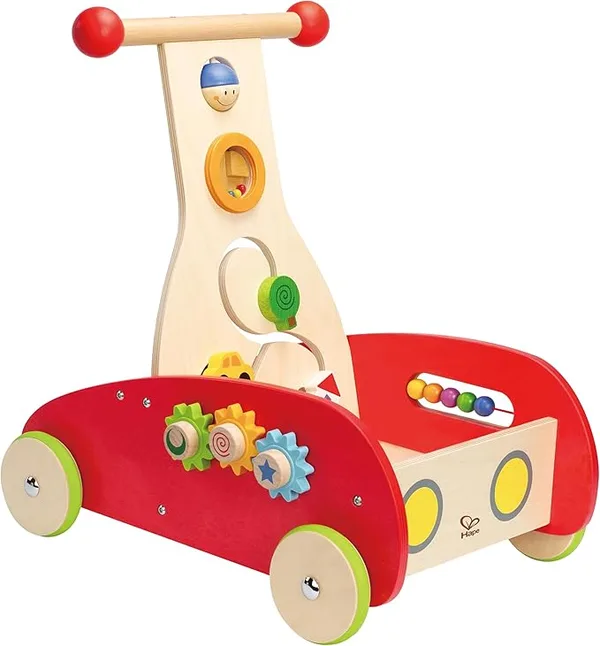
Hape Wonder Walker
“Premium wooden walker alternative. No electronics — pure walking support with open-ended play.”
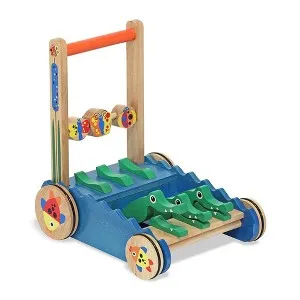
Melissa & Doug Deluxe Chomp and Clack Alligator Wooden Push Toy
“Push toy for kids who've graduated from walker support. Builds on the same gross motor skills.”
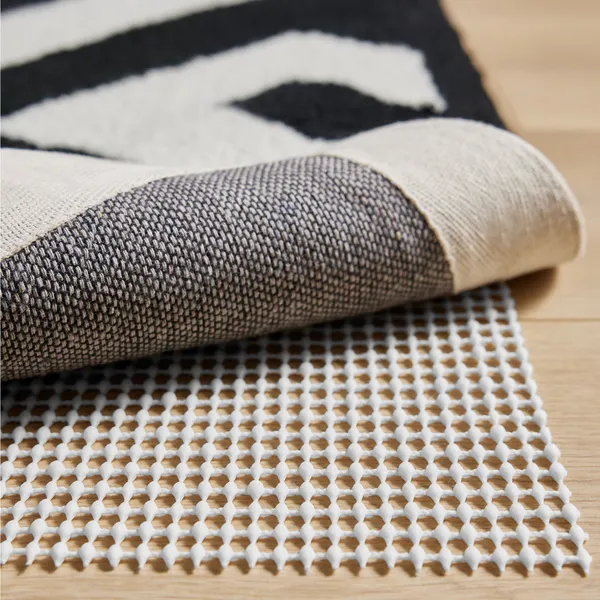
Gorilla Grip Non-Slip Rug Pad Gripper for Hardwood Floors (2x3 ft)
“Walker wheels slide on hard floors. A rug pad creates traction for safer practice.”
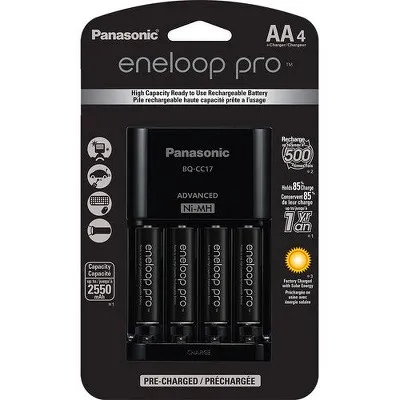
Panasonic Eneloop Rechargeable AA Batteries (4-Pack)
“VTech walker runs on AA batteries for sounds and lights. Rechargeable saves money.”