ScienceBasedKids.com may earn a commission from affiliate links in this review. Our ratings are never influenced by affiliate relationships. Read our full methodology.
Here is a confession from our testing: we watched a five-year-old who “doesn’t like reading” spend forty-five minutes voluntarily staring at words. Not a book. Not flashcards. Not a phonics app. A $22 board game with a plastic slider that goes ka-chunk. She wasn’t reading — she was winning. But the reading was happening anyway, word by word, tile by tile, in the peripheral vision of her competitive focus. That’s the trick ThinkFun pulled off with Zingo, and it’s a good one.
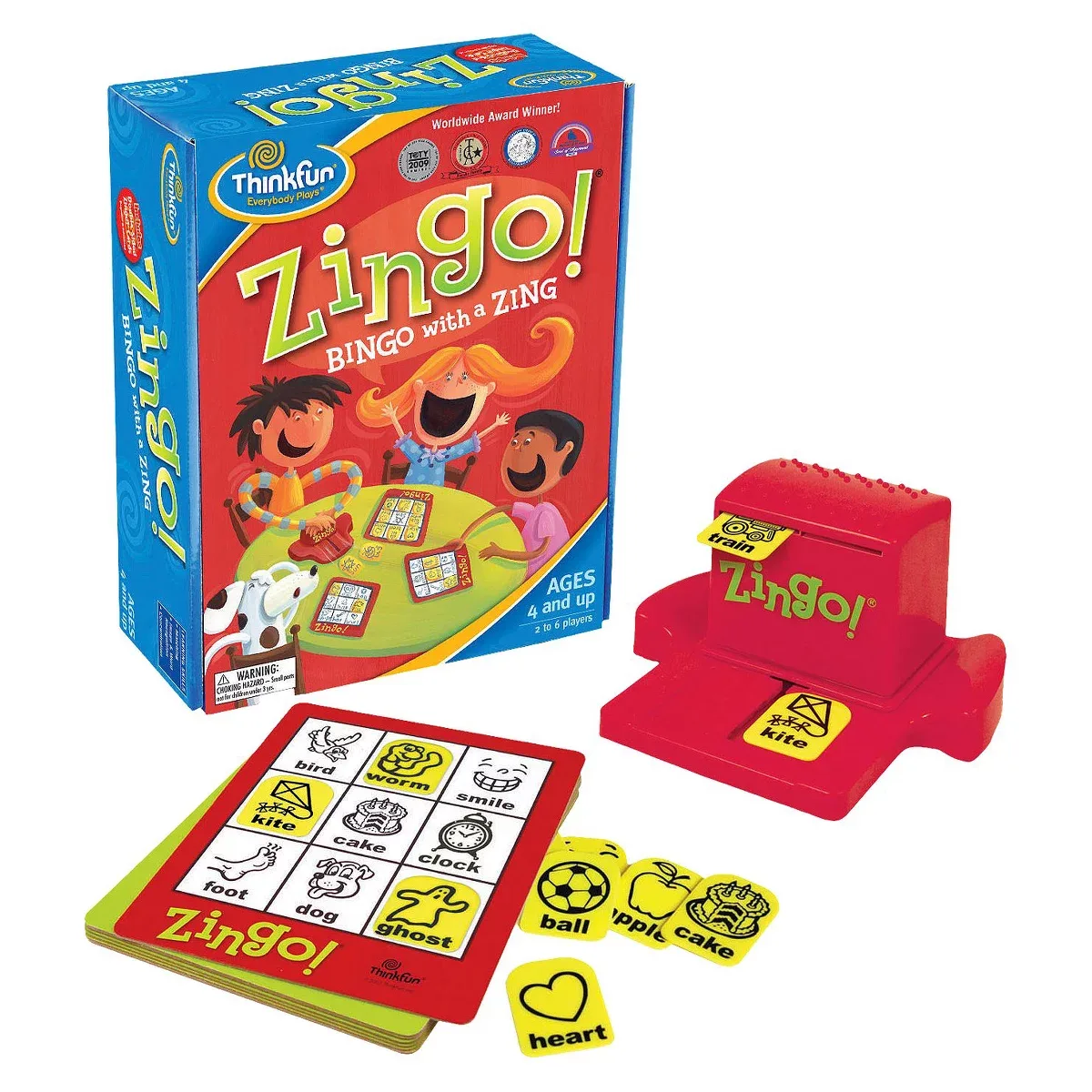
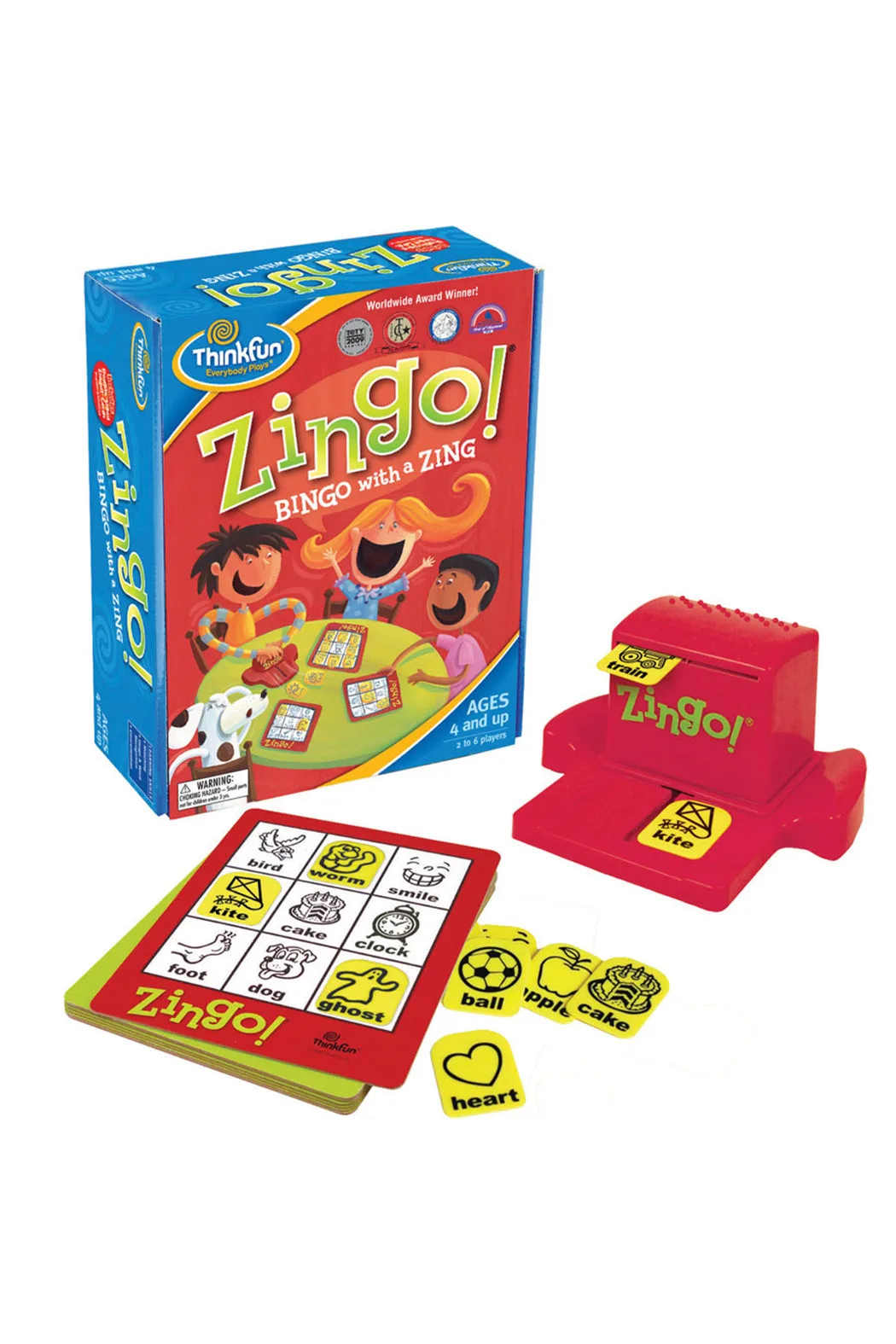
Zingo is, mechanically, bingo for small children. But calling it bingo undersells the design. ThinkFun rebuilt the game around a proprietary tile dispenser — the “Zinger” — that makes the act of revealing tiles tactile and exciting. They replaced numbers with words and images. And they calibrated the difficulty so that a four-year-old can play competitively while a seven-year-old is still challenged. The result is a game that feels fast, sounds exciting, and quietly builds the visual recognition and phonological mapping skills that sit at the foundation of reading.
Product Overview
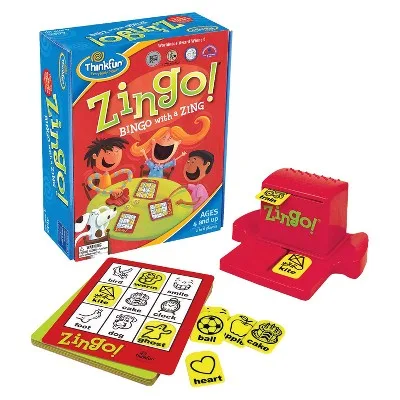
ThinkFun Zingo is a competitive matching game for 2-7 players ages 4 and up, with rounds lasting approximately 5 minutes. The premise: players race to match tiles dispensed from the Zinger to images and words on their Zingo cards. First player to fill their card wins.
In the box:
- 1 Zinger — a plastic tile dispenser with a satisfying sliding mechanism
- 72 double-sided tiles (each showing an image on one side and the same image with a word on the other)
- 7 double-sided Zingo cards (green/easy side and red/harder side)
- Rules sheet
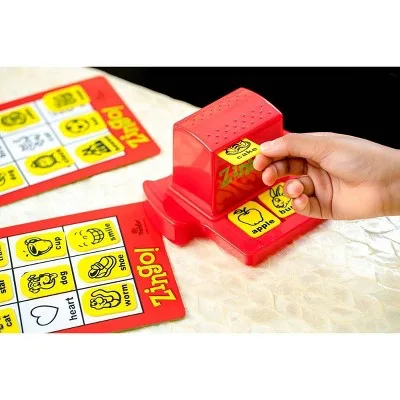
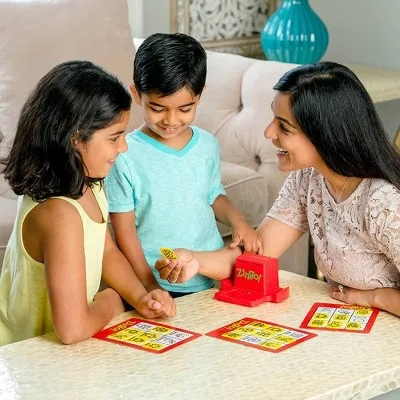
On each turn, a player slides the Zinger forward, revealing two tiles. Any player whose card has a matching image or word calls it out and claims the tile. If multiple players need the same tile, the fastest caller wins. The game inherits bingo’s simple loop — match, claim, fill — but the Zinger mechanism replaces the passive draw of bingo with an active, physical reveal that keeps every player engaged between turns.
The two-sided cards are a smart design choice. The green side uses common, easily recognizable images (star, tree, house). The red side introduces less obvious images and words, increasing the reading demand. This scaling lets the same game serve pre-readers and emerging readers simultaneously.
Our Evaluation
Build Quality: 7/10
The Zinger is the star component, and it’s well-built. The sliding mechanism has a satisfying resistance and a click that children find irresistible — several of our testers slid it back and forth during rule explanation, mesmerized by the action. The plastic is thick enough to survive drops, and after 30+ sessions of testing, ours showed no structural wear or loosening.
The tiles are thick cardboard with a glossy coating. They’re durable enough for the game’s purposes — you’re not shuffling them like playing cards — but they will show edge wear over time, especially if stored loosely. The glossy coating helps them slide in and out of the Zinger smoothly, and it resists the moisture of small, occasionally sticky fingers.
The Zingo cards are standard board game cardboard. They’re functional but unremarkable. The green/red two-sided printing is clear and the color coding is intuitive.
One minor design issue: when tiles are dispensed from the Zinger, they sometimes stick together or dispense unevenly. This happens perhaps once every three or four rounds. It’s a minor friction, not a dealbreaker, but it slightly disrupts the pace of a game that relies on pace.
Play Value: 9/10
Zingo’s gameplay loop is almost unfairly engaging. The combination of speed, competition, and the physical satisfaction of the Zinger creates the kind of excitement that makes children beg for “one more round” — and one more round takes five minutes, so parents usually say yes.
The speed element is what separates Zingo from ordinary matching games. When two tiles drop, every player scans their card simultaneously. There’s no waiting for your turn. There’s no downtime. A child who zones out for three seconds might miss a match. This constant engagement is pedagogically significant — the child is performing rapid visual scanning and word-image matching under time pressure, which strengthens processing speed and pattern recognition far more effectively than untimed practice.
The competitive element deserves nuance. Zingo is an explicitly competitive game — there is a winner, and other players are not that winner. For children who struggle with losing (a developmental reality for many four-year-olds), this can produce frustration. We observed tears in approximately 20% of sessions with four-year-olds, usually from children playing against older siblings or more experienced players. The game has no catch-up mechanism and no cooperative variant.
However — and this is important — the short round duration mitigates the sting. Losing a five-minute game is categorically different from losing a thirty-minute game. Children who were upset after one round were willing to try again immediately, and the randomness of tile distribution gives every player legitimate hope each round. “I lost” was almost always followed by “but I can win this time.”
For mixed-age groups, the two-sided cards offer some balancing. Give the green (easier) card to the younger child and the red (harder) card to the older one. It’s not perfect — the older child still has faster processing speed — but it narrows the gap.
Age Appropriateness: 8/10
The 4-8 age range is accurate but benefits from clarification. At four, a child can play Zingo on the green side by matching images. They don’t need to read the words — the pictures are sufficient. This makes the game accessible to pre-readers while exposing them to the word-image pairings incidentally. A four-year-old playing Zingo for the tenth time will start noticing the words beneath the images, even if nobody asks them to.
At five and six, the game becomes a natural bridge to reading. Children start recognizing whole words by sight — “STAR” is no longer a sequence of letters but a single visual unit that maps to the star image they’ve been matching for months. The red-side cards increase the challenge by introducing less iconic images and longer words.
At seven and eight, the game begins to lose its challenge for strong readers. The vocabulary is simple enough that fast readers will spot matches before the tiles have fully emerged from the Zinger. At this point, Zingo Sight Words (the expansion) is the better option, or the child has naturally graduated to more complex word games.
The sweet spot is ages 4-6, where the game sits perfectly at the intersection of accessible gameplay and productive challenge.
Durability: 6/10
The Zinger mechanism is robust — it’s the component most likely to survive years of use. The tiles, however, are vulnerable. At 72 tiles, losing even a few reduces the game’s playability. The tiles are small (about 1.5” square) and light, meaning they scatter when dropped and hide easily under furniture, between couch cushions, and inside heating vents. Every parent who has owned Zingo has a story about the Great Tile Search.
A dedicated storage solution is not optional — it’s essential. The box insert holds the tiles loosely, and dumping the box on the floor (which will happen) scatters them across the room. A small zip bag or container ($8) is the most valuable accessory you can buy for this game. We recommend it more strongly than any expansion.
The Zingo cards will survive moderate use. The tiles’ glossy coating delays but doesn’t prevent eventual edge wear. After approximately 50 rounds, our tiles were showing visible wear on the most-handled pieces.
Value for Money: 9/10
At $22, Zingo delivers exceptional value. The per-round cost is negligible (5 minutes of play, 50+ rounds in a typical ownership lifespan = pennies per session). The stealth-literacy value — pre-reading skill practice disguised as competition — adds a layer of return on investment that pure entertainment games can’t match.
For comparison: a set of flashcards costs $8-12, delivers comparable reading-skill repetition, and generates approximately zero excitement per session. Zingo costs $10 more and generates enthusiasm so reliable that children request it. The engagement differential is the value proposition — you’re not paying for superior pedagogy, you’re paying for a child’s willingness to do the pedagogy voluntarily.
The Evidence
Zingo’s developmental value centers on pre-reading skills: visual word recognition, phonological awareness, and the word-image mapping that forms the foundation of early literacy. The research here is substantial.
Visual Word Recognition and the Logographic Stage. Before children decode words phonetically (sounding out letters), they pass through what Ehri (1995) called the “pre-alphabetic” or “logographic” stage — recognizing words as whole visual patterns, like recognizing a face.1 A child in this stage doesn’t read “STAR” by sounding out S-T-A-R; they recognize the visual shape of the word and associate it with meaning. Zingo exercises exactly this skill. Through repeated exposure to word-image pairings on tiles and cards, children build a visual vocabulary of whole-word patterns. The speed mechanic accelerates this: under time pressure, the brain defaults to pattern recognition rather than analytical decoding, which is precisely the logographic skill being strengthened.
Phonological Awareness Through Incidental Exposure. Phonological awareness — the ability to recognize and manipulate the sounds within words — is the single strongest predictor of early reading success.2 The National Reading Panel (2000) identified phonological awareness training as one of the most effective interventions for pre-readers.3 Zingo provides phonological awareness practice through an indirect mechanism: when children call out matching words (“TREE!” “KITE!”), they’re producing the phonological form of the word in a context where the visual form is simultaneously present. This multimodal encoding — seeing the word, seeing the image, and saying the word aloud — creates stronger memory traces than any single modality alone.
Importantly, Zingo doesn’t teach phonological awareness explicitly. It creates conditions where phonological processing occurs naturally. A child shouting “FLOWER!” while slamming a tile onto their card is practicing word production, segmental awareness (the word has distinct sounds), and semantic retrieval (the word means this picture) — all at the speed of play, without the self-consciousness that accompanies formal instruction.
Rapid Automatized Naming and Processing Speed. Zingo’s speed mechanic connects to research on rapid automatized naming (RAN) — the ability to quickly name visual symbols. RAN speed is a reliable predictor of later reading fluency.4 Norton and Wolf (2012) demonstrated that children who name visual symbols quickly tend to become more fluent readers, independent of other cognitive abilities.5 Zingo effectively functions as a RAN training game: children practice rapidly identifying visual symbols (images and words) and producing their names under competitive time pressure. The game doesn’t just passively expose children to words — it requires the fast retrieval that RAN research identifies as critical.
Game-Based Learning and Motivation. The value of Zingo’s game format shouldn’t be dismissed as merely making learning “fun.” Tobias and Fletcher (2011) reviewed the evidence for game-based learning and found that games increase time-on-task, engagement, and willingness to retry after failure — factors that directly impact learning outcomes.6 A child who plays Zingo for 45 minutes (as our tester did) has performed hundreds of word-image matching trials with sustained attention and high motivation. The same child presented with flashcards for 45 minutes would likely disengage within 10.
The honest summary: Zingo’s pre-literacy value is real and grounded in well-established reading research. The game exercises visual word recognition, provides incidental phonological awareness practice, and trains rapid naming speed — three pillars of early reading development. It does this through a game mechanic that generates genuine excitement rather than compliance. The evidence doesn’t suggest Zingo will teach your child to read; it suggests Zingo builds the foundational pattern-recognition and word-awareness skills that make formal reading instruction more effective when it arrives.
Safety Notes
Zingo meets ASTM F963 and CPSIA safety standards. The tiles are small — approximately 1.5” square — and present a choking hazard for children under 3. The 4+ age rating is appropriate and should be respected. If younger siblings are present during play, tile access should be monitored.
The Zinger mechanism has no sharp edges and no pinch points. The sliding action requires moderate force that doesn’t trap small fingers.
No CPSC recalls have been issued for ThinkFun Zingo.
The Verdict
ThinkFun Zingo accomplishes something that most “educational” games fail at: it is genuinely exciting and educational, and neither quality comes at the expense of the other. The competitive matching mechanic generates real engagement — the kind where children lean forward, eyes wide, hands ready. And inside that engagement, the game is quietly building the word-recognition and phonological mapping skills that reading researchers have identified as foundational.
The Zinger device deserves credit here. It transforms the mundane act of drawing tiles into a physical event that captures and holds attention. It’s a small design choice with outsized impact on play experience.
The game isn’t perfect. The competitive structure will produce tears in some four-year-olds. The tiles scatter and disappear with distressing efficiency. The components are good but not great. But for $22, you get a game that your child will request repeatedly, and that builds pre-reading skills every single time they play — without either of you having to acknowledge that learning is happening.
Product Rating: 8/10 — Excellent game design, genuine stealth-literacy value, and reliable engagement. Docked for tile-loss vulnerability and the competitive structure’s potential to frustrate younger players.
Evidence Rating: Moderate — Pre-literacy skill development through visual word recognition and phonological awareness is well-supported by reading research. The specific mechanism (game-based rapid matching) aligns with established findings on rapid automatized naming and multimodal encoding.
Who Should Buy This
- Families with children ages 4-6 who want pre-reading practice without flashcard resistance
- Parents looking for a fast, replayable game that fills 5-minute windows
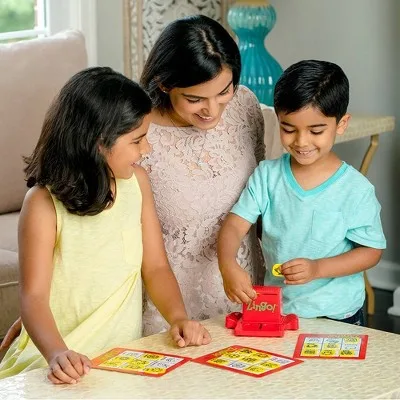
- Families with mixed-age children (the two-sided cards offer some leveling)
- Teachers and speech-language pathologists looking for engaging word-recognition practice
- Gift-givers — at $22, Zingo is one of the best-value educational games available
Who Should Skip This
- Families with children under 4 — the tiles are a choking hazard and the competitive mechanic requires emotional regulation skills still developing
- Children who are already fluent readers — the vocabulary will be too simple (try Zingo Sight Words instead)
- Families strongly opposed to competitive games — there is no cooperative mode, and someone will lose
- Households with very deep carpet or very many couch cushions — the tiles will find hiding places you didn’t know existed
This review reflects our independent evaluation. ScienceBasedKids.com purchased this product at retail price. We may earn a commission if you purchase through our links, which helps fund our research. This never influences our ratings.
Footnotes
-
Ehri, L. C. (1995). “Phases of development in learning to read words by sight.” Journal of Research in Reading, 18(2), 116-125. ↩
-
Wagner, R. K., & Torgesen, J. K. (1987). “The nature of phonological processing and its causal role in the acquisition of reading skills.” Psychological Bulletin, 101(2), 192-212. ↩
-
National Reading Panel. (2000). Teaching children to read: An evidence-based assessment of the scientific research literature on reading and its implications for reading instruction. National Institute of Child Health and Human Development. ↩
-
Denckla, M. B., & Rudel, R. G. (1976). “Rapid ‘automatized’ naming (R.A.N.): Dyslexia differentiated from other learning disabilities.” Neuropsychologia, 14(4), 471-479. ↩
-
Norton, E. S., & Wolf, M. (2012). “Rapid automatized naming (RAN) and reading fluency: Implications for understanding and treatment of reading disabilities.” Annual Review of Psychology, 63, 427-452. ↩
-
Tobias, S., & Fletcher, J. D. (Eds.). (2011). Computer Games and Instruction. Information Age Publishing. ↩
Enjoyed this review? We publish two new evidence-based evaluations every week.
Free. No spam. Unsubscribe anytime.
A single round of Zingo engages more pre-literacy skill repetitions than 10 minutes of typical flashcard practice, with zero resistance from the child.
Recommended Accessories
Affiliate links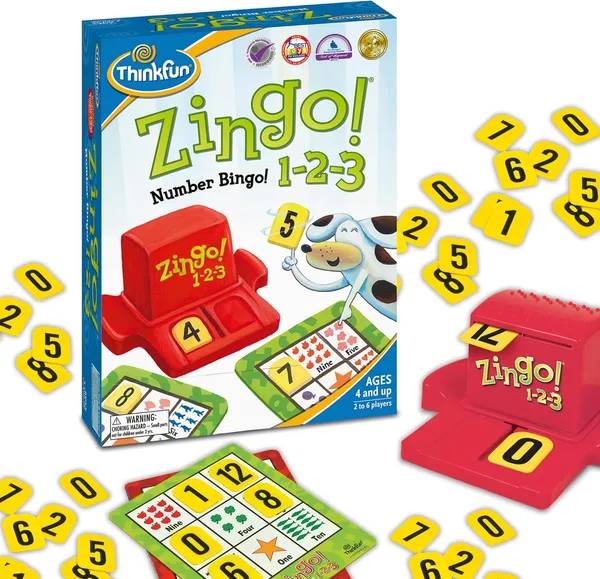
ThinkFun Zingo 1-2-3 (Number Version)
“Same satisfying Zinger mechanic but with numbers instead of words. Math skills variant that extends the Zingo system.”
ThinkFun Zingo Sight Words
“Sight word version for emerging readers. Directly extends the phonological awareness practice into actual reading.”
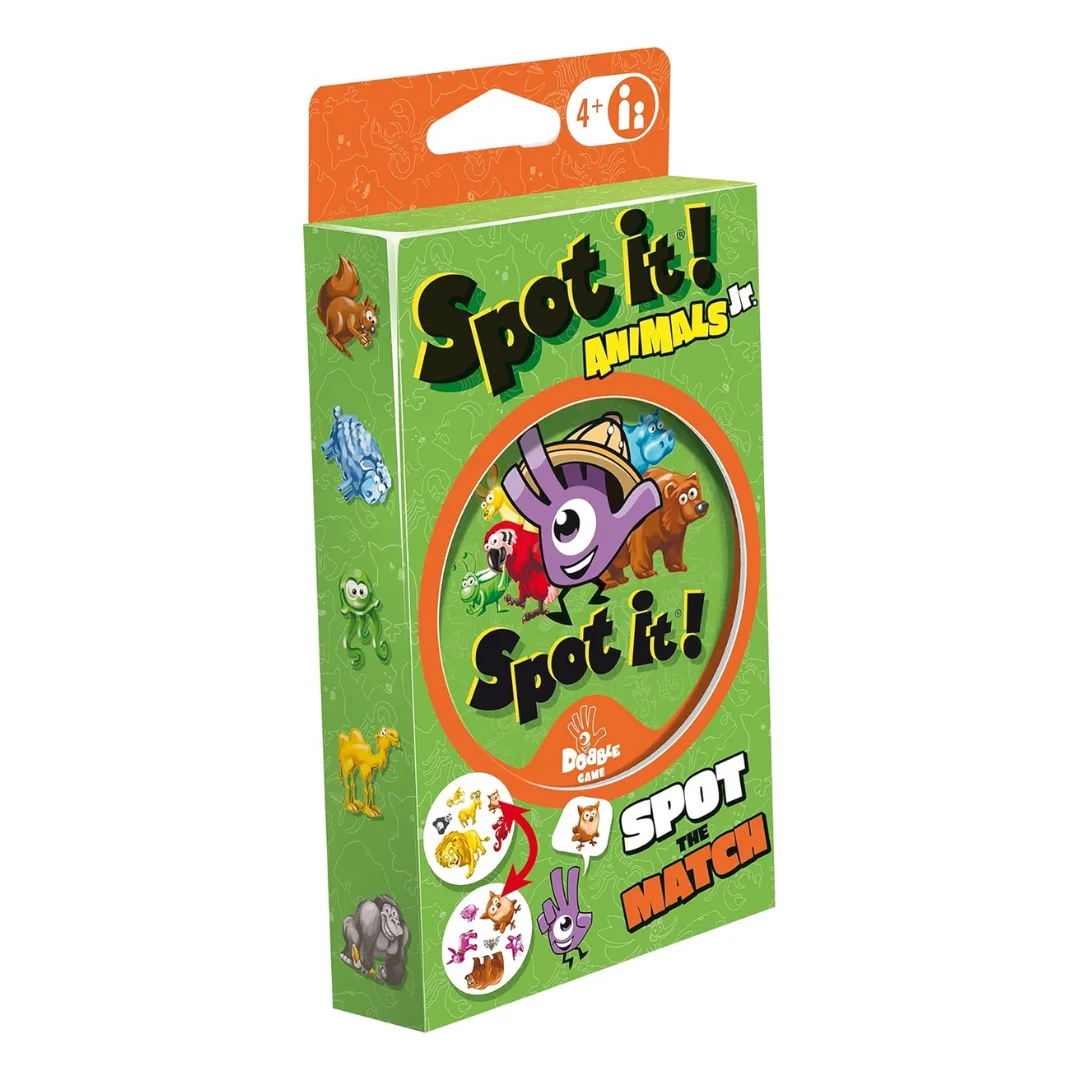
Spot It! Jr. Animals
“Different visual perception game with faster gameplay. Portable for travel, exercises similar pattern-matching skills.”
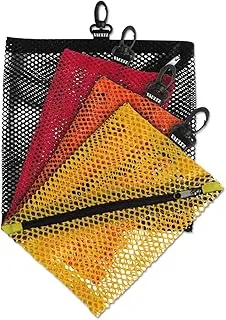
Vaultz Mesh Storage Bags with Zipper (4-Pack)
“Zingo tiles are tiny and love to scatter under furniture. Zip bags prevent the slow attrition of lost pieces.”