ScienceBasedKids.com may earn a commission from affiliate links in this review. Our ratings are never influenced by affiliate relationships. Read our full methodology.
The card goes around the table face-down in a hand of eight. Your nine-year-old holds her cards close, eyes scanning. She has two sashimi already — a third would score ten points, the biggest single-card payoff in the game. But there are only three rounds left, and if she doesn’t get the third sashimi, those two cards score zero. Zero. She could take the safe play: a dumpling (one point now, more if she collects more later) or a pudding (no points now, but puddings are scored at the end of the entire game, and she’s behind on puddings). She takes the sashimi. The hand passes. When the cards come back around, the third sashimi isn’t there. Someone else took it — maybe knowing she needed it, maybe not. Two wasted cards. She groans, then immediately starts calculating her recovery strategy. This entire decision — probability assessment, risk tolerance, opponent modeling, contingency planning — happened in about eight seconds. This is Sushi Go!, and it costs twelve dollars.
Product Overview
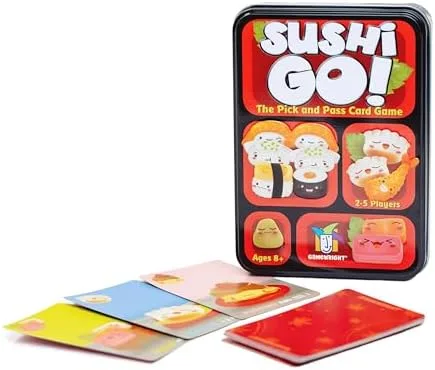
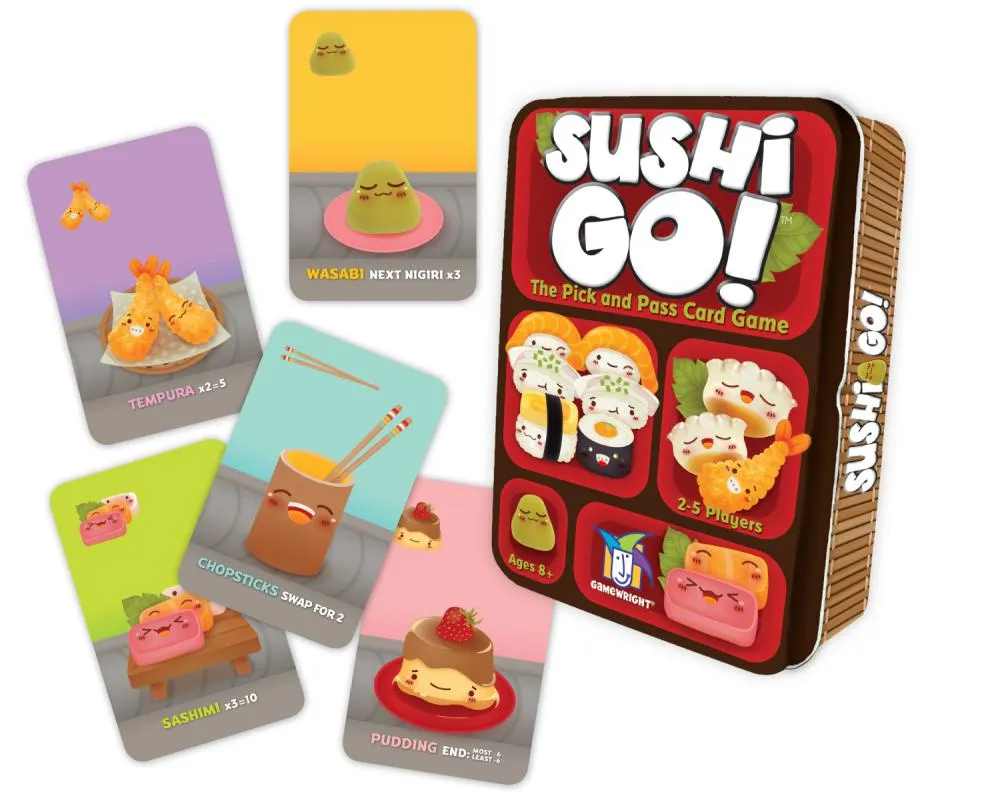
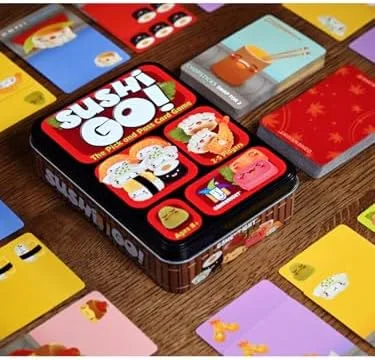
Sushi Go! is a card drafting game for 2-5 players ages 8 and up, designed by Phil Walker-Harding and published by Gamewright. Games last approximately 15 minutes. The premise is simple and delightful: you’re dining at a sushi restaurant, trying to grab the best combination of dishes as they pass by on the conveyor belt.
In the tin:
- 108 playing cards featuring adorable sushi-themed illustrations
- Rules sheet
- That’s it — the simplicity is the point
The core mechanic is card drafting: each player starts with a hand of cards, chooses one to keep face-down, then passes the remaining hand to the next player. Everyone reveals simultaneously. Repeat until all cards are played. Score the round. Play three rounds. Highest total score wins.
The card types create the strategic depth:
- Nigiri (1-3 points each) — safe, predictable scoring
- Wasabi (triples the next nigiri placed on it) — high-risk, high-reward
- Tempura (5 points per pair, zero for a single) — all-or-nothing set collection
- Sashimi (10 points per set of three, zero otherwise) — even riskier set collection
- Dumplings (1-3-6-10-15 points for 1-2-3-4-5 collected) — escalating returns
- Maki rolls (most maki icons wins 6 points, second-most gets 3) — competitive area majority
- Pudding (most puddings at game end gets 6 points, fewest loses 6) — long-term planning across all three rounds
- Chopsticks (lets you take two cards on a future turn) — delayed gratification and timing
Our Evaluation
Build Quality: 7/10
The cards are standard playing-card stock — adequate but not premium. After fifty-plus games, our test copies show visible wear on the corners and edges, particularly on frequently handled cards like the maki rolls and puddings. Card sleeves are a wise investment if this becomes a regular rotation game (it will become a regular rotation game).
The tin is charming and functional. It’s small enough to toss in a purse or backpack, sturdy enough to survive a diaper bag, and distinctive enough that children identify it instantly. The tin closure is snug without being difficult for children to open.
The card art — by Nan Rangsima and Phil Walker-Harding — deserves specific praise. Every sushi piece has a tiny, expressive face. The dumplings look progressively more crowded and anxious as you collect more. The wasabi looks eager. This anthropomorphic food art is doing real work: it makes the cards feel like characters rather than game components, and children respond to that distinction. Our testers named their favorites. Nobody names a poker card.
Play Value: 9/10
Sushi Go! achieves something rare: a game that a parent can explain in three minutes, an eight-year-old can play competently on the first game, and a family can play fifty times without it feeling stale. The depth emerges not from complex rules but from the interaction between simple rules — the same quality that makes Go and poker enduringly replayable.
The card drafting mechanic is the engine. Every card you take is a card you don’t pass to your neighbor. This creates a constant tension between what you want and what you’re willing to give. Do you take the third sashimi for yourself (10 points) or deny the maki roll to the player beside you (potentially costing them 6 points)? This kind of dual-perspective thinking — evaluating options by their benefit to you AND their cost to opponents — is sophisticated strategic reasoning disguised as picking cartoon sushi.
The three-round structure adds a meta-layer. Puddings persist across rounds, creating long-term investment decisions. A player who ignores puddings in rounds one and two may face a devastating six-point penalty at game end. A player who over-invests in puddings sacrifices immediate scoring. This temporal trade-off — now versus later — is the essence of planning.
Game length is perfect. Fifteen minutes means a frustrated loser can agree to “one more game” without committing to a significant time investment. We regularly played four or five consecutive games in a sitting, which means Sushi Go! delivers 60-75 minutes of engaged strategic play before anyone suggests doing something else.
Age Appropriateness: 8/10
The 8+ age rating is accurate. At eight, children can understand the scoring system, make informed card choices, and engage with the basic strategy of set collection. The adorable art makes the game appealing to younger children, and a six or seven-year-old can technically play — but they’ll be choosing cards based on which sushi looks cutest rather than which scores best.
The strategic sweet spot is 9-12, where children begin modeling opponent behavior (“my sister needs tempura, so I should take it even though I don’t want it”) and tracking cards through the passing rounds (“there were three sashimi in the original hand, I’ve seen two, so the third might still be coming”). This card-counting-lite behavior emerges naturally from gameplay and represents genuine probability reasoning.
Adults find Sushi Go! genuinely enjoyable, not merely tolerable. This is unusual for children’s games and significantly increases the game’s practical play value — a game that parents actually want to play gets played far more often than one they merely endure.
Durability: 6/10
Cards wear out. This is the inescapable reality of a card game that involves constant shuffling and handling. The tin protects cards during storage but can’t prevent in-game wear. Budget $5 for card sleeves and consider it part of the purchase price.
The tin itself is durable. The rules sheet is a single folded page that will eventually get coffee-stained or lost, but the rules are simple enough to remember after one read.
Value for Money: 10/10
At $12, Sushi Go! offers the best entertainment-per-dollar ratio of any game in our review portfolio. Fifteen minutes per game, infinitely replayable, genuinely enjoyable for ages 8 through adult, portable enough for travel, and strategic enough to sustain interest across months or years of play. The only games that compete at this price point are standard playing cards, and Sushi Go! is substantially easier to learn and more visually engaging for children.
The upgrade path to Sushi Go Party! ($22) provides additional value for families who exhaust the base game — more card types, more players (up to 8), and customizable menus that add replayability.
The Evidence
Sushi Go!‘s cognitive demands align with several areas of developmental research, though direct studies of card drafting games specifically are limited.
Probability and Statistical Reasoning. Fischbein (1975) established that children’s intuitive understanding of probability develops through concrete experiences with random events — not through abstract instruction.1 Card drafting provides exactly this kind of concrete probability experience. A child who tracks which cards have appeared, which are likely still in circulation, and which might come back around the table is engaging in informal probabilistic reasoning. Over many games, this develops into intuitive understanding of concepts like expected value and conditional probability — the mathematical foundations that formal education will later build on.
Set Collection and Pattern Recognition. The scoring system in Sushi Go! is fundamentally about recognizing and pursuing patterns: pairs of tempura, sets of three sashimi, escalating runs of dumplings. Clements and Sarama (2009) identified pattern recognition as a foundational mathematical skill that develops through repeated practice with varied patterns.2 The multiple scoring categories in Sushi Go! provide this variety naturally — each card type presents a different pattern with different risk-reward characteristics.
Theory of Mind and Opponent Modeling. Effective Sushi Go! play requires understanding that other players have different goals and different information. A child who recognizes that the player to their left needs tempura to complete a pair — and takes the tempura to prevent it — is exercising theory of mind in a strategic context. This is the same cognitive skill that underlies social navigation: understanding that other people have different desires, knowledge, and intentions than you do.3
Working Memory Under Time Pressure. Card drafting creates a natural time constraint — the rest of the table is waiting. This time pressure amplifies the working memory demands of tracking your collection, evaluating incoming cards, and modeling opponents. Diamond (2013) identified working memory as a core executive function that improves with practice in engaging, motivating contexts.4 Sushi Go! provides exactly such a context.
The honest limitation: There are no published studies specifically examining the learning outcomes of card drafting games with children. The cognitive demands we describe are inferred from the game mechanics and aligned with the broader developmental literature. This inference is reasonable but not empirical validation. We rate the evidence as “Emerging” because the cognitive alignment is strong but direct evidence is limited.
Safety Notes
Sushi Go! contains no small parts, sharp edges, or choking hazards. The cards are standard playing-card material with no coating that could peel off. The tin has smooth, rolled edges.
The game is safe for all ages to handle, though the strategic content is designed for ages 8+.
No CPSC recalls have been issued for Sushi Go!.
The Verdict
Sushi Go! is the kind of game that makes you wonder why you ever spent $40 on a board game. For twelve dollars, you get a card drafting mechanic that creates genuine strategic depth, adorable art that children connect with emotionally, game length that respects everyone’s attention span, portability that means it goes everywhere, and replayability that sustains interest across years. The card drafting mechanic — a concept borrowed from serious strategy games like 7 Wonders — is elegantly simplified without being simplified away. Children are making real strategic decisions: evaluating probability, managing risk, modeling opponents, and planning across multiple time horizons.
Product Rating: 8/10 — Exceptional strategic depth for the price, delightful art, perfect game length, and a mechanic that makes probability reasoning feel like fun. Docked only for card durability that doesn’t match the game’s longevity.
Evidence Rating: Emerging — The cognitive demands of card drafting align well with probability reasoning, working memory, and theory of mind research. Direct studies of card drafting games with children are lacking, but the mechanism-to-research alignment is strong.
Who Should Buy This
- Families looking for a travel game that isn’t boring
- Parents who want a strategy game their eight-year-old and their teenager can both enjoy
- Budget-conscious gift-givers ($12 buys genuine quality)
- Families transitioning from cooperative games to competitive games — the rounds are short enough that losing stings briefly
- Teachers looking for a probability and strategic thinking tool
- Anyone who has twenty minutes and wants to have fun
Who Should Skip This
- Families with children under 7 — the strategic layer will be invisible to them (try First Orchard or Hoot Owl Hoot instead)
- Children who struggle with losing — Sushi Go! has a winner every 15 minutes, which means frequent opportunities for frustration
- Families who prefer cooperative play — see Outfoxed! for a cooperative alternative
- Anyone looking for a long, immersive game experience — Sushi Go! is a sprinter, not a marathon runner
This review reflects our independent evaluation. ScienceBasedKids.com purchased this product at retail price. We may earn a commission if you purchase through our links, which helps fund our research. This never influences our ratings.
Footnotes
-
Fischbein, E. (1975). The Intuitive Sources of Probabilistic Thinking in Children. D. Reidel Publishing Company. ↩
-
Clements, D. H., & Sarama, J. (2009). Learning and Teaching Early Math: The Learning Trajectories Approach. Routledge. ↩
-
Wellman, H. M., Cross, D., & Watson, J. (2001). “Meta-analysis of theory-of-mind development: The truth about false belief.” Child Development, 72(3), 655-684. ↩
-
Diamond, A. (2013). “Executive functions.” Annual Review of Psychology, 64, 135-168. ↩
Enjoyed this review? We publish two new evidence-based evaluations every week.
Free. No spam. Unsubscribe anytime.
The simultaneous card pass creates time pressure that amplifies these demands — decisions must be made quickly, not leisurely.
Recommended Accessories
Affiliate links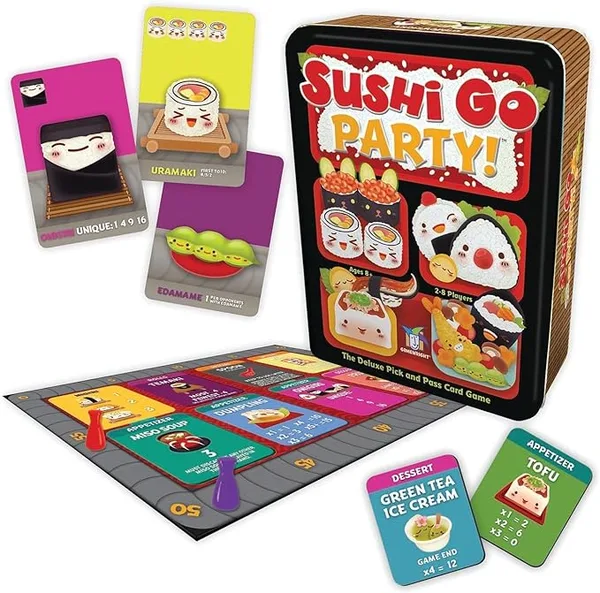
Sushi Go Party! (Expanded Edition)
“Supports up to 8 players with a customizable menu. The step-up when families master the original.”
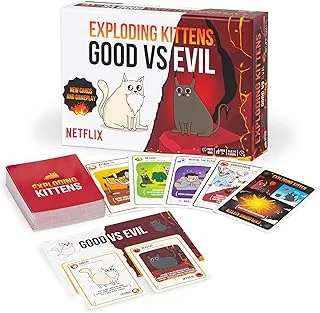
Exploding Kittens: Good vs Evil
“Different card game mechanic at the same age level. Risk assessment vs card drafting.”
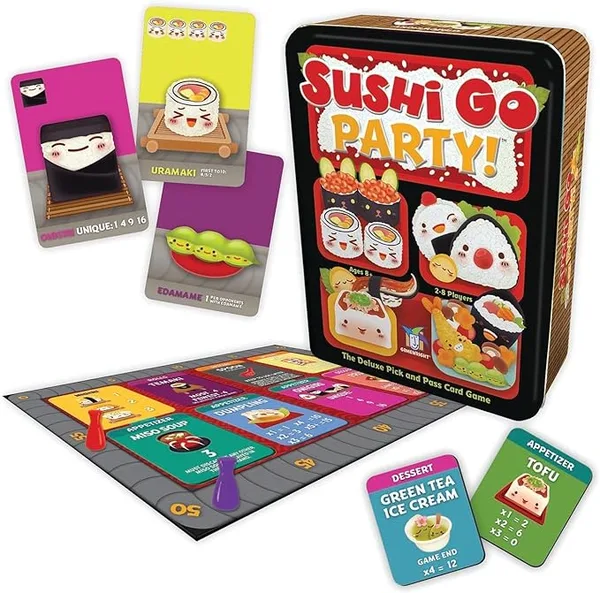
Sushi Go Party! Card Game
“The deluxe version adds 22 new menu items, supports up to 8 players, and includes a game board for scoring.”
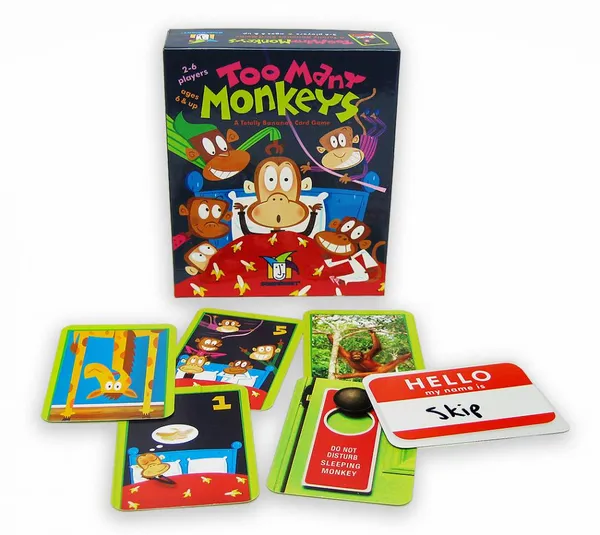
Gamewright Too Many Monkeys
“Same publisher, simpler card game. Good bridge for younger siblings who want to join game night.”