ScienceBasedKids.com may earn a commission from affiliate links in this review. Our ratings are never influenced by affiliate relationships. Read our full methodology.
Within four minutes of filling the Step2 Rain Showers Splash Pond, our eighteen-month-old test subject had water in her hair, both shoes, and — through a mechanism we still can’t explain — the back pocket of a parent standing three feet away. She was, by every observable measure, having the best afternoon of her life.
Water tables occupy a peculiar position in the toy landscape. No parent has ever described one as “educational.” No marketing team has tried to claim that pouring water from a cup into a spinning wheel develops executive function. A water table is honest in a way that most children’s products are not: it’s a tub of water at kid height, with some stuff to pour and splash, and that’s it. The question isn’t whether it’s developmental. The question is whether it’s worth sixty dollars and a permanently wet patio.
Product Overview
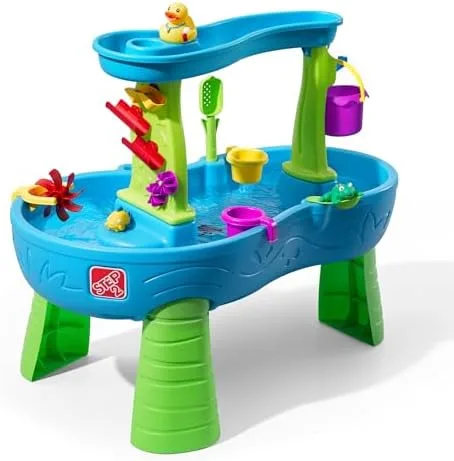
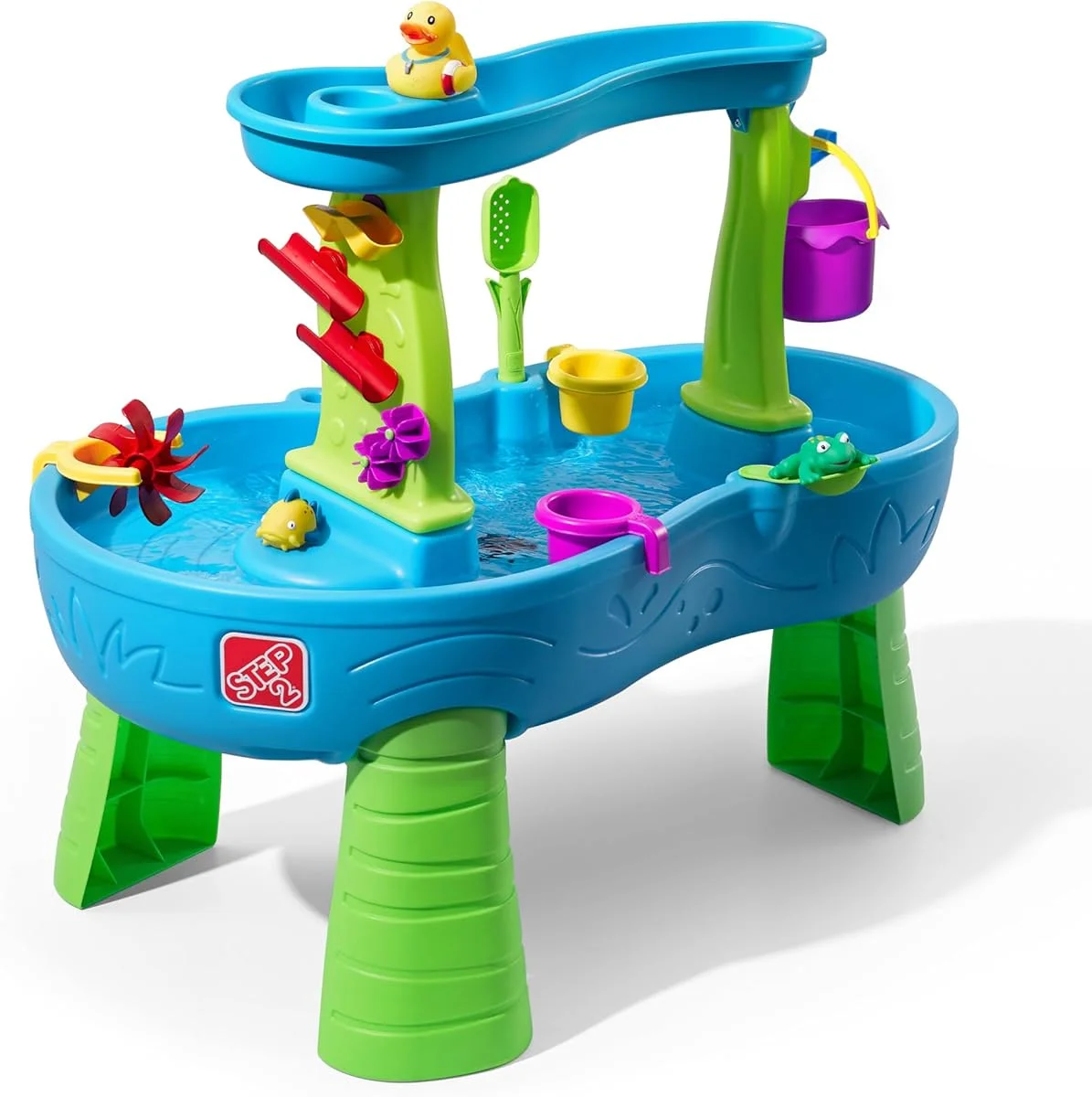
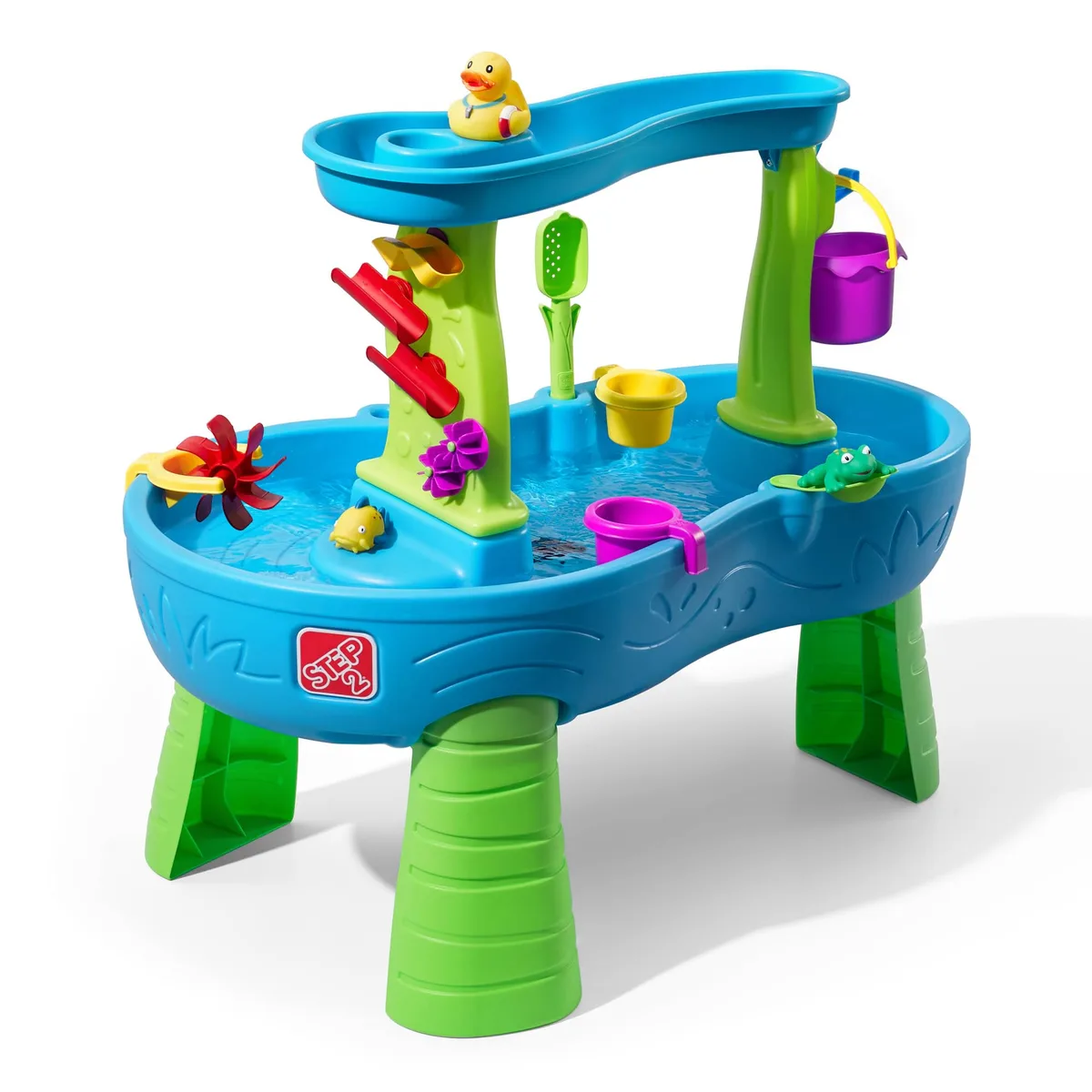
The Step2 Rain Showers Splash Pond Water Table is a two-tier plastic water play station that stands approximately 34 inches tall (at the top tier) and 27 inches at the main basin level. It features:
- A large lower basin (roughly 30” × 20”) for primary water play
- An elevated upper tier with a “rain shower” feature — pour water into the top and it trickles down through channels and spinning wheels into the basin below
- A removable center tower with spinning cups and ramps
- 13 included accessories: boats, cups, water spinners, and a “fishing” net
- A drain plug in the lower basin for cleanup
The table accommodates 2-4 children comfortably around its perimeter. It holds approximately 5 gallons of water in the lower basin. The height is designed for toddlers 18 months and up — a two-year-old can reach the upper tier comfortably; a standing adult will develop lower back pain within ten minutes. This is by design. It’s their table, not yours.
Step2 is an American manufacturer based in Streetsboro, Ohio, that has been making children’s outdoor products since 1991. They make a range of water tables; the Rain Showers Splash Pond is their bestseller and sits in the middle of their lineup ($40 for basic models up to $100+ for elaborate multi-station designs).
At $60 retail (prices fluctuate seasonally — expect $50-75 depending on timing), the Splash Pond represents a moderate investment for a seasonal outdoor toy.
Our Evaluation
Build Quality: 7/10
Step2 products are made from rotational-molded polyethylene — the same dense, thick plastic used in Little Tikes toys, playground equipment, and those indestructible storage containers in your garage. The material is UV-resistant, weather-tolerant, and strong enough to survive being climbed on by children who fundamentally misunderstand what a water table is for.
The Splash Pond’s construction is solid. The walls are thick, the seams are clean, and the whole unit feels stable when filled with water. We left our test unit outdoors for the entire testing period (four weeks, including rain, sun, and one hailstorm) with no visible material degradation. Parent reports confirm that Step2 water tables generally survive multiple seasons outdoors, though extended sun exposure will eventually fade the colors.
The accessories are less impressive. The included boats and cups are thin-walled plastic that feels cheap compared to the table itself. The spinning wheel mechanisms work but aren’t engineered for precision — they spin freely when new but accumulate grit and slow down with use. A rinse restores them. The drain plug is functional but slightly loose on our unit, requiring attention to ensure it’s seated before filling.
Assembly takes about 15 minutes and requires only a Phillips screwdriver. The instructions are adequate. The legs snap in with a satisfying permanence that suggests they will never come out again, which is both reassuring and slightly alarming.
Play Value: 9/10
Here is what we did not expect: sustained engagement. A water table looks like a five-minute toy — pour water, splash, done. In practice, children in our testing group played at the Splash Pond for 30-60 minutes per session. One pair of three-year-olds played for 90 minutes on a warm afternoon. Ninety minutes of uninterrupted, self-directed, largely conflict-free play from two three-year-olds. If you are a parent of three-year-olds, you understand the magnitude of this statement.
The play patterns we observed were remarkably varied:
Pouring and transferring — the foundational activity. Every child, at every age, spent time moving water from one container to another. This is repetitive, absorbing, and apparently infinitely satisfying. A cup of water poured from a height of eight inches is, to an eighteen-month-old, a perpetual motion machine of delight.
Cause-and-effect exploration — the rain shower feature, where water poured into the upper tier cascades down through channels and spinning cups, held particular fascination. Children would pour, watch, adjust their pour speed, watch again, pour into a different channel, compare results. This is rudimentary experimental thinking, and it happened without any adult scaffolding.
Cooperative play — the table’s perimeter design accommodates multiple children, and we observed natural turn-taking and sharing that the same children didn’t demonstrate with other toys. Something about the abundance of water (everyone can have as much as they want) and the design of the table (multiple stations, multiple access points) reduces resource conflict. This was a consistent observation across testing sessions.
Imaginative play — from age 3 up, the boats became characters, the table became an ocean, and elaborate narratives emerged. One four-year-old ran a “boat hospital” where injured vessels were brought to the upper tier for “surgery” (having water poured on them) before being returned to the sea.
The limitation is seasonality. This is a warm-weather toy. In most of the U.S., that means 4-6 months of use per year. Year-round engagement is possible in warmer climates, but for families in colder regions, the table will spend half the year stored in the garage or on the patio accumulating leaves.
Age Appropriateness: 8/10
Step2’s 18-month to 5-year range is accurate. Eighteen-month-olds can reach the lower basin and engage with basic pouring and splashing. Five-year-olds find the rain shower features and boat play engaging, though they’re approaching the upper limit.
Children over 5 largely lose interest unless younger children are present (the social dynamic sustains engagement longer than solo play). Under 18 months, children can’t comfortably reach the basin — and the drowning risk from even shallow standing water requires very close supervision at any age (see Safety Notes).
The sweet spot is 2-4 years old, where the table offers the ideal balance of physical accessibility and cognitive engagement.
Durability: 8/10
The table itself is nearly indestructible. Step2’s rotational-molded plastic is engineered for outdoor abuse, and our testing confirmed it. The accessories, as noted, are less durable — expect to lose or break the small cups and boats within a season. Replacement accessories are available from Step2 and aftermarket sellers.
The main durability consideration is hygiene. Standing water in an outdoor toy collects debris, insects, and — if left more than a day — algae. The drain plug exists for a reason: empty the table after each use. Families who forget this step (we did, once) will discover a small, fragrant ecosystem developing in their backyard. A vinegar-water solution and a scrub restore the table, but prevention is easier than remediation.
Value for Money: 8/10
At $60 for a toy that delivers sustained multi-child engagement across multiple summers, the per-hour cost is very low. The seasonal limitation is real, but within its season, this is one of the most engaging outdoor products we’ve tested for the toddler-preschool age range.
The included accessories are adequate, and additional accessories (Boon Bath Pipes, extra boats, cups) can extend the play possibilities for minimal cost. You don’t need to spend anything beyond the base purchase to get excellent value.
Compared to other outdoor investments: a playground-quality swing set costs $500+; a sandbox costs $80-200 and requires ongoing sand replacement; a splash pad costs $40-80 and delivers less sustained engagement in our testing. The water table hits a sweet spot of cost, engagement, and portability.
The Evidence
Let’s be straightforward: there is no published research on children’s water tables specifically. No one has conducted a randomized controlled trial on the Step2 Rain Showers Splash Pond. We rate the Evidence as None because we don’t have product-category-specific research. But that doesn’t mean the play is developmentally empty — it means the research lens needs to be broader.
Sensory Play. Water play is a form of sensory play, and the developmental value of sensory experiences in early childhood has meaningful support. Gascoyne (2012) argues that sensory play — including water, sand, and tactile materials — supports cognitive development, language acquisition, and emotional regulation in young children by providing rich, multi-modal experiences that strengthen neural pathways.1 The specific mechanisms are debated, but the principle that varied sensory input supports brain development in early childhood is well-established in developmental neuroscience.
Exploratory Play and Scientific Thinking. The pouring, transferring, and cause-and-effect experimentation we observed at the water table aligns with what researchers call “exploratory play.” Schulz and Bonawitz (2007) found that children’s spontaneous exploration of novel objects demonstrates sophisticated hypothesis-testing behavior — they preferentially explore objects and events that violate their expectations.2 A child who pours water at different speeds into the rain shower channels and observes different outcomes is engaged in this kind of exploratory reasoning, even if they wouldn’t describe it that way.
Social Play and Water. Interestingly, Pellegrini and Smith (1998) noted in their review of physical play that water play contexts tend to promote cooperative social interaction in young children, possibly because the shared resource (water) is abundant and non-rivalrous.3 This matches our observation that the water table produced less conflict than other shared toys. When everyone can have as much water as they want, there’s less to fight over.
Motor Development. The fine motor demands of water play — gripping cups, pouring with control, squeezing water toys, manipulating small objects in water — are significant for the 18-month to 5-year age range. While no study has measured the motor development benefits of water table play specifically, the general research on fine motor skill development through manipulative play is robust.4
The honest summary: We can’t point to a study that says “water tables improve X by Y%.” What we can say is that the play behaviors water tables elicit — sensory exploration, cause-and-effect experimentation, cooperative social play, fine motor practice — are all supported by developmental research as valuable activities for young children. The water table is a vehicle for these behaviors, not the active ingredient itself. A child pouring water at a kitchen sink accesses the same developmental processes. The water table makes it easier, more social, and — crucially — someone else’s problem to clean up.
Safety Notes
Water safety with young children is non-negotiable. The American Academy of Pediatrics notes that children can drown in as little as one inch of water, and toddlers are at highest risk due to their body proportions (heavy heads relative to body weight) and limited ability to right themselves after falling face-first into water.5
Supervision. Active adult supervision is required whenever the water table is in use. “Active” means within arm’s reach for children under 3, and within visual range with full attention for children 3-5. Do not leave a filled water table unattended — drain it after every play session. This is the single most important safety recommendation in this review.
Drowning risk. The Splash Pond’s lower basin holds approximately 5 gallons and reaches a depth of roughly 6 inches when filled. This is deep enough to present a drowning hazard to a child who falls face-first into the basin. The table’s height reduces this risk (a standing child would need to lean far over the edge to submerge their face), but it does not eliminate it, particularly for shorter children or children standing on uneven ground.
Slip hazard. Water tables create wet surfaces around the table. Place the table on grass rather than hard surfaces where possible. If placing on a patio or deck, be aware of the slip risk from accumulated water around the base. A rubber mat or textured surface underneath can help.
Sun exposure. Extended outdoor water play in direct sunlight increases sunburn and heat-related illness risk. Apply sunscreen before play. A patio umbrella or shade structure over the table is a practical investment for regular use. Ensure children drink water (from a cup, not the table) during play sessions.
Water hygiene. Do not let children drink from the water table. Use fresh water for each session. Do not add soap or chemicals to the water (it will inevitably be splashed into faces and occasionally ingested).
Do not use water beads in this water table. The CPSC issued safety alerts in 2022-2023 regarding water beads (also sold as “jelly marbles,” “gel beads,” or “Orbeez”) after reports of serious injury and death in young children. Water beads expand significantly when swallowed and can cause life-threatening bowel obstruction that is difficult to diagnose (they do not appear on X-ray). The 18-month to 5-year age range of this water table is the highest-risk group for ingestion. “Non-toxic” labeling does not address this mechanical hazard. Despite their popularity as a sensory material, we cannot recommend water beads for use with any product in this age range. For tactile sensory variety, consider foam blocks, sponges, or ice cubes instead.
The Verdict
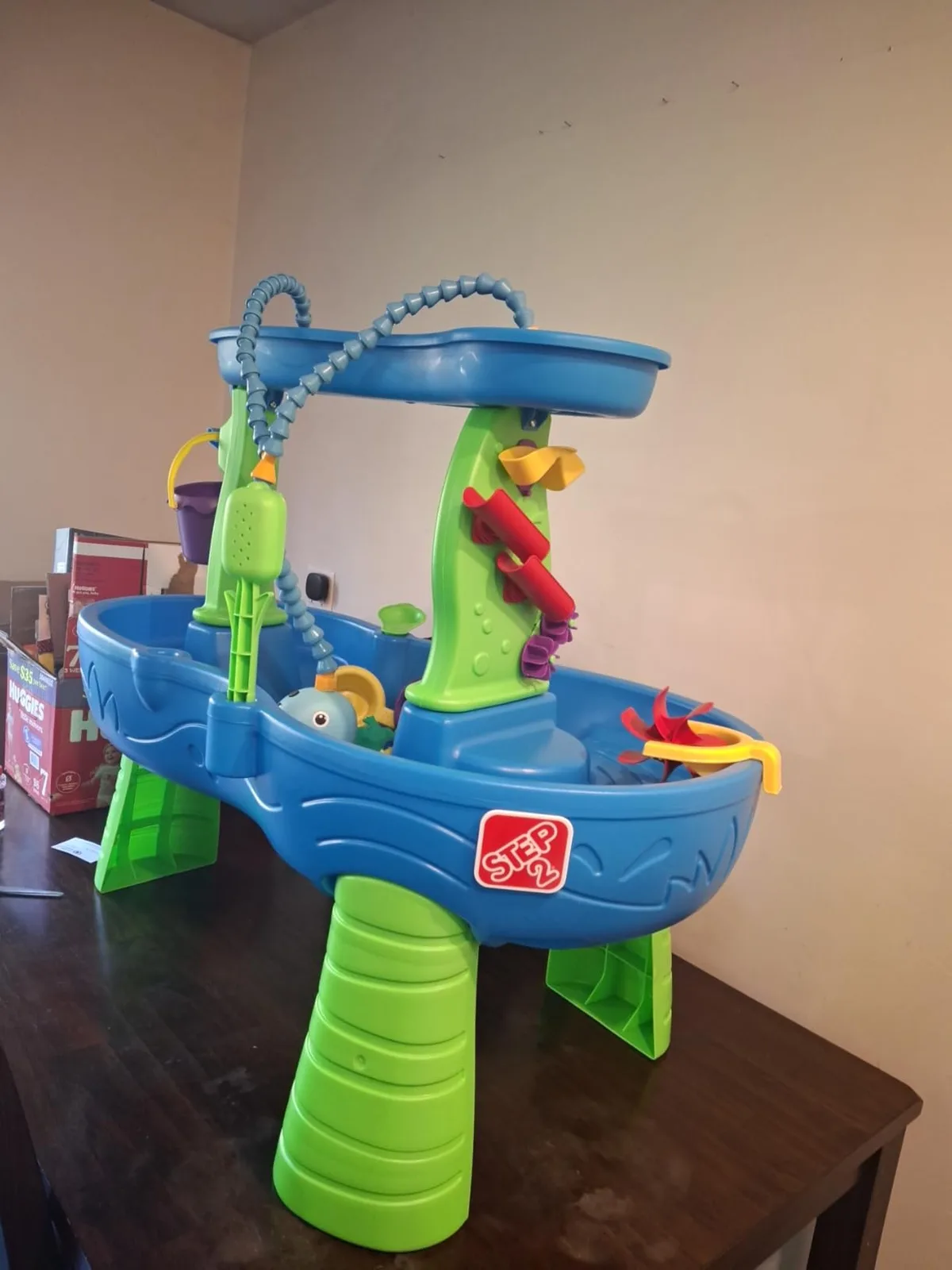
The Step2 Rain Showers Splash Pond is not a subtle product. It is a tub of water with some spinning things in it, and it makes a wet mess. This is exactly its value. In a market saturated with toys that promise cognitive enhancement, STEM learning, and developmental acceleration, the water table offers something more honest and perhaps more valuable: unhurried, absorbing, multi-sensory play that children choose to do for an hour at a time without any adult convincing.
The build quality is solid. The play value is outstanding for the age range. The price is fair. The seasonal limitation is real but appropriate — this is a summer toy, and it excels at being a summer toy. The accessories are fine, the mess is inevitable, and the engagement is genuine.
We can’t tell you it will make your child smarter. We can tell you it will make your summer afternoons quieter and wetter, which — depending on your perspective — might be worth more.
Product Rating: 7/10 — Excellent seasonal engagement with strong build quality, limited by seasonality and lack of year-round utility.
Evidence Rating: None — No water-table-specific research exists. Sensory play research is supportive of the play behaviors the table elicits.
Who Should Buy This
- Families with children ages 18 months to 4 years — the absolute sweet spot for water table play
- Parents who want an outdoor activity that produces sustained, largely self-directed play
- Households with outdoor space (patio, deck, or yard) and tolerance for water mess
- Families in warm climates who can use it year-round
- Anyone looking for a social play activity that accommodates 2-4 children simultaneously
Who Should Skip This
- Families without outdoor space — this is not an indoor toy
- Parents in cold climates who want year-round utility from a $60 purchase
- Anyone unwilling to commit to draining and cleaning after each use (hygiene is non-negotiable)
- Families with only children over 5 — the engagement window is closing
- Parents who are uncomfortable with the supervision requirements of water play with young children
This review reflects our independent evaluation. ScienceBasedKids.com purchased this product at retail price. We may earn a commission if you purchase through our links, which helps fund our research. This never influences our ratings.
Footnotes
-
Gascoyne, S. (2012). Sensory Play. London: Practical Pre-School Books. See also Gascoyne, S. (2016). “Sensory play: Developing a sense of wonder.” Nursery World, 2016(5), 22-25. ↩
-
Schulz, L. E., & Bonawitz, E. B. (2007). “Serious fun: Preschoolers engage in more exploratory play when evidence is confounded.” Developmental Psychology, 43(4), 1045-1050. ↩
-
Pellegrini, A. D., & Smith, P. K. (1998). “Physical activity play: The nature and function of a neglected aspect of play.” Child Development, 69(3), 577-598. ↩
-
Cameron, C. E., Brock, L. L., Murrah, W. M., Bell, L. H., Worzalla, S. L., Grissmer, D., & Morrison, F. J. (2012). “Fine motor skills and executive function both contribute to kindergarten achievement.” Child Development, 83(4), 1229-1244. ↩
-
American Academy of Pediatrics Committee on Injury, Violence, and Poison Prevention. (2010). “Prevention of drowning.” Pediatrics, 126(1), e253-e262. ↩
Enjoyed this review? We publish two new evidence-based evaluations every week.
Free. No spam. Unsubscribe anytime.
The 'intended play' category represents water used as the designers presumably imagined. The other 90% represents reality.
Recommended Accessories
Affiliate links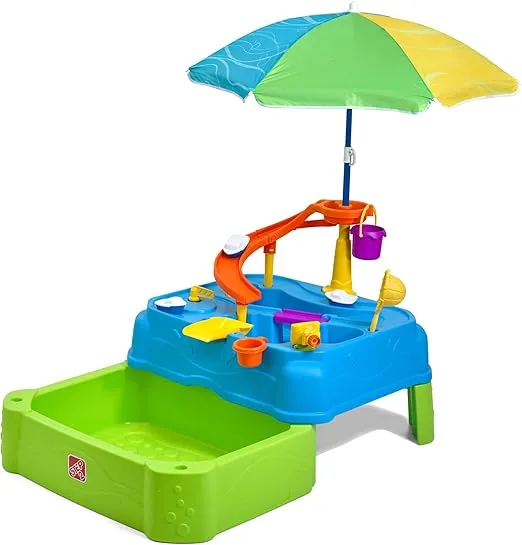
Step2 Waterpark Wonders Two-Tier Water Table (11-Piece Accessory Kit)
“Includes funnel, bucket, cup, three boats with wheels, and sprinkler attachment.”
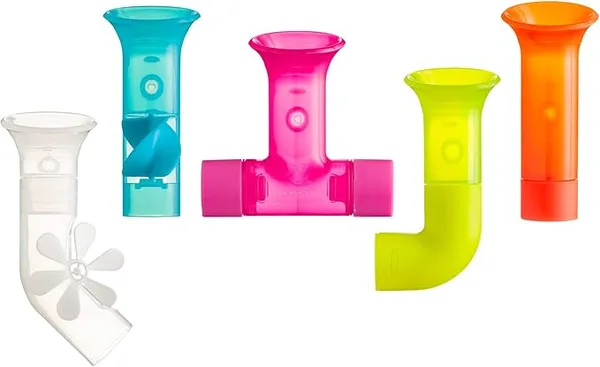
Boon Pipes Toddler Bath Toys (5-Count)
“Suction-cup pipes that attach to the table edge. Adds water engineering play.”
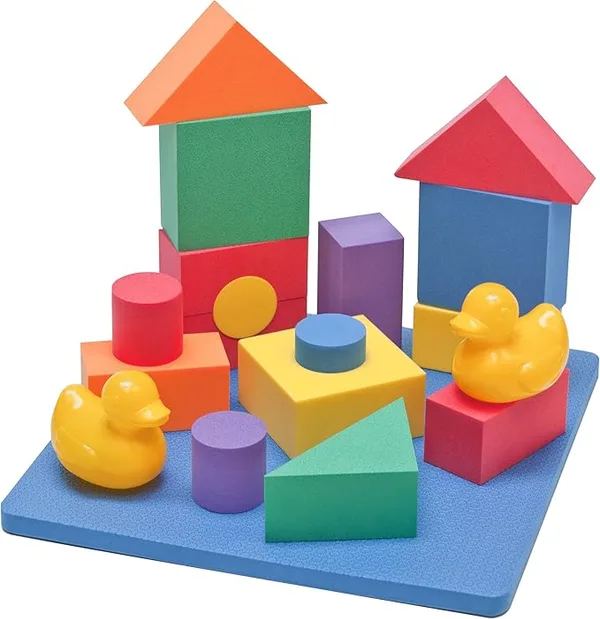
Wonder Blocks Non-Toxic Floating Waterproof Foam Blocks (16-Piece)
“BPA-free EVA foam blocks that float. Safe tactile sensory add-on for all ages.”
Step2 Naturally Playful Sandbox Lid
“Cover keeps debris out when not in use. Doubles as a play surface.”
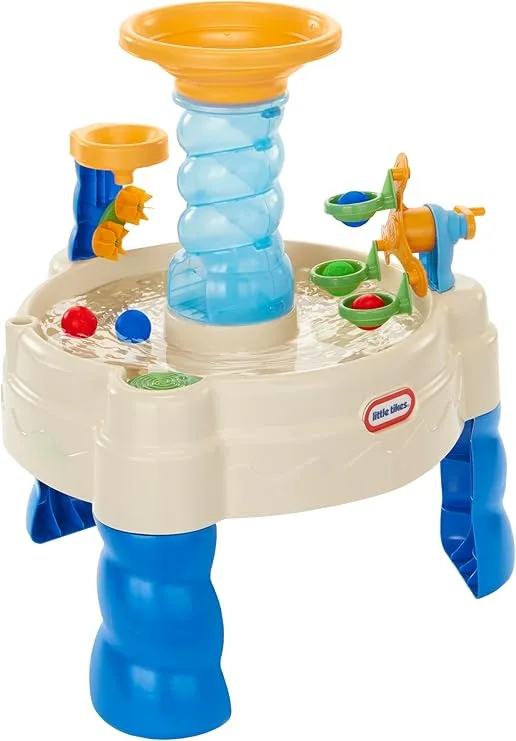
Little Tikes Spiralin' Seas Waterpark Play Table
“Budget alternative with spiral water feature. Smaller footprint for tight spaces.”