ScienceBasedKids.com may earn a commission from affiliate links in this review. Our ratings are never influenced by affiliate relationships. Read our full methodology.
Spirograph has been producing geometric art since 1965, and the fundamental experience hasn’t changed: place a toothed gear inside a toothed ring, insert a pen through one of the gear’s holes, and trace the curve that emerges as the gear rolls around the ring’s interior. The result is a hypotrochoid — a mathematical curve defined by the ratio between the gear and ring radii. If that sentence made your eyes glaze over, the visual result won’t: Spirograph patterns are intrinsically beautiful, and children who create them are doing real mathematics without ever writing an equation.
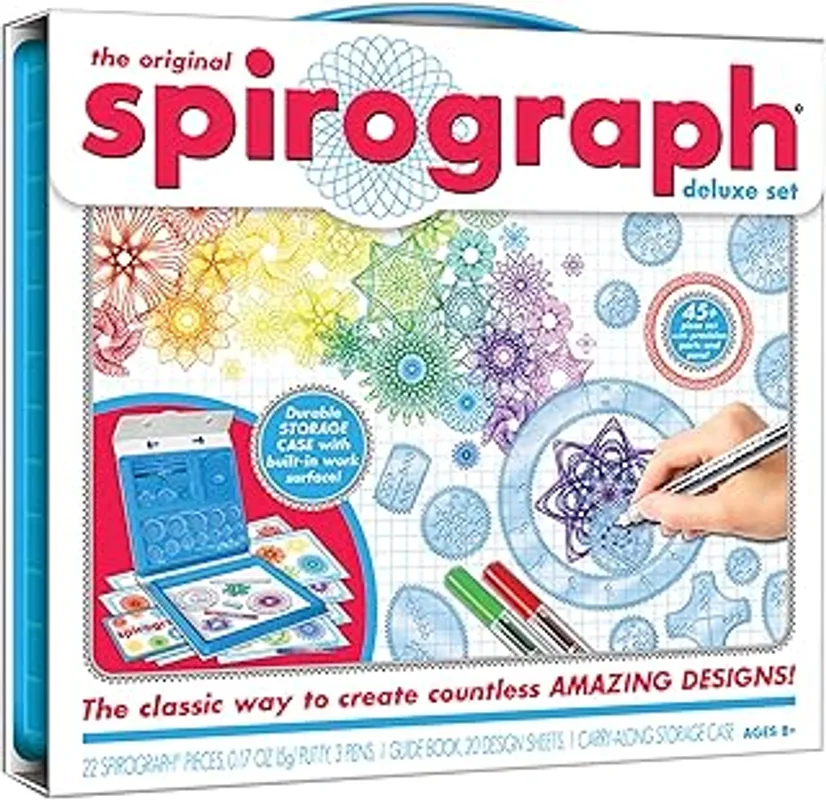
The Spirograph Deluxe Set ($25) is the current flagship, and we tested it for six weeks with children ages 7 through 12 to evaluate whether this classic toy still delivers in an era of digital art tools.
Product Overview
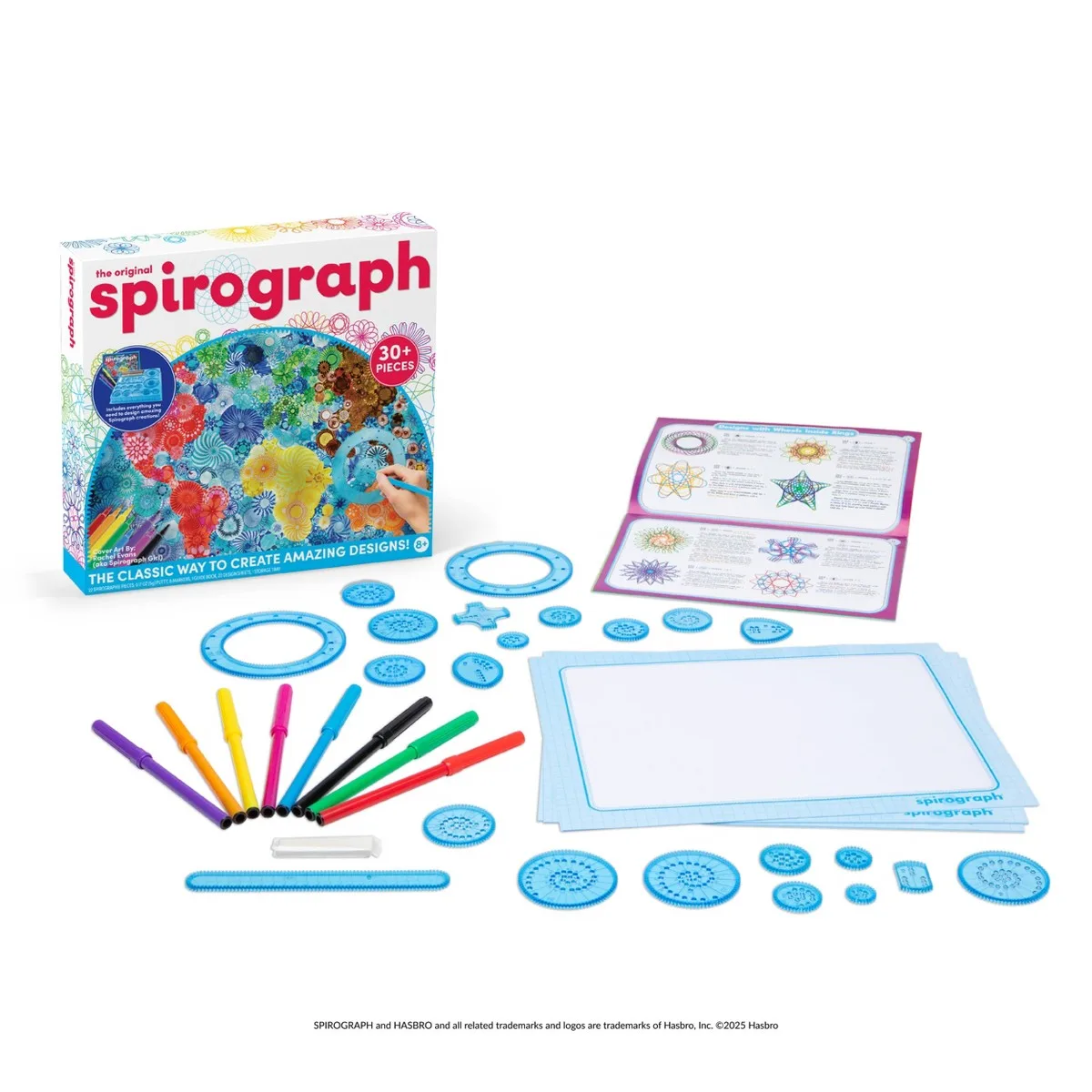
The Deluxe set includes:
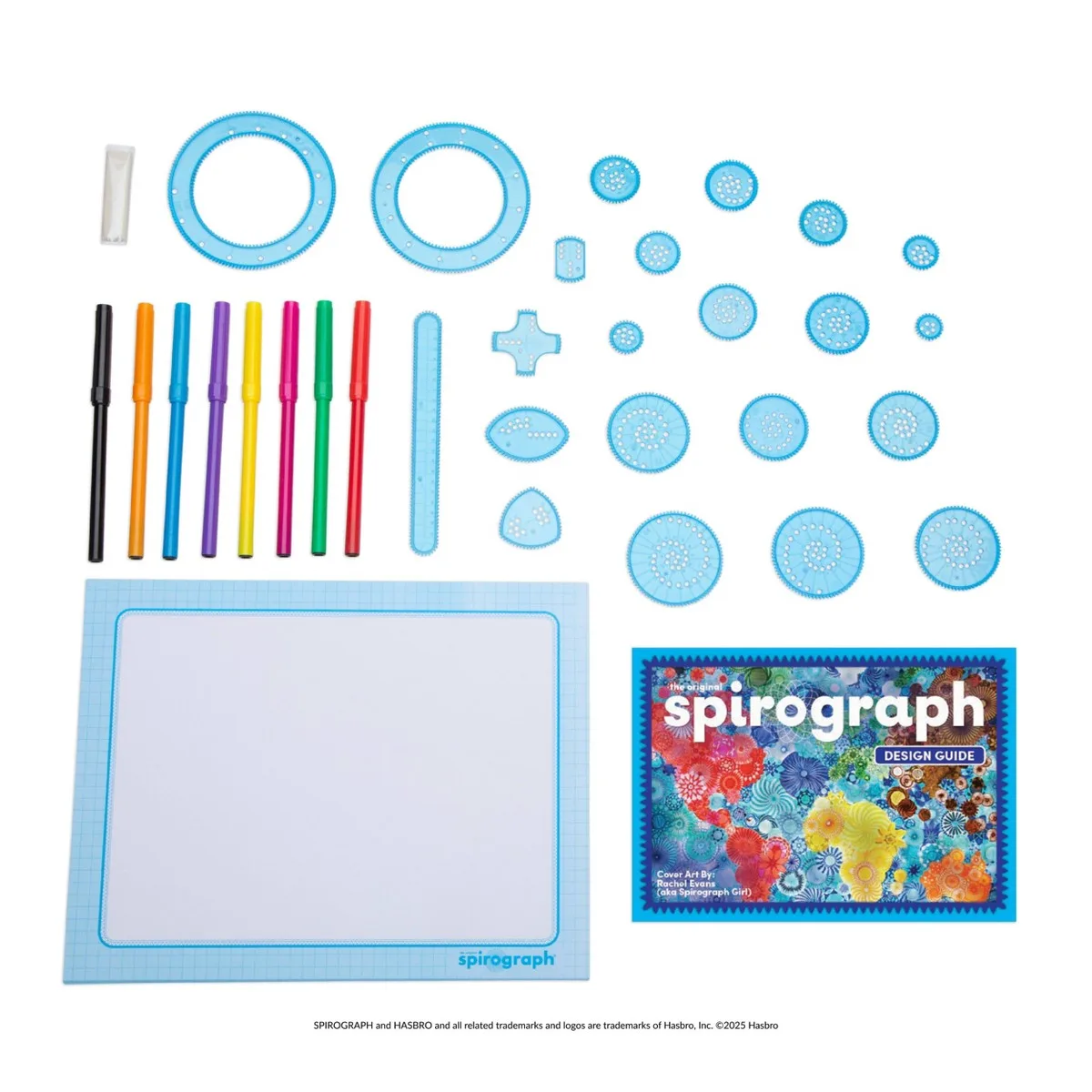
- 19 precision gears in various sizes
- 2 rings — large and small outer guides
- 1 rack — straight-line guide
- 3 Spirograph pens in different colors
- Reusable putty for securing paper
- Design guide with pattern suggestions
- Paper pad
Each gear has multiple pen holes at different distances from the center. Changing the hole changes the pattern. Changing the gear changes the pattern. Changing the ring changes the pattern. The combinatorial possibilities are enormous — the set can theoretically produce thousands of unique designs.
Our Evaluation
Build Quality: 7/10
The gears are precision-molded plastic with clean teeth that mesh smoothly with the rings. The pens are adequate but not exceptional — they tend to dry out during extended sessions, and the included colors are limited. The putty works well for securing paper. The carrying case is functional.
Play Value: 7/10
For children who connect with Spirograph, the engagement is deep and sustained. The meditative quality of tracing curves — the rhythmic rotation, the emerging pattern, the satisfaction of completion — appeals to children who enjoy precision and visual beauty. Several testers in the 9-11 age range became absorbed for 45-60 minute sessions, which is remarkable for an analog art tool.
The challenge: Spirograph has a steeper learning curve than it appears. Keeping the gear teeth engaged while maintaining pen pressure requires fine motor control and patience that frustrated our 7-8 year old testers. Slipping gears ruin patterns and must be restarted. By age 9-10, most children had developed the control needed for reliable pattern creation.
Age Appropriateness: 7/10
The 8+ recommendation is honest but the practical minimum is closer to 9. Children under 8 consistently struggled with the fine motor demands. The ideal age range is 9-12, where the motor skills are sufficient and the mathematical patterns are intellectually interesting.
Value for Money: 9/10
At $25 for a set that produces thousands of unique designs and remains engaging for years, Spirograph is exceptional value. The only recurring cost is paper and pens.
The Evidence
Mathematical Visualization. Spirograph patterns are real mathematical curves (hypotrochoids and epitrochoids) defined by gear ratios. Presmeg (2006) argued that visualization is a powerful mathematical reasoning tool that can be developed through physical experiences with geometric patterns.1
Fine Motor Control and Art. The precision required for Spirograph use develops fine motor control and hand-eye coordination. Grissmer et al. (2010) found that fine motor skills at kindergarten entry predicted later academic achievement, with effects persisting through fifth grade.2
The honest summary: Spirograph engages genuine mathematical visualization and fine motor development. The evidence supports both domains broadly, though not Spirograph specifically.
Safety Notes
Small gears may pose a choking hazard for children under 3. Pens are non-toxic. No CPSC recalls.
The Verdict
Spirograph remains a uniquely satisfying toy — one of the few products that’s genuinely mathematical and genuinely creative simultaneously. For children age 9+ who enjoy precision, pattern, and visual beauty, it delivers an experience that no digital tool fully replicates.
Product Rating: 7/10 — Unique mathematical-creative experience at an excellent price point. Steep learning curve for younger users limits the score.
Evidence Rating: Emerging — Mathematical visualization and fine motor development are well-supported. No Spirograph-specific research.
Who Should Buy This
- Children ages 9+ who enjoy precision, patterns, and visual art
- Math-curious children who might enjoy seeing geometry in action
- Families looking for screen-free creative activities
- Adults who remember Spirograph fondly — it’s still satisfying
Who Should Skip This
- Children under 9 — the fine motor demands will likely frustrate
- Children who prefer free-form art — Spirograph is structured by design
- Anyone seeking a quick-gratification activity — mastery takes practice
- Families looking for collaborative play — Spirograph is primarily solo
This review reflects our independent evaluation. ScienceBasedKids.com purchased this product at retail price.
Footnotes
-
Presmeg, N. C. (2006). “Research on visualization in learning and teaching mathematics.” Handbook of Research on the Psychology of Mathematics Education, 205-235. ↩
-
Grissmer, D., Grimm, K. J., Aiyer, S. M., Murrah, W. M., & Steele, J. S. (2010). “Fine motor skills and early comprehension of the world: Two new school readiness indicators.” Developmental Psychology, 46(5), 1008-1017. ↩
Enjoyed this review? We publish two new evidence-based evaluations every week.
Free. No spam. Unsubscribe anytime.
Fine motor control and patience were the most intensely engaged skills across all age groups.
Recommended Accessories
Affiliate links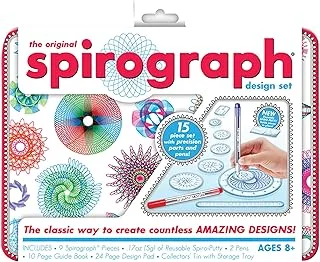
Spirograph Design Tin Set
“Travel-sized set in a collectible tin. Great for road trips and restaurants.”
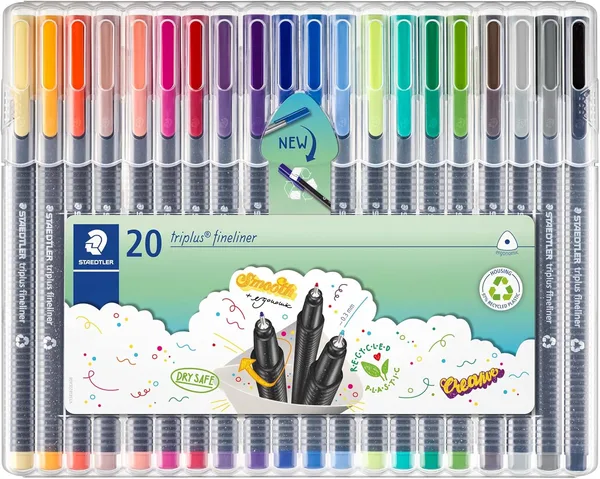
Staedtler Triplus Fineliner Pens (20-pack)
“Fine-tip pens in 20 colors. Better color range than included pens for layered designs.”
Beautiful Geometry by Eli Maor
“Illustrated book exploring mathematical beauty. Context for the curves Spirograph creates.”
Canson XL Mix Media Pad (9x12)
“Heavier paper prevents pen bleeding and holds up to Spirograph gear pressure better than standard paper.”