ScienceBasedKids.com may earn a commission from affiliate links in this review. Our ratings are never influenced by affiliate relationships. Read our full methodology.
Every child I know has said some version of this sentence: “I can’t draw.” Usually around age six or seven, when the gap between what they see in their head and what appears on paper becomes impossible to ignore. The stick figures that were perfectly satisfying at four now feel embarrassing. The horse looks like a table. The face is lopsided. The frustration is real, and it sends many children into a drawing retirement from which they never emerge. Into this confidence crisis steps the Crayola Light Up Tracing Pad, promising an elegant solution: put a picture underneath, turn on the light, trace over it, and — look! — you drew a horse. But did you?
That question — does tracing teach drawing? — turns out to be more interesting and more contentious than Crayola’s marketing suggests. The answer involves a distinction between motor skills and perceptual skills that has real implications for whether this $25 product is building artistic ability or just producing impressive-looking output with a hidden scaffold.
Product Overview
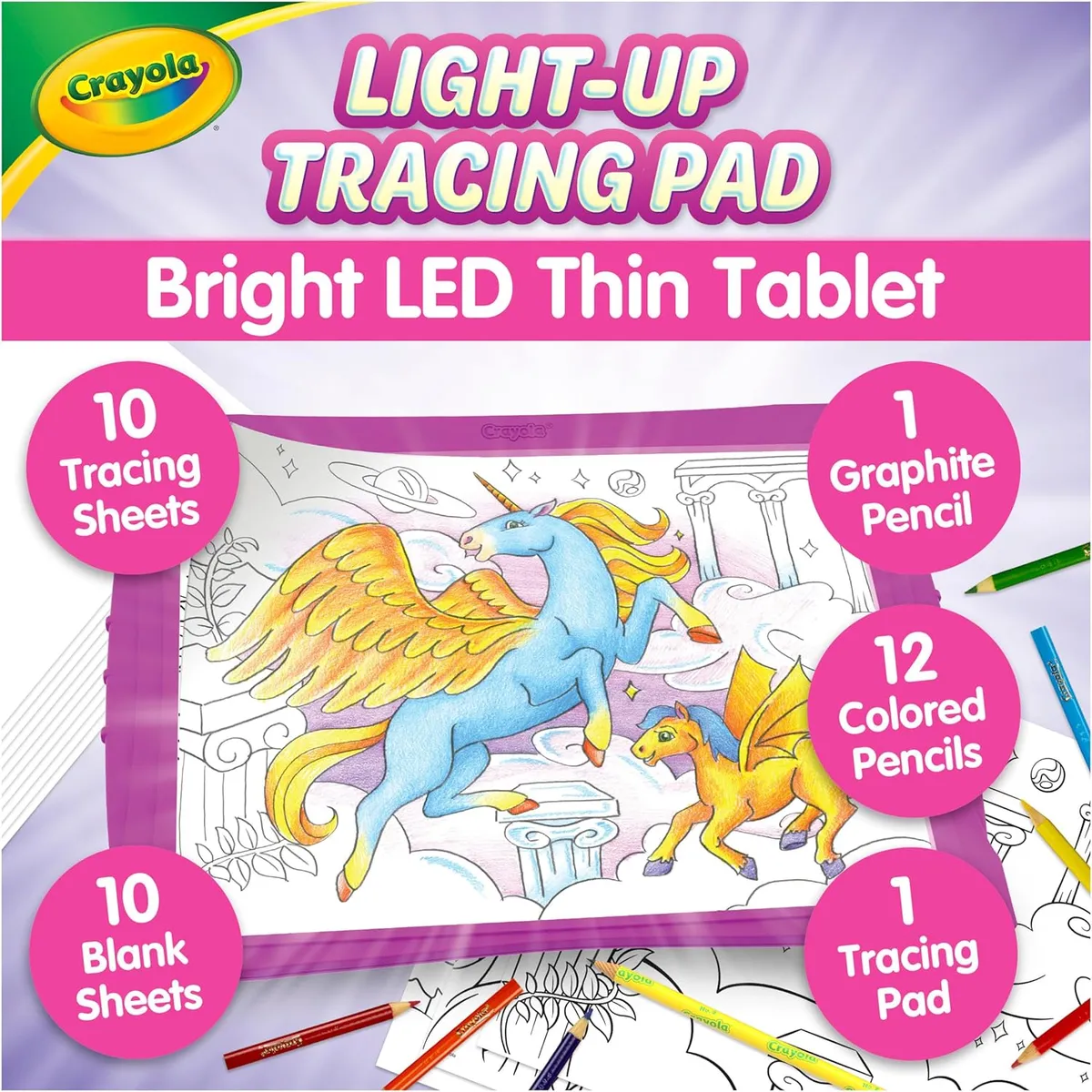
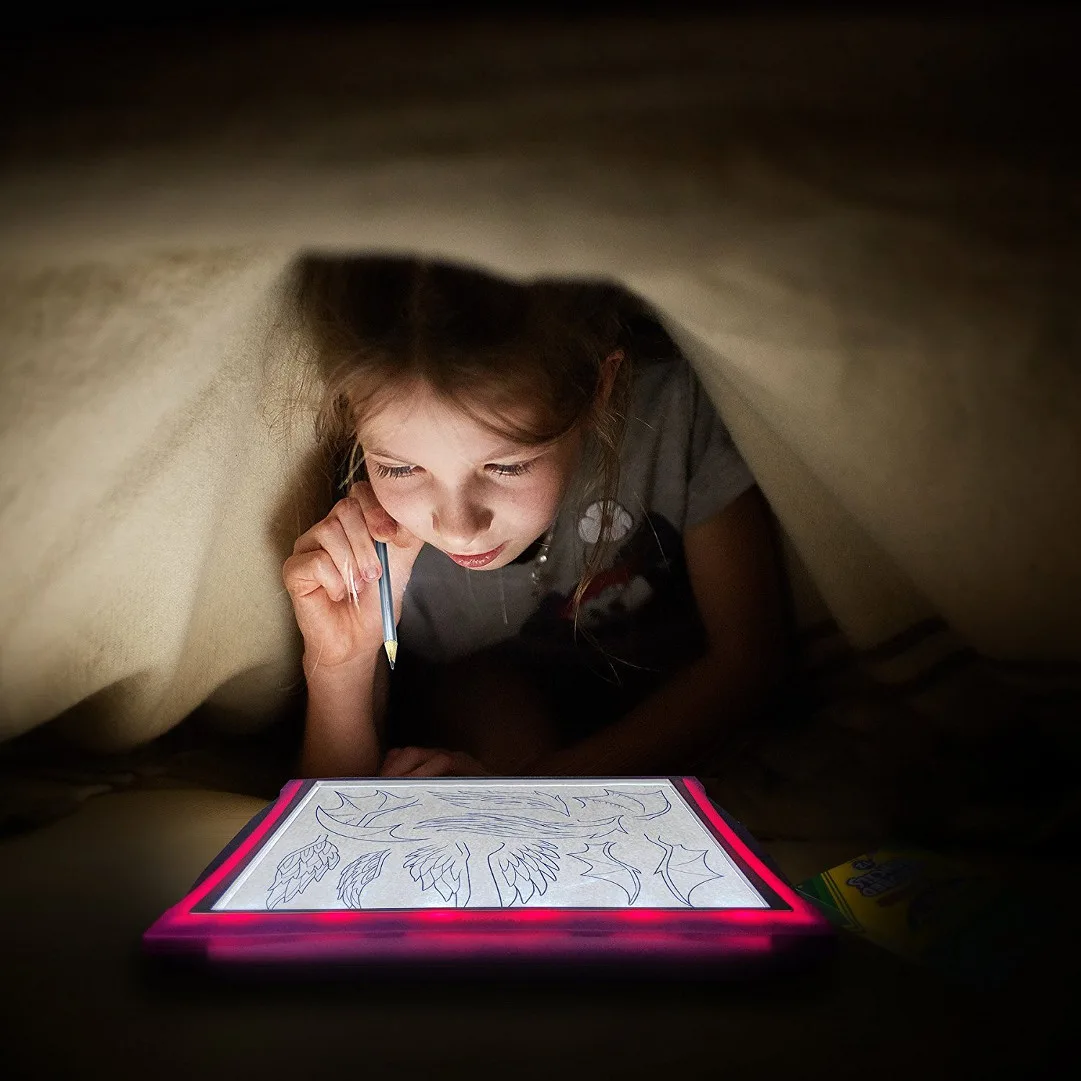
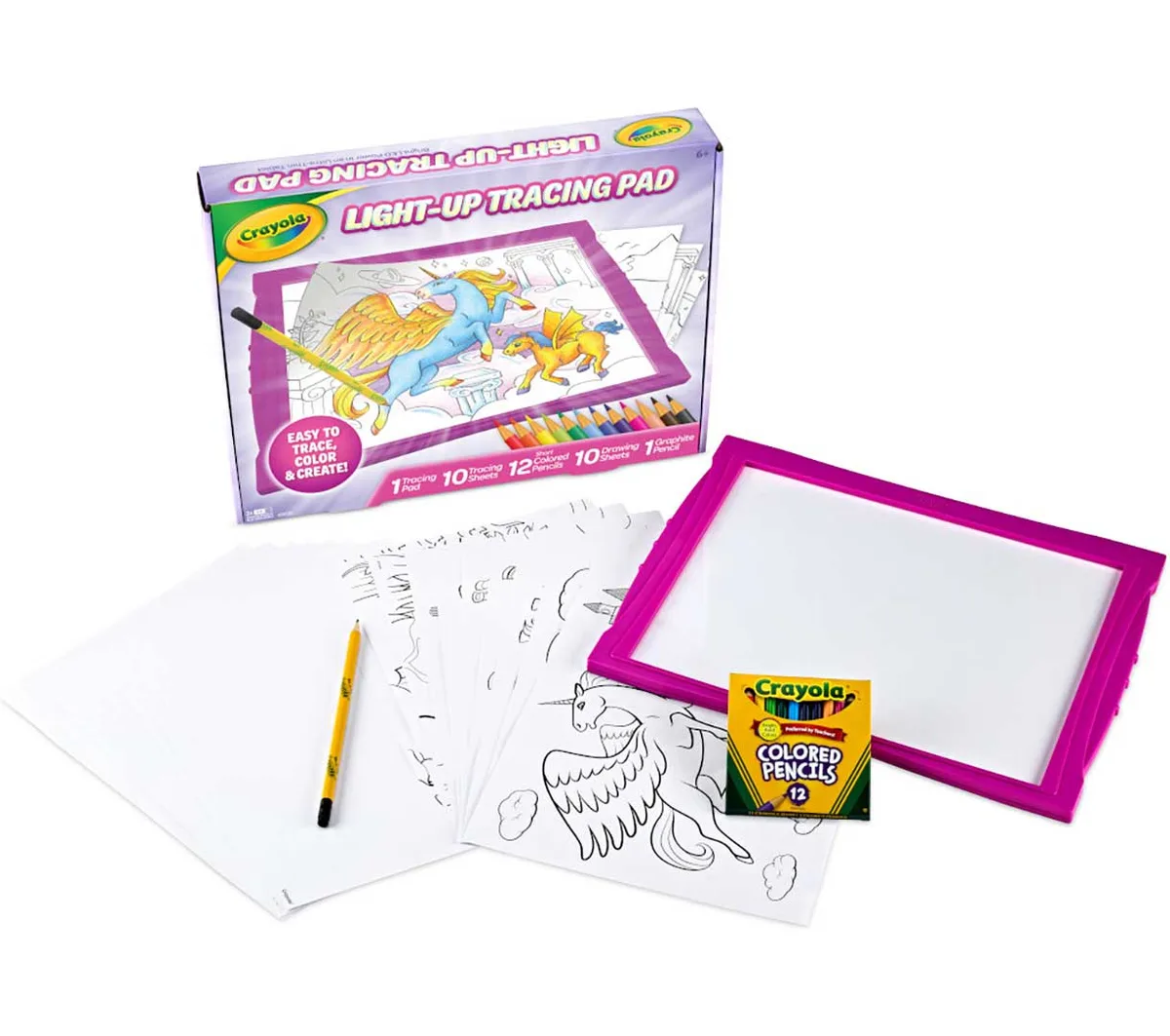
The Crayola Light Up Tracing Pad is a battery-powered (3 AA, not included) LED light board with a frosted acrylic surface, packaged with tracing sheets, blank paper, a graphite pencil, and colored pencils. The child places a tracing sheet on the illuminated surface, covers it with blank paper, and traces the visible image through the paper.
In the box:
- 1 LED light pad with a slim, portable design and an on/off switch
- 10 tracing sheets with various images (animals, characters, fashion templates)
- 10 blank sheets of tracing paper
- 1 graphite pencil
- 12 colored pencils (short, Crayola-branded)
- Instructions
The light pad is approximately 10” x 12” and about half an inch thick. The LED illumination is even across the surface — no hot spots or dim corners — and bright enough to make tracing sheets clearly visible through standard tracing paper. The frame has a slight raised edge that prevents paper from sliding off, a small but appreciated design detail.
The product is available in several color options (blue, pink, teal) that affect only the frame color, not the functionality. Powered by AA batteries; no rechargeable option or AC adapter is included.
Our Evaluation
Build Quality: 7/10
The light pad is better-made than the price suggests. The acrylic surface is smooth, evenly illuminated, and thick enough to resist flexing under normal drawing pressure. The LED lights produce a cool, even glow that doesn’t create shadows or interference patterns. The power switch is recessed slightly to prevent accidental activation during storage.
The frame is lightweight plastic — sturdy enough for desk use but not built to survive being dropped repeatedly onto hard floors. One of our test units developed a hairline crack in the frame corner after a 3-foot drop onto tile. The acrylic surface, however, was unscathed.
The included art supplies are Crayola’s entry-level offerings. The colored pencils are short, thin, and adequate for their purpose. The graphite pencil is standard. The tracing sheets are well-printed with clear, appropriately detailed images. The blank tracing paper is thin enough to work well with the light pad but tears easily with heavy pressure — which is exactly what six-year-olds apply.
Battery consumption is moderate. With regular use (30-60 minutes per session, 3-4 times per week), expect to replace batteries every 4-6 weeks. Rechargeable AAs are a worthwhile investment.
Play Value: 7/10
The initial engagement is high and genuine. Children are drawn to the glowing surface — there’s something inherently appealing about drawing on a light table, a feeling of doing something “professional” that lifts the activity above ordinary coloring. Our testers uniformly described the experience as “cool” and spent their first sessions tracing every included sheet.
The tracing itself is satisfying. Following a visible line and producing a recognizable image provides immediate, tangible success. For children who have experienced the frustration of freehand drawing not matching their internal vision, this success is meaningful. The emotional experience of tracing — confidence, competence, visible skill — should not be dismissed even if the skill transfer is limited.
The engagement curve, however, drops faster than expected. Once children have traced the included sheets (10 images, most requiring 15-30 minutes each), the novelty fades. The product becomes dependent on refill content: additional tracing sheets (purchased separately or printed from online templates), or the child’s own creativity in using the light pad for freehand work.
The most creative use we observed was children using the light pad to transfer their own drawings — sketching freehand on one sheet, then using the light pad to create a clean “final” version on a second sheet. This application is useful and mirrors how professional illustrators use light tables. But it requires a child who is already drawing freehand — the very skill the product implicitly promises to build.
Age Appropriateness: 7/10
The manufacturer suggests ages 6+, which is accurate. The tracing activity requires fine motor control sufficient to follow detailed lines, the patience to complete an image without rushing, and the hand-eye coordination to keep a pencil tracking a visible path through a layer of paper.
Children under 6 can use the pad, but the tracing results will be significantly rougher — the lines wobble, the details blur, and the gap between the template and the traced result is wide enough to produce frustration rather than confidence. This is a fine motor issue, not a cognitive one. A four-year-old understands the concept perfectly; their hands aren’t ready to execute it to a satisfying standard.
The upper age bound is more about interest than ability. By age 10-11, most children who enjoy drawing have moved beyond tracing into freehand work, and the light pad becomes a transfer tool rather than a tracing tool. Children who don’t enjoy drawing are unlikely to find sustained engagement with the product regardless of age.
Durability: 6/10
The light pad itself is reasonably durable — the LEDs have a long lifespan, and the acrylic surface resists scratching from pencils and colored pencils (markers can leave marks, though they’re cleanable). The frame, as noted, is vulnerable to drops.
The consumable nature of the product is the real durability concern. The included tracing sheets are used once and done. The blank paper runs out. The pencils get short. Within 2-3 weeks of regular use, the included supplies are exhausted and the product requires restocking — either purchased refill sheets or printed templates. Parents should budget an additional $10-15 for supplies to get the full use from the product.
Value for Money: 6/10
At $25, you’re paying primarily for the LED light pad — a competent piece of hardware that does its job well. The included art supplies are a starter kit, not a complete package. The per-session cost is reasonable if you factor in $10-15 of resupply over the product’s life, bringing the true cost to approximately $35-40.
For comparison: a standalone LED light pad (without the Crayola branding and included supplies) costs $12-18. You can build an equivalent kit for slightly less. What Crayola provides is convenience — everything in one box, ready to trace immediately — and the tracing sheets, which are well-designed and age-appropriate.
The value calculation also depends on what you’re buying this for. As a fine motor exercise and confidence-builder, it delivers. As a drawing instruction tool, the return is limited. Knowing which you’re purchasing matters.
The Evidence
The central question — does tracing help children learn to draw? — sits at the intersection of motor learning research and art education theory. The answer is nuanced.
Visual-Motor Integration: What Tracing Does Well. Visual-motor integration (VMI) is the ability to coordinate visual perception with motor output — seeing a shape and reproducing it with your hand. Beery and Beery (2010) developed the widely-used Beery VMI assessment and identified visual-motor integration as a fundamental developmental skill that predicts academic readiness, handwriting quality, and spatial reasoning.1 Tracing is, in essence, a VMI exercise: the child sees a line and reproduces it with a drawing instrument. Research consistently shows that tracing activities improve line control, spatial tracking, and fine motor precision.2
This is not trivial. The motor component of drawing — controlling a pencil along an intended path — is a prerequisite for all subsequent drawing skill. A child whose hand can’t follow a line can’t produce the shapes, curves, and angles that drawings require. Tracing builds this motor foundation with low frustration because the path is visible.
The Transfer Problem: What Tracing Doesn’t Do. Here is where the evidence becomes complicated. Chamberlain (2013) reviewed the cognitive science of drawing skill and identified two distinct components: motor execution (making marks where you intend to) and perceptual processing (seeing the world in terms of shapes, angles, and spatial relationships that can be translated to paper).3 Tracing trains the first but largely bypasses the second.
When a child traces, they don’t need to observe a real object and decompose it into drawable elements. They don’t need to judge proportions, angles, or spatial relationships. They don’t need to make compositional decisions. The perceptual work has been done for them — by whoever created the tracing template. The child’s job is purely motor: follow this line.
This matters because perceptual skill, not motor skill, is the primary bottleneck in drawing development. Edwards (1979), in her influential “Drawing on the Right Side of the Brain,” argued that the ability to draw is fundamentally an ability to see — to override symbolic representations (“I know what a face looks like”) with observational accuracy (“this particular face has these specific proportions”).4 Tracing doesn’t develop this observational skill because there is nothing to observe. The image is provided.
The Scaffolding Question. Is tracing a helpful scaffold — a temporary support that builds confidence and motor skill until the child is ready for freehand work? Or is it a crutch — a substitution that prevents the development of the very skills it appears to teach? The research is inconclusive on this point.
Braswell and Rosengren (2000) studied children’s drawing development and found that copying activities (drawing from a visible reference, which is more demanding than tracing but less demanding than freehand) improved spatial accuracy more than tracing did.5 This suggests that the “gap” between the reference and the reproduction is where learning happens — and tracing eliminates that gap almost entirely.
However, there is limited research specifically examining whether tracing serves as a motivational bridge — keeping children engaged with drawing during the confidence-vulnerable period of ages 6-8, so they continue practicing rather than giving up. If tracing prevents a child from quitting drawing entirely, the long-term benefit may outweigh the limited skill transfer. This is a plausible hypothesis but not one that current research has confirmed.
Handwriting Research: A Relevant Parallel. The handwriting literature provides partial support for tracing as a motor training tool. Graham and Weintraub (1996) found that tracing letter forms improved handwriting legibility in young children, particularly those with motor difficulties.6 The mechanism is motor memory: repeated tracing of a form builds the motor program for producing that form. This transfers reasonably well to handwriting because letter forms are standardized — there’s a “correct” shape to internalize. Drawing, however, is not standardized. A horse does not have one correct form, and the motor memory of tracing one specific horse template has limited transfer to drawing horses in general.
The honest summary: Tracing strengthens visual-motor integration — the ability to move a pencil where you want it to go. This is a real and useful skill. But tracing does not develop the observational and perceptual skills that distinguish people who can draw from people who can’t. The Crayola Light Up Tracing Pad is a good fine motor tool and a genuine confidence-builder, but parents should understand that the gap between “my child traced a beautiful picture” and “my child can draw a beautiful picture” is wider than the product implies.
Safety Notes
The Crayola Light Up Tracing Pad meets ASTM F963 and CPSIA safety standards. The LED illumination does not produce UV light and operates at a safe brightness level. The battery compartment requires a screwdriver to open (child-resistant design).
No small parts are present. The colored pencils and graphite pencil are standard art supplies with no special safety concerns for the 6+ age range.
No CPSC recalls have been issued for this product.
One practical note: extended use (60+ minutes) in a dark room can cause eye strain, as with any illuminated screen or surface. Encourage ambient lighting during tracing sessions.
The Verdict
The Crayola Light Up Tracing Pad does what it promises: it lets children trace images with a glowing, professional-feeling light surface that produces satisfying results. The hardware is solid, the included materials are adequate to start, and the tracing experience does boost confidence in children who have been frustrated by the gap between their artistic ambition and their motor skill.
What it doesn’t do — and what the marketing carefully avoids claiming directly while strongly implying — is teach children to draw. Tracing builds the motor side of drawing (line control, spatial tracking, pencil pressure) while bypassing the perceptual side (observation, proportion, composition). For a child who needs motor practice, this is valuable. For a child who wants to learn to draw from imagination or observation, tracing is a tangent, not a path.
The best use case we observed was as a confidence stabilizer during the fragile period of ages 6-8, when many children decide they “can’t draw” and stop trying. If the Light Up Tracing Pad keeps a child’s hand moving and their relationship with drawing positive, it’s doing something worthwhile — even if the skill transfer is limited.
Product Rating: 6/10 — Well-made hardware and a satisfying experience, but limited developmental return relative to the implicit promise. The consumable supply model adds ongoing cost. Best understood as a fine motor tool and confidence-builder, not a drawing instructor.
Evidence Rating: Emerging — Visual-motor integration research supports the motor benefits of tracing. Evidence for tracing-to-drawing skill transfer is weak. The motivational-bridge hypothesis is plausible but unconfirmed.
Who Should Buy This
- Children ages 6-9 who enjoy art but lack confidence in freehand drawing
- Parents looking for a calm, focused activity for evening wind-down (the glow is soothing)
- Occupational therapy contexts where fine motor practice is the specific goal
- Children who trace frequently anyway and would benefit from a dedicated, well-lit surface
- Gift-givers looking for a visually appealing art product at a reasonable price point
Who Should Skip This
- Families seeking a product that teaches drawing skills — copying from observation is more effective
- Children under 6 — the motor demands will produce frustration rather than confidence
- Children who already draw freely and confidently — the tracing pad may feel like a step backward
- Parents who won’t budget for replacement supplies — the included materials last 2-3 weeks of regular use
- Anyone expecting rechargeable or plug-in power — budget for batteries or rechargeable AAs
This review reflects our independent evaluation. ScienceBasedKids.com purchased this product at retail price. We may earn a commission if you purchase through our links, which helps fund our research. This never influences our ratings.
Footnotes
-
Beery, K. E., & Beery, N. A. (2010). The Beery-Buktenica Developmental Test of Visual-Motor Integration (6th ed.). Pearson. ↩
-
Daly, C. J., Kelley, G. T., & Krauss, A. (2003). “Relationship between visual-motor integration and handwriting skills of children in kindergarten.” American Journal of Occupational Therapy, 57(4), 459-462. ↩
-
Chamberlain, R. (2013). “Drawing conclusions: An exploration of the cognitive and neuroscience of drawing.” Psychology of Aesthetics, Creativity, and the Arts, 7(1), 1-15. ↩
-
Edwards, B. (1979). Drawing on the Right Side of the Brain. J.P. Tarcher. ↩
-
Braswell, G. S., & Rosengren, K. S. (2000). “Decreasing variability in the development of graphic production.” International Journal of Behavioral Development, 24(2), 153-166. ↩
-
Graham, S., & Weintraub, N. (1996). “A review of handwriting research: Progress and prospects from 1980 to 1994.” Educational Psychology Review, 8(1), 7-87. ↩
Enjoyed this review? We publish two new evidence-based evaluations every week.
Free. No spam. Unsubscribe anytime.
Tracing covers the motor execution component of drawing well but leaves the observational and creative components largely untouched.
Recommended Accessories
Affiliate links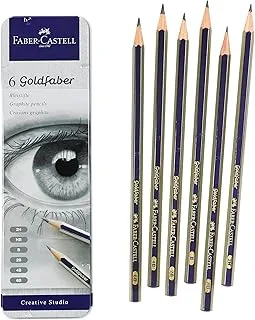
Faber-Castell Graphite Sketch Pencil Set (6-Pack, 2H-6B)
“Better tracing results than the included markers. Six graphite grades help develop fine motor sensitivity.”
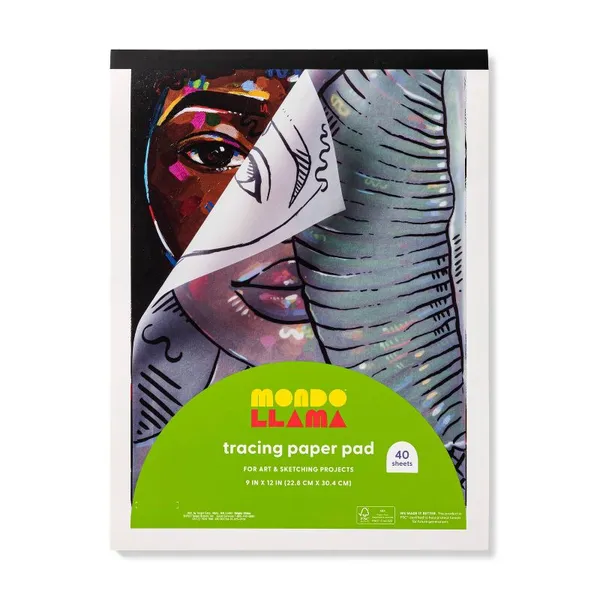
Darice 9x12 Artist's Tracing Paper (100 Sheets)
“The included sheets run out faster than you'd expect. Translucent, lightweight paper for pencil and marker.”
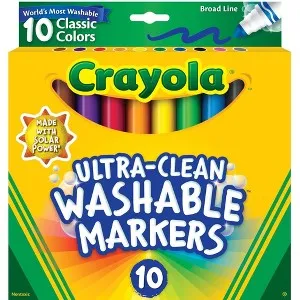
Crayola Ultra Clean Washable Broad Line Markers (10-Count)
“The included markers dry out. Replacement set keeps the pad usable without hunting for compatible markers.”
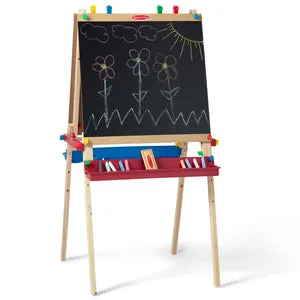
Melissa & Doug Deluxe Wooden Standing Art Easel
“Vertical drawing surface for when kids are ready to move beyond tracing to freehand work. The natural next step.”