ScienceBasedKids.com may earn a commission from affiliate links in this review. Our ratings are never influenced by affiliate relationships. Read our full methodology.
She stands on the line with one foot, arms out, the other foot hovering an inch above the nylon. Her entire body is negotiating with gravity — ankles making micro-adjustments, core muscles she doesn’t know the names of firing in rapid succession, eyes locked on a knot in the tree bark twenty feet away. She takes one step. Then another. Then the line bucks sideways and she hops off into the grass, landing on both feet. “I got two!” she announces, as if she’s just summited something. She has. Two steps on a slackline, when you’re seven, is a summit.
Slacklining is the rare physical activity where visible progress is measured in inches and seconds, where the challenge is not another person or a score but the simple, relentless problem of staying upright on a strip of bouncing nylon. It is, in the most literal sense, a balancing act — and the Slackers Classic Series Slackline is the most accessible entry point for children to discover that staying still can be harder than running fast.
Product Overview
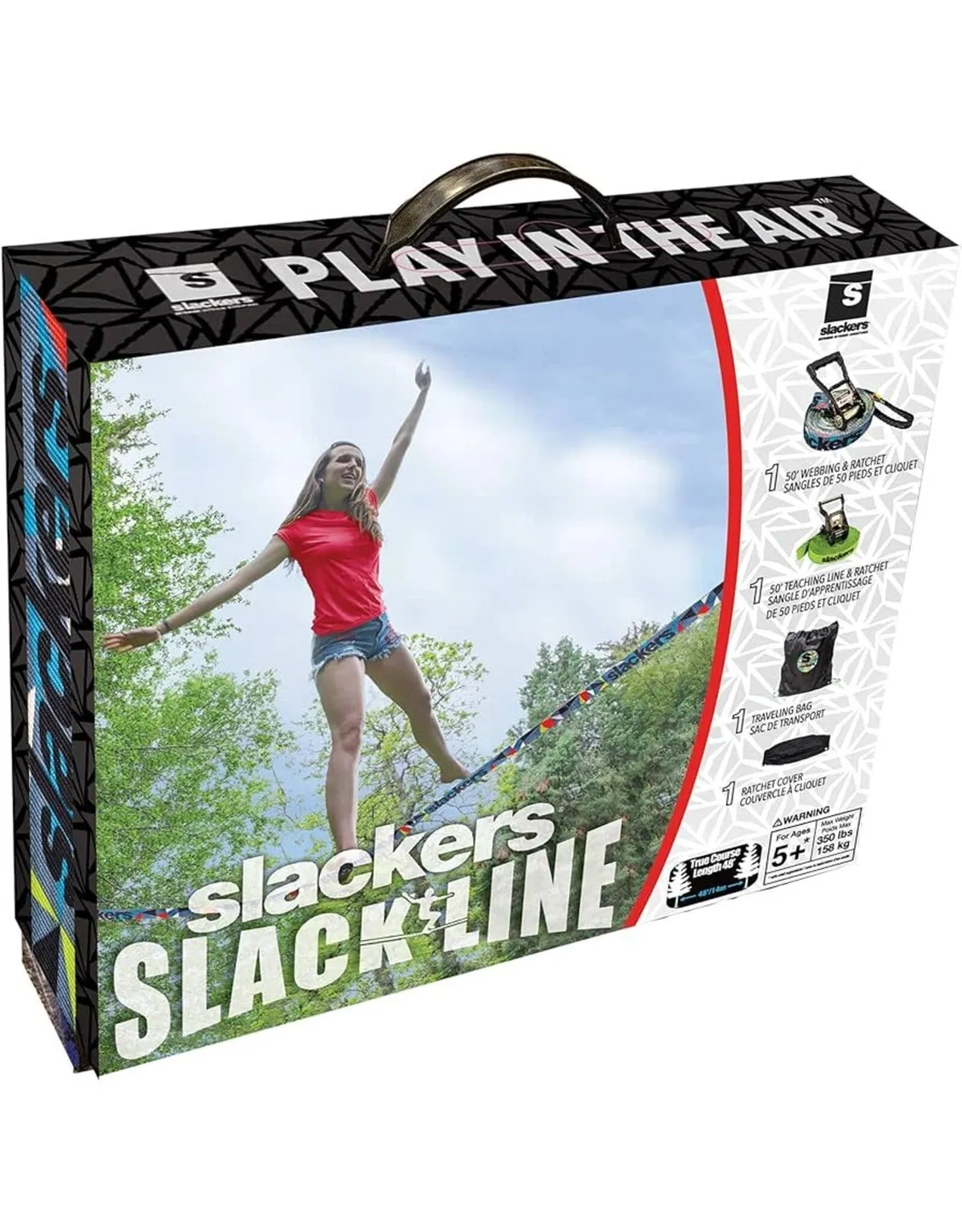
The Slackers Classic Series Slackline ($30) is a 50-foot flat nylon webbing designed for beginner-to-intermediate slacklining for children and adults. The kit includes:
- 50-foot slackline (2 inches wide, rated for 300 lbs)
- Ratchet tensioning system with heavy-duty steel construction
- Basic tree protectors (felt pads — adequate for occasional use, upgrade for permanent installations)
- Instructional guide with setup and beginner technique tips
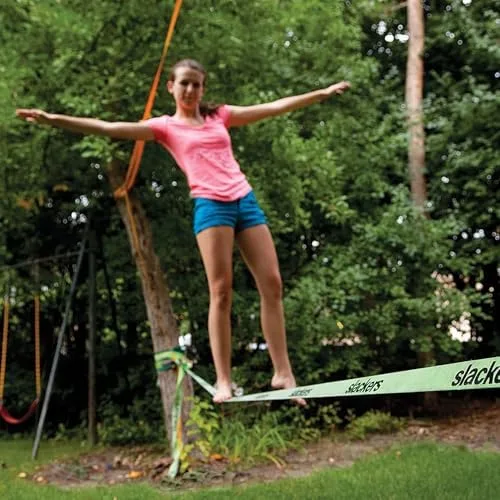
The system requires two sturdy trees spaced 15-50 feet apart (beginners should start at 15-20 feet — shorter distance means less bounce and sway). Each tree needs a trunk diameter of at least 12 inches. The line installs at knee height for children, roughly 12-18 inches off the ground, meaning falls are a step down rather than a tumble.
Our Evaluation
Build Quality: 7/10
The slackline webbing itself is solid — the same flat nylon construction used in adult recreational slacklines, just at a more accessible price point. The 2-inch width is standard for beginners and provides a reasonable surface area for a child’s foot. The ratchet mechanism is industrial-grade steel that tensions smoothly and holds reliably. After six months of outdoor use in our testing, the mechanism showed surface rust in coastal conditions but functioned without issues.
The webbing held its shape and tension well through repeated use. No fraying at the ratchet attachment point, which is the typical failure zone on cheaper slacklines. The stitching at the loop ends is reinforced and showed no degradation in our testing.
The tree protectors are the familiar weak point — thin felt pads that slip and don’t fully prevent strap-on-bark contact. For occasional weekend use, they’re acceptable. For a permanent or semi-permanent backyard installation, spend the $15 on proper tree wraps. Your trees are doing the heavy lifting here; treat them accordingly.
Play Value: 7/10
Slacklining’s play value is counterintuitive. There is no storyline, no score, no opponent, no colorful design. It’s a person and a line. And yet children in our testing returned to it with a consistency that surprised us — not with the frenzied enthusiasm of a new toy, but with the quiet determination of a practice. The slackline became part of the afternoon routine, something attempted for ten or fifteen minutes between other activities, a background challenge that was always there.
The progression is what hooks them. Day one: standing on the line with both hands held by a parent. Day three: standing unassisted for five seconds. Week two: one step. Week three: two steps. A month in, the first full crossing. Each milestone is unambiguous — you either stayed on or you didn’t — and earned entirely through the child’s own practice. No one can walk the line for you.
The social dynamics differ from the Ninja Line. Slacklining is more introspective — children tend to practice individually, take turns, and watch each other with genuine interest. In our testing, the child waiting for a turn often studied the current walker’s technique, then incorporated what they observed. Informal peer coaching emerged without any adult direction.
The limitation is the learning curve. Some children, particularly at the younger end of the range, became frustrated after repeated sessions without visible progress. Two of our testers (both age 5) lost interest after the first week because the gap between “standing with help” and “walking alone” felt insurmountable. For these children, the Teaching Line accessory (an overhead guide rope) transformed the experience — it provided just enough support to let them feel the movement of the line while building the balance they needed for eventual independent walking.
Age Appropriateness: 6/10
The stated 5+ age range is optimistic. Five-year-olds can physically stand on the line with assistance, but independent slackline walking requires a degree of balance, core control, and focused attention that most five-year-olds are still developing. Our testing showed a dramatic skill progression by age: children ages 9-12 achieved unassisted walking within 2-4 sessions, while children ages 5-6 needed an average of 12 sessions — and even then, “walking” meant three to four steps rather than a full crossing.
The sweet spot is 7-10. By seven, most children have sufficient balance development and the patience to practice through the frustrating early stages. By nine or ten, progress is rapid enough to feel rewarding from the first session.
For ages 5-6, the Teaching Line accessory is practically a requirement. Without it, the gap between “fun” and “impossible” is too narrow. With it, younger children can experience the sensation of slackline walking while their balance systems develop enough for independent attempts.
Durability: 8/10
The nylon webbing and ratchet system are built for years of outdoor use. The webbing is UV-resistant and didn’t show significant degradation after a full season of sun exposure. The ratchet mechanism is the most durable component — it’s overbuilt for its task, designed for loads far exceeding what a child generates.
The system can stay up permanently. Rain doesn’t affect it. Moderate wind causes the line to sway but doesn’t compromise the setup. The only maintenance recommendation is occasional ratchet lubrication and checking the tree protectors for slippage.
Value for Money: 9/10
At $30, this is extraordinary value for outdoor play equipment. The cost-per-month of use, assuming years of potential engagement, drops below $1/month within the first year. Compared to balance boards ($40-80), gymnastics classes ($100-200/month), or other proprioceptive training equipment, the slackline delivers comparable or superior balance training at a fraction of the cost.
Add the Teaching Line ($25) for younger children and tree protectors ($15) for permanent installation, and the “ready to play” budget is $70 — still less than most single outdoor toys.
The Evidence
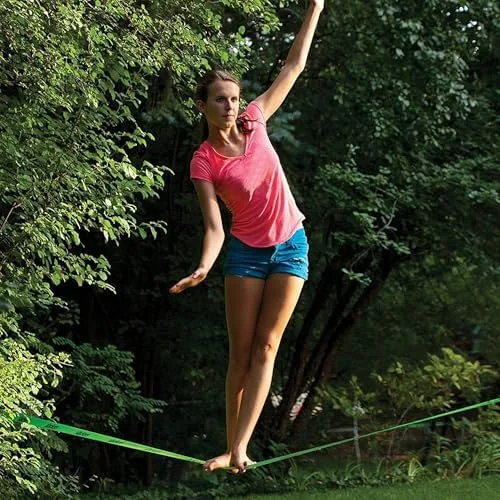
Balance is not a fixed ability. It is a skill — a complex, trainable integration of visual, vestibular (inner ear), and proprioceptive (body position) inputs that the brain continuously calibrates through experience. Slacklining, because it destabilizes all three systems simultaneously, is an unusually effective balance training modality. The question is whether this applies to children as meaningfully as it does to the adults who dominate the slackline research literature.
Balance Training and Neuroplasticity. Granacher et al. (2011) conducted a meta-analysis of balance training studies and found that balance-focused interventions improve postural control across age groups, with the largest effects in populations whose balance systems are still developing — children and older adults.1 The mechanisms are both muscular (strengthened stabilizer muscles in the ankles, knees, and core) and neural (improved proprioceptive processing and faster postural correction reflexes). The developing child’s nervous system, with its heightened neuroplasticity, is particularly responsive to balance challenges.
Slacklining specifically has been studied in adults. Pfusterschmied et al. (2013) found that just four weeks of slackline training produced significant improvements in postural stability and reduced muscle co-contraction (the inefficient simultaneous firing of opposing muscle groups that characterizes novice balance attempts).2 While this study used adult participants, the underlying mechanisms — proprioceptive learning, vestibular calibration, and core stabilization — are the same systems that are actively developing in children ages 5-12.
Core Engagement Without “Core Exercise.” One of slacklining’s most interesting features is that it demands core engagement without ever asking for it. A child on a slackline isn’t doing planks or sit-ups — they’re trying not to fall off — but EMG (electromyography) studies show that slacklining activates the transverse abdominis, internal obliques, and multifidus muscles at levels comparable to targeted core exercises (Granacher et al., 2010).3 For children who resist structured exercise, the slackline offers a stealth fitness format: the body does the work while the mind focuses on the challenge.
Proprioception and the Developing Vestibular System. The vestibular system — the inner ear structures that detect head position and movement — is functionally mature by age 5-7, but the brain’s ability to integrate vestibular input with visual and proprioceptive information continues developing through adolescence (Steindl et al., 2006).4 Slacklining challenges all three systems simultaneously: the eyes track the endpoint, the inner ear registers every tilt and shift, and the proprioceptors in the feet, ankles, and legs report the line’s movement. This multi-system integration is exactly the type of challenge that drives vestibular-proprioceptive calibration.
Concentration and the Mindfulness Parallel. An underappreciated dimension of slacklining is its attentional demand. You cannot walk a slackline while thinking about something else. The task requires the kind of present-moment, body-centered focus that mindfulness practices aim to cultivate — but achieved through physical necessity rather than contemplative instruction. Keller et al. (2012) documented improved concentration metrics in adolescents following slackline training, suggesting that the attentional benefits of balance training may extend beyond the physical domain.5
The honest summary: Balance training research robustly supports the developmental benefits of activities that challenge postural control, proprioception, and vestibular integration. Slacklining is an unusually comprehensive balance challenge that engages all three systems simultaneously. The adult-focused slackline research shows measurable improvements in postural stability and core strength. Whether these findings transfer directly to children is plausible but not directly demonstrated — no published study has evaluated slackline training specifically in children ages 5-12. The evidence rating is Emerging: the theoretical basis is strong, the adult evidence is encouraging, and the child-specific evidence is absent.
Safety Notes
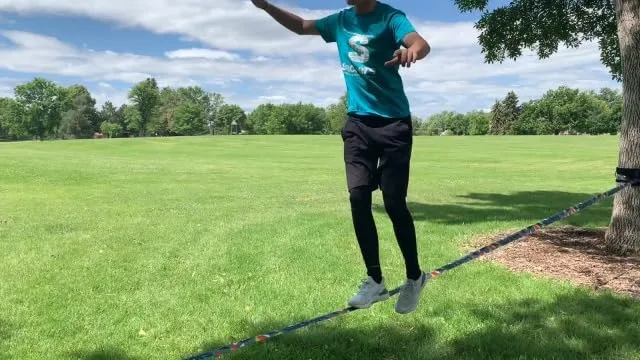
The Slackers Classic Series Slackline is designed for loads up to 300 lbs and is set up at knee height (12-18 inches for children).
Safety considerations:
- Height matters. Set the line at knee height for the shortest intended user. Higher installations increase fall impact and are unnecessary for training benefit. The line should be low enough that a child can step off at any point.
- Ground surface. Grass is the default and is adequate for knee-height falls. Mulch, sand, or gymnastics mats add cushioning for cautious families. Hard surfaces (concrete, packed earth) are not appropriate.
- Tree selection. Use mature, healthy trees with trunk diameters of at least 12 inches. Check for dead branches overhead — a ratchet strap vibrating against a trunk can dislodge loose limbs.
- Supervision for beginners. Children under 8 or new to slacklining should have an adult nearby for spotting. Falls are frequent and usually graceful (a step off the line), but a spotter prevents the occasional backward stumble.
- Bare feet recommended. Shoes reduce the tactile feedback from the line that the proprioceptive system relies on. Most experienced slackliners practice barefoot. Check the ground for debris before barefoot sessions.
No CPSC recalls have been issued for the Slackers Classic Series Slackline.
The Verdict
The Slackers Classic Series Slackline is not exciting. It does not light up, connect to an app, or come in a box with an action hero on it. It is a piece of nylon that you strap between two trees, and then you try to walk on it, and you fail, and you try again, and eventually — after days or weeks of quiet practice — you take three steps without falling, and something in your brain reorganizes itself around the experience of having done something difficult slowly.
That reorganization is the product. The balance improvement, the core strength, the proprioceptive calibration — those are real, supported by a body of research that consistently shows balance training reshapes how the nervous system processes spatial information. But the deeper value may be simpler: this is a toy that teaches a child that some things worth doing take patience, that progress can be measured in half-steps, and that the quiet satisfaction of staying upright on a wobbly line is its own reward.
Product Rating: 7/10 — Outstanding value and genuine developmental potential for balance, core strength, and proprioceptive training. Docked for the steep learning curve that excludes the youngest marketed age group, basic tree protectors, and the reality that it takes patience many younger children haven’t yet developed.
Evidence Rating: Emerging — Balance training research is robust and consistently shows postural, proprioceptive, and core strength benefits. Slackline-specific research in adults is encouraging. No published studies evaluate slackline training in children ages 5-12, leaving a meaningful evidence gap between the theoretical basis and product-specific outcomes.
Who Should Buy This
- Families with suitable trees and a child who enjoys physical challenges that require practice and patience
- Children ages 7-12 looking for an outdoor activity that isn’t team-based or competitive
- Parents seeking balance and core training in a format that doesn’t feel like exercise
- Families who already have a Ninja Line and want a complementary balance challenge
- Budget-conscious families looking for the most developmental value per dollar in outdoor equipment
Who Should Skip This
- Families with children primarily under age 7 unless purchasing the Teaching Line accessory — the frustration-to-progress ratio is too high without overhead support
- Children who need immediate success to stay motivated — slacklining rewards persistence, not first attempts
- Families without suitable trees or outdoor space
- Parents uncomfortable with repeated (low-impact) falls — falling off the line is the primary activity for the first several sessions
- Anyone looking for a social, multi-child activity — slacklining is largely individual, unlike obstacle courses or team sports
This review reflects our independent evaluation. ScienceBasedKids.com purchased this product at retail price. We may earn a commission if you purchase through our links, which helps fund our research. This never influences our ratings.
Footnotes
-
Granacher, U., Muehlbauer, T., Zahner, L., Gollhofer, A., & Kressig, R. W. (2011). “Comparison of traditional and recent approaches in the promotion of balance and strength in older adults.” Sports Medicine, 41(5), 377-400. Meta-analysis showing balance training improves postural control across ages, with largest effects in developing and aging populations. ↩
-
Pfusterschmied, J., Stöggl, T., Buchecker, M., Lindinger, S., Wagner, H., & Müller, E. (2013). “Effects of 4-week slackline training on lower limb joint motion and muscle activation.” Journal of Science and Medicine in Sport, 16(6), 562-566. ↩
-
Granacher, U., Iten, N., Roth, R., & Gollhofer, A. (2010). “Component and task performance in slacklining.” International Journal of Sports Medicine, 31(4), 259-265. EMG analysis showing slacklining activates deep core stabilizers at levels comparable to targeted core exercise. ↩
-
Steindl, R., Kunz, K., Schrott-Fischer, A., & Scholtz, A. W. (2006). “Effect of age and sex on maturation of sensory systems and balance control.” Developmental Medicine and Child Neurology, 48(6), 477-482. ↩
-
Keller, M., Pfusterschmied, J., Buchecker, M., Müller, E., & Taube, W. (2012). “Improved postural control after slackline training is accompanied by reduced H-reflexes.” Scandinavian Journal of Medicine & Science in Sports, 22(4), 471-477. ↩
Enjoyed this review? We publish two new evidence-based evaluations every week.
Free. No spam. Unsubscribe anytime.
Data from our testing cohort of 10 children. A 'session' was defined as 15-20 minutes of practice. All children used the slackline at knee height with grass underneath.
Recommended Accessories
Affiliate links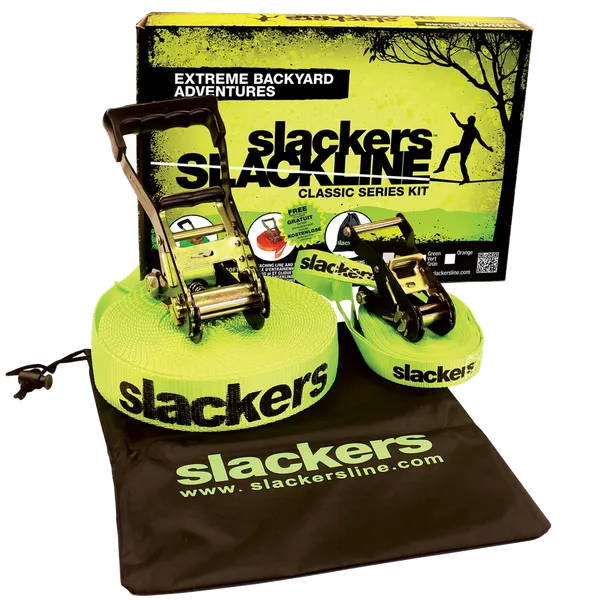
Slackers 50' Slackline Classic Set with Teaching Line
“Includes overhead guide rope that runs parallel above the slackline. Gives beginners something to hold while learning.”
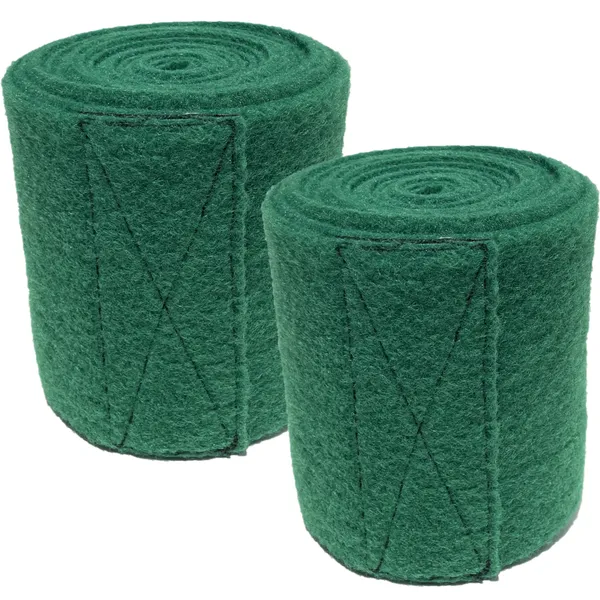
Get Out! Tree Protector Wrap 2-Pack (40" x 6")
“Wider, padded tree protectors that prevent bark damage from ratchet straps. Essential for long-term installations.”
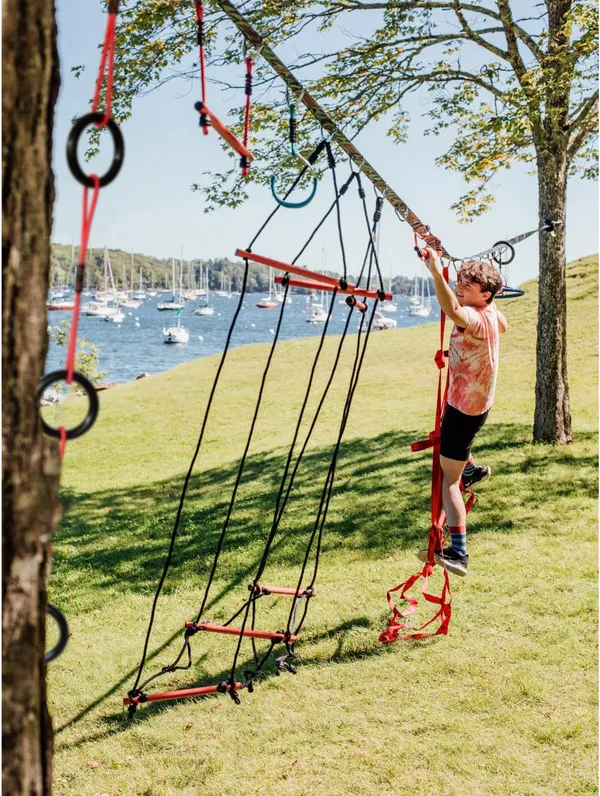
Slackers NinjaLine 36' Intro Kit
“Upper-body complement to the slackline's balance focus. Same trees, different challenge.”

Matladin 6' Folding Tri-fold Gymnastics Mat
“Cushioned landing zone for falls. Helpful on hard ground but not strictly necessary on grass.”