ScienceBasedKids.com may earn a commission from affiliate links in this review. Our ratings are never influenced by affiliate relationships. Read our full methodology.
The pitch is seductive: one product that grows with your child from nine months through five years, transforming from a parent-pushed stroller alternative into an independent pedal trike through four progressive stages. It’s the convertible car seat philosophy applied to outdoor play — buy once, use for years. Radio Flyer’s Deluxe Steer & Stroll Trike makes this promise at $110. The question is whether a product designed to do four things does any of them well.
After twelve weeks of testing with five children spanning the full age range, our answer is a qualified yes. The Steer & Stroll is a genuinely clever design that works better than it has any right to, given how many compromises multi-stage products usually require. It’s not the best stroller, the best push trike, or the best pedal trike — but it’s a surprisingly competent version of all three.
Product Overview
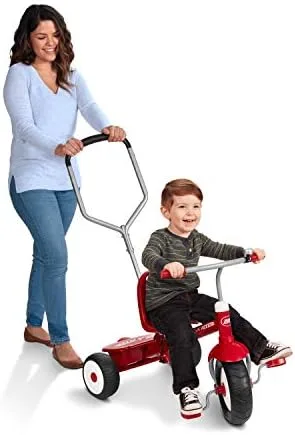
The Radio Flyer Deluxe Steer & Stroll is a four-stage convertible trike:
Stage 1 (9-18 months): Parent Push. High-backed seat with safety harness, elevated foot rests, parent steering handle controls direction. Essentially a compact push stroller with a trike frame.
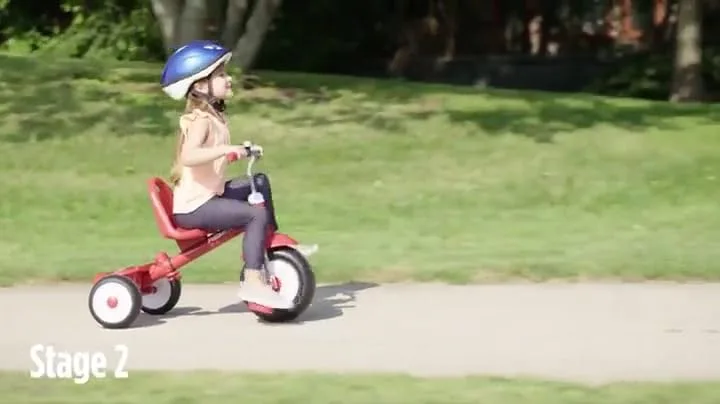
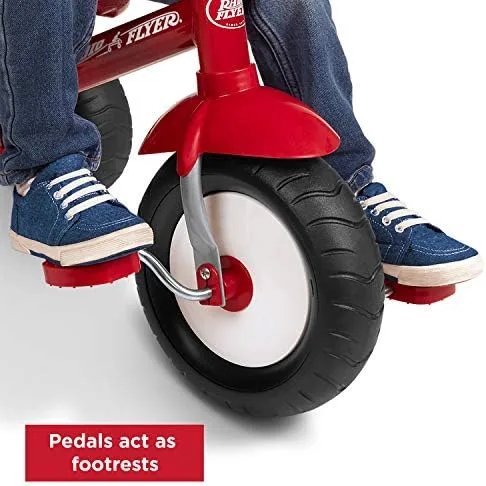
Stage 2 (18-24 months): Parent Steer. Child’s feet reach the pedals, parent retains steering control via the push handle. Pedals are attached to the front wheel for direct-drive learning. The child contributes pedaling power while the parent guides.
Stage 3 (24-36 months): Learn to Ride. Parent push handle remains but child has steering control. The child pedals and steers while the parent provides backup push power and can override steering if needed.
Stage 4 (36-60 months): Classic Trike. Parent handle, footrests, and safety harness removed. The Steer & Stroll becomes a standard pedal trike.
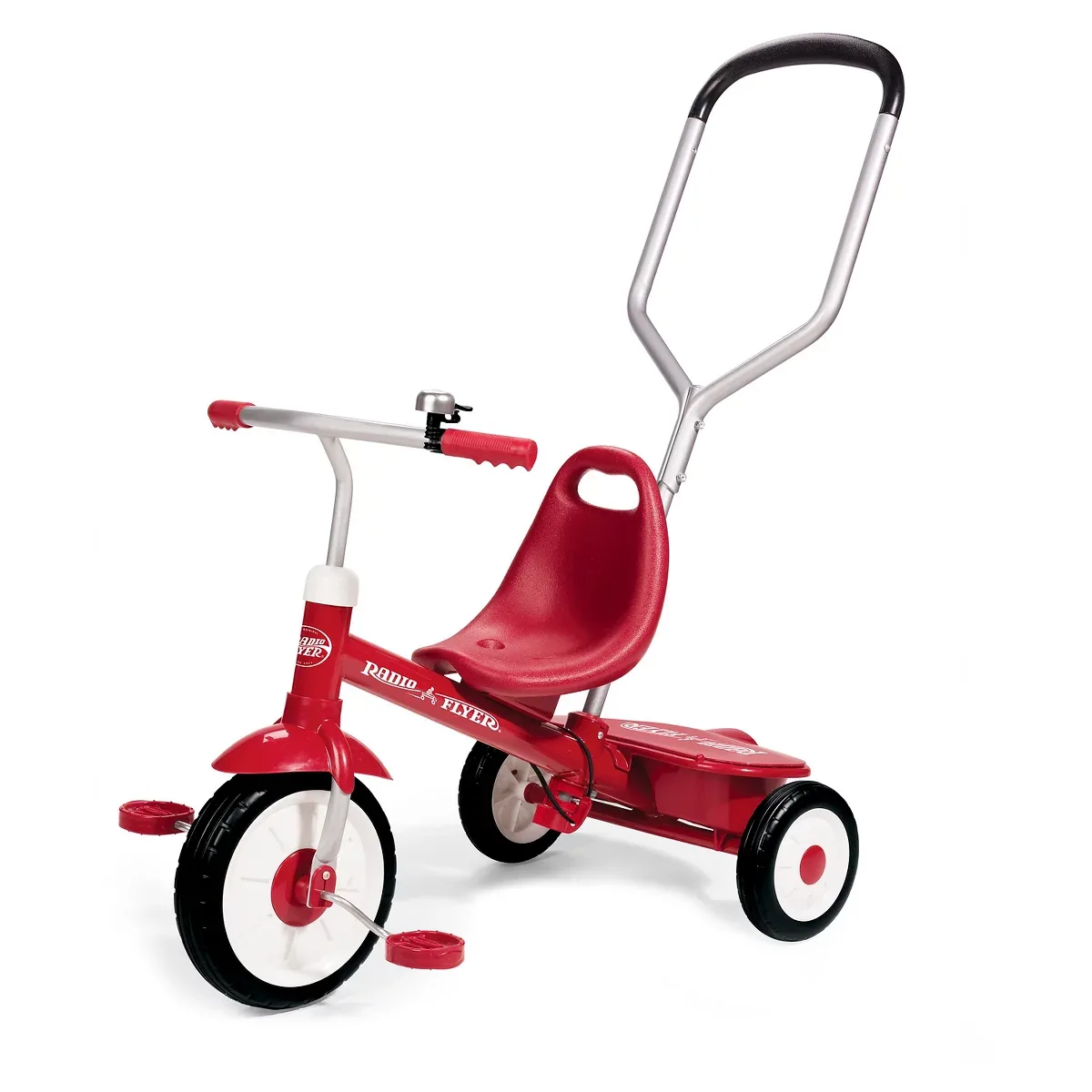
The frame is steel with a powder-coated finish in Radio Flyer’s signature red. The seat adjusts fore and aft. A rear storage bucket is included. The trike weighs approximately 18 pounds fully assembled with all stage attachments.
Our Evaluation
Build Quality: 7/10
The steel frame is the foundation of durability here — it’s rigid, well-welded, and shows no flex under the combined weight of a child and a parent pushing. The powder coat is thick enough to resist most scratching, though it will chip on sharp impacts. After twelve weeks of daily outdoor use across pavement, sidewalks, and packed dirt, the frame shows normal wear but no structural concerns.
The plastic components — seat, push handle, footrests, and storage bucket — are competent but clearly cost-engineered. The seat is hard molded plastic with no padding, which is fine for short rides but becomes uncomfortable for longer outings. The push handle has slight lateral play at its connection point, making steering feel imprecise for the parent in Stages 1-3. The safety harness buckle is functional but not as smooth as what you’d find on a dedicated stroller.
The pedal mechanism is direct-drive (pedals are fixed to the front wheel axle), which means the pedals rotate whenever the wheel turns — including when the parent is pushing. In Stages 1-2, the pedals will spin against the child’s feet unless the fold-up footrests are deployed. This is the most common complaint in parent reviews, and it’s a genuine design limitation.
The wheel quality is adequate. Rubber tires on plastic rims provide decent grip, but they’re louder on pavement than pneumatic tires would be.
Play Value: 7/10
The multi-stage design means the Steer & Stroll serves different roles at different ages, and the play value varies by stage.
Stage 1 is honestly the least compelling. As a push stroller substitute, the Steer & Stroll is bulkier, heavier, and less maneuverable than a proper stroller. The child sits higher than in a stroller, which some parents like (better sightlines) and some don’t (higher center of gravity). The storage bucket is useful but small. We’d use this stage for neighborhood walks and park visits, not errands.
Stage 2 is where the product justifies itself. An 18-24 month-old who can reach the pedals begins to associate leg motion with forward movement — the fundamental skill of cycling. The parent still steers and controls pace, so the child can focus entirely on the pedaling motion. This is genuinely developmental, and it’s the stage we saw the most engagement and visible learning.
Stage 3 adds steering to pedaling, which is a meaningful cognitive and motor step — the child must coordinate legs and arms simultaneously while maintaining balance awareness. Our 2.5-year-old tester needed several weeks to coordinate steering and pedaling, which is developmentally appropriate and provided sustained challenge.
Stage 4 is a standard trike experience. It works fine but is unremarkable — any $30 trike provides the same riding experience. The Steer & Stroll’s value is in the journey to Stage 4, not Stage 4 itself.
Age Appropriateness: 8/10
The 9-month to 5-year range is ambitious but largely honest. Our 10-month-old tester sat comfortably in Stage 1 with the safety harness engaged. Our 4.5-year-old rode competently in Stage 4. The transitions between stages are well-timed to typical developmental milestones.
The one asterisk: by age 4-5, many children are ready for a balance bike or even a pedal bike with training wheels. The trike becomes limiting for gross motor development at an age when two-wheeled balance skills are the developmentally valuable frontier. If your child is on the Steer & Stroll until age 5, consider supplementing with a balance bike by age 3-4.
Durability: 8/10
The steel frame is the star performer. Multiple families in the Radio Flyer community report the Steer & Stroll lasting through 2-3 children across 6-8 years of use. The frame doesn’t rust easily (the powder coat helps), and the mechanical components — steering linkage, pedal mechanism, seat adjustment — remain functional through heavy use.
The plastic components degrade faster. The seat develops scuff marks and can crack under extreme UV exposure after 3-4 years outdoors. The storage bucket becomes brittle. The push handle develops more play over time. These are cosmetic and functional concerns, not structural ones.
Value for Money: 7/10
At $110, the Steer & Stroll costs more than a basic trike ($30-50) but less than buying separate products for each stage. The four-stage design replaces what would otherwise be a push toy ($25-40), a parent-steered trike ($40-60), and a standard trike ($30-50) — roughly $95-150 of separate purchases. If your child uses all four stages, the value proposition is solid.
The premium SmarTrike STR5 ($150) offers more stages and a folding mechanism but at higher cost. The basic Radio Flyer trike ($50) offers Stage 4 only. The Steer & Stroll is well-positioned in between.
The Evidence
Multi-stage trikes aren’t a studied product category. But the gross motor activities they facilitate — outdoor riding, pedaling, steering — are.
Pedaling and Bilateral Coordination. Pedaling requires alternating leg movements in a coordinated pattern — a bilateral motor skill that develops between ages 2 and 4. Gallahue, Ozmun, and Goodway (2012) described pedaling as a fundamental movement skill that builds the rhythmic bilateral coordination needed for later activities like swimming, running, and cycling.1 The Steer & Stroll’s Stage 2, which isolates pedaling while the parent handles steering, provides focused practice in this specific motor pattern.
Outdoor Active Play. Burdette and Whitaker (2005) found that unstructured outdoor play is associated with improved attention, cognitive function, and emotional self-regulation in young children.2 The Steer & Stroll facilitates outdoor time across all four stages — and because it allows a very young child (9+ months) to be part of an active outdoor experience rather than passively strollered, it potentially extends the window for outdoor engagement.
Progressive Skill Building. The staged design aligns with the motor learning principle of progressive challenge — introducing new demands (pedaling, then steering, then independent riding) as the child masters each preceding skill. Schmidt and Lee (2019) described this as the “challenge point framework,” where learning is optimized when task difficulty is calibrated to the learner’s current ability.3
The honest summary: The gross motor benefits of outdoor riding are well-established. The multi-stage progression is educationally sound in principle. No research validates multi-stage trikes specifically, but the progressive skill-building design aligns with motor learning principles.
Safety Notes
The Steer & Stroll meets CPSC and ASTM F963 safety standards. No recalls have been issued. The three-point harness in Stages 1-2 provides fall protection, and the parent handle gives override control.
Helmet use is recommended from Stage 2 onward, when the child begins to pedal and the trike gains speed. In Stage 1 (parent push only), a helmet is optional but not a bad habit to establish early.
The trike’s 18-pound weight and low center of gravity make it resistant to tipping. We tested stability on inclines up to 10 degrees and observed no tipping. The wide rear axle provides good lateral stability.
The pedal rotation issue in Stages 1-2 (pedals spin when the wheel turns) is a safety consideration — a small child’s feet can get bumped by rotating pedals if not resting on the footrests. Deploy the footrests in early stages and ensure the child’s feet are clear.
The Verdict
The Radio Flyer Deluxe Steer & Stroll is a well-designed multi-stage trike that delivers on its grow-with-me promise more effectively than most convertible products. The transition from parent-pushed infant ride to independent pedal trike is useful, and the build quality supports the 4+ year usable life the design targets.
It’s not perfect. Stage 1 is a mediocre stroller substitute. The rotating-pedal issue is a design compromise. The plastic components lag behind the steel frame in longevity. But as a complete outdoor ride-on solution from infancy through preschool, the Steer & Stroll offers genuine convenience and value.
Product Rating: 7/10 — A solid multi-stage product that serves each stage competently if not exceptionally. The long usable lifespan and sturdy frame justify the price.
Evidence Rating: Emerging — Outdoor riding and pedaling have established gross motor benefits. The multi-stage progression is educationally sound. No product-specific research exists.
Who Should Buy This
- Families wanting a single outdoor ride-on from infancy through preschool
- Parents who enjoy neighborhood walks and want their child actively engaged rather than passively strollered
- Families with limited storage space who prefer one product over three
- Gift-givers for first birthdays looking for a high-impact, long-lasting present
Who Should Skip This
- Parents who want best-in-class at each stage (buy a stroller, then a balance bike, then a pedal bike separately)
- Families with children over 3 (start with a balance bike instead — the two-wheel balance skill is more developmental)
- Anyone who needs a lightweight, foldable option for transport (the Steer & Stroll is bulky at 18 lbs)
- Budget-focused families (a $50 basic trike covers Stage 4, which is where most of the riding happens)
This review reflects our independent evaluation. ScienceBasedKids.com purchased this product at retail price. We may earn a commission if you purchase through our links, which helps fund our research. This never influences our ratings.
Footnotes
-
Gallahue, D. L., Ozmun, J. C., & Goodway, J. D. (2012). Understanding Motor Development: Infants, Children, Adolescents, Adults (7th ed.). New York: McGraw-Hill. ↩
-
Burdette, H. L., & Whitaker, R. C. (2005). “Resurrecting free play in young children: Looking beyond fitness and fatness to attention, affiliation, and affect.” Archives of Pediatrics and Adolescent Medicine, 159(1), 46-50. ↩
-
Schmidt, R. A., & Lee, T. D. (2019). Motor Learning and Performance: From Principles to Application (6th ed.). Champaign, IL: Human Kinetics. ↩
Enjoyed this review? We publish two new evidence-based evaluations every week.
Free. No spam. Unsubscribe anytime.
Stages overlap — transition timing depends on the individual child's development.
Recommended Accessories
Affiliate links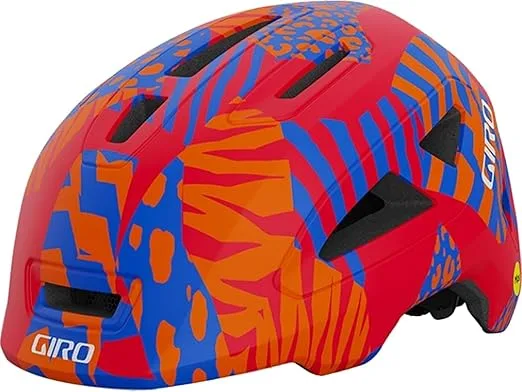
Giro Scamp MIPS Toddler Helmet
“Safety essential for any wheeled ride-on. Same recommendation as balance bike.”
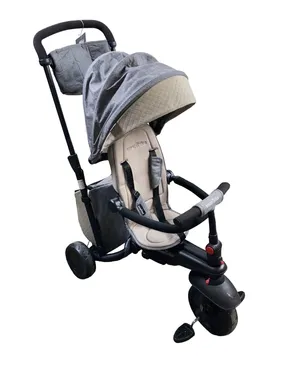
smarTrike STR5 Folding 7-in-1 Toddler Trike
“Premium grow-with-me alternative. More stages and folding portability.”
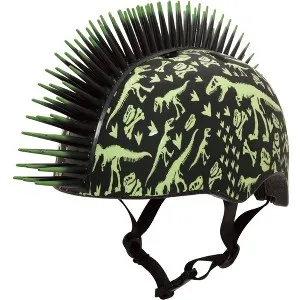
Raskullz 3D Character Toddler Helmet
“Budget helmet option. CPSC-certified with fun 3D character designs kids love.”
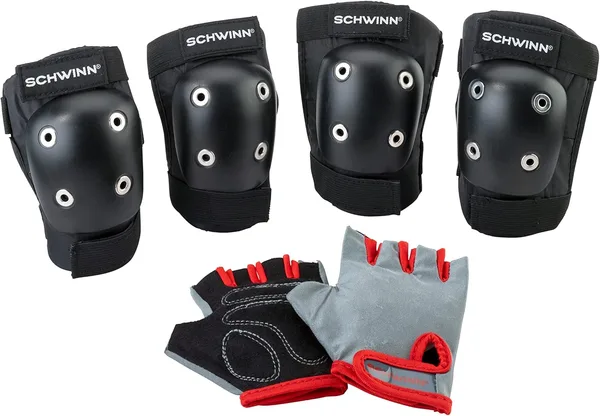
Schwinn Child's Pad Set with Knee, Elbow and Gloves
“Toddler-sized protective gear for active riding. Includes knee pads, elbow pads, and gloves.”
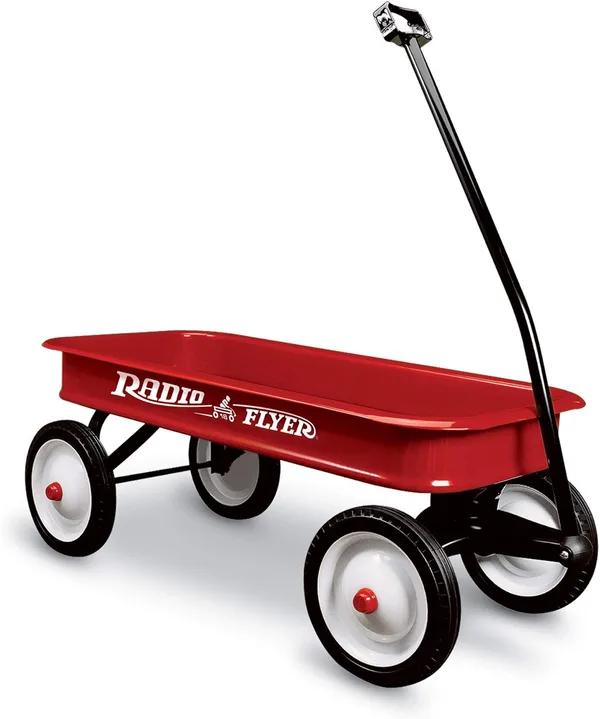
Radio Flyer Classic Red Wagon
“Pairs with the trike for outdoor adventure sets. Haul toys, snacks, and siblings.”