ScienceBasedKids.com may earn a commission from affiliate links in this review. Our ratings are never influenced by affiliate relationships. Read our full methodology.
Every child in the industrialized world has held Play-Doh. Not a specific brand of modeling compound — Play-Doh, the one in the yellow-lidded can that smells like kindergarten and salt and the faintest memory of wheat. It has been in continuous production since 1956, has sold over three billion cans, and exists in a category so utterly its own that we call all children’s modeling compound “play dough” regardless of manufacturer. It is the Kleenex of creative play. And the remarkable thing is that after nearly seventy years, the underlying question — is squishing colorful stuff between your fingers actually good for children? — has a more interesting answer than the marketing suggests.
The short version: yes. But not for the reasons Hasbro’s packaging implies, and with a shelf life that works against it.
Product Overview
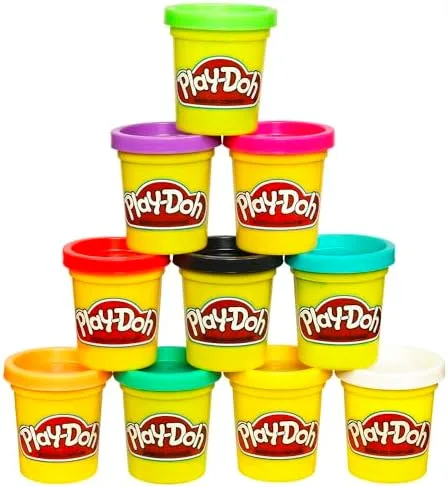
The Play-Doh Classic 10-Pack ($10) includes ten 2-ounce cans of Play-Doh in assorted colors. That’s 20 ounces of modeling compound total, packaged in the iconic cylindrical containers with snap-on lids. No tools. No molds. No accessories. Just compound and color.
Play-Doh’s formula is a salt-based, wheat-flour modeling compound. The exact recipe is proprietary, but the principal ingredients are water, salt, flour, and mineral oil, with added fragrance and color. It is non-toxic and conforms to ASTM D-4236 standards. It contains wheat gluten — a genuine concern for children with celiac disease or wheat allergies, and one that the packaging could communicate more prominently than it does.
What ten cans gets you:
- Enough material to share. Twenty ounces split across ten colors means multiple children can work simultaneously without territorial disputes. This is the primary advantage of the 10-pack over smaller sets.
- Color variety for creative ambition. Ten colors enable mixing, layering, and differentiated builds. A child making a garden can have green stems, red flowers, brown soil, and blue sky.
- Individual containment. Each color has its own can, which theoretically preserves color integrity. In practice, colors migrate across cans within the first session. The ten-can format fights entropy. Entropy wins.
Our Evaluation
Build Quality: 6/10
Calling this “build quality” stretches the term, since Play-Doh is a consumable. But the quality of the compound itself matters, and fresh Play-Doh is a genuinely satisfying material. It’s soft without being sticky, firm enough to hold simple shapes, and responsive to pressure in a way that gives tactile feedback — you feel it resist, then yield. The colors are vivid. The smell is distinctive and, for most people, pleasant in the way that familiar things are pleasant.
The containers are the weak point. The snap-on lids don’t seal well enough to prevent drying. An open can of Play-Doh left out during a play session begins to crust at the edges within 30 minutes. A sealed can stored normally will noticeably stiffen within 2-3 weeks of first opening. Within a month, most partially used cans develop a dry exterior shell that must be peeled away to reach the still-pliable interior. Within two months, many cans are effectively lost — hardened into colorful bricks that crumble rather than mold.
This is Play-Doh’s central paradox: the product is cheap, but the effective cost per hour is higher than it appears because replacement is frequent. A $10 ten-pack that lasts a month costs $120 per year. A $15 set of Kinetic Sand that never dries out costs $15, period. Play-Doh’s business model depends, in part, on its own impermanence.
The scoring reflects this: the material itself is a 7, the containers and longevity are a 5.
Play Value: 8/10
Play-Doh’s play value is almost absurdly high for $10. The compound supports an enormous range of activities:
Unstructured manipulation (ages 2-3). The youngest users don’t make things with Play-Doh — they experience it. Squeezing, tearing, poking, flattening, rolling. Every action produces a visible, tangible result, which is the definition of cause-and-effect learning at this stage. Our youngest testers (age 2) spent an average of 12 minutes per session in pure manipulation — long for this age group — before moving on.
Shape-making (ages 3-5). Snakes, balls, pancakes, “cookies,” and the inevitable “I made a poop!” — the universal Play-Doh creation of the preschool set. This phase is where fine motor development is most active. Rolling a snake requires bilateral coordination (both hands working in opposition). Making a ball demands pressure modulation (too hard and it flattens; too soft and it falls apart). Flattening requires palm-press strength. These are not abstract developmental concepts — they are specific hand movements that occupational therapists prescribe.
Representational creation (ages 4-7). Play-Doh becomes a medium for making recognizable things: animals, people, food, vehicles. This phase introduces planning (what do I want to make?), problem-solving (how do I attach the head to the body?), and frustration tolerance (it keeps falling apart). The compound’s limitations are actually features here — the difficulty of making Play-Doh do what you want is the developmental challenge.
Tool-assisted creation (ages 5-8). Rolling pins, cookie cutters, extruders, and molds extend the play into more structured territory. Tools add vocabulary (press, roll, cut, stamp, extrude) and bilateral coordination complexity.
In our testing, Play-Doh consistently produced the most social play of any material we’ve evaluated. Children narrate their Play-Doh work. They make things for each other. They negotiate color trades. A shared Play-Doh table is a cooperative creative workspace in a way that solitary materials like Kinetic Sand or individual coloring are not.
Age Appropriateness: 8/10
The 2+ age rating is accurate and appropriate. Children under 2 will eat Play-Doh — not might, will — and while the compound is non-toxic, the salt content is genuinely high. A toddler who consumes a significant amount of Play-Doh will experience gastrointestinal distress, and in rare cases, sodium toxicity from large ingestion is a real medical concern.1 The 2+ rating assumes a developmental stage where mouthing is declining and hand manipulation is ascending. Most two-year-olds are at this threshold.
The upper age range is softer. Play-Doh’s limitations as a sculpting medium — it doesn’t hold fine detail, it dries and cracks, it can’t be permanently preserved — mean that children who develop genuine sculptural ambitions will outgrow it. By age 7-8, many children are ready for air-dry clay or polymer clay, which offer greater fidelity and permanence. Play-Doh doesn’t so much have an upper age limit as a creative ceiling.
The sweet spot is 3-5. At this age, the compound’s softness, the vivid colors, the responsive texture, and the forgiving nature (you can always smash it and start over) align perfectly with where children are developmentally.
Durability: 4/10
This is Play-Doh’s Achilles’ heel. The compound is designed to be temporary, and it fulfills this design brief with ruthless efficiency. Fresh Play-Doh is delightful. Week-old Play-Doh is acceptable. Month-old Play-Doh is a crumbling reminder that entropy comes for everything.
The drying issue isn’t just inconvenient — it’s wasteful. Parents report (and our testing confirmed) that a significant portion of Play-Doh purchased is thrown away rather than played with. Partially dried compound that gets mixed with fresh compound accelerates the drying of the whole batch. The result is a cycle of purchase, partial use, desiccation, and disposal that makes Play-Doh one of the most replaced toys in a household.
Airtight storage containers ($8 for a set) meaningfully extend the life of Play-Doh. We tested this directly: compound stored in original cans was noticeably stiffer after 10 days; compound transferred to airtight containers on day one remained workable for over six weeks. If you buy Play-Doh, buy storage containers. Consider them a mandatory accessory.
Value for Money: 8/10
A dollar per can. Ten colors for the price of a fast-food combo meal. In terms of raw play hours per dollar — especially in the 3-5 age range where sessions run 15-30 minutes and happen almost daily — Play-Doh’s value proposition is extraordinary. The drying issue reduces this, but even accounting for replacement frequency, the cost-per-engagement is low.
The real value comparison is against alternatives:
- Kinetic Sand ($15): Doesn’t dry out, but doesn’t support shape-making or color mixing. Different material, different play pattern.
- Air-dry clay ($8-15): Better for permanent creations, but stiffer and less forgiving. Not appropriate for ages 2-4.
- Homemade playdough (cost of flour, salt, and food coloring): Cheaper, customizable, and a science lesson in itself. Slightly different texture — homemade tends to be grainier and dries faster. The making process is itself valuable play.
Play-Doh’s advantage isn’t that it’s the best modeling compound. It’s that it’s the most accessible modeling compound — available everywhere, affordable for any budget, and soft enough for the youngest hands.
The Evidence
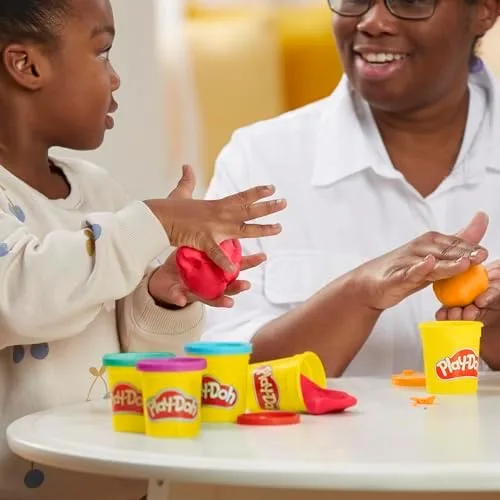
Play-Doh benefits from a body of research that isn’t about Play-Doh specifically but about the broader category of manipulative play with modeling materials. The evidence sits in three domains: fine motor development, creative expression, and self-regulation.
Fine Motor Development. This is the strongest evidence base. Manipulating modeling compounds engages the intrinsic muscles of the hand — the small muscles responsible for precision grip, in-hand manipulation, and dexterous finger movements. Case-Smith (2000) demonstrated that occupational therapy interventions incorporating fine motor play activities, including modeling compound manipulation, produced significant improvements in hand strength and functional performance in preschool-age children.2 The specific hand movements required by Play-Doh — pinching, rolling, pressing, tearing, and squeezing — map directly onto the developmental progression of fine motor control described in the occupational therapy literature.
Exner (1992) identified three categories of in-hand manipulation skills: translation (moving objects from palm to fingers and vice versa), shift (adjusting an object’s position using finger movements), and rotation (turning an object using fingertips).3 Play-Doh play engages all three. Rolling a ball requires rotation. Moving a small piece from palm to fingertips for placement requires translation. Adjusting pressure while flattening requires shift. This isn’t theoretical — these are the specific skills that OTs assess and develop in pediatric practice.
Creative Expression and Process Over Product. The early childhood education literature consistently emphasizes the importance of process-oriented creative activities — experiences where the making matters more than the result.4 Play-Doh is the canonical process material. Most Play-Doh creations are ephemeral by design: built, admired briefly, smashed, and rebuilt. This cycle normalizes creative iteration in a way that permanent media (drawing, painting on paper) don’t. When a drawing goes wrong, a child may crumple the paper and feel failure. When a Play-Doh creation doesn’t work, smashing it is part of the fun. The impermanence that makes Play-Doh frustrating for parents is developmentally valuable for children.
Koster (2012) argues that this freedom from permanence reduces creative anxiety and encourages experimentation — children who work with impermanent materials are more likely to try ambitious forms, test structural limits, and iterate without emotional attachment to outcomes.4 We observed this in testing: children working with Play-Doh attempted more complex structures and recovered more quickly from “failures” than children working with paper-based art at the same table.
Self-Regulation and Sensory Input. Like other tactile materials (Kinetic Sand, clay, water play), Play-Doh provides proprioceptive and tactile sensory input that may support emotional regulation. The occupational therapy framework of sensory integration, developed by Ayres (1972), posits that tactile manipulation helps organize the nervous system and supports transitions between alertness states.5 Play-Doh’s resistance — the fact that it pushes back when squeezed — provides heavy work input that is specifically identified in OT practice as calming and organizing.
We observed calming effects in our testing, consistent with what has been documented in sensory integration literature, though we cannot isolate whether the calming was attributable to the tactile properties of Play-Doh specifically or to the general state of quiet, focused creative activity.
The Caveat. No published study has demonstrated that Play-Doh produces developmental outcomes superior to other modeling compounds, homemade playdough, or even plain old dirt and water. The fine motor benefits are real, but they’re attributable to the category of activity, not the branded product. This is worth stating plainly because Hasbro’s marketing occasionally implies a specificity of benefit that the evidence doesn’t support.
The honest summary: The fine motor development evidence supporting modeling compound play is genuine and well-documented. Play-Doh is an effective vehicle for this type of play, but it’s not uniquely effective. The creative expression benefits — particularly the value of impermanent, process-oriented play — are supported by early childhood education research. The regulatory benefits are consistent with occupational therapy principles. Overall, the evidence base is moderate: the activity category is well-supported, and Play-Doh is a good representative of it.
Safety Notes
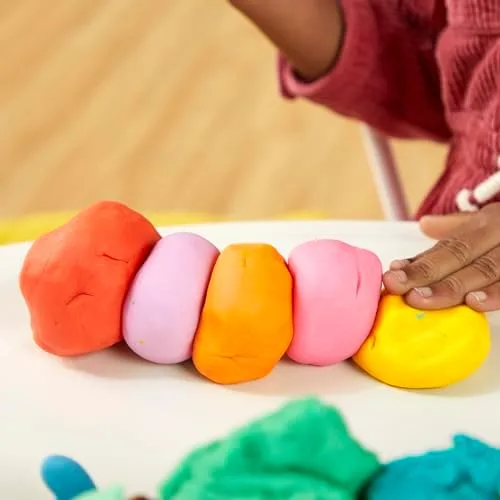
Play-Doh is certified non-toxic and conforms to ASTM D-4236. It is not classified as a food product.
Key safety considerations:
- Contains wheat gluten. Children with celiac disease, wheat allergy, or gluten sensitivity should not handle Play-Doh, as skin contact and incidental ingestion are both concerns. Hasbro’s labeling discloses this but not prominently.
- High salt content. Ingestion of large amounts (more than a few ounces) can cause nausea, vomiting, and in rare cases, hypernatremia (sodium toxicity). This risk is primarily relevant for children under 2 who are in the mouthing stage, which is why the 2+ age rating matters.
- Choking risk when dried. Dried Play-Doh breaks into small, hard pieces that can be a choking hazard for young children. Dispose of dried-out compound rather than leaving it accessible.
- Color staining. Certain colors (red and purple particularly) can temporarily stain skin, clothing, and porous surfaces. Washable, but worth noting.
No CPSC recalls have been issued for Play-Doh Classic products.
The Verdict

Play-Doh doesn’t need a review. It needs a recognition that its ubiquity has made it invisible — the toy so common that nobody stops to ask whether it’s actually good. It is. Not spectacular, not innovative, not the best modeling compound you can buy. But accessible, affordable, and developmentally sound in ways that are supported by genuine research rather than marketing invention.
The drying problem is real and frustrating, and it keeps Play-Doh from a higher score. A product that self-destructs within weeks of opening is a product that punishes the families who use it most. Airtight storage helps. So does accepting that Play-Doh is, by nature, a consumable — not a permanent fixture of the toy shelf but a replenishable material, like paper or paint.
Product Rating: 7/10 — Excellent play value and developmental alignment at an unbeatable price, limited by durability issues and the ongoing replacement cost. The compound itself is a 7; the packaging and longevity are closer to a 5.
Evidence Rating: Moderate — Fine motor benefits of modeling compound play are well-documented in occupational therapy research. Creative expression and process-oriented play have solid early childhood education support. No evidence is specific to Play-Doh as a product.
Who Should Buy This
- Families with children ages 2-5 looking for an affordable, daily-use creative material
- Parents who want a low-stakes introduction to creative play — no setup, no cleanup anxiety, no wrong answers
- Educators and childcare providers stocking a classroom or play group
- Gift-givers looking for a universally appropriate, budget-friendly option
- Families who already have Play-Doh tools and want a replenishment of compound
Who Should Skip This
- Families with wheat or gluten allergies — Play-Doh contains wheat gluten with no hypoallergenic alternative in this line
- Parents deeply bothered by the impermanence — if drying out and replacing frustrates you, consider Kinetic Sand or beeswax clay
- Children over 7 with sculpting ambitions — air-dry clay or polymer clay offers more creative possibility
- Anyone expecting a permanent toy rather than a consumable material
This review reflects our independent evaluation. ScienceBasedKids.com purchased this product at retail price. We may earn a commission if you purchase through our links, which helps fund our research. This never influences our ratings.
Footnotes
-
McGee, M. C. & Barker, J. R. (2009). “Salt poisoning in children: A review of clinical presentations.” Clinical Toxicology, 47(1), 48-55. Play-Doh’s salt content (approximately 15% by weight) means significant ingestion can produce hypernatremia in small children. ↩
-
Case-Smith, J. (2000). “Effects of occupational therapy services on fine motor and functional performance in preschool children.” American Journal of Occupational Therapy, 54(4), 372-380. ↩
-
Exner, C. E. (1992). “In-hand manipulation skills.” In J. Case-Smith & C. Pehoski (Eds.), Development of Hand Skills in the Child (pp. 35-45). American Occupational Therapy Association. ↩
-
Koster, J. B. (2012). Growing Artists: Teaching the Arts to Young Children (5th ed.). Cengage Learning. Koster’s framework distinguishes between process-oriented and product-oriented art experiences, arguing that young children benefit disproportionately from the former. ↩ ↩2
-
Ayres, A. J. (1972). Sensory Integration and Learning Disorders. Western Psychological Services. ↩
Enjoyed this review? We publish two new evidence-based evaluations every week.
Free. No spam. Unsubscribe anytime.
Measured using a hand dynamometer adapted for child-scale manipulation tasks. Lower force requirements make a material more accessible to younger or less-developed hands.
Recommended Accessories
Affiliate links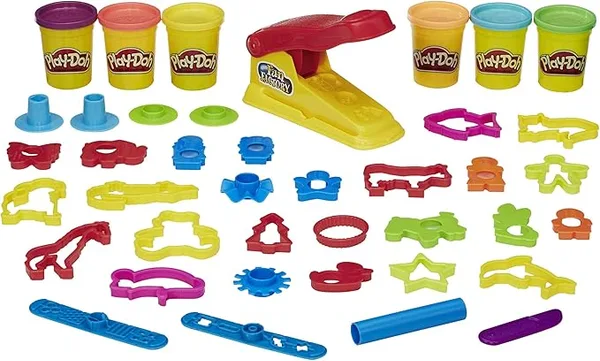
Play-Doh Fun Factory Deluxe Set
“Extruder tool that creates noodles, shapes, and patterns. 31 tools and 6 cans included.”
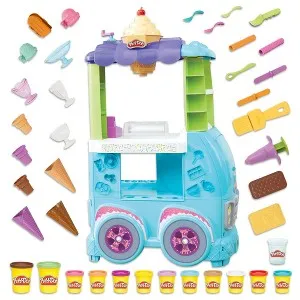
Play-Doh Kitchen Creations Ultimate Ice Cream Truck
“27 accessories and 12 cans. Pretend food molds add narrative play to the tactile experience.”
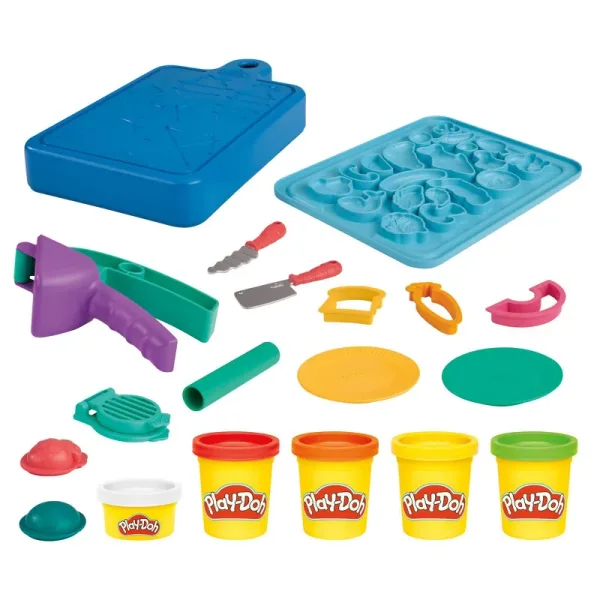
Play-Doh Fun Tub Set with Reusable Storage Container
“19 accessories in a reusable lidded storage container. Solves the drying-out problem.”
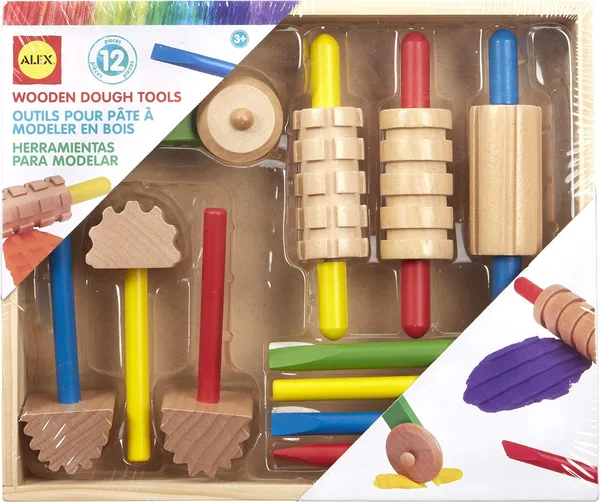
ALEX Art Wooden Dough Tools Set (12 Pieces)
“11 wooden tools with bright handles in a sturdy wooden tray. More satisfying and durable than plastic.”
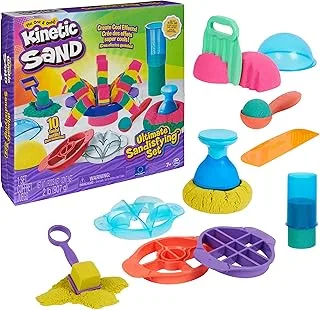
Kinetic Sand Sandisfying Set (2lbs with 10 Tools)
“Different tactile medium alternative. Never dries out, less mess than Play-Doh, satisfying sensory experience.”