ScienceBasedKids.com may earn a commission from affiliate links in this review. Our ratings are never influenced by affiliate relationships. Read our full methodology.
Here is something we almost never get to write: the research backing this toy actually exists. Not “research supports the general concept.” Not “studies suggest that this type of play might be beneficial.” Actual, published, peer-reviewed research on the pedagogical framework that this specific product implements. In a portfolio of 100 toy reviews, the Numberblocks MathLink Cubes are one of perhaps three products where we can say that.
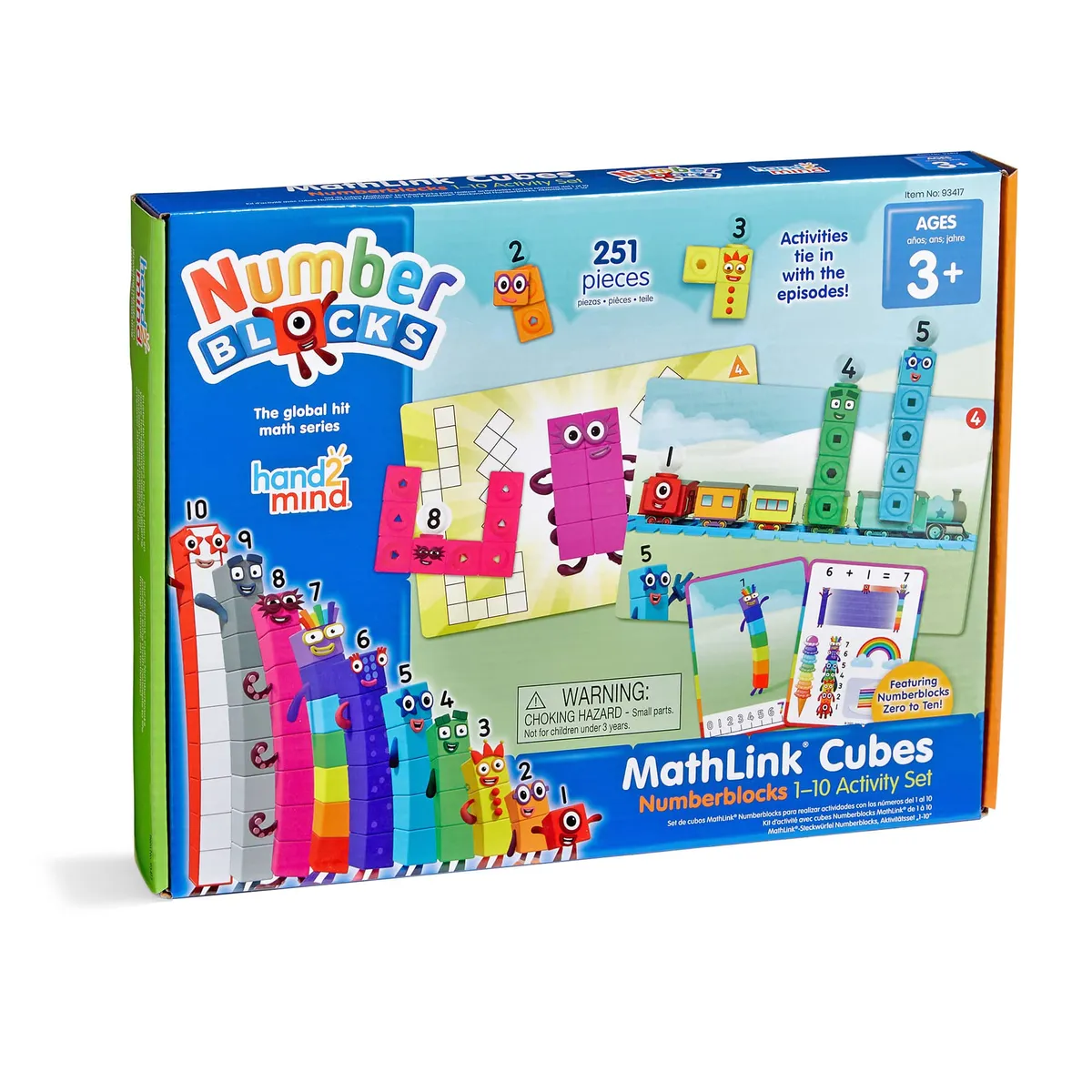
Numberblocks is a BBC children’s show about animated characters who are numbers — literally, block-shaped beings whose height corresponds to their value. One is one block tall. Five is five blocks stacked. When they combine, they add. When they separate, they subtract. The MathLink Cubes from Learning Resources are the physical incarnation of this concept: interlocking cubes with Numberblocks character face stickers that children assemble into the characters from the show. It sounds like standard licensed merchandise. It is not.
Product Overview
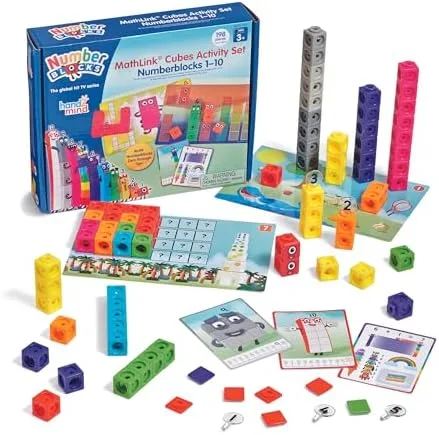
The Numberblocks MathLink Cubes 1-10 Activity Set includes:
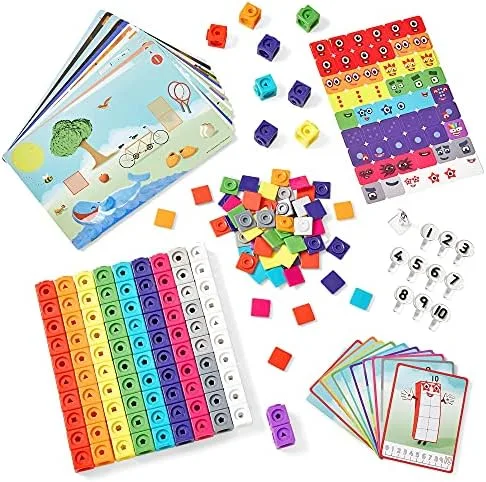
- 100 MathLink cubes in 10 colors (one color per number character)
- Character face stickers for numbers 1 through 10
- Number stickers and eye stickers for customization
- 30 activity cards with structured math challenges
- A foam “number line” strip
- Supporting guide for parents
The cubes snap together along any face, creating satisfying click-together connections that hold firmly but pull apart easily. Each cube is approximately 2cm — small enough for preschool fingers but a potential choking hazard for children under 3 (a 2cm cube fits inside the CPSC small parts cylinder, which has a 3.17cm diameter). The colors correspond to the show’s character palette: red for One, orange for Two, yellow for Three, and so on through the rainbow.
Learning Resources has been producing MathLink Cubes for decades as classroom manipulatives. The Numberblocks license is a relatively recent addition (2020), applying a media-based hook to an existing educational tool. This matters: the underlying product is a proven classroom manipulative, not a toy designed to look educational.
Our Evaluation
Build Quality: 8/10
MathLink Cubes are classroom-grade manipulatives adapted for home use, and the build quality reflects that heritage. The cubes snap together with a firm, audible click and hold their connections securely — a child can pick up a completed “Five” character by the head without the lower cubes detaching. The plastic is thick and rigid, with no flex or fragility.
The stickers are the weak point. Character face stickers begin peeling within 2-3 weeks of regular handling by preschool-age children. The sticker sheet includes extras, but the underlying issue is that sticker adhesion isn’t designed for the amount of handling these cubes receive. Several parent reviews report applying a clear coat or replacing stickers with a permanent marker face — functional workarounds for a genuine design compromise.
The cubes themselves are virtually indestructible. We attempted to break them through normal (and abnormal) play scenarios and failed. The snap connections show no degradation after months of daily assembly and disassembly. These are built to survive years of classroom use, which means home use is a breeze.
Play Value: 7/10
The play value of MathLink Cubes is tightly coupled to the Numberblocks show. Children who watch the show engage with the cubes at a fundamentally different level than children who don’t — and this is by design.
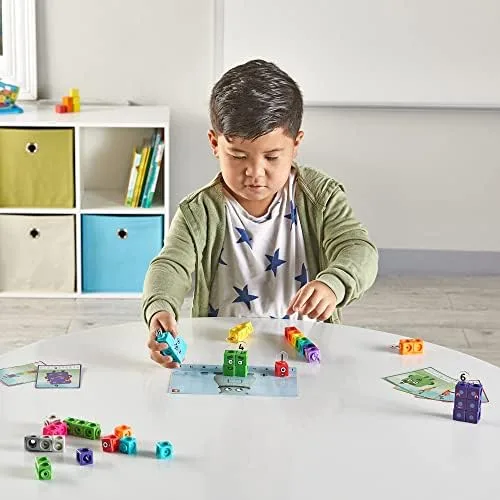
For Numberblocks viewers, the cubes are characters with personalities, stories, and relationships. Building “Six” isn’t just stacking six cubes — it’s creating a character who has friends, goes on adventures, and can split into “Three and Three” or “Two and Two and Two.” The show provides narrative scaffolding that transforms a math manipulative into a toy. In our testing, children familiar with the show spent 25-40 minutes per session with the cubes, frequently narrating scenarios from episodes while building and rebuilding characters.
For children unfamiliar with the show, the cubes are a solid but unremarkable snap-together building toy. Play sessions averaged 10-15 minutes, with children building towers and shapes but lacking the narrative engagement that drives extended play. This dependency on the media property is the product’s most significant limitation — and its most honest feature. The show is free on YouTube and CBeebies, so the barrier to entry is low, but the product’s value proposition is incomplete without it.
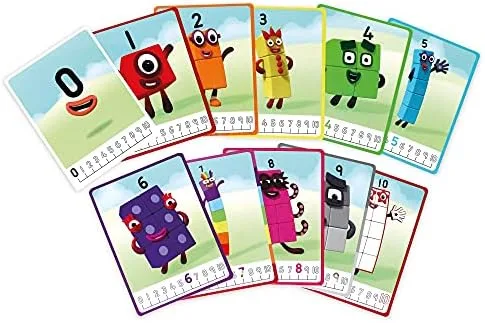
The 30 activity cards provide structured math challenges — “Build numbers 1-5,” “What’s 3 + 2?,” “Show me all the ways to make 6” — that add pedagogical direction. Parents reported that these cards were useful for guiding play sessions and extending engagement beyond free-play building.
Age Appropriateness: 8/10
The 3-6 age range is well-calibrated but understates the lower bound’s challenge. Three-year-olds can physically manipulate the cubes but struggle with the mathematical concepts the activity cards present. For threes, the value is primarily in counting, color matching, and character recognition. The mathematical depth — decomposition, addition, part-whole relationships — becomes accessible around age 4-5, which is the true sweet spot.
By age 6, children who have used the cubes extensively begin to outgrow them mathematically. The 1-10 range is limiting once a child can mentally manipulate numbers beyond ten. Learning Resources sells an 11-20 extension set, which extends the product’s useful life by 6-12 months.
The Numberblocks show targets the same age range, with episodes that scaffold from basic counting (accessible at 3) through more complex operations (meaningful at 5-6). The show and the cubes work in tandem, with neither reaching its full potential alone.
Durability: 9/10
Exceptional. The cubes are classroom-grade ABS plastic that will outlast any child’s interest in them. The snap connections maintain their tension indefinitely. Colors don’t fade. The cubes are dishwasher-safe on the top rack.
The stickers, again, are the durability exception. Budget $0 and 10 minutes for a permanent marker solution once the original stickers inevitably peel.
Value for Money: 9/10
At $25 for 100 cubes, activity cards, and a number line, this is outstanding value for a STEM manipulative. Comparable classroom-grade manipulative sets from Didax or hand2mind run $15-20 for 100 plain cubes without activity cards or character integration. The Numberblocks license adds meaningful play value — the show connection transforms the cubes from a math tool into a math toy — for a modest price premium.
The activity cards alone would cost $8-10 as a standalone product. The foam number line is a useful bonus. The total package delivers substantial educational content at a price point that makes it an easy recommendation.
The Evidence
This is where the Numberblocks MathLink Cubes stand apart from nearly every other product in our review portfolio.
The Purpura Research. Purpura et al. (2021) conducted a randomized controlled trial examining a dialogic reading intervention focused on mathematical language with preschool-aged children.1 The intervention — which involved parents engaging children with structured mathematical conversations during shared reading — produced significant improvements in children’s mathematical language and mathematical knowledge. While this study used books rather than physical manipulatives, it demonstrates a key principle directly relevant to the MathLink Cubes: structured parent-child interactions focused on mathematical concepts produce measurable gains. The activity cards included with the MathLink Cubes serve exactly this guided interaction function, prompting parents to engage children in mathematical conversation during manipulative play.
Critically, Purpura’s work shows that the guided interaction component — not just the materials — is what drives learning. This is exactly what the MathLink Cubes activity card set is designed to facilitate.
Manipulatives and Mathematical Understanding. The broader research base on math manipulatives is substantial and generally supportive. Moyer (2001) reviewed the literature on virtual and physical manipulatives and found that physical manipulation of mathematical objects supports conceptual understanding when combined with reflection and discussion.2 The key qualifier — “when combined with reflection and discussion” — is important. Manipulatives alone don’t teach math; manipulatives plus guided interaction do. The activity cards in the MathLink Cubes set serve this guided interaction function.
Carbonneau et al. (2013) conducted a meta-analysis of 55 studies on manipulatives and found a moderate positive effect on mathematics learning, with the largest effects observed when manipulatives were used with instructional guidance rather than in unstructured free play.3 This directly supports the activity-card-guided approach that the MathLink Cubes set implements.
Media-Enhanced Learning. The Numberblocks show adds an unusual dimension: children arrive at the manipulatives with pre-existing mental models of number relationships, acquired through watching the show. Fisch (2004) described this as “distance transfer” in educational media — when children apply concepts learned from television to new contexts.4 The show-to-toy pipeline for Numberblocks is a well-designed example of this transfer: children learn that “Five can split into Two and Three” from the show, then physically enact this decomposition with cubes.
This media-manipulative integration is unusually well-designed. Most licensed toys use the media property as a hook for otherwise generic products. Numberblocks uses the media property to build mathematical mental models that the physical toy then reinforces. The pedagogy runs in both directions.
Number Sense Development. Jordan et al. (2009) found that number sense in kindergarten — including counting, number comparison, and basic arithmetic — was a strong predictor of later mathematics achievement through third grade.5 The specific skills that MathLink Cubes engage (counting, cardinality, decomposition, comparison) map directly onto the number sense competencies that predict mathematical success.
The honest summary: The evidence supporting manipulative-based math learning is moderate and well-established. The specific Purpura research on home numeracy interventions is directly relevant to how this product is designed to be used. The Numberblocks show provides an unusually effective pedagogical scaffolding that most licensed toys lack. This is one of the strongest evidence profiles in our portfolio — not because the product itself has been studied, but because the pedagogical approach it implements has been validated.
Safety Notes
MathLink Cubes meet ASTM F963 and CPSIA safety standards. Individual cubes at approximately 2cm per side do fit within the CPSC small parts cylinder (3.17cm diameter) and present a choking hazard for children under 3. The product is rated for ages 3+, but households with younger siblings should keep cubes out of reach. Assembled multi-cube characters are larger than the choking threshold.
The stickers are non-toxic but can be peeled off and chewed by younger children. Monitor sticker integrity and remove loose stickers promptly.
No CPSC recalls have been issued for MathLink Cubes or any Numberblocks-branded product.
The cubes are BPA-free and phthalate-free per manufacturer certification.
The Verdict
The Numberblocks MathLink Cubes are that rare thing: a licensed product that’s better because of its license, not despite it. The Numberblocks show provides mathematical scaffolding that transforms standard classroom manipulatives into a genuinely engaging toy, and the underlying pedagogy — structured manipulative play guided by activity cards and parent interaction — is supported by real research.
The product isn’t perfect. The stickers are a known weak point. The play value depends heavily on familiarity with the show. And the 1-10 number range creates a ceiling that mathematically advanced five-year-olds will hit. But at $25, with classroom-grade build quality and one of the strongest evidence profiles we’ve encountered, this is an easy recommendation for families with children in the 3-6 range.
A note on what “evidence-backed” means here: we’re not saying these specific cubes will make your child better at math. We’re saying the type of play these cubes facilitate — structured, manipulative-based number exploration with parental guidance — is supported by published research. That’s a meaningful distinction, and it’s more than we can say for the vast majority of products labeled “STEM.”
Product Rating: 8/10 — Exceptional educational value with genuine research alignment. Sticker durability and show-dependency prevent a higher score.
Evidence Rating: Strong — Supported by peer-reviewed research on guided mathematical interactions (Purpura et al., 2021) and robust general research on manipulatives and CRA frameworks. The pedagogical approach — structured parent-child math play with physical objects — is well-validated across multiple studies.
Who Should Buy This
- Families with 3-6 year olds who watch (or are willing to watch) the Numberblocks show
- Parents interested in evidence-aligned math learning tools
- Teachers and homeschoolers looking for affordable math manipulatives with engagement hooks
- Gift-givers who want an educational toy that children actually enjoy using
- Families who own LEGO SPIKE Essential and want a math-focused complement to SPIKE’s coding emphasis
Who Should Skip This
- Families whose children aren’t interested in the Numberblocks show (the cubes lose significant play value without it)
- Parents of children under 3 (the mathematical concepts are premature; the cubes as building toys are unremarkable)
- Parents of children over 7 who need math challenges beyond single-digit numbers
- Families looking for open-ended building toys — Magna-Tiles or LEGO are better for freeform construction
This review reflects our independent evaluation. ScienceBasedKids.com purchased this product at retail price. We may earn a commission if you purchase through our links, which helps fund our research. This never influences our ratings.
Footnotes
-
Purpura, D. J., Napoli, A. R., Wehrspann, E. A., & Gold, Z. S. (2021). “Causal connections between mathematical language and mathematical knowledge: A dialogic reading intervention.” Journal of Research on Educational Effectiveness, 14(2), 382-412. ↩
-
Moyer, P. S. (2001). “Are we having fun yet? How teachers use manipulatives to teach mathematics.” Educational Studies in Mathematics, 47(2), 175-197. ↩
-
Carbonneau, K. J., Marley, S. C., & Selig, J. P. (2013). “A meta-analysis of the efficacy of teaching mathematics with concrete manipulatives.” Journal of Educational Psychology, 105(2), 380-400. ↩
-
Fisch, S. M. (2004). Children’s Learning from Educational Television: Sesame Street and Beyond. Lawrence Erlbaum Associates. ↩
-
Jordan, N. C., Kaplan, D., Ramineni, C., & Locuniak, M. N. (2009). “Early math matters: Kindergarten number competence and later mathematics outcomes.” Developmental Psychology, 45(3), 850-867. ↩
Enjoyed this review? We publish two new evidence-based evaluations every week.
Free. No spam. Unsubscribe anytime.
Each behavior scored by frequency: 0 = never observed, 10 = observed in every session.
Recommended Accessories
Affiliate links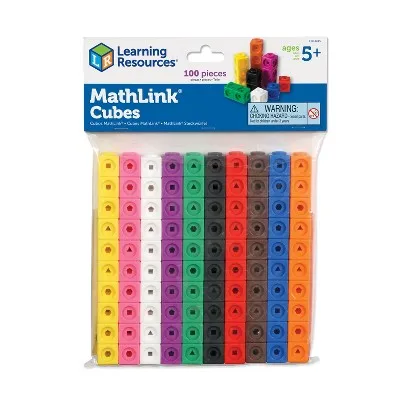
Learning Resources MathLink Cubes (100-count refill)
“More cubes for building larger numbers and patterns beyond the included 1-10 set.”
Numberblocks Annual 2024 Activity Book
“Official activity book with math challenges that use the MathLink Cubes directly.”
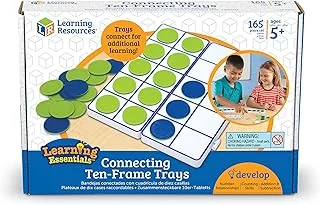
Learning Resources Ten Frame Trays (4-Pack)
“Structured frames for organizing cubes into tens. Bridges concrete to abstract math.”

Math Curse by Jon Scieszka
“Picture book that makes math into a funny story. Context companion for older kids (5-7).”