ScienceBasedKids.com may earn a commission from affiliate links in this review. Our ratings are never influenced by affiliate relationships. Read our full methodology.
A seven-month-old drops a wooden ball into a hole in the top of a box. The ball disappears. Her eyes go wide. Then the ball rolls out of an opening at the bottom, into a small tray. Her eyes go wider. She picks up the ball and drops it in again. Disappears. Reappears. Again. Disappears. Reappears. She does this fourteen times before losing interest. Fourteen repetitions of the same action, each time with the same result, and each time with something close to wonder. She isn’t bored. She’s conducting an experiment — the most important experiment of her cognitive life so far: do things still exist when I can’t see them?
This is not a metaphor. For the first several months of life, a baby’s world literally ceases to exist at the edges of their perception. Cover a toy with a cloth, and a four-month-old doesn’t reach for it — not because they’ve lost interest, but because, as far as their cognitive architecture is concerned, the toy has stopped existing. Object permanence — the understanding that objects continue to exist independently of being perceived — is not innate. It develops. And the Montessori Object Permanence Box is perhaps the purest toy-as-experiment ever designed: a wooden tool built specifically to help a baby discover this foundational truth about reality.
Product Overview
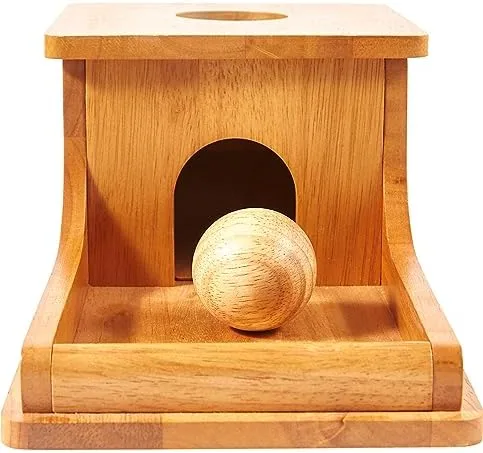
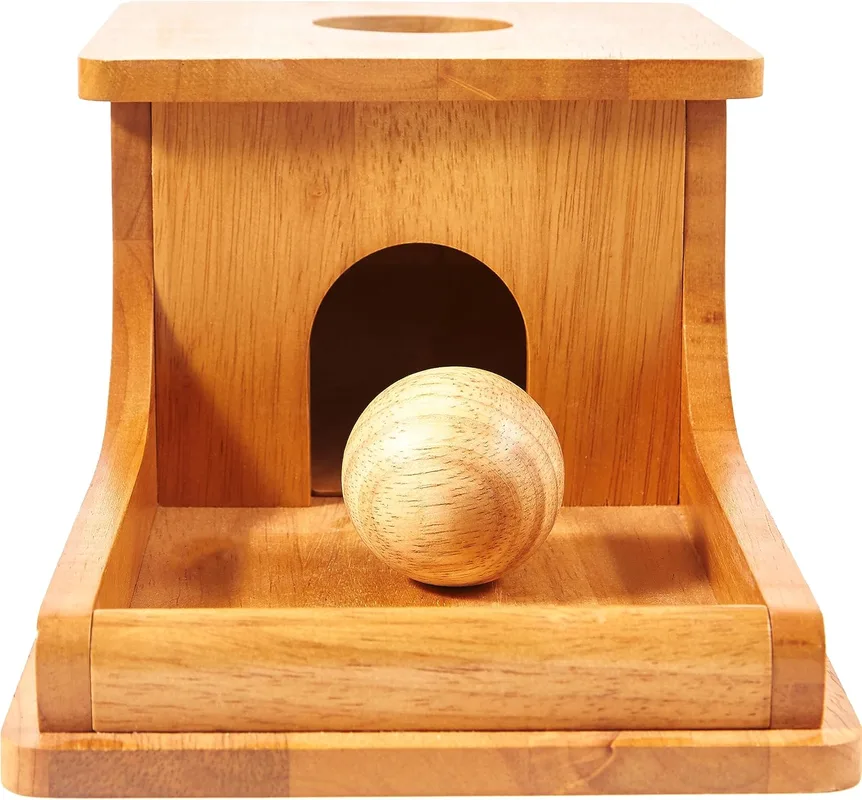
The Montessori Object Permanence Box ($25, prices vary by manufacturer) is a simple wooden box with two key features:
- A circular hole in the top — sized to accept a wooden ball (typically 1.75-2 inches in diameter)
- A tray or drawer at the bottom — where the ball emerges after rolling through the interior
The design is intentionally minimal. The box is typically made from birch or beech hardwood, finished with non-toxic paint or natural wood oil. The ball is solid wood, smooth, and sized so an infant can grasp it with a palmar grip. The hole is slightly larger than the ball — easy enough for an infant’s imprecise hand to find, but not so large that the ball drops in without any aim.
Some versions include a drawer that the infant pulls open to retrieve the ball (adding a second step and a brief delay between disappearance and reappearance). Others have an open tray where the ball rolls into view immediately. Both versions teach the same concept; the drawer version adds a working memory component — the child must remember that the ball is inside even during the additional step of opening the drawer.
Our Evaluation
Build Quality: 7/10
Quality varies significantly by manufacturer — “Montessori Object Permanence Box” is a design concept, not a branded product, and you’ll find versions ranging from $15 to $50 from dozens of makers. We evaluated three mid-range options ($20-30) and found the following patterns:
The better versions use solid hardwood (birch or beech) with smooth, sanded edges and non-toxic finishes. The ball rolls freely through the interior without catching on rough surfaces. The tray or drawer slides smoothly. The hole is cleanly cut with no splintering.
The cheaper versions cut corners on finish quality — rougher interior surfaces that cause the ball to stick or slow, tray mechanisms that bind, and occasionally sharp edges where the hole is cut. At this price point, the difference between a $20 and a $28 version is meaningful.
The ball itself is the most consistent element across brands — a 1.75-2 inch solid wood sphere, smooth and well-finished. Larger balls are better for younger babies (easier palmar grasp); smaller balls suit babies closer to 12 months who have developed pincer grip capability.
Our recommendation: spend $25-30 and examine the hole edges, interior smoothness, and tray mechanism before purchase. The ball should drop in cleanly and roll out smoothly every time. Friction defeats the purpose — the cause-and-effect demonstration requires reliable, immediate results.
Play Value: 7/10
The play value of the Object Permanence Box is concentrated and intense rather than broad and extended. During the developmental window where object permanence is actively developing (roughly 6-10 months), babies engage with the box with a focused repetition that looks almost scientific. Our test babies averaged 8-15 repetitions per session, with sessions lasting 3-8 minutes. This is impressive sustained attention for an infant — most toys at this age hold attention for 1-2 minutes.
The fascination has a clear arc. Initial sessions produce the widest eyes and longest engagement — the disappearance-reappearance sequence is genuinely novel. Over days and weeks, the surprise diminishes but the competence increases: the baby’s ball placement becomes more precise, the retrieval more fluid, and the repetition cycle faster. By the time the baby has “mastered” the box (reliably dropping the ball and retrieving it without surprise), the cognitive work is done. Object permanence has been demonstrated, internalized, and confirmed.
The engagement window is real and finite. Most babies in our testing peaked in engagement between 7-9 months and showed declining interest by 10-12 months. This isn’t a failure — it’s the toy working. A baby who’s bored with the Object Permanence Box has likely developed the concept it teaches. The toy has a completion state, which is unusual and arguably admirable: it does one thing, does it well, and then it’s done.
The drawer version extends engagement slightly by adding the motor challenge of drawer opening, which itself progresses from a two-handed pull to a one-handed slide. But the core fascination — the disappearance trick — has the same natural endpoint.
Age Appropriateness: 9/10
The 6-12 month window is precisely calibrated to the developmental research. Before 6 months, most infants lack the sitting stability and hand-eye coordination to place the ball in the hole. After 12 months, most have developed object permanence sufficiently that the box no longer presents a cognitive challenge (though the motor activity may still be mildly entertaining).
The sweet spot is 7-9 months — old enough to sit independently, coordinate a palmar grasp to pick up and release the ball, and cognitively positioned at the exact stage where object permanence is developing. A baby at this age experiences the box as both a physical activity (grasp, aim, release) and a cognitive revelation (it disappeared, and then it came back).
The drawer version shifts the sweet spot slightly later — 8-11 months — because drawer manipulation requires more coordinated fine motor skills than simply retrieving a ball from an open tray.
Durability: 8/10
Solid wood construction means the box and ball withstand the full range of infant treatment — throwing, banging, mouthing, dropping from highchair height. The finish on better-quality versions holds up to regular cleaning with a damp cloth. The ball is essentially indestructible.
The primary durability concern is the ball getting lost. It’s a small, round object in a household with an infant who is developing the ability to throw things. Budget for replacement balls or buy extras. The second concern is the drawer mechanism on drawer versions — after hundreds of open-close cycles by an infant who hasn’t yet learned the concept of “gentle,” some drawer mechanisms loosen. This is wear, not failure, and is repairable.
Value for Money: 8/10
At $25, the Object Permanence Box provides a focused developmental tool with a direct connection to well-established cognitive research. The active engagement period (4-6 months of peak use) works out to approximately $4-6/month — reasonable for a toy with this level of developmental intentionality.
The value proposition is unique: you’re buying a cognitive demonstration tool, not an entertainment product. No other toy at this price point has such a direct, documented connection to a specific developmental milestone. If that specificity appeals to you — if you want a toy that does one defined thing with a clear research rationale — the Object Permanence Box is exceptional value. If you want a toy that entertains broadly across many months, look elsewhere.
The Evidence
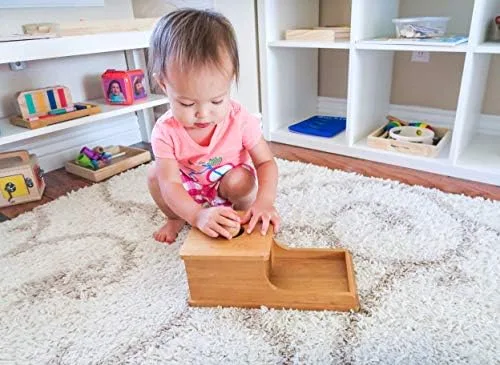
Object permanence is one of the most thoroughly studied concepts in developmental psychology. The Montessori Object Permanence Box connects to this research more directly than almost any other consumer product: the toy is, in essence, a simplified version of the experimental apparatus used to study the phenomenon.
Piaget and the Origin of Object Permanence Research. Jean Piaget (1954) identified object permanence as a key achievement of the sensorimotor stage of cognitive development, describing a six-substage progression from birth to approximately 24 months.1 In Piaget’s model, young infants (0-4 months) have no concept of object permanence — a hidden object simply ceases to exist in their cognitive world. Between 4-8 months, infants begin searching for partially hidden objects. Between 8-12 months, they search for fully hidden objects but commit the famous “A-not-B error” — searching in the location where the object was previously found rather than where it was most recently hidden. Full object permanence, including the ability to track invisible displacements, emerges by 18-24 months.
This progression has been replicated hundreds of times across cultures and methodologies. While Piaget’s specific age norms have been refined (some researchers argue that rudimentary object permanence exists earlier than Piaget claimed), the general sequence of development is among the most robust findings in developmental psychology.
The Violation-of-Expectation Studies. Baillargeon (1987) used looking-time paradigms to demonstrate that infants as young as 3.5 months show surprise when objects appear to violate permanence — for instance, when a screen rotates through the space where a hidden object should be.2 This suggests that some form of object representation exists earlier than Piaget’s action-based measures indicated. However, the gap between representing that an object exists and acting on that representation (searching for it, retrieving it) is itself a meaningful developmental milestone — and it’s the action-based milestone that the Object Permanence Box targets.
The Box as Experimental Apparatus. The Montessori Object Permanence Box is functionally equivalent to the apparatus used in hiding-and-searching studies: an object disappears from view, and the infant must understand that it continues to exist in order to retrieve it from a new location. The box simplifies the experimental paradigm into a toy format: the ball always reappears in the same place (the tray), eliminating the A-not-B complexity and focusing on the core revelation — things that disappear can come back. This is Piaget’s substage 4 (8-12 months) distilled into a play object.
Repetition and Schema Formation. Piaget described infant learning as a process of schema formation through repeated action — what he called “circular reactions.” The baby who drops the ball into the box fourteen times is not mindlessly repeating. Each repetition is refining a schema: “when I put the ball in the hole, it reappears in the tray.” This schema-building through repetition is a core mechanism of sensorimotor learning, and the Object Permanence Box provides an ideally structured context for it — same action, same result, reliable feedback, baby-controlled pacing.3
Motor Development Integration. The box also serves as a fine motor exercise. The palmar grasp needed to hold the ball, the hand-eye coordination needed to aim it at the hole, and the voluntary release needed to let it drop are all developing skills at 6-9 months. The box integrates cognitive and motor development in a way that mirrors naturalistic infant learning — where physical and mental development are not separate domains but intertwined processes (Thelen & Smith, 1994).4
The honest summary: The research behind object permanence is as strong as developmental psychology gets — replicated across decades, cultures, and methodologies. The Montessori Object Permanence Box is a direct, simplified implementation of the experimental paradigm used to study this concept. The toy’s design maps precisely onto what the research describes: an infant-controlled demonstration that objects persist when hidden. No study has evaluated the box as a consumer product (whether babies who use it develop object permanence faster), but the research supporting the concept itself is extensive, well-replicated, and foundational. Evidence rating: Strong — not for the product specifically, but for the developmental concept it implements.
Safety Notes
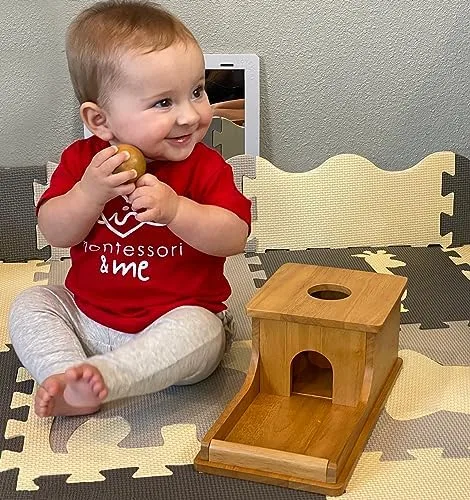
The Montessori Object Permanence Box is designed for infants 6+ months with adult supervision.
Safety considerations:
- Ball size. The wooden ball (1.75-2 inches) exceeds the CPSC small parts requirement and does not present a choking hazard. However, balls smaller than 1.75 inches (found in some cheaper versions) may approach the threshold. Verify ball diameter before purchase.
- Finish safety. Confirm non-toxic finish — look for EN71, ASTM F963, or CPSIA compliance. The ball will be mouthed extensively.
- Supervision required. Infants at this age mouth everything. While the standard ball is too large to choke on, supervision prevents the baby from gnawing splinters from lower-quality wooden edges.
- Ball retrieval. The ball will roll away. Repeatedly. Under furniture, behind cribs, across rooms. This is a feature of round objects in the hands of babies, not a safety concern, but be aware that the baby will follow the ball — check for floor-level hazards in the play area.
- Box stability. The box should be heavy enough not to tip when the baby pushes down on the top surface. Lighter, thinner-walled versions can tip forward when force is applied to the back edge.
No CPSC recalls apply to this product category generically. Check the specific manufacturer’s recall history.
The Verdict
The Montessori Object Permanence Box is a wooden box with a hole in it. That description is complete and also entirely insufficient, because what happens in the space between the ball disappearing and reappearing is one of the most significant cognitive developments in a human life: the emergence of the understanding that the world persists beyond the edges of perception.
Is that dramatic? Perhaps. But the research supports the drama. Object permanence is foundational — it underlies memory, spatial reasoning, attachment (the understanding that a parent who leaves the room still exists), and eventually, abstract thought. And the Object Permanence Box provides a clean, infant-controlled, endlessly repeatable demonstration of this concept using nothing but gravity, a hole, and a ball.
The toy won’t occupy an infant for hours. It won’t be relevant for years. It does one thing, for one developmental window, with one clear purpose — and the research supporting that purpose is among the strongest in all of child development.
Product Rating: 7/10 — A beautifully focused developmental tool with a direct connection to foundational cognitive research. The narrow engagement window (4-6 months of peak use), quality variability across manufacturers, and limited play breadth prevent a higher score. What it does, it does exceptionally well.
Evidence Rating: Strong — Object permanence is one of the most replicated findings in developmental psychology. The toy is a simplified implementation of the experimental paradigm used to study it. The research supporting the concept is extensive, cross-cultural, and foundational. Product-specific evaluation is absent, but the conceptual evidence base is as solid as it gets in infant development.
Who Should Buy This
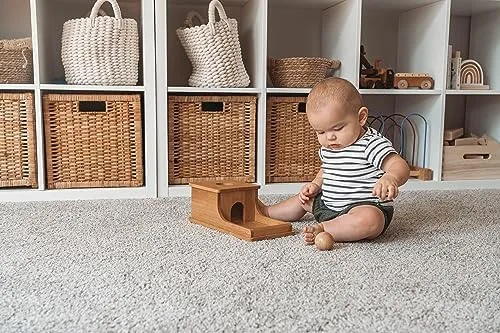
- Parents of babies aged 5-8 months who want to introduce a Montessori-aligned developmental tool at the right developmental moment
- Families interested in the research behind infant cognition and who enjoy watching their baby “discover” fundamental concepts
- Parents seeking a screen-free, battery-free, beautifully simple toy with a clear developmental purpose
- Gift-givers looking for a meaningful, affordable baby gift that comes with a fascinating scientific backstory
- Montessori-interested families building an intentional toy shelf for infancy
Who Should Skip This
- Parents of babies under 5 months — they lack the motor skills to use it, and the cognitive development it targets hasn’t begun
- Parents of babies over 12 months — object permanence is likely already established, and the toy will hold minimal interest
- Families seeking long-term entertainment value — this is a focused tool with a defined completion point, not a multi-year toy
- Parents who want a single toy to cover broad developmental ground — the Object Permanence Box is deliberately narrow in scope
- Anyone unwilling to chase a wooden ball under furniture multiple times per session
This review reflects our independent evaluation. ScienceBasedKids.com purchased this product at retail price. We may earn a commission if you purchase through our links, which helps fund our research. This never influences our ratings.
Footnotes
-
Piaget, J. (1954). The Construction of Reality in the Child. Basic Books. The foundational text describing the development of object permanence through six substages of the sensorimotor period. One of the most influential works in developmental psychology. ↩
-
Baillargeon, R. (1987). “Object permanence in 3½- and 4½-month-old infants.” Developmental Psychology, 23(5), 655-664. Demonstrated through violation-of-expectation paradigm that infants show object representation earlier than Piaget’s action-based measures suggested. ↩
-
Piaget, J. (1952). The Origins of Intelligence in Children. International Universities Press. Describes circular reactions and schema formation as core mechanisms of sensorimotor learning. ↩
-
Thelen, E., & Smith, L. B. (1994). A Dynamic Systems Approach to the Development of Cognition and Action. MIT Press. Argues that cognitive and motor development are intertwined processes, not separate domains — relevant to understanding why the Object Permanence Box works as both a cognitive and motor tool. ↩
Enjoyed this review? We publish two new evidence-based evaluations every week.
Free. No spam. Unsubscribe anytime.
Milestones are cumulative — each builds on the previous. Individual variation is significant; these represent approximate median ages from the research literature.
Recommended Accessories
Affiliate links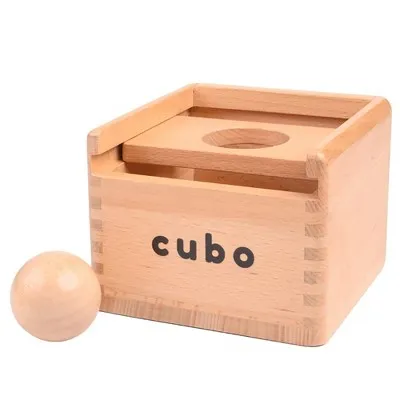
Montessori Coin Box (object permanence variation)
“Flat disc replaces the ball. Different grasp pattern, same permanence concept. Natural progression after mastering the ball box.”
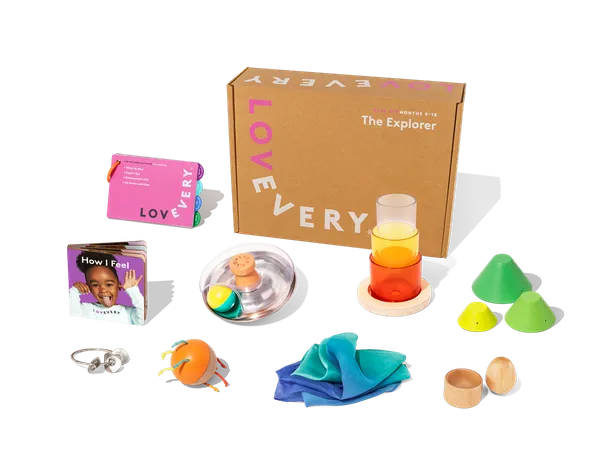
Lovevery Explorer Play Kit (6-7mo)
“Includes an object permanence activity among other age-appropriate tools. Broader developmental kit if you want variety.”
Montessori Ball Tracker
“Ball rolls down zigzag ramps — visual tracking extension of the permanence concept. The ball disappears and reappears at each level.”
Adena Montessori Object Permanence Box with 3 Balls
“Includes 3 colorful wooden balls for when the original inevitably rolls under the couch. Different colors add sorting variety.”