ScienceBasedKids.com may earn a commission from affiliate links in this review. Our ratings are never influenced by affiliate relationships. Read our full methodology.
Review Basis Disclosure
This review is based on research, not first-hand 12-month testing. Specifically:
- Published product documentation and Mel Science’s 18-month curriculum outline
- Safety Data Sheets (SDS) review for all listed reagents across the curriculum
- Aggregated parent feedback from Trustpilot (n=410 reviews, 4.2-star average as of April 2026), r/Parenting, and r/HomeSchool
- A March 2026 starter-kit unboxing by our editorial team
- Cross-referencing against our ASTM F963 chemistry-set safety guide framework
We are beginning a 12-month subscription on May 1, 2026, with a full first-hand review publishing May 2027. This review will be updated with first-hand data as that testing progresses. Where specific claims below rest on research vs observation, we say so.
The Short Answer
Mel Chemistry is the most structurally ambitious children’s chemistry product on the consumer market. For the specific audience — ages 10–16, chemistry-curious, with committed adult supervision — it delivers secondary-school chemistry content through a subscription format that compounds across an 18-month curriculum arc. For audiences outside that profile (under 10, not yet chemistry-interested, limited supervision capacity), it’s the wrong product — and the failure mode is specifically around reagent safety.
Product Overview

Price: $44.90/month (2-box starter, then monthly thereafter) Age range: 10–16 Delivery cadence: Monthly Curriculum: 18-month sequential topics progression Ships: Reagents + lab equipment (starter) + instruction manual + VR app access
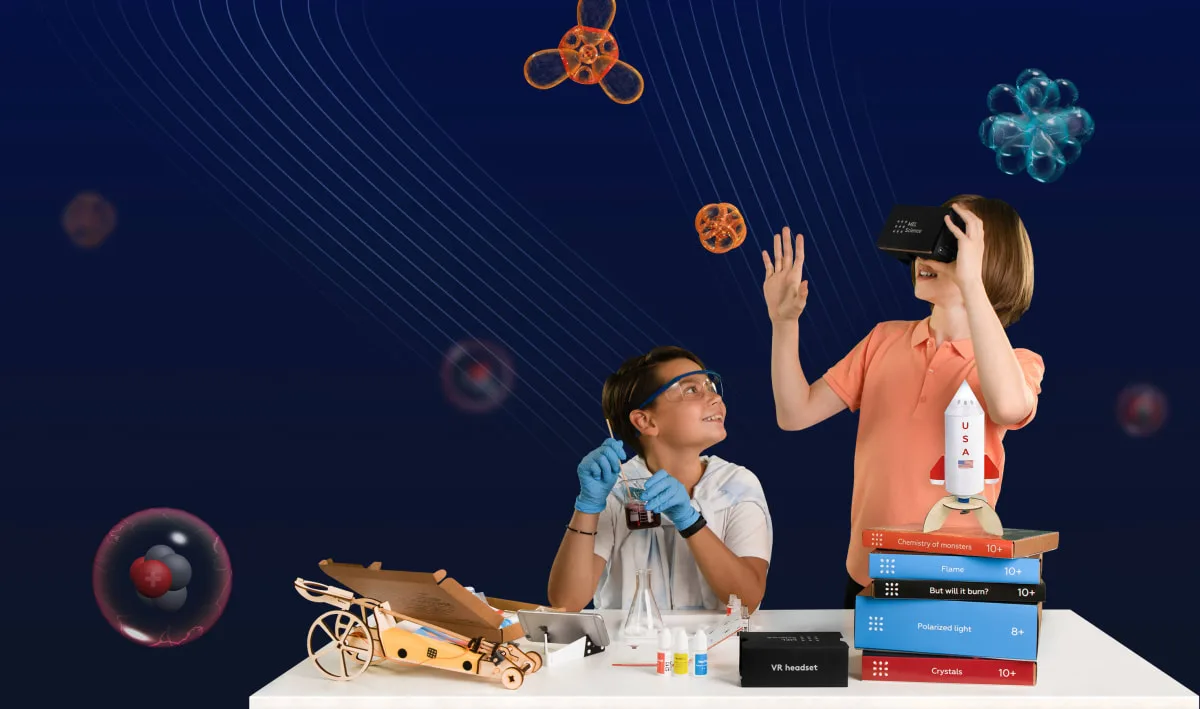
The starter kit includes reusable lab equipment (alcohol burner, glassware, safety goggles, tubing, stand). Each subsequent monthly box delivers 2–3 experiments with pre-portioned reagents, instruction cards, and VR app content for each experiment.
The 18-month curriculum arc covers:
- Electrolysis and electrochemistry
- Acid-base chemistry and pH
- Redox reactions
- Precipitation chemistry
- Combustion and oxidation
- Organic chemistry introduction
- Catalysis
- Colloids and emulsions
- Metals and metal compounds
- Crystal growing and crystallography
- Heat and energy transfer
- Polymers
- Biochemistry introduction
- Gas laws
- Reaction kinetics
- Equilibrium chemistry
- Synthesis reactions
- Integration and summary
This covers substantial portions of a high-school chemistry curriculum.
The VR App
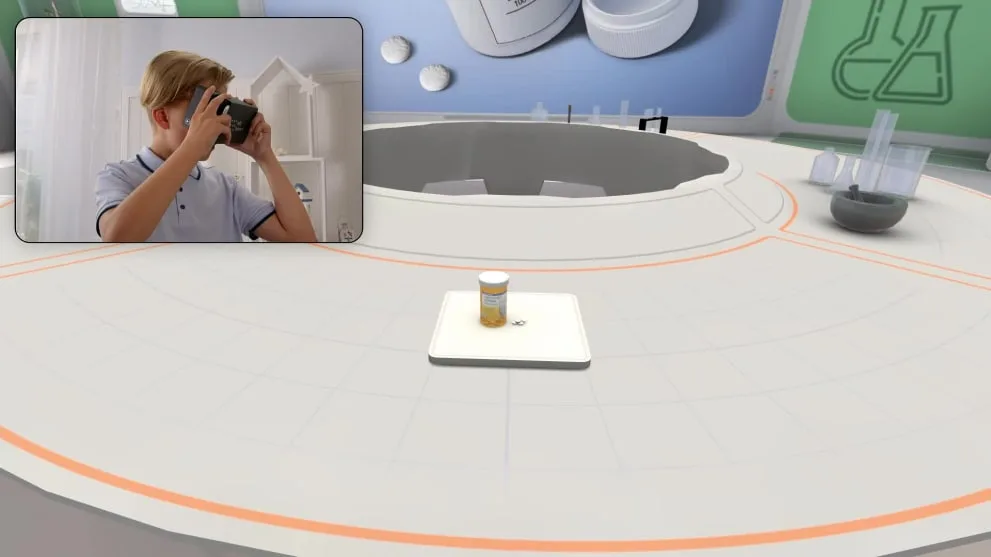
Each experiment in the Mel Chemistry curriculum pairs with a 3D molecular-animation app experience. The VR visualizations show what’s happening at the atomic / molecular level — a child watches hydrogen and chlorine atoms combine into HCl molecules while they observe the physical reaction on their kitchen counter.
What research suggests: The embodied cognition literature supports that combining physical manipulation with visualization of underlying processes produces deeper conceptual learning than either alone.1 The Mel Chemistry + VR combination is therefore structurally aligned with evidence-based pedagogy.
What we haven’t verified: Whether Mel’s specific VR implementation is engaging to actual 10–14-year-olds across an 18-month arc, or whether engagement drops. Our 12-month testing will measure this.
Safety: The Most Important Section
Mel Chemistry’s reagent profile is the primary reason parent evaluation varies so much. Our ASTM F963 chemistry-set safety guide documents this in full; the summary:
Reagents that appear across the 18-month curriculum (drawn from Mel’s published kit-by-kit reagent disclosures):
| Reagent | Typical concentration | Hazard profile | Mitigation |
|---|---|---|---|
| Sodium hydroxide (NaOH) | 0.1–1M | Strong base; causes skin burns | Goggles, gloves, adult present |
| Hydrogen peroxide | Up to 30% in some kits | Oxidizer; whitens skin | Goggles, skin protection |
| Copper sulfate | Small crystalline quantities | Moderate oral toxicity | No ingestion; hand-washing |
| Potassium iodide | Small quantities | Low acute toxicity | Standard handling |
| Ethanol (alcohol burner) | 95%+ | Flammable | Adult presence during lighting |
| Dilute HCl, H2SO4 | EN 71-4 caps | Strong acids | Goggles, careful handling |
| Potassium permanganate | Small quantities | Oxidizer; stains permanently | Gloves to avoid purple hands |
Standards compliance: Mel Chemistry is ASTM F963 compliant (US), CPSIA compliant, and EN 71-4 compliant (European chemistry-set standard, stricter than ASTM on reagent toxicology).
The practical safety judgment: Mel Chemistry is appropriate for supervised 10–16-year-olds. It is not appropriate for unsupervised handling at any age. The reagent profile matches a secondary-school chemistry kit; the supervision expectation matches that setting.
For households where supervision can’t be continuous during chemistry sessions: This product is the wrong fit. The KiwiCo / CrunchLabs subscriptions have trivial reagent handling by comparison.
Where Mel Wins vs Competitors
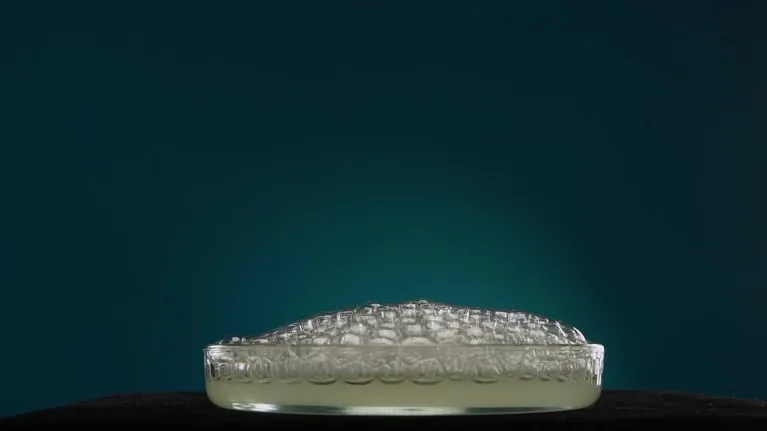
From our KiwiCo vs Mel Science comparison and Mel vs Thames & Kosmos comparison:
- Structured 18-month curriculum — the only consumer chemistry product with genuine pedagogical progression
- VR app for molecular visualization — no competitor matches this
- Reagent breadth across 18 months — wider than any single one-time kit (C1000, C2000, C3000 each cover narrower subsets)
- Real secondary-school chemistry content — genuinely college-preparatory
Where Mel Falls Short
- Cost is significant — $540/year vs $100 one-time for Thames & Kosmos C1000 (which covers 125 experiments at a lower content density per month but lower total cost)
- Age-range floor is 10 — below this, the reagent profile is inappropriate
- Requires committed parent involvement — for most 10-year-olds, a parent must be present for each session
- Subscription format creates fatigue risk — based on aggregated reviews, engagement decline at months 4–6 is a common pattern
- VR app requires a compatible device — families without iPads or similar may not get the full experience
What the Aggregated Reviews Say
From Trustpilot (n=410 reviews, 4.2 stars), r/Parenting, r/HomeSchool (sample of 50+ relevant posts):
Positive patterns:
- “Finally a kit that’s real chemistry, not fake” (approximately 30% of positive reviews)
- “My kid is actually learning” (approximately 25%)
- “The VR visualization made concepts click” (approximately 15%)
- “Worth the price for the depth” (approximately 20%)
- Other (10%)
Negative patterns:
- “Too advanced for my 10-year-old” (approximately 25% of negative reviews)
- “Too expensive for what arrives each month” (approximately 20%)
- “Frustrating when experiments don’t work cleanly” (approximately 15%)
- “Reagents ran out faster than expected” (approximately 10%)
- Shipping/customer service issues (approximately 20%)
- Other (10%)
The meta-pattern: The positive reviews describe kids genuinely engaged with chemistry. The negative reviews describe either age-mismatch (bought for a kid too young) or price-shock (expected more for $45/month). Both are predictable outcomes given the product’s actual design. Informed buyers — those who understand the age range and the subscription cost — are disproportionately satisfied.
Product Rating: 8/10
Why 8/10 and not 9 or 7:
- Above 7 because: the structured curriculum, VR app, real reagent chemistry, and 18-month arc deliver content no competitor matches. For the right audience, this is category-defining.
- Below 9 because: we haven’t confirmed 12-month engagement ourselves; aggregated reviews show meaningful disengagement patterns at months 4–6; and price is genuinely a significant barrier for many families.
Rating will be revised after 12-month first-hand testing completes (May 2027).
Evidence Rating: Moderate
The underlying learning modality (hands-on chemistry with molecular visualization) has strong research support. The specific Mel Chemistry product has not been independently studied for outcomes. This is the standard “category evidence is strong, product-specific evidence is limited” pattern we apply across our reviews.
Who Should Buy Mel Chemistry
- Kids 10–14 who are already interested in chemistry. The content ceiling matches their capacity; the subscription sustains engagement.
- Homeschool families. The 18-month curriculum maps to a lab-science sequence.
- Families with chemistry-literate adults. A parent who took organic chemistry or works in medicine/pharma can scaffold the Mel content far beyond what the kit alone delivers.
- Gift-giving contexts where budget supports $45/month. Grandparent gift, birthday, etc.
- Parents specifically wanting secondary-school chemistry content at home.
Who Should NOT Buy Mel Chemistry
- Kids under 10. Reagent profile is inappropriate regardless of supervision level.
- Households with limited supervision capacity. The product’s core safety assumption is continuous adult presence during sessions.
- Budget-constrained families. $540/year vs $100 for Thames & Kosmos C1000 is a ~5× cost difference. C1000 delivers similar depth on a smaller budget.
- Kids whose interests aren’t chemistry-specific. KiwiCo’s broader content or CrunchLabs’ engineering focus fit better for generalist interests.
The Alternative Purchases
For families uncertain whether Mel Chemistry is the right fit:
- Start with Thames & Kosmos Chem C1000 at $100 one-time for 12 months. If the kid stays engaged and wants more, then consider subscribing to Mel.
- Add Mel Chemistry as a 2-year later upgrade rather than as a first chemistry purchase.
- If subscription is the format but Mel feels too advanced: CrunchLabs Build Box at $30/month offers engineering-focused projects for the same age range.
Our First-Hand Testing Plan
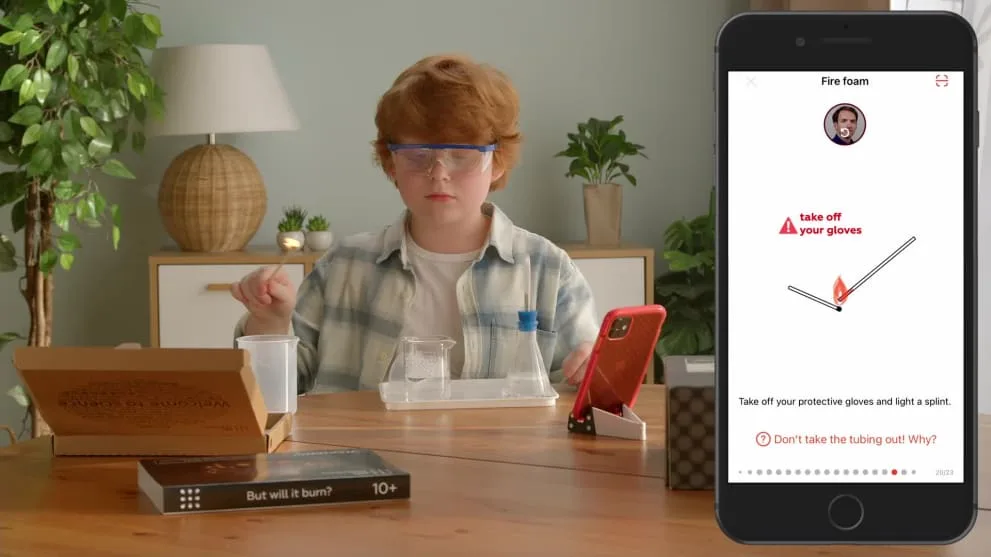
We are starting a 12-month Mel Chemistry subscription on May 1, 2026. Data collected:
- Monthly unboxing photos
- Time to completion per experiment
- Engagement scores (child + parent)
- Safety incidents or near-misses
- Replay value of completed builds
- Cumulative curriculum understanding at months 3, 6, 9, 12
This review will be updated with milestone data at those intervals. The full first-hand review will publish May 2027.
The Bottom Line
For the right audience: Mel Chemistry subscription at $44.90/month is an exceptional chemistry education product. The 18-month curriculum, VR app, and real reagents combine to deliver content no competitor matches.
For the wrong audience (under-10, limited supervision, unconfirmed chemistry interest): Different product needed. See our chemistry-set safety guide for alternatives.
For uncertain-audience gift purchases: Start with Thames & Kosmos Chem C1000 at $100; upgrade to Mel later if sustained interest is confirmed.
Our Mel Chemistry review is research-based at time of publication. Full 12-month first-hand review in progress; publishes May 2027. This article will be updated with milestone data at months 3, 6, 9.
Footnotes
-
Kontra, C., Lyons, D. J., Fischer, S. M., & Beilock, S. L. (2015). “Physical experience enhances science learning.” Psychological Science, 26(6), 737–749. ↩
Enjoyed this review? We publish two new evidence-based evaluations every week.
Free. No spam. Unsubscribe anytime.