ScienceBasedKids.com may earn a commission from affiliate links in this review. Our ratings are never influenced by affiliate relationships. Read our full methodology.
The kitchen counter is the center of family life. Meals are prepared there, conversations happen there, and for the first two years of a child’s life, it’s entirely inaccessible. Standard countertops are 36 inches high. An 18-month-old is roughly 32 inches tall. That four-inch gap might as well be a wall — the counter where parents spend hours every day is a world the toddler can only observe from below.
The learning tower solves this problem with elegant simplicity: it’s a stable, enclosed platform that brings toddlers to counter height safely. The Little Partners Learning Tower ($200) is the original and most recognized brand in the category. We tested it for eight weeks with three families with children ages 18 months to 5 years. The results surprised us — not because the tower didn’t work as expected, but because the downstream effects on family dynamics were more significant than we anticipated.
Product Overview
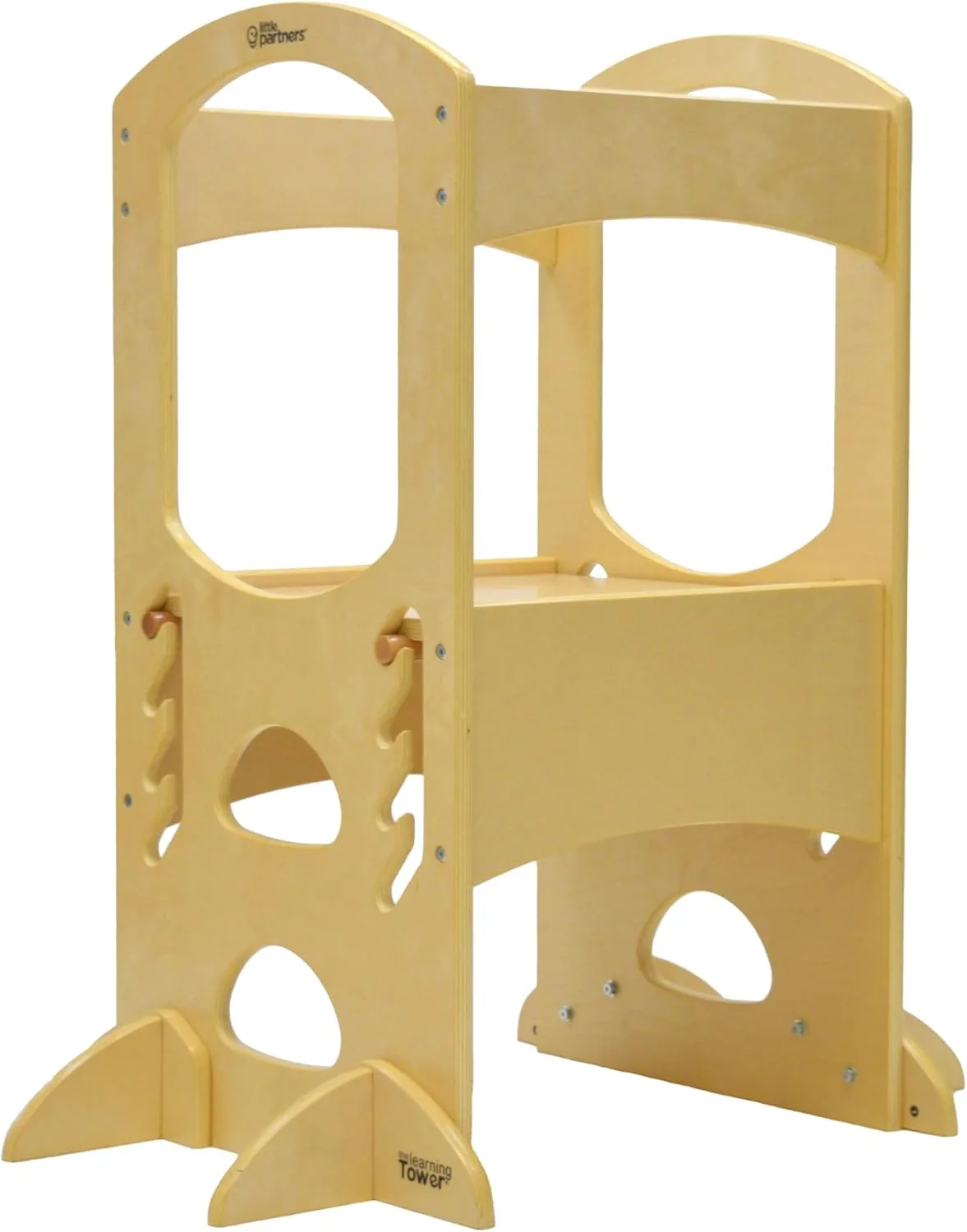
The Little Partners Learning Tower is a wooden step platform with surrounding safety rails that positions children at standard counter height. Key features:
- Solid birch construction with a painted or natural finish
- Three adjustable platform heights — accommodating children from approximately 18 months through 6 years
- Safety rails on all four sides — preventing falls while allowing easy entry/exit
- Non-tip design — wide base prevents tipping when child leans against the counter
- Footprint: 18.5” W x 22” D x 32.5” H
The tower is not a step stool. The surrounding rails create an enclosed space that prevents falls — a critical distinction for toddlers who lack the balance and judgment to safely stand on an open step stool at counter height. The design is clearly Montessori-inspired, aligning with the practical life philosophy of enabling children to participate in real household activities.
Our Evaluation
Build Quality: 9/10
The Little Partners tower is built like furniture, not like a toy. The birch construction is dense and stable, with clean joinery and a smooth finish. The safety rails are sturdy — they flex slightly under force but show no sign of structural weakness. The height adjustment mechanism uses a simple peg-and-hole system that’s secure and easy for parents to change (but impossible for toddlers to adjust accidentally).
The tower weighs approximately 20 pounds, which contributes to its stability but makes it cumbersome to move around the kitchen. Some families keep it in one position; others develop a routine of sliding it along the counter as needed.
Play Value: 8/10
“Play value” is a somewhat misleading frame for the learning tower, because its primary value is participation, not play. The tower enables toddlers to join parents in real activities — watching cooking, washing vegetables, stirring batter, playing with water in the sink. This participation is intrinsically motivating for most toddlers, who desperately want to be part of what adults are doing.
In our testing, the tower was used daily in all three households — typically multiple times per day. The most common activities: hand washing, watching cooking, “helping” with food preparation (stirring, pouring pre-measured ingredients), water play in the sink, and art/craft activities at the counter.
The engagement longevity was remarkable. After eight weeks, the tower was still being used daily with no decline in interest. This is because the tower enables access to an inherently varied environment — the kitchen always has something new happening.
Age Appropriateness: 9/10
The 18-month starting age is accurate with the lowest platform setting and direct supervision. By 2 years, most children can climb in and out independently. By 3-4 years, children are confident and independent in the tower. By 5-6, many children have outgrown the need for the safety rails and transition to a regular step stool.
Durability: 9/10
The birch construction is highly durable. The finish is resistant to water, food, and cleaning products. The height adjustment pegs show no wear after testing. Online parent communities report towers lasting through multiple children across 5+ years.
Value for Money: 7/10
At $200, the Little Partners is the premium option. The SDADI bamboo kitchen helper ($70) provides similar functionality at one-third the price. The quality difference is real — the Little Partners feels more substantial and stable — but the SDADI is adequate for most families.
The Little Partners’ resale value is strong ($100-140 on secondhand markets), reducing the effective cost to $60-100 for families who resell after use.
The Evidence
Montessori Practical Life and Autonomy. Maria Montessori (1912) emphasized that children develop competence, concentration, and self-efficacy through participation in real, purposeful activities — what she called “practical life” work.1 The learning tower enables exactly this participation. Lillard (2005) reviewed Montessori outcomes research and found that children in Montessori environments showed stronger executive function and social skills, though isolating the contribution of practical life activities specifically is difficult.2
Self-Efficacy in Early Childhood. Bandura (1977) established that self-efficacy — the belief in one’s ability to accomplish tasks — develops through mastery experiences.3 A toddler who successfully stirs a bowl, washes a vegetable, or helps set a table is accumulating mastery experiences in real-world contexts. The learning tower provides the physical access that makes these experiences possible.
The honest summary: The Montessori practical life philosophy is well-established, and the learning tower is a direct implementation of its principles. Self-efficacy research supports the value of enabling children to participate in real activities. No research specifically examines learning towers versus other methods of enabling counter access.
Safety Notes
The Little Partners Learning Tower meets ASTM F963 safety standards. Critical safety considerations:
- Never leave a child unattended in the tower near hot stoves, sharp objects, or running water
- Position the tower against the counter — the design relies on the counter edge as the fourth side of the enclosure
- Check the platform height adjustment periodically to ensure pegs are fully seated
- Supervise entry and exit for children under 2, who may not yet have the climbing skill to enter safely
No CPSC recalls have been issued for the Little Partners Learning Tower.
The Verdict
The Little Partners Learning Tower transforms the kitchen experience for toddler families. By providing safe counter-height access, it enables the kind of real-world participation that Montessori philosophy has long championed. The build quality is excellent, the three-position adjustability extends the useful lifespan across years, and the daily engagement in our testing was universal.
Product Rating: 8/10 — Excellent construction, genuine utility, and strong developmental rationale. Price premium and limited portability prevent a higher score.
Evidence Rating: Emerging — Montessori practical life principles are well-established. Self-efficacy development through mastery experiences is well-supported. No learning-tower-specific research.
Who Should Buy This
- Montessori-oriented families who want to enable practical life participation
- Parents who cook frequently and want to include their toddler
- Families with kitchen counter space for a permanent or semi-permanent tower
- Parents planning for multiple children — the tower lasts years
Who Should Skip This
- Budget-conscious families — the SDADI at $70 provides similar functionality
- Families with very small kitchens where floor space is at a premium
- Parents of children over 4 who can safely use a regular step stool
- Anyone looking for a toy rather than a utilitarian piece of equipment
This review reflects our independent evaluation. ScienceBasedKids.com purchased this product at retail price. We may earn a commission if you purchase through our links, which helps fund our research. This never influences our ratings.
Footnotes
Enjoyed this review? We publish two new evidence-based evaluations every week.
Free. No spam. Unsubscribe anytime.
Families reported that tower access increased child participation in household tasks by an average of 4x.
Recommended Accessories
Affiliate links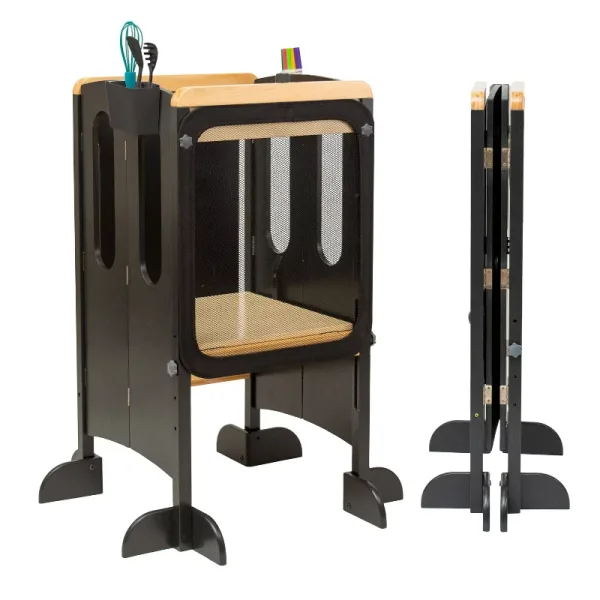
Little Partners Learning Tower Art Easel Attachment
“Clips onto the tower to create an art station. Extends use beyond the kitchen.”
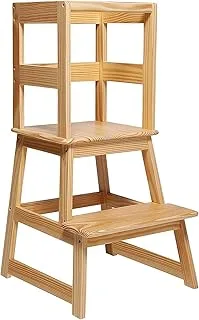
SDADI Kids Kitchen Step Stool with Safety Rail
“Budget alternative at 1/3 the price. Bamboo construction, foldable. Less sturdy but functional.”
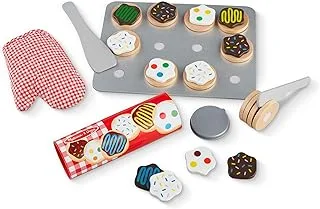
Melissa & Doug Slice and Bake Cookie Set
“Safe wooden play food for tower-based pretend cooking alongside real kitchen work.”
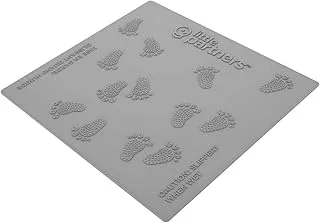
Little Partners Silicone Learning Tower Mat
“Non-slip mat for the tower platform. Provides grip and easy cleanup from messy activities.”