ScienceBasedKids.com may earn a commission from affiliate links in this review. Our ratings are never influenced by affiliate relationships. Read our full methodology.
The play kitchen occupies a unique position in the toy ecosystem. It’s enormous — physically dominating whatever room it inhabits. It’s expensive — quality versions cost as much as a decent piece of real furniture. And it’s arguably the single most effective vehicle for the type of play that developmental psychologists care most about: sustained, complex, socially negotiated pretend play.
The KidKraft Uptown Elite ($230) is the company’s premium offering — a 43-inch tall, full-featured play kitchen with a refrigerator, freezer, oven, microwave, dishwasher, and more clickable knobs than some actual apartments. We tested it for ten weeks with children ages 3 through 7, observing how the kitchen supported (or failed to support) the kind of pretend play that research suggests matters for development.
Product Overview
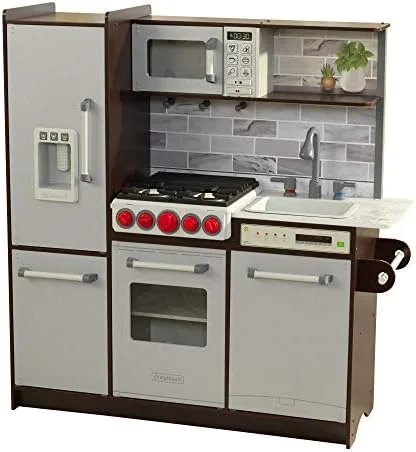
The KidKraft Uptown Elite Kitchen is a large-format play kitchen (43” H x 42.5” W x 15.5” D) made primarily of engineered wood with plastic hardware. Features include:
- Refrigerator with freezer — opening doors with interior shelving
- Oven with see-through window — opening door, clickable temperature knob
- Microwave — opening door, push-button interface
- Dishwasher — pull-down door with interior rack
- Ice maker — with a push-button mechanism that drops plastic ice cubes
- Sink with removable basin — faucet handles that turn
- Burners — four stovetop positions with clickable knobs
- Cordless phone — mounted on the side (a charmingly dated detail)
- Chalkboard panel — for writing specials or grocery lists
Assembly requires approximately 90-120 minutes and an additional adult. The instructions are clear but the piece count is high (100+ components).
Our Evaluation
Build Quality: 7/10
The KidKraft Uptown Elite is well-made for an engineered wood product at this price point. The structure is stable once assembled, the doors open and close with satisfying action, and the clickable knobs have a tactile feedback that children find satisfying. The ice maker mechanism works reliably.
The primary material is MDF with a laminate finish. It’s attractive and wipes clean easily, but it’s not real wood, and it won’t fool anyone who touches it. The plastic components (knobs, faucet handles, ice maker) are adequate quality — functional but not premium.
Build quality concerns: some families report alignment issues during assembly, particularly with the refrigerator doors. Our test unit required minor shimming to get one door to close flush. The laminate can chip at edges if the kitchen is bumped against walls during repositioning.
Play Value: 9/10
The play kitchen format is one of the highest-engagement categories in our testing portfolio. The Uptown Elite specifically excels because its realistic features provide abundant “props” for pretend play without requiring additional purchases.
In our testing, the kitchen generated:
Imitative play (ages 3-4): Young children mimicked adult cooking behaviors — stirring pots, opening the oven, checking the fridge. This imitative play is the foundation of more complex pretend play and appeared immediately in every child we observed.
Narrative play (ages 4-6): Children created restaurant scenarios, family dinner preparations, baking shows, and elaborate multi-course meals with invisible ingredients. The kitchen’s many features provided environmental cues that scaffolded increasingly complex narratives.
Social negotiation (ages 5-7): When multiple children played together, the kitchen became a site for role assignment (“I’m the chef, you’re the waiter”), social negotiation (“It’s my turn to use the oven”), and cooperative storytelling. These interactions are exactly the kind of social-cognitive practice that developmental research highlights.
The kitchen sustained daily play for the full ten-week testing period with no decline in engagement — a remarkable longevity that few toys achieve.
Age Appropriateness: 9/10
The 3+ recommendation is appropriate. The kitchen’s height (43”) works well for children ages 3-7. Younger children may need a step stool for the microwave and upper cabinets, which is actually an accurate simulation of real kitchen dynamics.
Durability: 7/10
The wooden structure is solid and will last years. The laminate finish is reasonably durable for normal use. The plastic components are the weak point — the ice maker mechanism is the first thing likely to break under heavy use, and the knob mechanisms can loosen over time. Several online parent reviews report needing to re-glue plastic components after 1-2 years.
Value for Money: 7/10
At $230, the Uptown Elite is mid-range for full-size play kitchens. The IKEA DUKTIG ($99) offers a simpler, more minimalist option at less than half the price. Premium wooden kitchens from brands like Teamson Kids can exceed $300. Given the multi-year play lifespan and daily engagement we observed, the cost-per-play-hour is very low.
The Evidence
Pretend Play and Social-Cognitive Development. This is among the strongest evidence bases in our review portfolio. Lillard et al. (2013) conducted a comprehensive review of pretend play research, finding consistent associations between pretend play and social understanding, language development, and self-regulation.1 While the causal mechanisms remain debated, the correlational evidence is robust.
Theory of Mind. Kitchen play specifically involves role-taking — adopting perspectives of cooks, waiters, parents, and guests. Wellman (2014) documented that theory of mind develops rapidly between ages 3 and 5, and role-playing activities provide natural practice in perspective-taking.2
Executive Function. Pretend play requires holding multiple representations in mind simultaneously (the block is “really” a phone, the empty bowl is “really” full of soup). Carlson et al. (2014) found that children who engaged in more complex pretend play showed stronger executive function development.3
The honest summary: The pretend play research base is among the strongest supporting any toy category we review. Kitchen play specifically engages role-taking, narrative construction, and social negotiation — all well-documented developmental processes. The evidence supports the activity strongly; any quality play kitchen facilitates it.
Safety Notes
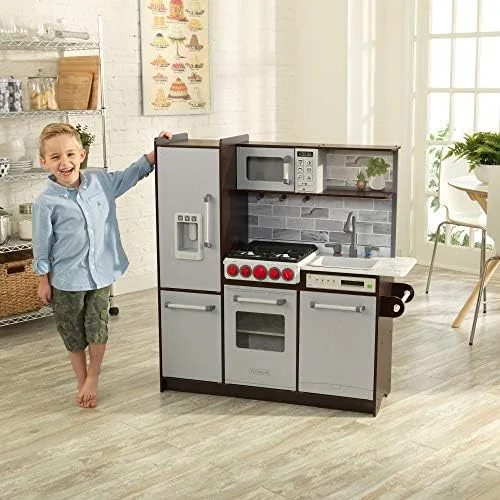
The KidKraft Uptown Elite meets ASTM F963 and CPSIA safety standards. The unit should be wall-anchored to prevent tip-over, which is KidKraft’s recommendation and a critical safety step for any large play furniture. Tip-over anchoring hardware is included.
No CPSC recalls have been issued for the Uptown Elite Kitchen.
The Verdict
The KidKraft Uptown Elite Kitchen is the best full-featured play kitchen we’ve tested. Its realistic design sustains complex pretend play across a wide age range, the feature set provides environmental scaffolding for increasingly sophisticated narratives, and the daily engagement longevity is exceptional. Assembly is tedious but straightforward.
Product Rating: 8/10 — Excellent pretend play vehicle with realistic features and strong engagement. MDF construction and plastic hardware limitations prevent a higher score.
Evidence Rating: Moderate — Pretend play has one of the strongest developmental evidence bases in toy research. Kitchen play specifically engages role-taking, narrative construction, and social negotiation.
Who Should Buy This
- Families with children ages 3-6 looking for a high-engagement daily play toy
- Parents who value pretend play and social-cognitive development
- Families with multiple children who want a collaborative play center
- Anyone with the space for a large-format toy that will be used daily for years
Who Should Skip This
- Families with very limited space — this kitchen is large
- Minimalist families — the IKEA DUKTIG at $99 serves the same function with less visual clutter
- Parents of children over 8 — engagement typically wanes by this age
- Anyone who wants real wood construction — this is engineered wood with laminate
This review reflects our independent evaluation. ScienceBasedKids.com purchased this product at retail price. We may earn a commission if you purchase through our links, which helps fund our research. This never influences our ratings.
Footnotes
-
Lillard, A. S., Lerner, M. D., Hopkins, E. J., Dore, R. A., Smith, E. D., & Palmquist, C. M. (2013). “The impact of pretend play on children’s development: A review of the evidence.” Psychological Bulletin, 139(1), 1-34. ↩
-
Wellman, H. M. (2014). Making minds: How theory of mind develops. Oxford University Press. ↩
-
Carlson, S. M., White, R. E., & Davis-Unger, A. C. (2014). “Evidence for a relation between executive function and pretense representation in preschool children.” Cognitive Development, 29, 1-16. ↩
Enjoyed this review? We publish two new evidence-based evaluations every week.
Free. No spam. Unsubscribe anytime.
Complexity increased sharply between ages 3 and 5, plateauing around age 6-7.
Recommended Accessories
Affiliate links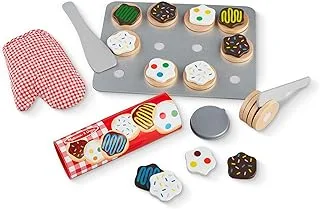
Melissa & Doug Slice and Bake Wooden Cookie Play Food Set
“Wooden play food with Velcro slicing. Perfect scale for the Uptown Elite kitchen.”

KidKraft 27-Piece Cookware Playset
“Pots, pans, and utensils sized for KidKraft kitchens. Metallic finish adds realism.”
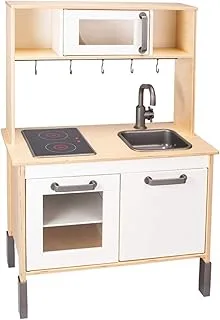
IKEA DUKTIG Play Kitchen
“Minimalist alternative at half the price. Birch wood, Scandinavian design, hackable.”
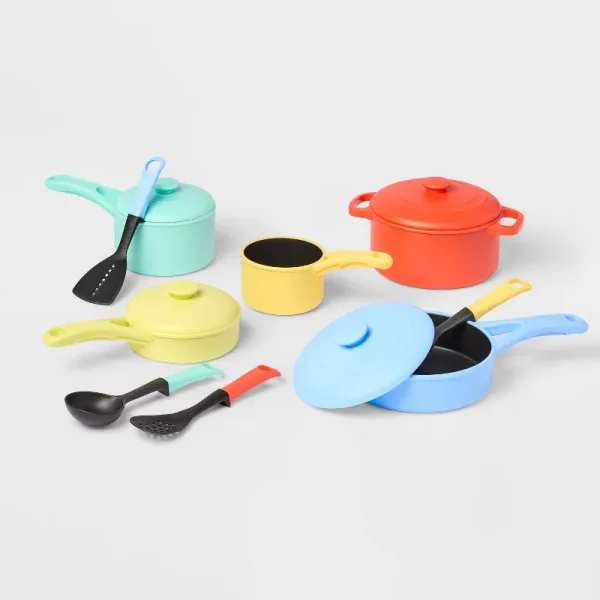
Hape Playfully Delicious Wooden Play Food Set
“Premium wooden play food with realistic details. Complements any play kitchen.”
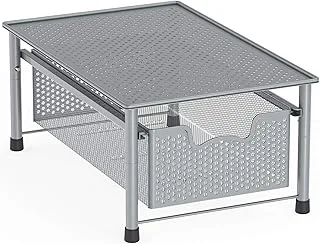
SimpleHouseware Stackable Kitchen Cabinet Organizer
“Fits inside KidKraft cabinet shelves. Keeps play food organized and accessible.”