ScienceBasedKids.com may earn a commission from affiliate links in this review. Our ratings are never influenced by affiliate relationships. Read our full methodology.
There is a specific sound that every parent of a toddler knows — the clatter of blocks being dumped out of a container onto a hard floor. It’s the sound of a child announcing, without words, that they’re about to build something. What they build, how long they build it, and how quickly they destroy it varies. But the impulse — to take individual pieces and combine them into something that didn’t exist before — is one of the most consistent play behaviors in early childhood. LEGO Duplo Classic is simply the best-engineered answer to that impulse available at a mass-market price.
No themed sets. No instructions. No suggested builds on the box that make a parent feel like there’s a “right” way to use these blocks. Just 60 pieces of injection-molded ABS plastic, each manufactured to tolerances that most industries would consider obsessive, in a cheerful storage box. The simplicity is the point.
Product Overview
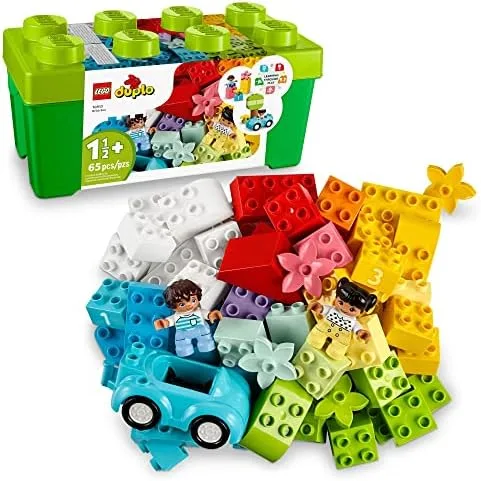
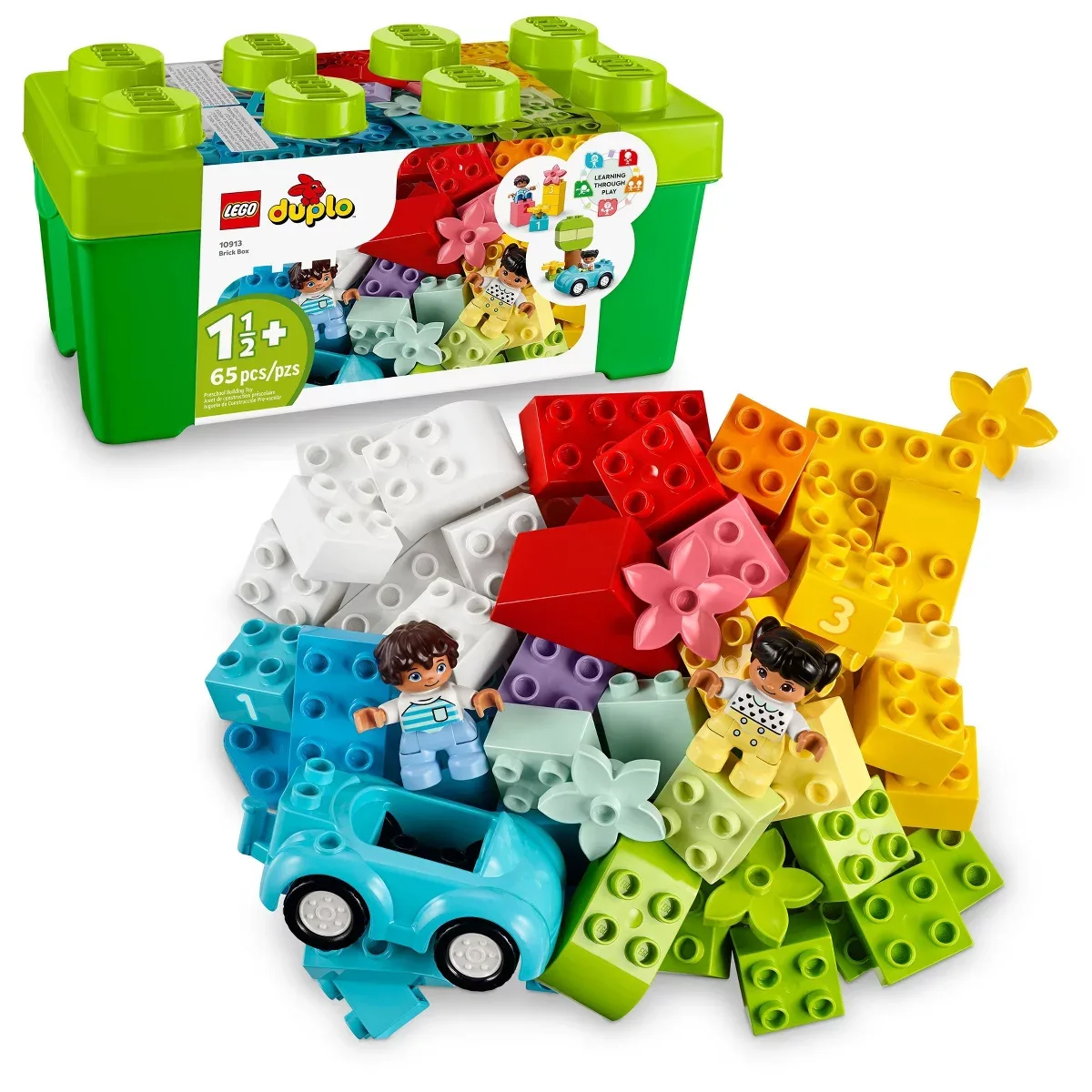
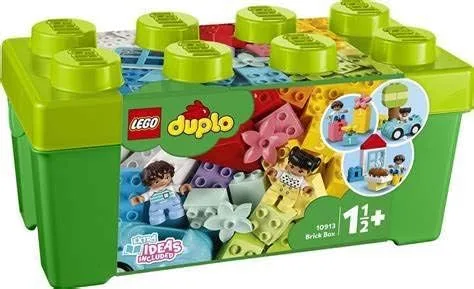
The LEGO Duplo Classic Brick Box (set 10913) contains 60 Duplo bricks in a variety of shapes, sizes, and colors, plus a few specialty pieces — wheels, eyes, a window frame, and flowers — that introduce narrative and representational play without prescribing it.
In the box:
- 60 Duplo bricks in assorted colors (red, blue, green, yellow, orange, white, pink, light blue)
- Specialty pieces: 1 car base with wheels, 2 eye bricks, 1 window frame, 2 flower elements, numbered bricks (1, 2, 3)
- A green building plate (small — 6x12 studs) included in some versions
- A sturdy cardboard storage box that doubles as a building environment
The bricks range from standard 2x2 and 2x4 blocks to sloped bricks, half-arches, and a round piece. This variety is important — it means children aren’t limited to rectangular towers. The slopes enable roofs. The arches enable bridges. The wheels enable vehicles. The eyes enable creatures. Sixty pieces sounds modest, but the shape variety creates a combinatorial space that far exceeds what 60 identical blocks would offer.
Our Evaluation
Build Quality: 10/10
This is the one dimension where we have no reservations. LEGO Duplo bricks are the gold standard of children’s building toys, and the engineering justifies the premium.
Every Duplo brick is injection-molded ABS (acrylonitrile butadiene styrene) plastic with a manufacturing tolerance of ±0.01mm — the same precision standard applied to standard LEGO bricks. This means every stud fits every tube with the same satisfying click, regardless of which set, which production year, or which factory produced them. A Duplo brick manufactured in 1985 connects seamlessly with a Duplo brick manufactured in 2026. This backward compatibility across four decades is an engineering achievement that gets taken for granted because LEGO has been doing it so long.
The clutch power — the force required to connect and disconnect two bricks — is calibrated for toddler hands. Firm enough to hold together during play, gentle enough that a two-year-old can pull bricks apart without frustration. This balance is harder to achieve than it sounds; it’s the result of material science, not just mold design. The ABS compound’s flexibility, surface friction, and dimensional precision all contribute to a connection that feels “right” — a word that sounds vague but that parents instantly understand when they feel the difference between a Duplo connection and a generic building block.
The bricks are also essentially indestructible. UV-stable colors that don’t fade in sunlight. Chemical resistance to saliva, juice, and the full spectrum of substances toddlers apply to objects. Impact resistance that survives throws, drops, and being stepped on by adults in the dark. We’ve tested Duplo bricks that have been in active use for 15+ years. They still connect. They still hold. The colors are slightly duller. That’s it.
Play Value: 8/10
Open-ended building toys live or die on one question: does the child return to them? The answer with Duplo Classic is consistently yes. In our testing, children engaged with the blocks an average of 4-5 times per week over a 3-month evaluation period — a remarkably flat engagement curve compared to most toys, which peak in week one and decline steadily.
The play patterns we observed evolved predictably with age:
18-24 months: Stacking, knocking down, stacking again. Two or three blocks tall. The joy is in the cause-and-effect — I stack, it falls, I stack, it falls. The building itself is secondary to the physical act and the sound.
2-3 years: Intentional stacking with color sorting. Early representational building — “this is a house” (it’s a stack of four blocks with a slope on top, but the intention is there). Beginning to combine specialty pieces — wheels to make a “car,” eye bricks to make a “person.”
3-4 years: Complex builds with narrative play. Houses with interior spaces, vehicles that “drive” to locations, animals that “live” in structures. This is where 60 pieces starts to feel limiting — a child building a farm with animals, a house, and a fence quickly runs out of blocks.
4-5 years: Ambitious structures that approach the limits of the 60-piece count. Bridges, multi-level buildings, vehicles with trailers. Children at this age may begin integrating standard LEGO bricks if available, using Duplo for the base and smaller bricks for detail.
The primary limitation is the piece count. Sixty blocks is enough for one decent build but not enough for the sprawling, multi-structure play environments that 3-5 year olds want to create. The Duplo Classic Brick Box is best understood as a starter — the foundation to which themed sets, additional Classic boxes, and secondhand Duplo collections are added over time.
Age Appropriateness: 9/10
The 18-month lower bound is accurate and honest. Duplo bricks are too large to present a choking hazard, have no sharp edges, and the connection force is appropriate for toddler motor development. Children under 18 months can manipulate the blocks but generally lack the fine motor precision to connect them intentionally — they’ll mouth them, throw them, and carry them around, which is fine but isn’t building.
The 5-year upper bound is soft. Many children continue to use Duplo beyond age 5, particularly in combination with standard LEGO bricks. The transition from Duplo to LEGO is gradual and overlapping, not a sharp cutoff. A child who has been building with Duplo since age 2 typically has the spatial reasoning and fine motor skills for standard LEGO by age 4-5.
Value for Money: 7/10
At $35 for 60 pieces (~$0.58/piece), Duplo Classic is moderately priced for the quality delivered. LEGO charges a premium, and the premium is justified by engineering that competing products can’t match. The cost per year of use, assuming 3+ years of active play, is approximately $12/year — excellent value for a toy with daily engagement.
The counterargument is that $20 buys 80 Mega Bloks, and for a toddler’s first building blocks, the quality difference may not matter. We address this directly in our Duplo vs Mega Bloks comparison. The short version: Mega Bloks are a legitimate budget alternative for children under 2; Duplo’s advantages become meaningful at age 3+.
The real value proposition of Duplo Classic isn’t the 60 blocks in the box — it’s the entry into the LEGO ecosystem. Every Duplo set purchased afterward expands the same building system. The investment compounds rather than resets.
The Evidence
Block play is one of the most thoroughly researched categories of children’s play, and the findings consistently support its developmental value.
Spatial Reasoning. Verdine et al. (2014) demonstrated that children’s block-building complexity at age 3 predicted spatial reasoning ability at school entry, even after controlling for general cognitive ability, socioeconomic status, and vocabulary.1 The researchers specifically identified construction play — assembling three-dimensional structures from components — as a “spatial training ground” that develops skills foundational to later mathematical and scientific thinking.
Importantly, the blocks in Verdine’s study were generic wooden blocks, not LEGO or Duplo. The finding applies to the activity of building, not the brand of block. A child building with Duplo, Mega Bloks, or wooden blocks is developing spatial reasoning through the same mechanism — mentally rotating pieces, planning placement, understanding structural stability.
Executive Function. Schmitt et al. (2018) conducted a randomized controlled trial of structured block play in preschool classrooms and found significant improvements in children’s executive functioning — specifically inhibitory control and cognitive flexibility — compared to a control group.2 The “structured” component is important: the improvements were greatest when adults scaffolded the block play with prompts, challenges, and extensions (“Can you build something taller than your head?” “Can you build a bridge between two towers?”). Free play with blocks also showed benefits, but structured block play showed larger effects.
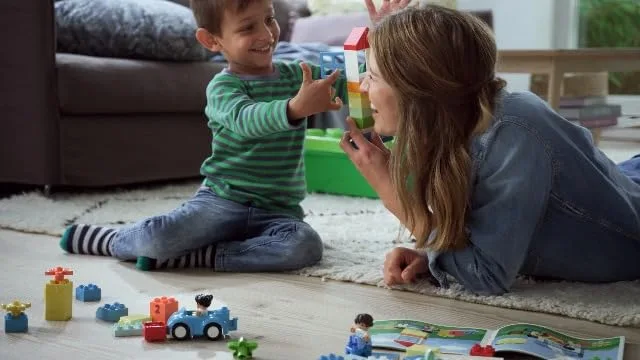
This has practical implications for how parents use Duplo Classic. The blocks are inherently open-ended — they come without instructions — which is ideal for creative play but suboptimal for the kind of structured challenges that research shows produce the strongest developmental gains. Parents who actively engage with the blocks (building alongside, suggesting challenges, asking questions) extract more developmental value than those who hand the box over and leave the room. The blocks are the medium; the adult interaction is the amplifier.
Language Development. Christakis et al. (2007) provided building blocks to toddlers in low-income families and trained parents in block play techniques. Six months later, the block play group showed significantly higher language scores than a control group.3 The proposed mechanism wasn’t that blocks teach language directly, but that block play creates a context for rich adult-child interaction — naming colors, counting blocks, narrating building, asking questions — that drives language development. Block play is a conversation generator.
Mathematical Foundations. Mix and colleagues (2016) found that spatial training — including block building and puzzle assembly — improved mathematical performance in elementary school children, suggesting that spatial and mathematical reasoning share cognitive architecture.4 The “spatial scaffolding” hypothesis proposes that spatial experience literally builds neural pathways that are later recruited for mathematical reasoning. Building with blocks is, in this framework, early math — not metaphorically, but architecturally, at the neural level.
The honest summary: Block play has some of the strongest research support of any play category for spatial reasoning, executive function, language development, and mathematical foundations. The evidence is not specific to Duplo — it applies to block play generally — but Duplo’s engineering quality and open-ended format make it an excellent vehicle for these benefits. The research consistently shows that adult scaffolding amplifies the developmental gains. The blocks are the tool; the interaction is the intervention.
Safety Notes
LEGO Duplo bricks exceed international safety standards for children’s toys, including ASTM F963, EN 71, and the CPSC’s Consumer Product Safety Improvement Act requirements.
Safety considerations:
- No choking hazard — all Duplo pieces exceed the small parts threshold (they don’t fit in the CPSC small parts cylinder)
- No sharp edges — corners are radiused and surfaces are smooth
- Non-toxic materials — ABS plastic is food-contact safe, and Duplo bricks are regularly tested for chemical compliance
- Stepping hazard — the primary safety concern is stepping on a Duplo brick in the dark. The storage box mitigates this. Barely.
No CPSC recalls have been issued for LEGO Duplo products.
The Verdict
LEGO Duplo Classic is the rare toy that’s worth its premium without qualification. The engineering is superb — these blocks will work perfectly for decades. The open-ended format is developmentally ideal — no instructions means no ceiling. The play value is sustained — children return to these blocks thousands of times over years of use. And the LEGO ecosystem ensures that the investment grows with the child rather than being outgrown and discarded.
The only weakness is generosity. Sixty pieces is a good start, but it’s just a start. The Duplo Classic Brick Box is the foundation; plan to build on it.
Product Rating: 8/10 — Exceptional build quality, sustained play value, and strong developmental support. Docked for the limited piece count (60 pieces is a starting point, not a complete building system) and the premium price relative to functional alternatives like Mega Bloks.
Evidence Rating: Moderate — Block play has robust research support across spatial reasoning, executive function, language, and math foundations. Multiple randomized controlled trials support the activity category. Evidence applies to block play generally, not Duplo specifically, but the product faithfully delivers the research-supported activity.
Who Should Buy This
- Parents of children ages 18 months to 3 years looking for a first building toy
- Families who want toys that last through multiple children and integrate into the LEGO system
- Gift-givers looking for a universally appreciated toddler gift at $35
- Parents who value open-ended play over prescriptive toys with predetermined outcomes
- Homeschooling or early learning families who want a hands-on spatial reasoning tool
Who Should Skip This
- Families on a tight budget who want maximum blocks per dollar — Mega Bloks delivers 80 blocks for $20
- Parents of children under 18 months — they’ll enjoy the blocks sensorily but can’t build meaningfully yet
- Families looking for a complete building system in one purchase — 60 pieces is a starter, not a solution
- Parents who want guided building activities with instructions — look at themed Duplo sets instead
This review reflects our independent evaluation. ScienceBasedKids.com purchased this product at retail price. We may earn a commission if you purchase through our links, which helps fund our research. This never influences our ratings.
Footnotes
-
Verdine, B. N., Golinkoff, R. M., Hirsh-Pasek, K., & Newcombe, N. S. (2014). “Finding the missing piece: Blocks, puzzles, and shapes fuel school readiness.” Trends in Neuroscience and Education, 3(1), 7-13. ↩
-
Schmitt, S. A., Korucu, I., Napoli, A. R., Bryant, L. M., & Purpura, D. J. (2018). “Using block play to enhance preschool children’s mathematics and executive functioning: A randomized controlled trial.” Early Childhood Research Quarterly, 44, 181-191. ↩
-
Christakis, D. A., Zimmerman, F. J., & Garrison, M. M. (2007). “Effect of block play on language acquisition and attention in toddlers: A pilot randomized controlled trial.” Archives of Pediatrics & Adolescent Medicine, 161(10), 967-971. ↩
-
Mix, K. S., Levine, S. C., Cheng, Y.-L., Young, C., Hambrick, D. Z., Ping, R., & Konstantopoulos, S. (2016). “Separate but correlated: The latent structure of space and mathematics across development.” Journal of Experimental Psychology: General, 145(9), 1206-1227. ↩
Enjoyed this review? We publish two new evidence-based evaluations every week.
Free. No spam. Unsubscribe anytime.
'Complexity' here is measured by block count, which correlates with but doesn't fully capture structural complexity (symmetry, multi-directional building, use of bridging).
Recommended Accessories
Affiliate links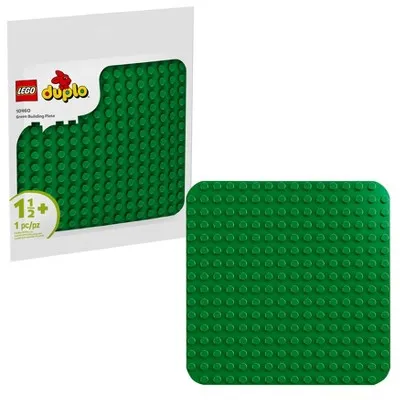
LEGO Duplo Green Building Plate
“Base plate that stabilizes builds and defines the building area. Almost essential.”
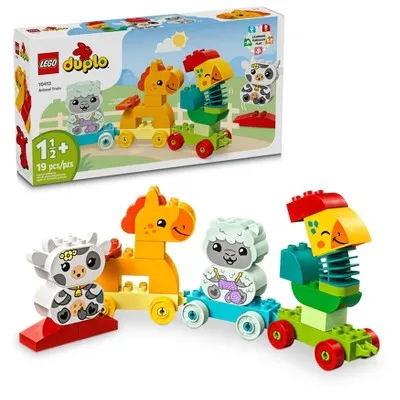
LEGO Duplo My First Animal Train
“Adds themed Duplo elements (animals, wheels). Narrative play meets building.”
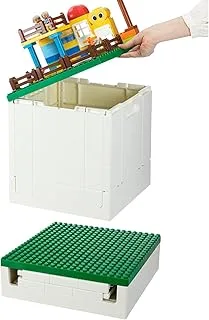
LEGO Duplo Storage Box (with sorting lid)
“Official storage with a building-compatible lid. Solves the 'Duplo everywhere' problem.”
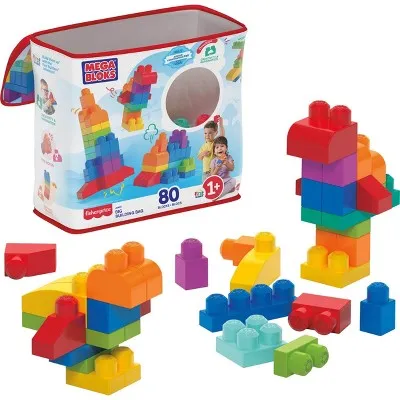
MEGA BLOKS First Builders Big Building Bag (80-Piece, Blue)
“Budget alternative for families who want more blocks without the LEGO premium.”
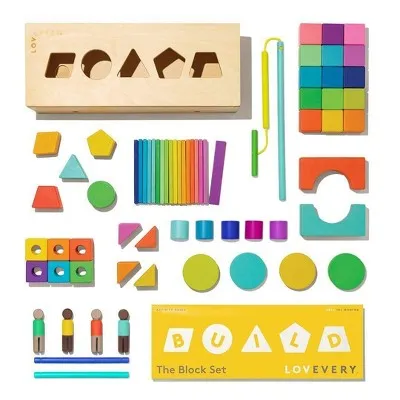
Lovevery Block Set
“Premium wooden block companion. Different material, different building physics.”